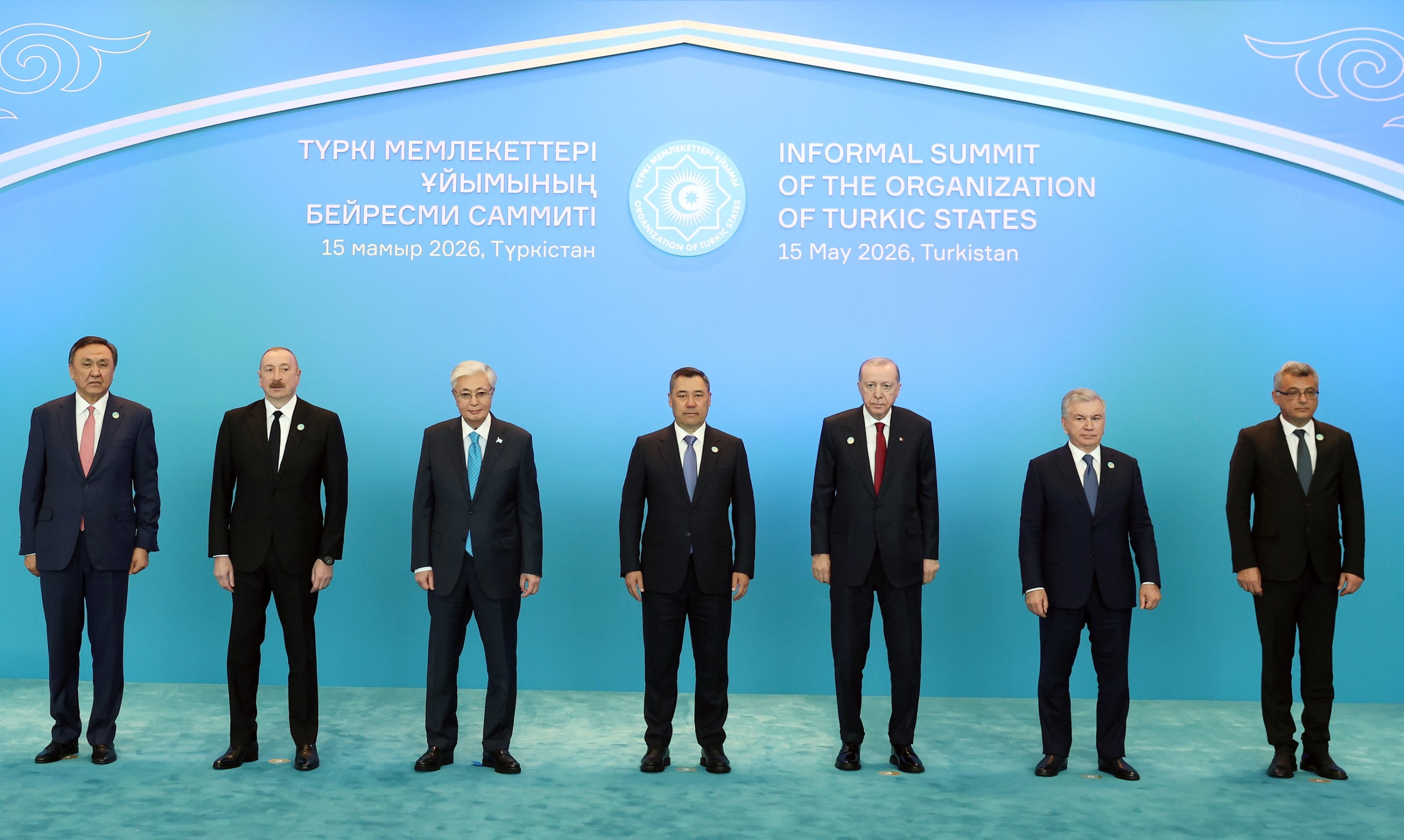
President Recep Tayyip Erdoğan on Friday called for greater coordination across the Turkic world in light of regional crises, warning that regional conflicts and emerging digital threats make closer cooperation essential for shared security and prosperity.
Speaking at the informal summit of the Organization of Turkic States (OTS) in Kazakhstan, Erdoğan said the conflicts across the region have proved once again the strategic importance of solidarity among Turkic states.
“The crises in Palestine, Lebanon, Iran, Ukraine and many others indicate that we need to strengthen our defense and increase our cooperation in the industrial sector,” he told counterparts from Azerbaijan, Kazakhstan, Kyrgyzstan and Uzbekistan.
The OTS was established in 2009 under the Nakhchivan Agreement as the Cooperation Council of Turkic Speaking States before adopting its current name in 2021. Headquartered in Istanbul, the OTS also has four observers: Hungary, Turkmenistan, the Turkish Republic of Northern Cyprus (TRNC) and the Economic Cooperation Organization.
Erdoğan said that transportation and connectivity projects, particularly the Middle Corridor linking East and West, would remain strategic priorities for OTS.
“As the crisis centered on the Strait of Hormuz shows today, transportation projects connecting the Turkic world, especially the Middle Corridor, will continue to be our priority for many years to come,” he said. “As Türkiye, we are ready to share the experience we have gained in the defense industry, which we have shaped with high technology, with the members of our organization.”
Cybersecurity cooperation
Erdoğan described cybersecurity as a critical pillar of national security, warning that artificial intelligence and digitalization are creating new vulnerabilities.
“Cyber security is vital and essential in today’s world, just like security on land, in the air, and at sea,” he said.
“We must be vigilant against the new risk areas brought about by artificial intelligence technologies,” Erdoğan added, citing threats targeting databases and critical national infrastructure.
He said Türkiye plans to prioritize deeper cybersecurity coordination during its upcoming term chairing the organization.
“During our next term as chair of the Organization of Turkic States, we aim to further advance coordination and cooperation in the field of cybersecurity,” he said.
AI vision
Erdoğan said Turkic states should embrace artificial intelligence and digital transformation as an opportunity rather than a threat.
“It is time for us to add the expression ‘unity in digital vision’ to Gaspıralı’s motto of ‘unity in language, thought, and work,’” he said, referring to the prominent Crimean Tatar intellectual Ismail Gaspıralı.
“This vision should be built upon a foundation of qualified human resources, strong digital infrastructure, and a data-driven approach to public administration,” Erdoğan said.
He warned that falling behind in technological transformation could weaken national independence.
“To prevent artificial intelligence from becoming a tool of domination, we must approach this theme with the right perspective, viewing it as an opportunity.”
Erdoğan also called for stronger digital connectivity and joint technology initiatives among Turkic nations.
“We believe that the Turkish language model, which will make the richness of our common language visible in the digital world, and similar artificial intelligence-based initiatives should be supported,” he said.
Common Turkic alphabet
Erdoğan highlighted cultural integration as one of the key pillars of cooperation within the Turkic world.
“It is important that the Common Turkic Alphabet is used in a wide range of areas, from education to culture, from academic cooperation to digital transformation,” he said.
He also welcomed UNESCO’s designation of Dec. 15 as “World Turkic Language Family Day,” describing it as “a shared success for all of us.”
The “Common Turkic Alphabet” is a Latin-based writing system developed through cooperation among Turkic-speaking countries to promote closer linguistic, cultural and digital integration.
The framework, agreed upon by linguists and language institutions under the Organization of Turkic States in 2024, includes 34 letters designed to represent sounds shared across Turkic languages while accommodating national differences.
Several member states, including Türkiye, Azerbaijan and Uzbekistan, already use Latin-based alphabets, while Kazakhstan has been transitioning away from Cyrillic in recent years.
DAILYSABAH
هلدینگ کاسپین استانبول | خرید ملک در ترکیه | صرافی معتبر ایرانی در ترکیه | خرید و فروش طلا در ترکیه | مهاجرت به ترکیه | واردات و صادرات در ترکیه | نیازمندیهای ترکیه | اخبار ترکیه | اخبار جهانی | توریست ایران | خدمات توریستی در ایران | تورهای گردشگری ایران | هلدینگ اول | خدمات کاریابی و فریلنسری و شغل | مرجع اطلاعات ایران (همه چیز در ایران) | کیف پول و خدمات مالی و پرداخت یار | اخبار ایران | تابلو زنده قیمت ارز در ترکیه و استانبول | صرافی آنلاین ترکیه | قیمت طلا و نقره در ترکیه | سرمایه گذاری در ترکیه | جواهرات در ترکیه | نرخ لحظه ای ارزها در استانبول | قیمت دلار امروز در ترکیه | قیمت دلار استانبول امروز | قیمت لحظه ای دلار | اخبار روز ترکیه استانبول | اپلیکیشن ISTEX | اپلیکیشن قیمت لحظه ای دلار و یورو و لیر و ارزها در ترکیه
About the Author