Home – CBSNews.com
President Trump said “nobody’s going to control” the Strait of Hormuz, when asked if he would allow a short-term deal for Iran and Oman to control it.
“The strait’s going to be open to everybody,” he told reporters during Wednesday’s Cabinet meeting. “It’s international waters.”
“Nobody’s going to control it,” he continued. “We’re going to watch over it. We’ll watch over it. But nobody’s going to control it. That’s part of the negotiation that we have. They would like to control it. Nobody’s going to control it. It’s international waters. And Oman will behave just like everybody else or we’ll have to blow them up. They understand that. They’ll be fine.”
Speaking during a Cabinet meeting, Treasury Secretary Scott Bessent claimed oil prices will be lower than before the Iran war when the conflict ends.
“Oil will be lower than pre-conflict levels when this ends,” he said.
The current average for a gallon of regular gasoline is $4.46 nationwide, according to AAA.
Secretary of State Marco Rubio repeated many of the comments President Trump has reiterated in recent weeks at a Cabinet meeting Wednesday, saying Iran cannot get a nuclear weapon and they’d prefer to negotiate a deal.
“The bottom line is Iran is never going to have a nuclear weapon and if recent events have done anything it’s to remind us once again they are the world-leading sponsor of terrorism and they can never have a nuclear weapon,” Rubio said. “The president’s preference, your preference, is always to negotiate these things and figure out if you can have agreements. Diplomacy is always the first option and we continue to work on that.”
Rubio highlighted the work of envoys Steve Witkoff, Jared Kushner and Vice President JD Vance in working toward a deal, but offered no specifics on the negotiations.
“If there is an agreement to be made, we want that to be made and I think there’s been progress and interest and we will see over the next few hours and days,” the secretary said. “I want to remind everybody, you (Mr. Trump) have other options available if that doesn’t work.”
President Trump said Iran is “negotiating on fumes” and needs to make a deal, but he said the U.S. still may need to return to attacks while speaking at a Cabinet meeting at the White House.
“They want very much to make a deal,” he said. “So far, they haven’t gotten there, we’re not satisfied with it, but we will be. We will be. Either that or we’ll have to just finish the job. Their navy is gone, as I’ve said a thousand times, their navy is gone, their air force is gone, everything’s gone. And they’re negotiating on fumes. But we’ll see what happens. Maybe we have to go back and finish it, maybe we don’t.”
“Right now, I think it looks like they want to just make a deal,” he said. “I don’t think they have a choice.”
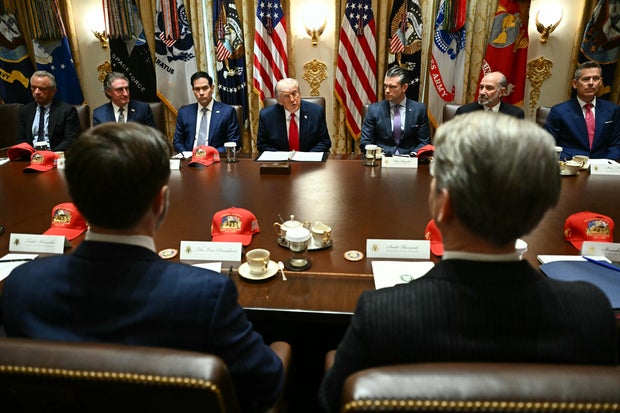
Kent NISHIMURA /AFP via Getty Images
Mr. Trump said Iranian leadership thought they would just wait him out because of political pressure from the midterms.
“They thought they were going to out wait me, you know,” he said. “‘We’ll out wait him. He’s got the midterms.’ I don’t care about the midterms. Look what happened last night. That was the prelude to the midterms.”
The White House has rebuffed a report by Iran’s IRIB state TV network after the outlet said it had a draft of the “Islamabad Framework” memorandum of understanding, saying what Iranian state media claimed is “not true.”
Iranian state TV claimed a draft of the initial framework claimed all shipping traffic would be managed by Iran, along with other points that appear contrary to the Trump administration’s stated positions. The Trump administration has made it clear they won’t allow Iran to control the strait or impose tolls.
“This report from Iranian controlled media is not true and the MOU they ‘released’ is a complete fabrication,” an official White House account wrote on X. “Nobody should believe what Iranian state media is putting out. FACTS MATTER.”
The U.S. blockade on the Strait of Hormuz has turned around 109 commercial vessels heading into or leaving ports in Iran, according to U.S. Central Command.
That total is an increase by one vessel since Tuesday’s update.
Lifting the blockade on the strait has been a key condition of negotiations between the U.S. and Iran.
Iran agreed in principle to a deal over the weekend that will be a two-step process, with the immediate opening of the Strait of Hormuz in exchange for lifting the U.S. blockade, followed by negotiations on a mechanism for Iran to give up various parts of its nuclear program, the official said.
Israel is issuing evacuation orders to the ancient city of Tyre in Lebanon, as well as 11 camps in the area.
Among those camps are Shabriha, Hammadiya, Jal al-Bahr, Zoqoq al-Mafdi, Al-Bass, Al-Maashouk, Burj al-Shamali, Nabaa, Al-Housh, Rashidieh and Ain Baal.
“In light of the terrorist Hezbollah’s violation of the ceasefire agreement and its targeting of Israeli territory, the IDF is forced to act strongly against it,” the Israel Defense Forces said. “The IDF does not intend to harm you.
“For your safety, you must evacuate your homes immediately according to the area shown on the map and move north of the Zahrani River.”
Residents of the city of Nabatieh were warned to evacuate earlier in the day ahead of a bombing campaign.
Oil prices dropped Wednesday on rekindled hope of the Strait of Hormuz reopening as the U.S. and Iran appeared to be nearing an agreement to deescalate the war launched 89 days ago by the U.S. and Israel.
Brent North Sea crude, the international benchmark, fell 5% to $94.61 a barrel briefly, before rebounding slightly to trade around the $95 mark.
The main U.S. crude contract, WTI, tumbled almost 6% to trade at $89 a barrel early Wednesday.
CBS/AP
Iran’s IRIB state TV network reported Wednesday that it had “obtained” a draft of the “Islamabad Framework” – a memorandum of understanding taking shape with the U.S. that would see the countries agree to extend their ceasefire and reopen the Strait of Hormuz, while also launching direct negotiations on more contentious matters.
IRIB called the version it obtained an “unofficial preliminary document outlining a 14-point draft of the agreement,” which it cast as a potential step toward ending the war that was still being revised and negotiated between the two countries.
The White House later rejected the reporting, writing, “This report from Iranian controlled media is not true and the MOU they ‘released’ is a complete fabrication. Nobody should believe what Iranian state media is putting out.”
IRIB said the draft includes a commitment from the U.S. to lift its blockade of Iranian ports and vessels. In return, Iran would restore the flow of commercial shipping through the Persian Gulf and the Sea of Oman, through the Strait of Hormuz, to pre-war levels within one month.
IRIB said military vessels would be excluded from Iran’s lifting of restrictions in the strait and that commercial traffic — including vessel inspections and the imposition of service “fees” — would remain under the authority of Iran in coordination with neighbor Oman.
“The Strait of Hormuz, between us and Oman as coastal countries, must have a defined mechanism,” Esmail Baqaei, spokesman for both Iran’s Foreign Ministry and its team negotiating with the U.S., told IRIB.
The IRIB report said the draft agreement included the U.S. accepting “an obligation” to withdraw American forces from the Mideast, but it noted that specifics, including whether the withdrawal would apply only to recently added forces or also long-standing troop deployments, remained subject to negotiation.
The draft envisions, per the report, that if direct talks between Iran and the U.S. yield a final agreement on a wider peace deal within the provisioned 60 days, that deal would be enshrined as a binding United Nations Security Council resolution.
The report concluded by stressing that the Islamabad Framework remained unfinalized – and noting a significant possibility that the two sides could still fail to resolve their differences on terms to even begin direct negotiations on contentious issues such as Iran’s nuclear material.
“Today, 23 vessels that requested permission from the IRGC Navy to pass through the Strait of Hormuz received their permits,” declared a reporter on Iran’s IRIB state TV network Wednesday.
“The IRGC Navy’s conditions remain in place. These conditions were made clear on the first day, and continue to be valid today: no hostile country can pass its vessels through the Strait of Hormuz, but it cooperates with those who wish to respect Iranian order.”
It was the latest in a series of similar reports by the same state TV reporter this week. They have all been delivered from near the Iranian coast, and clearly intended to portray a new state of play in the busy shipping lanes of the strait — which, until the U.S. and Israel launched their joint war on Iran, had always been free and open for commercial vessels.
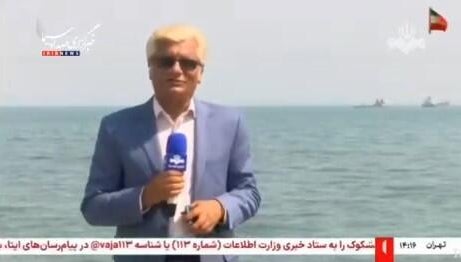
IRIB/Iranian state TV
Since the U.S. imposed its own military blockade on Iranian ports and vessels on April 13, Tehran has threatened to attack any ship that tries to transit the Strait of Hormuz without its permission. It says dozens have sought and been granted clearance this week, though the real numbers are impossible to verify as ships can mask their true locations.
Iranian officials say they are implementing a new system, in conjunction with Oman, to control shipping traffic through the strait. They say they are not imposing tolls, which the Trump administration accuses Tehran of attempting to do, but that the new system will carry costs for shippers.
U.S. Secretary of State Marco Rubio said this week that the strait would reopen “one way or the other,” calling Iran’s actions in relation to commercial traffic unlawful and “unsustainable for the world, it’s unacceptable.”
Iran’s national telecommunications company TCI said Wednesday that internet access across the country had “almost returned to the level” seen before it was blocked at the outset of the U.S.-Israeli war with Iran, though an official acknowledged lingering connectivity issues for some people and promised help.
Davoud Zareian, a deputy spokesperson with TCI, said “in case of disruption, users should first turn their modem or router off and on,” and if problems continue, he urged clients to contact the company “so that specialists can examine and resolve the issue.”
Zareian said internet traffic had “grown significantly and has almost returned to the level before the outage.”
In its latest update, international internet monitoring group Netblocks said Wednesday that connectivity in Iran “has now been in a state of restoration for 24 hours.”
“Service remains heavily filtered, with new restrictions on messaging and app stores compared to pre-January,” the organization said, adding that “calls for a free and open internet transcend political divisions and should be heard.”
“Welcome back #Iran!” the group said in an updated Tuesday, confirming that access was being restored in the country.
Iran’s Ministry of Intelligence said in a long statement released Wednesday that the country has been facing a long-running “hybrid war” with the West and Israel, and warned that although military conflict may have shifted, the struggle continues through economic pressure, media influence, and internal destabilization efforts.
The statement describes the conflict as a “47-year ‘full-scale hybrid war’ against the heroic people of Iran,” accusing the U.S., Israel and their allies of wielding sanctions, cyberattacks and political interference in a bid to weaken the Islamic Republic regime.
“Not only were the enemy’s vile goals not achieved, but the false myth of the invincibility of the Western–Zionist enemy was invalidated,” declared the ministry in its statement.
It said Iran’s adversaries were currently focused on exerting soft power, listing efforts such as “intensification of economic pressure,” “ethnic and religious provocations,” and “various cyberattacks.”
It concluded by saying any hostile actions would draw a firm response, warning specifically that any attempts to foment domestic unrest or carry out espionage or sabotage would be “pursued with maximum precision and decisiveness by the country’s powerful intelligence community.”
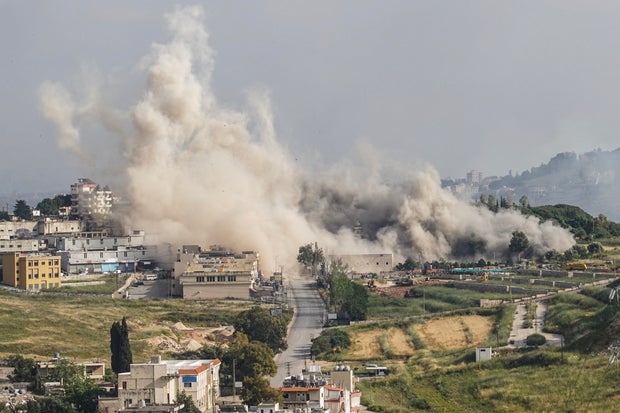
The Israel Defense Forces claimed in a brief statement Wednesday to have struck “more than 150 Hezbollah infrastructure sites and terrorists” in attacks on the Iranian-backed group Hezbollah in Lebanon over the last day.
The IDF said the strikes were in and around the southern Lebanese cities of Tyre and Nabatieh and in the Beqaa Valley area.
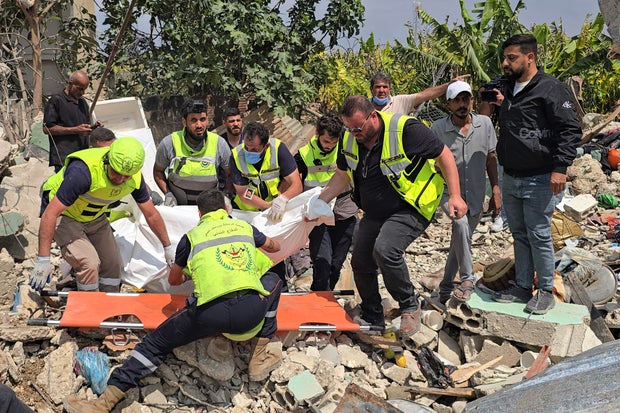
Lebanese officials say the attacks killed more than 30 people, with children among those pulled from the rubble of buildings in the cities. Lebanon’s health ministry says that since Israel and Hezbollah started fighting at the beginning of the U.S.-Israeli war with Iran, more than 3,200 people have been killed and almost 10,000 wounded in the country.
Earlier Wednesday, IDF spokesman Avichay Adraee issued a warning via social media to residents of Nabatieh — a city home to roughly 25,000 people — to flee their homes and evacuate about a mile northward, across the Zahrani River, ahead of planned strikes.
“In light of the terrorist Hezbollah’s violation of the ceasefire agreement, the Israel Defense Forces are forced to act against it with force,” Adraee said, repeating language he has used in daily evacuation orders for Lebanese towns and villages.
Abbas Fakih/AFP/Getty
“The IDF does not intend to harm you. For your safety, you must evacuate your homes immediately and move to the north of the Zahrani River,” said the IDF spokesman. “We emphasize that anyone who is present near Hezbollah members, its facilities, and its combat means is putting their life in danger!”
Speaking on the sidelines of a security forum in Russia’s capital, the Deputy Secretary of Iran’s Supreme National Security Council, Ali Bagheri Kani, said indirect negotiations with Washington continued, but he renewed the regime’s insistence that the issue of its enriched uranium stockpile wasn’t yet on the agenda.
“This issue is not on the agenda of the negotiations,” he said when asked about the roughly 900 pounds of highly enriched uranium that international monitors believe is still buried under one of Iran’s badly damaged nuclear facilities, according to Russian news agency TASS.
President Trump had previously claimed Iran was ready to hand what he refers to as its “nuclear dust” over to the U.S., but on Monday he said the regime could dispose of its highly-enriched uranium inside the country, or “at another acceptable location.”
A senior Trump administration official said over the weekend that Iran had agreed in principle to dispose of its highly-enriched uranium during the negotiations but that officials were still working through details of a mechanism for its disposal.
An official with Iran’s Islamic Revolutionary Guard Corps said Wednesday that a renewal of the war with the United States was unlikely, but he warned that Iran stood ready to defend itself against any new attack.
“The possibility of war is low because of the enemy’s weakness; the armed forces are lying in wait with full magazines,” Mohammad Akbarzadeh, the deputy political chief of the IRGC’s naval force, was quoted as saying by the semi-official Tasnim news agency, which is linked with the guard.
“Do not doubt that we will turn the area from Chabahar to Mahshahr into a graveyard for aggressors,” he said, referring to locations at either end of Iran’s lengthy southern coast in the Persian Gulf.
President Trump will meet with his Cabinet on Wednesday at a precarious moment for talks aimed at ending the war with Iran, just days after insisting his administration and Tehran had “largely negotiated” a settlement but with the negotiations still in a state of flux.
As he prepares to huddle with his top aides, Mr. Trump is projecting confidence that he’s closing in on a deal that will reopen the Strait of Hormuz and provide him a credible argument that Iran’s nuclear capability has been diminished enough to declare victory, winding down a conflict that’s been politically unpopular for Republicans.
But as things stand, he also risks finding closure to his war of choice comes with an unsatisfactory ending.
The emerging deal puts off many critical issues to be resolved later and has already exposed the president to fierce criticism — even from some of his own supporters — that Iran’s hardline leaders will emerge from the conflict battered but emboldened. It all comes to a head just as the midterm elections to determine control of Congress come into focus and as Republicans worry that rising costs and fuel prices are darkening the American electorate’s mood.
Talks were further complicated after U.S. forces carried out what the Pentagon called “defensive” strikes on missile launch sites and mine-laying boats in southern Iran on Monday. The U.S. said it acted with “restraint” in light of the weekslong ceasefire, while Iran decried the action as a sign of “bad faith and unreliability.”
Secretary of State Marco Rubio said Tuesday that talks with Iran on reopening the strait and extending the ceasefire — a period that the administration says could be used to hash out the finer details of a nuclear agreement — will take several more days. “He’s either going to make a good deal or no deal,” Rubio told reporters.
Ten Indian sailors, detained in Iran in July on an oil tanker, have been released after “sustained diplomatic engagement,” India’s shipping authorities said late Tuesday.
The sailors on the MV Harbour Phoenix were “detained, arrested and imprisoned in Iran following the vessel’s interception near Jask Port in July 2025,” India’s Directorate General of Shipping said in a statement.
“The seafarers have now been released and reunited safely,” the shipping authority said. “…Necessary arrangements are being coordinated for the earliest return of the crew members to India.”
New Delhi and Tehran have long-standing diplomatic and energy ties, but India also balances that with close links to the United States and Israel.
Iranian forces regularly announce the interception of ships it says are illegally transporting fuel in the Gulf.
India has pursued a policy of quiet diplomacy and minimal public comment during negotiations for the release of the sailors. It did not give further details on the reason for their arrest or about the vessel, which ship tracking sites list as a Palau-flagged oil products tanker.
India has one of the world’s largest merchant navy workforces, with thousands of Indian sailors operating in Gulf shipping lanes.
Lebanon said Israeli strikes on the country’s south killed 31 people on Tuesday, as Israel said it was intensifying attacks despite a fragile truce in its war with the militant group Hezbollah, an Iranian proxy.
Hezbollah, meanwhile, said it faced Israeli troops entering the southern town of Zawtar al-Sharqiyah, as the Israeli military said it was expanding its ground operations.
In a statement, the Lebanese health ministry said 31 people, including at least four children and three women, were killed in attacks and 40 wounded.
Fourteen were killed in Burj al-Shamali near Tyre, five in Kawthariyat al-Riz, four in Habbush, six in Maarakeh and two in Salaa, the health ministry said.
Kawnat HAJU/AFP/Getty
An Agence France-Presse correspondent in the southern city of Nabatieh reported airstrikes following an unprecedented warning on the city and saw plumes of smoke rising from various locations within it.
Lebanon’s state-run National News Agency said one of the strikes hit the vicinity of a public hospital, causing “significant damage to the hospital’s departments.”
The Israeli military issued evacuation warnings for at least 50 southern and eastern towns and villages on Tuesday, including Nabatieh.
An Israeli military official told AFP that troops had begun operating beyond the Israel-announced “Yellow Line” in south Lebanon, which runs six miles deep inside Lebanese territory.
wp:paragraph
هلدینگ کاسپین استانبول | خرید ملک در ترکیه | صرافی معتبر ایرانی در ترکیه | خرید و فروش طلا در ترکیه | مهاجرت به ترکیه | واردات و صادرات در ترکیه | نیازمندیهای ترکیه | اخبار ترکیه | اخبار جهانی | توریست ایران | خدمات توریستی در ایران | تورهای گردشگری ایران | هلدینگ اول | خدمات کاریابی و فریلنسری و شغل | مرجع اطلاعات ایران (همه چیز در ایران) | کیف پول و خدمات مالی و پرداخت یار | اخبار ایران | تابلو زنده قیمت ارز در ترکیه و استانبول | صرافی آنلاین ترکیه | قیمت طلا و نقره در ترکیه | سرمایه گذاری در ترکیه | جواهرات در ترکیه | نرخ لحظه ای ارزها در استانبول | قیمت دلار امروز در ترکیه | قیمت دلار استانبول امروز | قیمت لحظه ای دلار | اخبار روز ترکیه استانبول | اپلیکیشن ISTEX | اپلیکیشن قیمت لحظه ای دلار و یورو و لیر و ارزها در ترکیه
/wp:paragraph wp:paragraph /wp:paragraph
About the Author