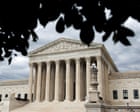
The US supreme court on Thursday ruled in favor of Terry Pitchford, a Black man convicted of capital murder and on death row in Mississippi, who claimed that his conviction was due to the jury having racial bias.
The justices sided with Pitchford in a 5-4 vote.
Pitchford, now 40, was just 18 when he and another teen robbed a grocery store in 2004. The other teen, who fired fatal shots, was still a minor and ineligible for the death penalty, but Pitchford was convicted of capital murder and sentenced to death.
The focus of the supreme court ruling was on jury selection in Pitchford’s case, when state prosecutors removed four out of five Black jurors. A jury composed of 11 white jurors and one Black juror would later convict Pitchford and sentence him to death.
The now retired prosecutor Doug Evans, who the Associated Press notes had a history of dismissing Black jurors for discriminatory reasons, had excused the four other Black jurors. Pitchford’s attorney objected to the strikes during the trial, but the judge, Joseph Loper, allowed them.
“The trial court did not afford Pitchford’s counsel a sufficient opportunity to rebut the prosecutor’s proffered race-neutral reasons for striking the four Black jurors and never determined whether the prosecutor’s stated reasons were pretextual,” Justice Brett Kavanaugh wrote in the court’s majority opinion.
The supreme court’s decision revives a federal judge’s ruling that invalidated Pitchford’s conviction on grounds that his lawyer was not allowed to pursue a line of questioning that Evans’s jury selection was based on race.
During oral arguments in March, several supreme court justices appeared skeptical of whether Loper had sufficiently applied a Batson challenge, which refers to a 1986 ruling in Batson v Kentucky, in which the court reaffirmed that it is unconstitutional to keep Black people off juries due to their race.
A Batson challenge triggers a three-step process in which the objecting party must first show that there is an inference of discrimination. The striking party must then show reasonable, race-neutral explanations for striking certain jurors. The judge later determines whether there was purposeful discrimination.
Much of the oral arguments focused on Loper’s actions in the third step of the challenge.
Seven years ago, in a case that also involved Loper, Mississippi’s highest court and Evans, the supreme court overturned the death sentence and conviction of Curtis Flowers, a Black man who had been tried six times dating back more than 20 years. At that time, the supreme court had seven of the nine current justices. Brett Kavanaugh, a conservative justice, wrote that Evans showed a “relentless, determined effort to rid the jury of Black individuals”.
Prosecutors may seek to try Pitchford again,
The Guardian wp:paragraph
هلدینگ کاسپین استانبول | خرید ملک در ترکیه | صرافی معتبر ایرانی در ترکیه | خرید و فروش طلا در ترکیه | مهاجرت به ترکیه | واردات و صادرات در ترکیه | نیازمندیهای ترکیه | اخبار ترکیه | اخبار جهانی | توریست ایران | خدمات توریستی در ایران | تورهای گردشگری ایران | هلدینگ اول | خدمات کاریابی و فریلنسری و شغل | مرجع اطلاعات ایران (همه چیز در ایران) | کیف پول و خدمات مالی و پرداخت یار | اخبار ایران | تابلو زنده قیمت ارز در ترکیه و استانبول | صرافی آنلاین ترکیه | قیمت طلا و نقره در ترکیه | سرمایه گذاری در ترکیه | جواهرات در ترکیه | نرخ لحظه ای ارزها در استانبول | قیمت دلار امروز در ترکیه | قیمت دلار استانبول امروز | قیمت لحظه ای دلار | اخبار روز ترکیه استانبول | اپلیکیشن ISTEX | اپلیکیشن قیمت لحظه ای دلار و یورو و لیر و ارزها در ترکیه
/wp:paragraph wp:paragraph /wp:paragraph
About the Author