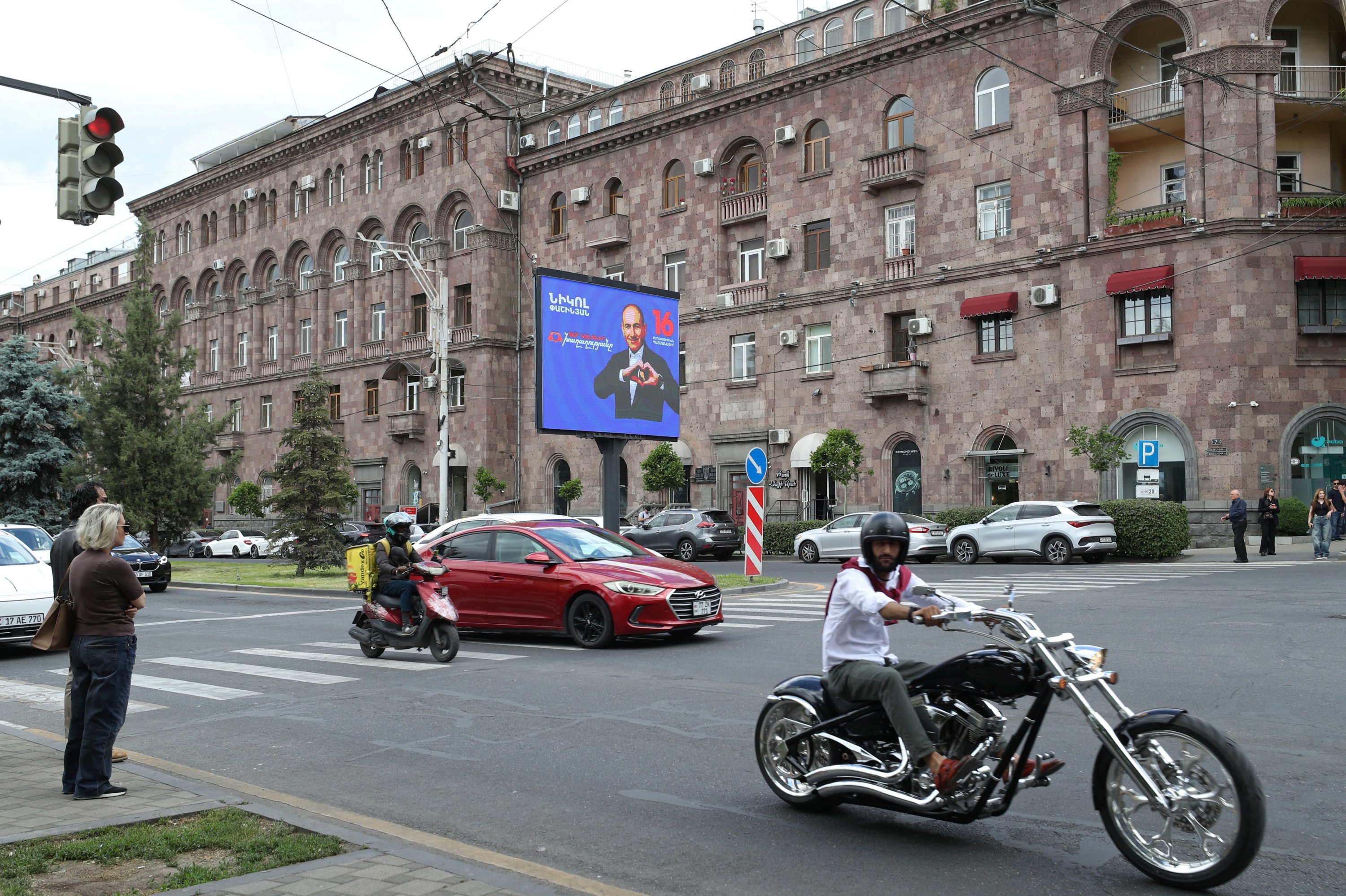
Armenians head to the polls Sunday in a parliamentary election seen as a key test of Prime Minister Nikol Pashinyan’s pro-Western agenda.
The election comes amid rising tensions with Russia and accusations that Moscow is seeking to influence the vote in the former Soviet republic.
Still technically Yerevan’s ally, Moscow has compared Armenia’s EU ambitions to the same path that it claims triggered its 2022 invasion of Ukraine.
The June 7 vote comes after years of upheaval since Pashinyan was propelled to power in a 2018 street revolution.
The small Caucasus country is recovering from the 2023 Azerbaijan military offensive that saw Baku reclaim its Karabakh region.
Pashinyan has framed the vote as a choice between a lasting peace with Azerbaijan or a return to war.
The 51-year-old has also sought to loosen Armenia’s dependence on Moscow, which maintained neutrality during the Karabakh conflict and mediated for peace.
He has frozen participation in a Russia-led security bloc while deepening ties with the European Union and the United States and set Armenia on a path toward possible EU membership.
While U.S. President Donald Trump offered his “TOTAL Endorsement for Re-Election” to “great friend and Leader” Pashinyan, Moscow has bristled at the possible loss of yet another ally in its backyard.
In a pointed remark, Russian President Vladimir Putin said in May: “We all see what is happening with Ukraine now … How did it all begin? With Ukraine’s attempt to join the EU.”
The Kremlin has been accused of seeking to sway the vote.
Analysts have noted misinformation on the web, hacker activity and Kremlin-friendly narratives portraying Western cooperation as dangerous.
In the weeks before the vote, Russia banned the import of several products from Armenia, seen as a move to heap economic pressure on the country.
And Armenian officials have warned that “enemies of freedom” are funding propaganda efforts.
‘Defense of peace’
Pashinyan has insisted he does not want a rupture with Moscow.
“We did not have, do not have, and will not have any intention of harming Russia’s interests,” he told journalists.
But the campaign is undoubtedly a battle over Armenia’s geopolitical future.
Pashinyan and his chief opponents have all accused each other of risking a fresh conflict.
He told voters that Armenia could face a “catastrophic war” with Azerbaijan within months if his Civil Contract party – leading the polls – fails to secure a strong majority.
His opponents say that rhetoric is fearmongering.
Samvel Karapetyan, a billionaire Russian-Armenian businessman whose Strong Armenia party is polling second, has rejected claims he would drag Armenia back into Russia’s orbit, but warned against Pashinyan’s “reckless rush” to the West.
“Russia has been and will remain our strategic partner and principal economic partner,” he said.
Karapetyan has been under house arrest since last year on charges of plotting a coup – allegations he rejects as politically motivated.
Europe has made little secret of who it wants to win.
In a high-profile visit in May, French President Emmanuel Macron threw his support behind Pashinyan, embracing the Armenian leader as a dear friend.
At an evening reception, Macron took to the microphone and Pashinyan to the drums for a rendition of “La Boheme,” the 1965 classic by the late Charles Aznavour, a singer beloved in both countries.
‘Proxy wars’
Polls show Pashinyan’s Civil Contract party ahead, but it remains unclear whether it can secure the two-thirds parliamentary majority needed to pass constitutional amendments demanded by Baku as a condition for a final peace treaty.
A late-May survey by the International Republican Institute put the party at 32%, while the two main opposition forces – Strong Armenia and Armenia – polled at 9% combined.
Pashinyan’s democratic record is also on the ballot paper.
Eight years after he swept to power on a promise to dismantle Armenia’s oligarchic system, he faces increasing criticism of democratic backsliding.
Armenia is drifting “from populism to authoritarian methods of governance,” analyst Gevorg Poghosyan said, pointing to the pressure being put on political competitors.
Another analyst, Vigen Hakobian, said Pashinyan had “turned Armenia into an arena for proxy wars between different superpowers.”
Still, for many Armenians, the opposition remains associated with Russian influence and oligarchs.
“If pro-Kremlin forces win the elections, then the possibility of democratic development will disappear,” said Artur Sakunts, head of the Helsinki Citizens’ Assembly-Vanadzor.
On Yerevan’s streets, people are split over whether Pashinyan’s balancing act offers security or exposes Armenia to greater danger.
“I trust Nikol to decide whom to be friends with – Russia or Europe,” said Suren Sargsyan, 72.
But unemployed Simon Petrosyan, 62, said he would vote for the opposition.
Pashinyan had turned Armenia into “a battlefield for all the great powers,” he said.
DAILYSABAH
هلدینگ کاسپین استانبول | خرید ملک در ترکیه | صرافی معتبر ایرانی در ترکیه | خرید و فروش طلا در ترکیه | مهاجرت به ترکیه | واردات و صادرات در ترکیه | نیازمندیهای ترکیه | اخبار ترکیه | اخبار جهانی | توریست ایران | خدمات توریستی در ایران | تورهای گردشگری ایران | هلدینگ اول | خدمات کاریابی و فریلنسری و شغل | مرجع اطلاعات ایران (همه چیز در ایران) | کیف پول و خدمات مالی و پرداخت یار | اخبار ایران | تابلو زنده قیمت ارز در ترکیه و استانبول | صرافی آنلاین ترکیه | قیمت طلا و نقره در ترکیه | سرمایه گذاری در ترکیه | جواهرات در ترکیه | نرخ لحظه ای ارزها در استانبول | قیمت دلار امروز در ترکیه | قیمت دلار استانبول امروز | قیمت لحظه ای دلار | اخبار روز ترکیه استانبول | اپلیکیشن ISTEX | اپلیکیشن قیمت لحظه ای دلار و یورو و لیر و ارزها در ترکیه
About the Author