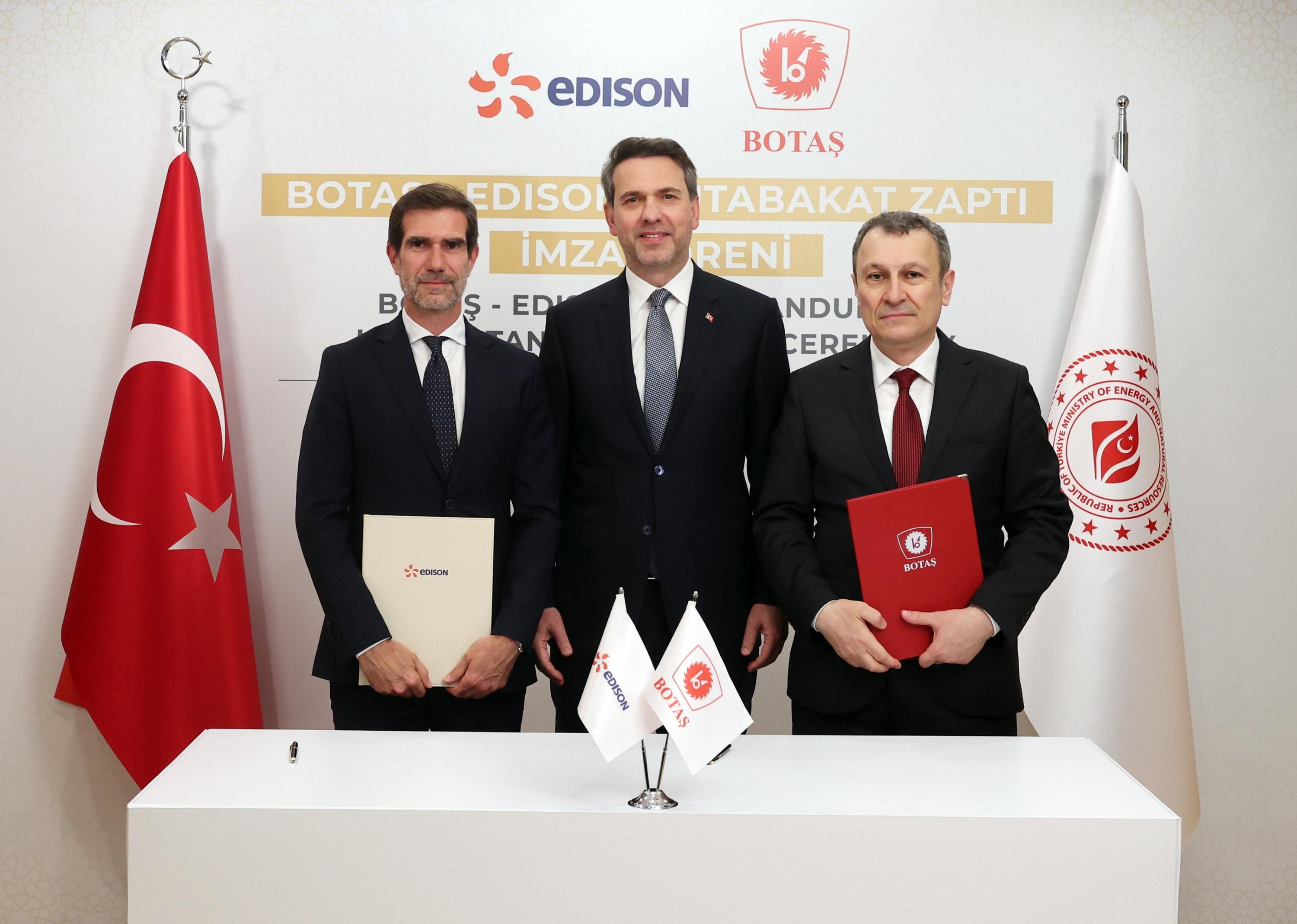
One of the most established companies in the European energy market, Edison has recently regained attention thanks to its growing cooperation with Türkiye. In particular, the memorandum of understanding on natural gas and liquefied natural gas (LNG) cooperation signed with BOTAŞ, the oil and natural gas pipeline operator of the Turkish state, on May 22, has brought the company’s importance not only in commercial terms but also in geopolitical terms back to the agenda. However, to understand Edison, one must look not only at its current activities but also at its historical development and ownership structure.
Italian, French at same time
Founded in 1884, Edison is one of Italy’s oldest energy companies. The company initially operated in electricity generation and distribution, and over time evolved into an integrated energy company active in natural gas trading, LNG, renewable energy and energy services. Having played an important role in Italy’s industrialization process since its foundation, Edison has long been considered one of the flagship companies of the country’s energy sector.
To understand Edison’s current structure, its ownership structure must be examined. At this point, the question arises: Is Edison Italy’s Energy Giant or France’s Strategic Instrument?
Although Edison is publicly known as an Italian energy company, control of the company has long been in the hands of the French energy giant EDF (Electricité de France). EDF is the largest energy company in France and is state-controlled. Therefore, although Edison is legally an Italian company, a significant part of its strategic decision-making mechanisms is shaped by the EDF group. While the company operates as a local actor serving Italy’s energy needs, it also functions as an international player aligned with France’s energy strategies.
Therefore, returning to the Edison BOTAŞ agreement, it can be said that it stands out as a development that strengthens a multidimensional energy partnership between three countries beyond energy trade.
How Iran War affected Edison
One of the agreements forming the backbone of Edison’s natural gas portfolio is its long-term LNG supply contract with QatarEnergy. This contract, regarded as one of the largest LNG agreements in Europe, plays a critical role in Italy’s energy security.
The agreement between Edison and QatarEnergy entered into force in 2009. Under the contract, Qatar undertakes to supply Italy with LNG equivalent to 6.4 billion cubic meters of natural gas annually. The duration of the agreement is 25 years, and it will continue until 2034. For this reason, Edison’s relationship with Qatar is not a short-term commercial agreement but a strategic energy partnership. This volume corresponds to a significant share of Italy’s total natural gas consumption. LNG cargoes are loaded from Qatar’s Ras Laffan facilities and delivered to the Adriatic LNG terminal. In this way, Edison can ensure a regular and long-term LNG flow to the Italian market.
However, the war in the Middle East in 2026 significantly affected this supply chain. As a result of the expansion of conflicts with Iran in the region, part of Qatar’s LNG infrastructure was damaged. According to statements by QatarEnergy, Iranian attacks rendered approximately 17% of Qatar’s LNG export capacity inoperable. Two LNG production trains and one GTL (Gas-to-Liquids) facility were damaged. The lost capacity corresponds to approximately 12.8 million tons of LNG production annually.
QatarEnergy CEO Saad Al Kaabi stated that repairs could take three to five years. According to QatarEnergy calculations, annual revenue losses from production alone reach approximately $20 billion. Infrastructure damage is estimated at around $26 billion. These figures show that the attacks have significant consequences not only for Qatar but also for the global LNG market.
Following the damage, QatarEnergy issued force majeure notifications to many of its long-term customers. Edison was among these customers. The first notification was made in March 2026, initially stating that five LNG cargoes could not be delivered.
Later, due to the continuation of the war, the notification was updated several times. By May 2026, it was announced that a total of 17 LNG cargoes planned for delivery to Edison were cancelled. This volume corresponds to approximately 2.2 billion cubic meters of natural gas.
In other words, around one-third of Edison’s annual contracted volume was temporarily lost.
A notable point for the company is that no interruption in gas supply to customers occurred. After the crisis began, Edison sought alternative LNG sources. In particular, LNG cargoes from the United States were purchased in an attempt to fill the gap. By the end of May, nine of the 17 lost cargoes had been replaced, restoring approximately 1 billion cubic meters of volume.
Türkiye bridging companies
At this point, the importance of Türkiye increases. In a period when Qatar-related supply disruptions are taking place, Edison’s signing of a cooperation agreement with BOTAŞ cannot be considered coincidental. Behind the Edison BOTAŞ agreement lies largely the supply risk originating from Qatar. Türkiye’s LNG terminals, storage facilities, access to Azerbaijani gas and its ambition to become a regional trading hub offer alternative supply options for Edison.
In addition, the agreement covers not only LNG trade but also natural gas trade, storage, swap operations and potentially future hydrogen-compatible energy infrastructure. Türkiye’s LNG terminals, Floating Storage and Regasification Unit (FSRU) capacity, underground storage facilities, and international pipeline connections have strategic importance for European energy security.
The transportation of Azerbaijani gas to Europe via the Trans-Anatolian Natural Gas Pipeline (TANAP) and the Trans-Adriatic Pipeline (TAP) has strengthened Türkiye’s role as an energy corridor. The relationship established between Edison and BOTAŞ can also be seen as a reflection of this strategic transformation.
When developments following the natural gas and LNG cooperation memorandum signed between Edison and BOTAŞ in May are evaluated together with those of the Baku Energy Week at the beginning of June, the picture shows that European energy security is evolving from short-term crisis management toward the construction of a long-term supply architecture.
Likewise, BOTAŞ’s agreement with SOCAR and Abu Dhabi National Oil Company (ADNOC), the state-owned energy firms of Azerbaijan and the United Arab Emirates, signed in Baku as part of Baku Energy Week, indicates the medium and long-term expansion capacity of the energy corridor. With a total volume of 33 billion cubic meters and scheduled to come online in 2029, this long-term supply agreement defines a new supply phase that will extend from Azerbaijan’s Absheron field and potential production increases to Türkiye and from there to European markets.
In this framework, Edison’s role emerges as a critical intermediary layer. Although Edison does not directly operate under a single sales contract with SOCAR, the company represents the downstream side of the system as one of the main commercial buyers of Azerbaijani gas reaching Europe via the Southern Gas Corridor. SOCAR, on the other hand, as both operator of key fields such as Shah Deniz and a strategic shareholder in the TANAP system, stands at the center of this chain not only as a producer but also as an infrastructure manager. For this reason, the Edison SOCAR relationship is not a direct bilateral contract but a multilayered energy corridor based on production, transit and market integration.
DAILYSABAH
هلدینگ کاسپین استانبول | خرید ملک در ترکیه | صرافی معتبر ایرانی در ترکیه | خرید و فروش طلا در ترکیه | مهاجرت به ترکیه | واردات و صادرات در ترکیه | نیازمندیهای ترکیه | اخبار ترکیه | اخبار جهانی | توریست ایران | خدمات توریستی در ایران | تورهای گردشگری ایران | هلدینگ اول | خدمات کاریابی و فریلنسری و شغل | مرجع اطلاعات ایران (همه چیز در ایران) | کیف پول و خدمات مالی و پرداخت یار | اخبار ایران | تابلو زنده قیمت ارز در ترکیه و استانبول | صرافی آنلاین ترکیه | قیمت طلا و نقره در ترکیه | سرمایه گذاری در ترکیه | جواهرات در ترکیه | نرخ لحظه ای ارزها در استانبول | قیمت دلار امروز در ترکیه | قیمت دلار استانبول امروز | قیمت لحظه ای دلار | اخبار روز ترکیه استانبول | اپلیکیشن ISTEX | اپلیکیشن قیمت لحظه ای دلار و یورو و لیر و ارزها در ترکیه
About the Author