Iran is already preparing for the perilous transition from wartime unity to a fractious peace marked by hyperinflation, a 10% contraction in the economy, power cuts and calls for a triumphalist government to end its unprecedented hunting down of dissent.
With peace not yet secured, the debates within the regime about Iran’s future are only just starting to emerge but its rulers are clearly thinking about how after surviving the war, they can survive the peace.
Open discussions on channels such as Azad are heard on alternative future postwar directions for the country. There are advocates of greater openness, and others such as Saeed Ajorlou, close to the Iranian negotiating team, who say, now the myth of a weak Iran has been shattered in western minds, the country must seek development through autonomy.
Much will depend on whether Donald Trump is really willing to lift the economic blockade on Iran by reducing sanctions and ending asset freezes, but few Iranian economists think the relief will be more than a small fraction of the estimated $270bn (£200bn) losses inflicted on the economy including its infrastructure, schools, energy, steelworks and housing.
Iranian commentators such as Fuad Habibi, a sociology professor at the University of Kurdistan, are wary of terms such as social collapse but are very open that the conditions that led to the bloody protests in January have not been solved, and indeed made worse by war.
He said: “Economic crises and livelihood dissatisfaction have clearly increased, even without precise statistics. We are witnessing a rare increase in prices due to the naval blockade and the consequences of the war. The internet blockade has also led to direct or indirect unemployment of at least 2 million.
“Since we do not have a society in which protests are expressed through official channels such as parties, guilds and unions, you will always be surprised.”
The current so-called cohesion is due to the existence of an external factor because, in the face of bombing and destruction by an enemy, internal solidarity is created. But as Hegel said, the moment a front wins is the moment a split begins within it.
If a deal does happen to end the war, the Iranian economy would enter peacetime facing food inflation at its highest since the second world war, with the annual food inflation in May at 130% according to the Statistical Centre of Iran. Inflation for meat and chicken reached 176%. Health experts even warn of an increase in malnutrition, osteoporosis and growth stunting, due to the way in which Iranians are having to eradicate dairy products from their diet.
The former communications minister Mohammad Javad Azari Jahromi wrote on his Telegram channel: “Trump and Netanyahu’s next bomb may not be gunpowder; it may be inflation. The battlefield is the people’s table, housing rent, and … gentlemen in charge, are you aware of the accumulation of dissatisfaction? Is the country’s economic defence ready, or, God forbid, will we be surprised again?”
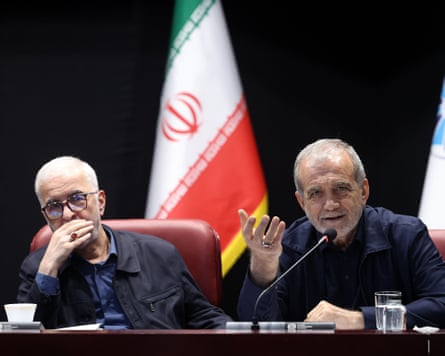
The president, Masoud Pezeshkian, appears to have been deputed to keep the domestic wheels of government working, and has been repeatedly warning of hard times ahead, and the need to maintain social cohesion.
The ministry of energy was forced to deny controlled two-hour blackouts would start as early as next month despite the damage to infrastructure. Arash Najafi, the head of the energy commission of the Iranian chamber of commerce, had warned this week: “To maintain production, people must prepare themselves for two hours of daily shutdowns.” Incentives such as 30% price discounts are being offered to those who cut their energy consumption by 10%.
The sense of hardship is starting to emerge as internet censorship is slowly lifted, a decision so controversial that it has led to hardliners in the parliament trying to impeach the communications minister.
Rahim Ghomeishi, a political activist, wrote this week: “We had been thrown out of a broken boat. Fear of bloodthirsty whales, fear of terrible waves had taken over our entire being. Now that we have returned to the boat, we cannot be content just because we have been rescued.
“Poverty was not supposed to become normal in the country. We were not supposed to wake up to news of executions every morning. Most people were not supposed to be strangers unable to decide about their own lives and destinies, the most important concern in life was not supposed to be filling our stomachs.”
Although much of the domestic political debate turns on the wisdom of negotiating with America, or an arcane battle about how long Iran should renounce a currently theoretical right to enrich uranium, many believe the true prize from the war will be the end of the economic straitjacket. But the sums likely to be involved are not a bonanza.
Albert Baghzian, a professor of economics at the University of Tehran, told Khabar Online: “In an economy of the size of Iran’s economy, with this level of efficiency in the policymaking sector, it is wrong to think that the influx of $12bn or $24bn will lead to a major opening. In our economy, figures higher than this have been brought in many times, but because we had not planned properly, resources were wasted, we ended up where we are today.”
But debates about how the economy could be reorganised and corruption tackled come up against the power of the Islamic Revolutionary Guard Corps (IRGC).
The senior Iranian economist Mousa Ghaninejad hinted at the problem this week: “The main issue in the Iranian economy is the dominance of command-based governance over rule-based governance, meaning that decisions are made in many cases not based on stable and transparent rules, but rather on short-term expediency and political considerations.”
Ever since the January protests, the repression has grown worse, reflected in new espionage laws, asset seizures of dissidents, executions and denunciations of dissidents in the nightly rallies. The national parliament is still banned from meetings in person.
This drove the Islamic National Unity party, one of the leading reformist parties, this week to publish an open version of a letter sent privately to Pezeshkian urging him to stop executions, which only fuel internal divisions, do not meet the fundamental requirements for a fair trial and “tarnish the country’s image at a time of moral superiority during the war”. At least 22 political prisoners were executed between 17 March and 27 April.
But the chances of pluralism are slim. It took the hospitalisation this week of Mir Hossein Mousavi, the former prime minister, who has been under house arrest since 2011 and whose home was bombed in the war, for the president to feel emboldened to intervene with the security forces.
Extraordinarily, Trump seems to be content to coexist with this enemy. He said this week he had a good call with the Iran-backed Lebanese group Hezbollah, and he would be honoured to meet Khamenei, the new supreme leader. “In some circles he has a good reputation,” Trump mused.
The IRGC and political leadership showed in the period between the 10-day war of 2025 and the renewed war in February 2026 that they could reorganise for battle. But the test is imminent whether they can reorganise for peace by addressing the problems, domestic and international, that hold the country back.
If, after the end of the war, the economic blockade of Iran continues and there is no opening in international relations for the entry of capital, technology, raw materials and resources necessary for reconstruction, the devastation will not be repaired, but will become part of everyday life. The destruction will turn from a temporary incident into a permanent social condition, a situation in which people are forced to live in a context of scarcity, exhaustion and instability.
The Guardian wp:paragraph
هلدینگ کاسپین استانبول | خرید ملک در ترکیه | صرافی معتبر ایرانی در ترکیه | خرید و فروش طلا در ترکیه | مهاجرت به ترکیه | واردات و صادرات در ترکیه | نیازمندیهای ترکیه | اخبار ترکیه | اخبار جهانی | توریست ایران | خدمات توریستی در ایران | تورهای گردشگری ایران | هلدینگ اول | خدمات کاریابی و فریلنسری و شغل | مرجع اطلاعات ایران (همه چیز در ایران) | کیف پول و خدمات مالی و پرداخت یار | اخبار ایران | تابلو زنده قیمت ارز در ترکیه و استانبول | صرافی آنلاین ترکیه | قیمت طلا و نقره در ترکیه | سرمایه گذاری در ترکیه | جواهرات در ترکیه | نرخ لحظه ای ارزها در استانبول | قیمت دلار امروز در ترکیه | قیمت دلار استانبول امروز | قیمت لحظه ای دلار | اخبار روز ترکیه استانبول | اپلیکیشن ISTEX | اپلیکیشن قیمت لحظه ای دلار و یورو و لیر و ارزها در ترکیه
/wp:paragraph wp:paragraph /wp:paragraph
About the Author