
As Mark was getting ready for his high school graduation, he thought about how his dad would have probably insisted on adjusting his slacks – they were a bit tight – and fixed up his tie. “He would want me to look my best,” he said.
But his dad and namesake, Marco, was 2,000 miles away. He had been arrested by Immigration and Customs Enforcement (ICE) in Maryland just before Christmas and deported to El Salvador in March.
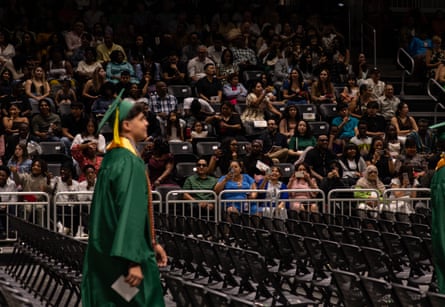
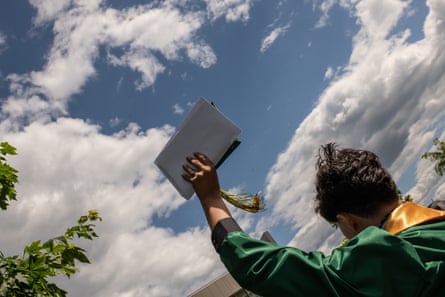
When he walked up to the podium and got his diploma last week, he felt a sense of relief – like he had walked out of a nightmare. His mother, Rosie, told him afterwards: “Congratulations – we finally made it though.”
Mark used to love school – he took advanced placement classes, he had a girlfriend and a tight-knit group of friends that his mom calls “wholesome”. But everything began to unravel after Marco was arrested, and then deported. “For a lot of this semester, I just didn’t want to go to school,” he said. “Even after I came to terms with what happened to my dad, I never, never ever wanted to be there.
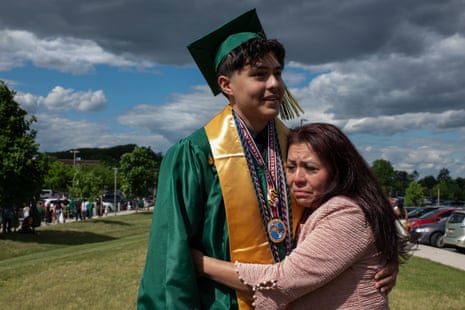
It didn’t matter to the immigration system that Marco had lived in the US for nearly 40 years, that he owned a contracting business in Maryland, that he had a 17-year-old son and 35-year-old daughter who are both US citizens.
It didn’t seem to matter, Mark said, that Marco’s biggest dream had been to see his son graduate.
Mark is one of tens of thousands of US citizen children separated from their parents by the US immigration system. A Guardian investigation found that during the first seven months of Donald Trump’s presidency, his administration arrested the parents of at least 27,000 children – including 12,000 US citizen children. During that period, the US Department of Homeland Security (DHS) was deporting about twice as many parents each month compared with 2024.
Marco watched a livestream of his son’s ceremony from Aguascalientes, Mexico, where he now resides. His pride came with a shadow.
“I was very happy. A little sad that I couldn’t be present,” he said.
Mark and his mother thought about ways to include his father in the ceremony. For a while, they had talked about ordering a lifesized cardboard cutout of Marco to bring to the graduation ceremony. But Mark couldn’t quite figure out where to order something like that in time. Instead, Mark video-called him after the ceremony, alongside his mom, Rosie, his older sister and her mom, from an Italian restaurant in Baltimore. He missed the barbecue his dad would have cooked for them all had he been there. Maybe they would have had a small party in the back yard with family friends.

“He would have made a really good carne asada!” Mark said.
He’s not sure when his whole family will be in the same place again, to eat together.
Marco and a friend had been shopping at a Home Depot – getting supplies for a contracting job – when ICE officers stopped them. It felt like Murphy’s law. Marco, who ran a construction business, had been avoiding Home Depot because he knew that immigration agents were conducting raids there. But he couldn’t find the part he needed for a project anywhere else – so he decided to swallow his fears and go.
Marco was first held at a federal building in Baltimore, and then transferred within a week to a detention center in Mississippi. “It was a nightmare,” said Rosie.
She and Mark began scrambling to gather documents, evidence and paperwork to fight Marco’s deportation. He had been, effectively, undocumented, but his lawyer thought he could qualify for residency via a humanitarian relief program for Central Americans who had come to the US before 1990.Mark’s half-sister, who had been estranged from her father for some years, rushed in to help as well, trying to coordinate with Marco and the family’s lawyer.
It was to no avail – an immigration judge ordered Marco’s removal. “The judge denied the case even though documentation was presented that Marco had been here for 37 years,” Rosie said. Marco was sent back to El Salvador – a country he and his parents had left when he was three years old to move to Mexico.
Marco mostly doesn’t like to talk about any of it. He wanted to stay in the US for his family, but it was also a relief to leave the detention center – where he had been struggling to eat the poor quality food, and struggling to watch fellow detainees crying and screaming through the night. After three months in detention, he’d lost 30lbs.
“My dad had always wanted to lose some weight – but not like this,” Mark said.
With his dad in detention, Mark grew increasingly stressed, and then depressed. He had trouble getting out of bed and concentrating at school, and began skipping classes. Eventually, he dropped out of an advanced placement class because he couldn’t keep up. In math class, his grade dipped to an “E” – he was failing.
Soon, Mark and Rosie realized that they were eating through their savings. Marco had brought in enough money to cover the family’s rent, utilities and groceries. Rosie’s job at Burger King helped pay for extras – like new clothes and dinners out. Suddenly, Mark and Rosie had to figure out how to pay for everything on their own.
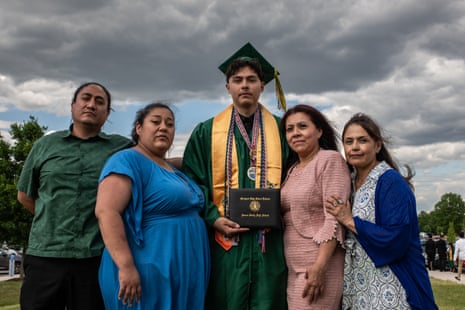
“Separation in that way breaks our hearts. We are suffering in every aspect,” Rosie said. “I just never thought this would happen, that they’d tear us apart like this.”
He stopped going out with friends as much. More than anything, he was worried that ICE agents would arrest his mother as well. He insisted on doing all the groceries and errands, so his mother could stay home safe . His mom tried to be strong for him, but he could hear her crying in her room.
Marco sensed his son was falling into a depression. “I understood why,” he said. But he prayed Mark would make it through senior year. “Every night I would read the Bible before going to bed. And I would say: ‘My biggest wish is for Mark to graduate from high school.’”
Just before he was deported, Marco wrote his son a letter – a single page, filled front and back. It began: “To my greatest son, Mark … How wonderful it was when we saw you for the first time when you were born.”
He told Mark to take care of his mother and his girlfriend, to exercise, to keep learning and to find a good job as an electrician. “You can do small jobs by yourself and the pay range is from 100 to 200 dollars in a few hours installing lights, switches, replacing plugs,” the letter read. Mark chuckled as he read it back. “He just wants me to be OK.”
Mark wanted to be OK too.He asked his math teacher for extra work so he could bring his grades back up.
He began taking shifts at Walmart, so he and his mom could pay the bills. The Montgomery County Immigrant Rights Collective, a local mutual aid group, also fundraised to help the family cover basics.
He reconnected with his half-sister after nearly a decade without contact. “She’s having a baby soon, so I’ll be an uncle!” he said. She promised him if anything happened to Rosie, she’d be there to take care of him and support him. “That was one good thing out of this,” Mark said.
Marco, meanwhile, struggled with his own bouts of post-traumatic stress and grief in El Salvador. He started working odd jobs almost immediately after arriving there – he didn’t want to burden Rosie and Mark any further. “He even wants to support us financially from over there, but he just can’t make that much,” Mark said.
“He feels helpless,” Rosie said.
Eventually, he was able to make his way to Mexico, to his parents and brother. But he’s still exploring options to try to return to the US, legally, or Canada – anywhere that’s a bit closer to Rosie and Mark. “It will take me time,” Marco said. For now, he said, he just wants to do what he can to support Mark. “I am amazed because before the arrest, Mark was still a child. He’s grown so much since then.”
He’ll be starting community college soon, and plans to become either a civil or mechanical engineer. He was able to convince his dad that this could be even more lucrative, in the long run, as becoming an electrician.
Mark is trying to save up enough to visit his dad in Mexico in August. “I’m not sure if I’ll make it because flights are expensive,” he said. But if he does go, he’ll be packing his cap and gown, so he can pose for a round of pictures with his dad. “And we can recreate the graduation for him.”
The Guardian is using first names only to protect the family’s privacy and safety
The Guardian wp:paragraph
هلدینگ کاسپین استانبول | خرید ملک در ترکیه | صرافی معتبر ایرانی در ترکیه | خرید و فروش طلا در ترکیه | مهاجرت به ترکیه | واردات و صادرات در ترکیه | نیازمندیهای ترکیه | اخبار ترکیه | اخبار جهانی | توریست ایران | خدمات توریستی در ایران | تورهای گردشگری ایران | هلدینگ اول | خدمات کاریابی و فریلنسری و شغل | مرجع اطلاعات ایران (همه چیز در ایران) | کیف پول و خدمات مالی و پرداخت یار | اخبار ایران | تابلو زنده قیمت ارز در ترکیه و استانبول | صرافی آنلاین ترکیه | قیمت طلا و نقره در ترکیه | سرمایه گذاری در ترکیه | جواهرات در ترکیه | نرخ لحظه ای ارزها در استانبول | قیمت دلار امروز در ترکیه | قیمت دلار استانبول امروز | قیمت لحظه ای دلار | اخبار روز ترکیه استانبول | اپلیکیشن ISTEX | اپلیکیشن قیمت لحظه ای دلار و یورو و لیر و ارزها در ترکیه
/wp:paragraph wp:paragraph /wp:paragraph
About the Author