There is no shortage of interest in the voting patterns of the white working class. Of particular note is how this group – especially since the sea change of the 1960s – finds themselves so consistently on the wrong side of progressive politics. The national preoccupation with the white working class’s affinity for rightwing conservatism has propagated countless bestselling books, long reads and think pieces that are often mawkish or condescending or both. Their almost exclusively centrist white elite authors plead for us to understand how those in the white working class feel “left behind”, and that they turned hard right because Democrats didn’t tend to their economic anxieties. These pieces pose questions like “Why is the working class leaving the Democratic party?” and equate the term “working class” with whiteness, ignoring any explanation for why the Black working classes – which suffered far more economic angst and Covid-related disparities in the last decade – continue to vote solidly blue.
But after three presidential elections in which non-college-educated white voters (the most functional definition we have for this group) have overwhelmingly supported Donald Trump, journalists and researchers are now questioning if these voters will go Maga again in the 2026 midterms. Pollsters speculate that they are breaking with Trump: his approval ratings have recently dipped below 50% with non-college-educated whites, as their economics are no better off under Trump 2.0 – down 14 points in the last 15 months.
This handwringing about the marriage between Trump and his least affluent white voters blindly looks towards changing economic tides to explain past voting and forecast upcoming elections. It’s a historically misguided assumption, however, that the downturn drove the white working class into Trump’s arms, and that his failure to redress their conditions will be the cause of their potential breakup. Generations of voters in the US have proven that in times of expanding democracy and the perceived challenge to their resources posed by other races, the white working class had the choice to side with the conditions of all working people but repeatedly aligned with white elites who shored up their racial anxieties with state-backed force against their perceived competition. That’s because, as past politics reveal, the white working class has repeatedly prioritized racial power as their political priority. Even when siding with conservatives has cost them the most economically, they continue to measure their gains racially.
The assumption that economic angst drives political loyalties for the white lower classes inaccurately assumes that they are chiefly interested in economics as the reward for their vote. In reality, access to power over other racial groups is their preferred political currency. When presented with proposals of a multiracial democracy, and in instances when governments were seen as responsive to Black social movements, working and poor whites have repeatedly supported politicians that champion successive tax cuts for the rich, slashed spending marked for low- and modest-income Americans, and authorized anti-Black and anti-immigrant policies that exclusively benefit the wealthiest white Americans.
It’s a concept that the famed social scientist and historian WEB Du Bois laid bare in his magnum opus Black Reconstruction, published 70 years after the US civil war as the march of a new century still grappled with questions of race, slavery and democracy. Du Bois understood that the racial order required by capitalism could only be maintained if white elites successfully manipulated the white masses against their class alliances with other races. They needed to be goaded into loyalty to a white supremacist planter class that struggled to keep its chokehold on the postwar south. Convincing poor white farmers to side with the wealthy land owners they otherwise begrudged required posing newly enfranchised African Americans as a threat to even the lowest white man’s standing.
The collapse of Reconstruction’s promise
In the wake of the civil war and at the dawn of Reconstruction, tens of millions of Americans were left reeling from the massive carnage of an estimated 1.5m casualties, including nearly 700,000 dead. The question of how a “more perfect union” could form in the wake of such devastation simultaneously hinged upon what that democracy would do economically for more than a million mostly white disabled, pension-less veterans and poverty-stricken widows, and millions of formerly enslaved African Americans, who, as disenfranchised human property, had built the nearly unfathomable wealth of the fallen Confederacy. By 1860, slavery churned 80% of the country’s gross national product and almost exclusively lined the pockets of wealthy whites. That ballooning national prosperity omitted not only the African Americans upon whose backs it was built, but also the majority of non-slaveholding whites who made up over three-quarters of the white population in the south alone.
Du Bois was keen to how antebellum and Reconstruction-era elites weaponized racial resentment to thwart the class solidarity that could have emerged from the growing multiracial rosters of tens of millions of indigents during and after the war. The country’s pre- and postwar industrialism was based on cotton that only remained in demand so long as the gross exploitation of Black labor kept production cheap. The market logic of slavery should have resulted in strong abolitionist sentiment from poor and working-class whites. Slavery, after all, devalued and even disregarded their wages. No one was going to offer the white yeoman a day’s pay for what the enslaved could be forced to do for free. Instead, the white masses traded in on what Du Bois called the “psychological wages of whiteness”, in which whites, regardless of their poverty status, were remunerated not economically but, rather, socially and politically by their participation in Black subjugation. They were granted universal control over Black life across public and private spheres by virtue of their whiteness alone.
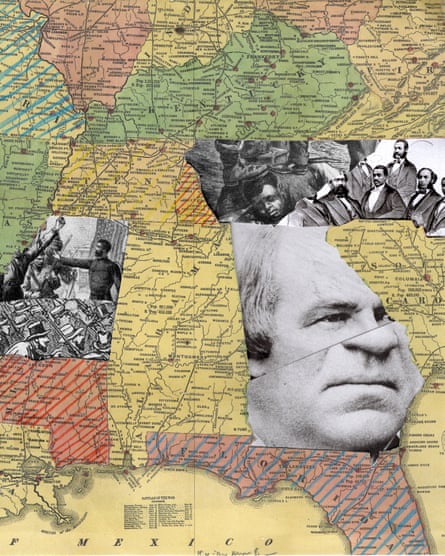
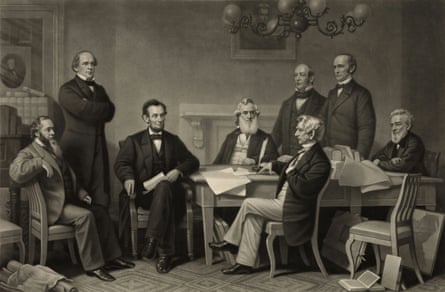
Nowhere was the maneuvering of the white denizens and the payout on their psychological wages more apparent for Du Bois than under the presidency of Andrew Johnson. Johnson, a notorious drunkard who succeeded Abraham Lincoln upon his assassination, would go on to dodge removal from office by one vote during his impeachment. By the dusk of the war, Black abolitionists had forced Lincoln to concede Black men’s access to the vote, land grants and federal protections from white terrorism – promises that Johnson swiftly set out to revoke upon taking office.
His policies were moored by white supremacy and immediately transposed the economic interests of the white lower classes on to racial politics just as some poor white farmers – many of whom openly despised the southern planter aristocracy – flirted with interracial class alliances that challenged tax reforms and labor exploitations. Johnson, however, understood the political messaging of aid for the white lower classes as a ripe opportunity to dismantle budding cross-racial solidarities, foil the spread of multiracial democracy, and undo political and economic enfranchisement for Black and Native peoples. He immediately sent federal troops to throw tens of thousands of Black freedmen off the 40-acre plots of former confederate plantations that had been allotted them by the Freedman’s Bureau. The tracts were mostly remitted to former plantation owners, but also to poor whites whom Johnson upheld as “free, industrious and honest farmers”. Throughout his corrupt administration, the southern Democrat openly effused pity for the white everyman (whom he called the real victim of the war) and relished in his rivals’ charge that he was “too much of the poor man’s friend”.
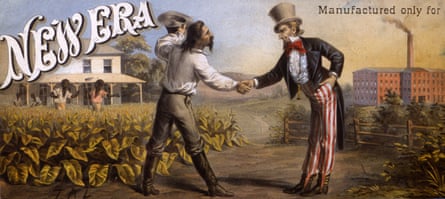
In prior decades, Johnson won over thousands of poor whites by deeding 160 acres of Indigenous lands to any westbound white settler “without money”, an earmark of the Homestead Act. In the face of political criticism for overlooking those who paid for these parcels, he made no apology for “standing by the poor man in getting him a home that he could call his”. But as the historian Carol Anderson notes, Johnson found his poor white base – who were first impoverished by planters and then conscripted as cannon fodder during the war – entirely expendable when the pressing undertaking of his administration turned to how to stomp out the threat of Black citizenship under the 13th, 14th, and 15th “Reconstruction amendments”.
Ultimately, Johnson, who boasted of his rural destitute beginnings, was far more loyal to white supremacy and its control of capitalism than he was to the common white man. He talked a good game of his adoration for the poor, but his policies never addressed the root of postwar poverty’s spread: the broken pension system that left millions of disabled veterans, war widows and their children insolvent. His approach to government entitlements for landless whites seemed to begin and end merely at his belief that other racial groups possessed what rightfully belonged to the white man. He promptly reinstated the leadership of the former Confederacy (fresh off their insurrectionist attempt to overthrow the United States of America) when he had no other way to sustain the brutal subjugation of Black labor and organizing needed to keep cotton king.
What did poor whites get besides a few morsels of land and some grandstanding gestures for abandoning their class interests and siding with Johnson and his neo-Confederates? Such a trade-off against their bottom line must be based on far more than mere feelings of racial superiority. The “psychological” wages of whiteness were actuated by an invitation to participate in the country’s nascent police state, which, after the passage of the Fugitive Slave Act of 1850, incentivized both northern and southern whites, slave-owning or not, to lend themselves to the surveillance and reporting of suspected fugitives.
Any white person of any status could ask any Black people they deemed “out of place” to produce their manumission papers or slave passes. Formal and informal participation in the police state held out both personal and financial reward for reporting fugitives, and the far greater collective prize of curtailing the Black resistance and political movements that stimulated Black urban and northern migration. As Du Bois explained, free and fleeing African Americans directly competed with white skilled and semi-skilled laborers. White industrial workers rallied around race and saw being treated better than Black workers as their plight more than any grievance towards owners about compensation and conditions overall. A white labor agitator, affronted by Black workers who took an even lower wage than European immigrants, wrote to a fellow organizer: “I was formerly, like yourself, a very warm advocate of the abolition of slavery. This was before I saw that there was white slavery.”
Enslavers were hypervigilant to punish, thwart and curtail any seeds of uprisings among the human chattel on their private plantations, but turned to landless whites to police Black movement in the public sphere, where runaways posed a permanent threat by communicating across covert abolitionist networks and inspiring others to join them. “Patroller” was synonymous with slave patroller, but so was white skin synonymous with a law enforcement badge, as Gautham Rao explains in White Power: Policing American Slavery. The wages of whiteness deputized all whites with the power to detain, arrest, seize and search. Perhaps most importantly, it gave them a universal right to anti-Black violence and a state-backed justification that they were carrying out their obligations as citizens to protect the white man’s property. “It was a system in which white power and police power were one and the same,” Rao writes.
But many white commoners questioned why they should be the ones to help hunt down the rich man’s human stock, just as newly arrived European immigrants wondered why they should have to share a rundown tenement they didn’t own with northbound Black migrants. The white patrolling that should have logically ended with emancipation instead persisted for generations after the 13th amendment as the meaning and purchase of whiteness itself, particularly as millions of newly arrived European immigrants took on a collective form of public authority based solely on race, regardless of class. For hundreds of thousands of European newcomers who dwelled in urban slum conditions that were indistinguishable from those of African Americans, enforcing the police state offered the most ready-made means to the whiteness requisite for full social citizenship as their ticket into white communities and institutions. The delegitimization of Black resistance as “unlawful” was paired with the added bonus of legitimizing all white state and extralegal violence as “lawful” acts by “law abiding citizens”. Hundreds of mob massacres, in which law enforcement and white vigilantes routinely cooperated, gave immigrant and native-born whites alike an unearned advantage by destroying the competition of Black business districts, voters, schools, homeowners and civic organizations that advocated for racially fair governance. Those white psychological wages paid out in the dividends of criminalizing Black resistance while they subsequently masked white vigilantism, lynchings, and everyday domestic terrorism as legitimate and necessary.
The alliance with public authority over their pockets was as economically irrational then as it is now. In contemporary electoral politics there is little if any basis to correlate white economic anxieties with conservative political leanings. Sweeping socialist-inspired federal policies, including the Social Security Act, the Federal Housing Administration and the GI Bill, offered tens of billions of dollars in segregated government handouts that lifted poor and working-class whites into middle-class suburbanization. At the same time, racially loaded terms like “pork barrel policy” (so-called because of the barrels of salted pork that Union troops distributed to the enslaved) were used to sour white public opinion and embolden white voter watchdogging over any policies that include aid to people of color, even if they primarily benefited whites.
When, during the height of the civil rights movement in 1964, a second President Johnson called for a national War on Poverty, he garnered white public sympathy for the campaign by humanizing white rural poverty, particularly in Appalachia. Half a decade later, his party would clamor to hold on to a white voter they feared was growing alienated by the anti-war and anti-racist activism of college students and Johnson’s backing of the Civil Rights Act. Throughout the 1960s, the Democratic party lost white racists, not white workers. It was not until the 1970 “hard hat riot”, in which mobs of construction and office workers, fomented by the Civil Rights Act’s desegregation of labor unions, attacked student anti-war protesters gathered on Wall Street, that blue-collar whites in the north and rust belt realigned the horizontal class solidarities they held under FDR’s New Deal into a vertical racial alliance with middle-class and wealthy white suburbanites. Under Nixon’s “silent majority” conservative coalition, their white wages were once again paid in the Nixonian aggressive crackdown on Black political organizing in cities and the politically motivated expansion of the carceral and police states in response to it.
The Maga-fication of class resentment into racial animosity
Like populist movement-reliant conservative presidents before him, Trump and his Maga acolytes drum the rhetoric that Black people and racialized immigrants have stolen what should belong to whites. And they reward the white lower classes not with any economic relief but with an invitation to self-deputize in a draconian police state that deliberately blurs the lines between law enforcement and white vigilantism. When compared with the median incomes of non-college-educated households of other races, whites fair quite well. Even among the lowest household income sectors, whites possess more than 20 times the wealth on averageof low-income Blacks – a gap that widened when working whites received a sizable pandemic wealth bump under Biden administration bailouts. As much as both parties have bent over backwards to validate the narrative that salt-of-the-earth blue-collar whites were driven right by a liberal agenda that catered to gender-inclusive pronouns over bottom-line suburban family finances, the claim of the economic angst-based Maga voter was empirically debunked by researchers almost as quickly as it was popularized by pundits. It was social, demographic and cultural status threat, not economic hardship, that sparked the white rage that fueled Trump’s rise.
It otherwise would seem implausible that non-college-educated white voters would be so outspoken in dismantling DEI efforts in the elite colleges to which their children will likely never apply and the white-collar managerial sector in which, by definition, they do not work. But the Maga masses recognized their racial wages when Trump drummed and delivered upon the promise of ballooning a police state that targets racialized immigrants and multiracial cities. Instead of demanding economic relief for working families, his base ardently supported a $70bn increase in federal funds for Immigration and Custom Enforcement. As of June 2026, 50 people have died in ICE custody, most of whom, like 43-year-old legal resident Mamuka Artmeladze who died on 4 June, had no criminal record and were never charged with any crime. Many of these detainments were the result of anonymous tips called into ICE by everyday citizens who incessantly surveil the everyday life of people of color. Business owners have even exploited the vulnerability of their undocumented employees by cutting pay and hours – cashing in on their psychological wages as they renege on the actual wages owed to laborers.
Trump’s frequent response to the economic downturn is the repeatedly debunked claim that “immigrants are taking your jobs!” It’s a manipulation that he amplified but certainly did not invent. The tactic borrows heavily from Reconstruction-era neo-Confederates and their sympathizers, but was fine-tuned in the post-civil rights era conservative party, which, as historian Kenneth Durr said, pivoted racial anxiety into economic grievance and repackaged white rights as working-class rights to disguise the message. Across both parties, terms like “economic opportunity”, “upward mobility”, “housing” and “job creation” are effectively dogwhistles for the last 100 years of government rhetoric that champions working-class whites over working-class everyone else while the outcomes of their policies enrich the wealthiest Americans at everyone else’s expense.
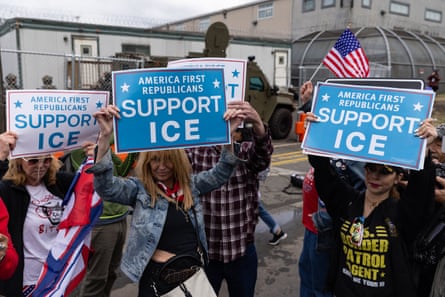
But it’s never been about jobs. The scapegoating of immigrants and African Americans for “taking” what belongs to whites is but the moral and political justification for everyday white buy-in to the state-sanctioned violence against these groups. The policing is the payout, and no amount of economic stimulus, healthcare subsidies or housing bailouts are chips worth bargaining if it means losing the psychological wages that have paid them off for 150 years.
During Reconstruction, Frederick Douglass warned that northern liberals of the “so-called benevolent societies” were more concerned with peace and reconciliation across white classes and southern Confederates than they were with the welfare of the freedman and a democracy that included Black rights. So too is it grating and insulting to Black and immigrant voters to watch Maga set our citizenship aflame while white coastal elites ask repeatedly what the Democratic party should be doing to satisfy working-class Maga. Many explanations have been given of what the white masses “lost” that turned them Maga. Almost nothing has been asked of what they gained and how they have gladly traded in their economic bottom line for the social and political currency of universal white dominance.
If we have learned one thing about Trump’s base, it should be to not confuse attitudes expressed in approval ratings with any potential change in their voting patterns. Millions of Trump voters openly disapproved of his performance and personality across his three campaigns. Yet they would never consider an alternative that shared power with people of color and required relinquishing the full public authority of their whiteness. The coastal elite’s calls to sympathize with the white working class are only a rejustification of their psychological wages, not an attempt to part them from the racism they cash out from them. No amount of persuasion will move those who have chosen to maintain control and violence over putting food on the table when the point of their trade-off is keeping others from putting food on theirs.
The Guardian wp:paragraph
هلدینگ کاسپین استانبول | خرید ملک در ترکیه | صرافی معتبر ایرانی در ترکیه | خرید و فروش طلا در ترکیه | مهاجرت به ترکیه | واردات و صادرات در ترکیه | نیازمندیهای ترکیه | اخبار ترکیه | اخبار جهانی | توریست ایران | خدمات توریستی در ایران | تورهای گردشگری ایران | هلدینگ اول | خدمات کاریابی و فریلنسری و شغل | مرجع اطلاعات ایران (همه چیز در ایران) | کیف پول و خدمات مالی و پرداخت یار | اخبار ایران | تابلو زنده قیمت ارز در ترکیه و استانبول | صرافی آنلاین ترکیه | قیمت طلا و نقره در ترکیه | سرمایه گذاری در ترکیه | جواهرات در ترکیه | نرخ لحظه ای ارزها در استانبول | قیمت دلار امروز در ترکیه | قیمت دلار استانبول امروز | قیمت لحظه ای دلار | اخبار روز ترکیه استانبول | اپلیکیشن ISTEX | اپلیکیشن قیمت لحظه ای دلار و یورو و لیر و ارزها در ترکیه
/wp:paragraph wp:paragraph /wp:paragraph
About the Author