Reports in Arab and international media indicate that French President Emmanuel Macron is preparing to make an official visit to Syria.
This prospect comes at a sensitive political moment for the country, following the profound transformations it has undergone and the emergence of a new phase in the redefinition of relations between the Syrian state and its domestic and external environment.
Having entered a new political phase after decades of an authoritarian regime that weighed heavily on its resources and the lives of its people, Syria is now seeking to rebuild state institutions and reaffirm its sovereignty while opening itself to various international actors. This openness, however, is guided by a fundamental principle: it cannot extend to those who support or participate in actions targeting the Syrian people.
As for the position of France and the United States regarding the conflict that followed the outbreak of the revolution against Bashar al-Assad’s regime, it represents another case deserving critical examination.
From the outset of the Syrian revolution, Paris adopted a clear stance by severing diplomatic relations with Damascus and closing its embassy, in line with the broader policy of the European Union. Nevertheless, despite its political firmness, this position did not translate, in the eyes of many Syrians, into genuine support for the choices of the Syrian people during their political transition.
Paris and Washington chose instead to support YPG in northeastern Syria, which is the Syrian branch of the PKK, an organization designated as a terrorist by the U.S., the EU and Türkiye. This is where the paradox begins.
By supporting these terrorist groups, which exploited the chaos and, with the complicity of the Assad regime itself, succeeded in imposing military control over the entirety of northeastern Syria, France and the U.S. encouraged separatist tendencies. However, from the standpoint of political science and international law, no sovereign state can accept a violation of its sovereignty or the establishment of a separate military and administrative entity on its territory.
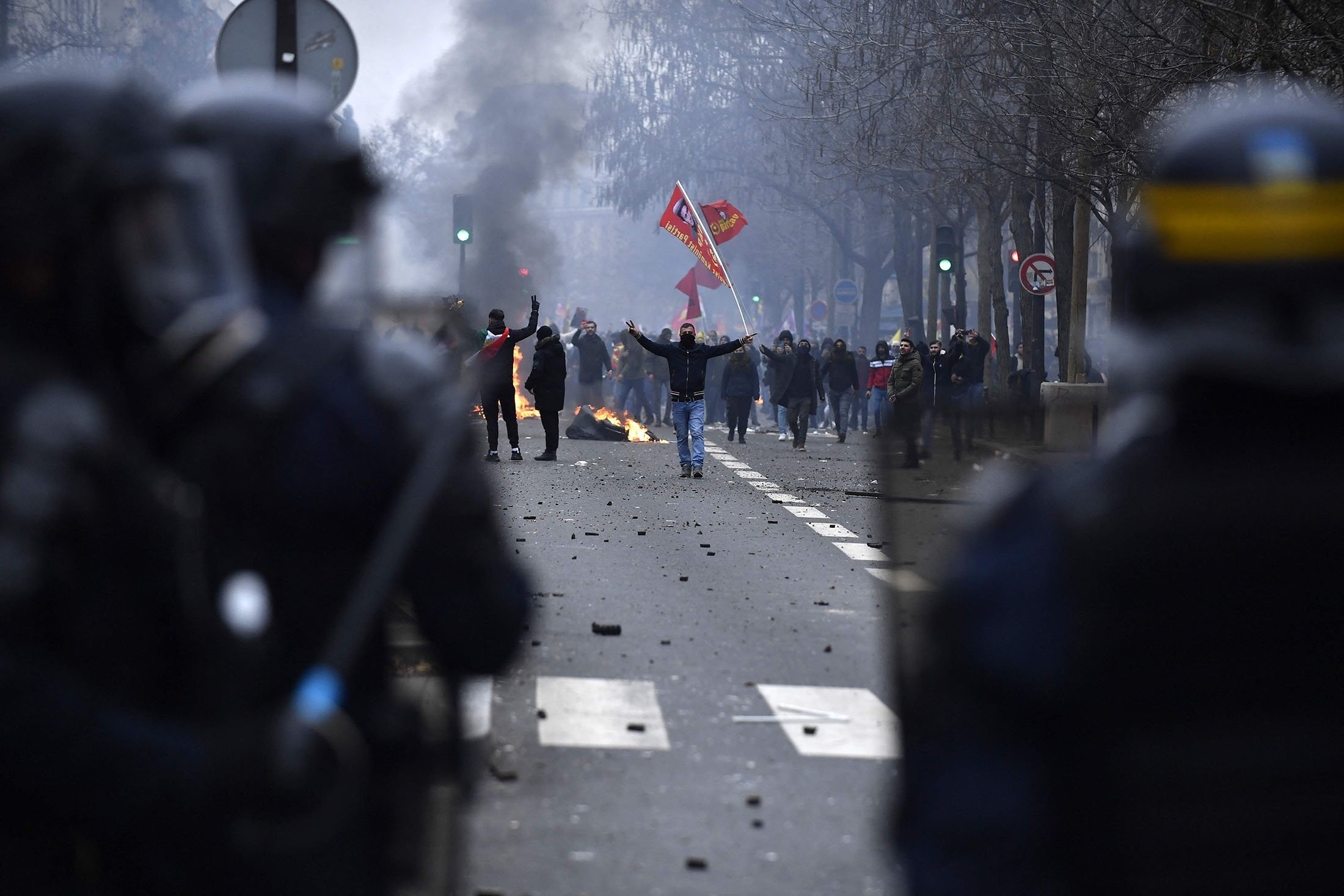
In reality, the YPG has never represented the Kurds or their interests in Syria, just as the PKK has never represented the Kurds in Türkiye. In the eyes of many, these organizations are projects that serve the interests and agendas of their leaders far more than the communities they claim to represent. According to reports by human rights organizations and local groups, these terrorist organizations have committed numerous violations and crimes against Syrians, Arabs and Kurds alike, under the watchful eye of the West and with its continued support.
Nor is France’s support for separatist movements in Syria surprising, any more than its tendency to foster communal divisions. French policy in the region can be seen as the continuation, albeit in different forms, of a legacy dating back to the French Mandate in the early twentieth century, when France divided Syria into five statelets along sectarian lines. Colonial France saw no problem in fragmenting a vast region historically known for its geographical and historical unity into small entities solely to consolidate its authority.
Following Syria’s liberation from the Assad regime and the efforts of the new Syrian state to restore its authority over the entire territory of the Syrian Arab Republic, Washington supported Syria’s territorial integrity and abandoned its terrorist “allies.” President Donald Trump himself stated explicitly that they had been generously compensated for the services they provided. France, by contrast, continues to act according to an outdated colonial mentality and persists in supporting minorities at the expense of the Syrian state.
France today differs little from France of the past. Once again, it sees no problem with the division of Syria and supports terrorist groups toward that end. Just last week, Paris hosted Mazloum Abdi. Perhaps we should begin with a few simple questions: Who is Mazloum Abdi today? What is his official position? How should this visit be interpreted?
Mazloum Abdi, presented as “the commander-in-chief of the Syrian Democratic Forces (SDF),” by the French and some other Western powers, currently holds no official position within the Syrian government. And the aforementioned SDF constitutes the civilian façade of the YPG, for “discussing political and security developments in Syria.” The YPG forces Abdi commands are supposed to have been dissolved, and their integration into the Syrian army is currently underway in accordance with the March 10, 2025, agreement.
Why is France suddenly interested in him now? Why is it attempting to rehabilitate his political standing while the U.S. is exerting significant pressure on him through its ambassador in Ankara, Tom Barrack, who has repeatedly emphasized throughout his meetings in the region the necessity of fully integrating the YPG, both militarily and administratively, into the institutions of the Syrian state and the government in Damascus?
Would it not be more logical for Paris to “discuss political and security developments in Syria” with the Syrian state itself?
Paris’s reception of representatives of a separatist terrorist entity can only be interpreted as a means of pressure on President Ahmed al-Sharaa’s government. Likewise, the visits by YPG members to European capitals and their efforts to secure external support (against whom, and for what purpose?) cannot be separated from broader regional dynamics linked to issues such as the war in Gaza, Hezbollah’s fight with Israel in Lebanon, and American pressure aimed at pushing Syria toward escalatory paths that could draw it into a ground confrontation in Lebanon. The Syrian president has explicitly rejected this possibility, stressing that Trump’s remarks had been misinterpreted by the media and affirming that Syria would not intervene militarily in Lebanon.
Ultimately, Macron’s potential visit and the accompanying French political initiatives appear to be part of a broader debate about France’s place in the new Syria and the limits of its role, between supporting the reconstruction of a strong central state and pursuing an approach based on engagement with various local actors outside official institutions.
At the same time, Syria’s new authorities are seeking to build a stable and sovereign state by balancing relations with international powers according to the supreme national interest rather than the legacies of the past. This is not a matter of taking sides in their favor, but rather of adopting a realistic reading of international relations and of what best serves the interests of the Syrian people and their emerging state after more than fifty years of repression and oppression.
If the issue of the YPG’s existence within the Syrian state, as well as the issue of Israeli support for certain Druze groups, is not resolved definitively and fundamentally, and if the West continues to deal with these separatist forces through a logic of containment or political rehabilitation, they will remain a ready-made instrument of pressure that can be used at any time against the Syrian state in an attempt to impose upon it policies it does not wish to pursue.
By contrast, the new Syrian state has every right, in such a fragile regional context, to adopt choices that may not please the West to extend its authority over the entirety of Syrian territory, in the hope that the future will be broader and more promising for all.
DAILYSABAH
هلدینگ کاسپین استانبول | خرید ملک در ترکیه | صرافی معتبر ایرانی در ترکیه | خرید و فروش طلا در ترکیه | مهاجرت به ترکیه | واردات و صادرات در ترکیه | نیازمندیهای ترکیه | اخبار ترکیه | اخبار جهانی | توریست ایران | خدمات توریستی در ایران | تورهای گردشگری ایران | هلدینگ اول | خدمات کاریابی و فریلنسری و شغل | مرجع اطلاعات ایران (همه چیز در ایران) | کیف پول و خدمات مالی و پرداخت یار | اخبار ایران | تابلو زنده قیمت ارز در ترکیه و استانبول | صرافی آنلاین ترکیه | قیمت طلا و نقره در ترکیه | سرمایه گذاری در ترکیه | جواهرات در ترکیه | نرخ لحظه ای ارزها در استانبول | قیمت دلار امروز در ترکیه | قیمت دلار استانبول امروز | قیمت لحظه ای دلار | اخبار روز ترکیه استانبول | اپلیکیشن ISTEX | اپلیکیشن قیمت لحظه ای دلار و یورو و لیر و ارزها در ترکیه
About the Author