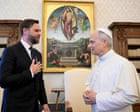
At the heart of this strange, perhaps rather poignant, book is the biblical question: “What must I do to be saved?” Not in the crude sense of how to secure a place in heaven, but as an urgent challenge to a whole repertoire of destructive assumptions and habits endorsed by the majority culture. Vance’s famous first book, Hillbilly Elegy, chronicled, among other things, the impact of substance abuse on generations of the rural poor. It is not too much of a stretch to see this book as a vision of the modern west through the lens of addiction and its generational effects. Except, this time, it is the norms and expectations of elite modernity that are as lethal for the ambitious young professional as fentanyl is for the less privileged.
Vance offers a diagnosis that is not particularly original, but derives its force from the intensity of the personal questioning he undertook to arrive at it. The US vice president describes with clarity the pervasive mechanisms, in education and the professional and political worlds, that induct us into wanting what others want – not what we regard as inherently desirable. Most of us instinctively desire emotional security, meaningful work and, perhaps above all, hope and joy in nurturing the next generation, introducing them to a world of value and promise. One of the most telling moments in the book is the spectacularly successful young Vance’s painful bafflement when faced with the challenge of becoming a parent: “I knew exactly how to help my kid get into a good college but was woefully underprepared to make him a good man.”
Wanting what others want enslaves us to patterns of work that are inhumanly feverish and that wreak havoc with family life. They also corrupt our intellectual life, producing a hyper-anxious conformity of moral opinion. Vance refers to his experience at Yale law school, where, he says, progressive orthodoxies exercised an iron grip; to express scepticism about the absolute moral obviousness of a pro-choice position was to invite instant excommunication from the inner circle of the elect. And this kind of ostracism was practised by left and right alike: for both, the ultimate goal was simply to be as fully assimilated as possible into an administrative aristocracy that allowed you maximal personal liberty – imagined as maximal personal income and status.
Vance’s return to Christian faith was shaped by two basic insights. The first he expresses provocatively in the statement, “I found liberation in guilt”. To be both honest and compassionate we need a language (and a ritual) of repentance and renewal. What draws Vance towards a specifically Catholic identity is the need to see grace as being absorbed and assimilated over and over again in a long history of learning and growing – in contrast to the quick spiritual fixes he sees in the evangelical world of his childhood. The beginning of Christian wisdom is possible only through candour about your own failures and the resulting capacity to respond to the failures of others, not with collusive tolerance, but with mercy and hope.
The Catholic perspective is compelling also because of its history of social analysis that goes beyond the narrow polarisations of modern politics. The social vision classically articulated in the late 19th century by Pope Leo XIII stresses that economic life must enable rather than subvert the dignity of persons and families, the sense of meaningful ownership in regard to one’s labour and its conditions – and this provides a powerful foundation for union activism and the demand for just wages. Vance gives a scathing account of a conversation with a critic of the US administration’s immigration policy who argues that abundant migrant labour absolves employers from paying a higher wage to American citizens and so guarantees better profits. We are brought back to the emptiness and toxicity of the addictive cycle of profit- and status-driven activity that Vance has already depicted.
Despite the very loose structure of the book, this seems to be the thread of the argument. It rehearses in some respects a view of modernity – and specifically of US modernity – that has been set out more elaborately in the works of a series of American scholars and commentators from Robert Bellah to David Brooks. This is a perspective that focuses on the anxiety and isolation produced by individualistic hopes and desires, expresses a renewed concern for “character”, and urges the rediscovery of resources that enable us to raise the next generation into a good life. It is not too far from what “Blue Labour” and “Red Toryism” have foregrounded on this side of the Atlantic. The importance of the Christian vision here is not so much that of a system of specific ethical absolutes – though they are undoubtedly there – as of an attitude that allows us to acknowledge failure without despair , to approach one another with generosity, and ultimately to know that our deepest desires point towards being at home with what is most real: the unconditional love that made us.
And so to the looming question that the book leaves us with: what on earth has any of this to do with the administration of which JD Vance is a leading member? And perhaps the subsidiary question of who is his audience: this is not a book calculated to appeal to the Maga hardcore; nor is it going to win plaudits from either the technophile billionaires who control the digital world, about which Vance has hard things to say (despite a rather grating tribute to Elon Musk as a creator of American jobs), or traditional free-market capitalists. At the same time, it is unlikely to win any friends on the left. Although his treatment of the abortion issue is more nuanced and sensitive than much conservative writing on this topic, this alone will put him beyond the pale as far as most progressives are concerned.
What he does not tell us (despite suggesting at a couple of points that he is going to) is why he was ready to hitch his wagon to the Trump cause. He dismisses much of the early criticism of Trump as simply an elite fastidiousness about the president’s “style”, and he insists on the “success” of the first Trump administration, without doing much to connect it with the values implied in these pages. But how are we to take seriously a book that ignores the rampant corruption of the Trumpian ruling class, the disgraceful verbal bullying that has become normalised in the president’s online and offline tirades, the recklessly arbitrary foreign policies (Vance’s carefully expressed reservations here about the funding of military support for Ukraine would apply with far more force to the fiasco of the Iran war), and the murderous brutality of the implementation of new immigration controls?
The book has already been slated because of its author rather than its content. That content is in fact by no means as vacuous or vicious as some have assumed – though there are some bad moments of shaky argument about traditional gender roles, or about how “rising racial conflict and gender division” are the direct result of de-Christianisation (a claim rather hard to square with the record of Christian nationalism in America’s past and present). But it does nothing to resolve the enigma of what makes the vice president tick. At one point, he quotes approvingly a pastor saying to an addict in jail, “Show me your friends and I’ll show you your future”. Well, yes: back to the opening question about what you must do to be saved. “Look at the company you keep” might be a start.
The Guardian wp:paragraph
هلدینگ کاسپین استانبول | خرید ملک در ترکیه | صرافی معتبر ایرانی در ترکیه | خرید و فروش طلا در ترکیه | مهاجرت به ترکیه | واردات و صادرات در ترکیه | نیازمندیهای ترکیه | اخبار ترکیه | اخبار جهانی | توریست ایران | خدمات توریستی در ایران | تورهای گردشگری ایران | هلدینگ اول | خدمات کاریابی و فریلنسری و شغل | مرجع اطلاعات ایران (همه چیز در ایران) | کیف پول و خدمات مالی و پرداخت یار | اخبار ایران | تابلو زنده قیمت ارز در ترکیه و استانبول | صرافی آنلاین ترکیه | قیمت طلا و نقره در ترکیه | سرمایه گذاری در ترکیه | جواهرات در ترکیه | نرخ لحظه ای ارزها در استانبول | قیمت دلار امروز در ترکیه | قیمت دلار استانبول امروز | قیمت لحظه ای دلار | اخبار روز ترکیه استانبول | اپلیکیشن ISTEX | اپلیکیشن قیمت لحظه ای دلار و یورو و لیر و ارزها در ترکیه
/wp:paragraph wp:paragraph /wp:paragraph
About the Author


