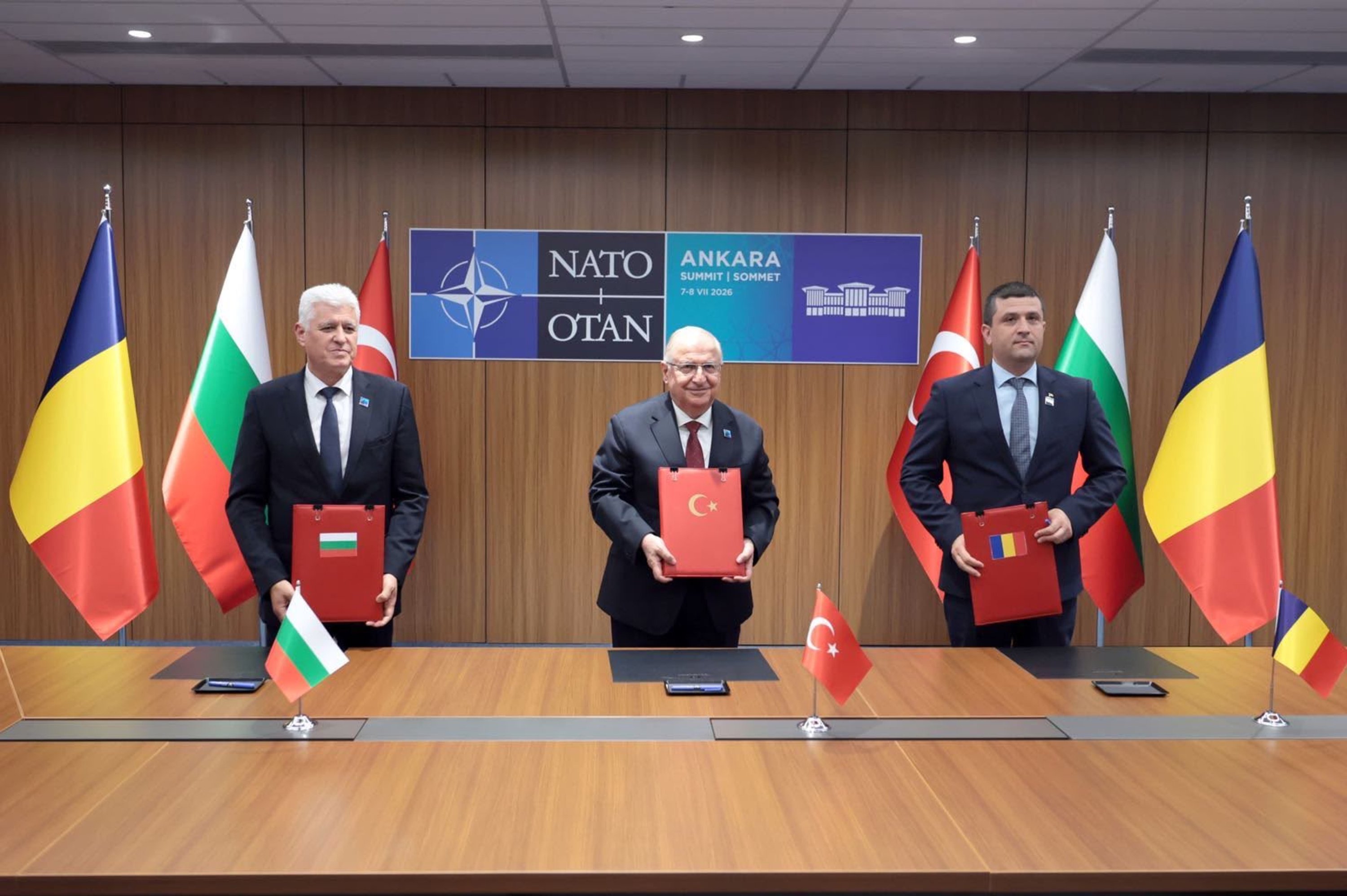
Defense Minister Yaşar Güler hosted his Romanian and Bulgarian counterparts on Wednesday on the sidelines of the NATO summit in Ankara, and the three countries signed a new memorandum for amending the regulations to expand their joint Black Sea mission. The new memorandum involves missions to protect critical infrastructure as well.
The three countries are littoral to the Black Sea, which has become a minefield in both senses of the word after the Russia-Ukraine conflict broke out in 2022. Stray naval mines have threatened maritime security for the countries, while the risk later escalated into stray drones and drone attacks by both sides of the conflict targeting vessels, sometimes far from their shores.
The Turkish-Romanian-Bulgarian task force has neutralized more than 150 mines floating in the Black Sea, and most of the work was done by Türkiye, whose maritime trade was threatened by the conflict. The new memorandum means the expansion of the mission to protect energy infrastructure, telecoms and undersea pipelines operated or owned by the three countries. All three have gas exploration or production projects in the Black Sea. Romania looks to become the European Union’s largest gas producer through its Neptun Deep offshore gas project.
The Black Sea is home to Türkiye’s largest-ever natural gas reserve, which the country has been gradually discovering since 2020. The Sakarya gas field is estimated to contain 710 billion cubic meters (bcm) of gas. It will meet approximately 30% of the nation’s annual gas needs once the production reaches total capacity. Last year, Türkiye announced a separate 75 bcm gas discovery in the Black Sea.
Güler met separately with Romanian Defense Minister Radu-Dinel Miruta and Bulgarian Defense Minister Dimitar Stoyanov in Ankara, and the three ministers later attended a working lunch with NATO defense ministers.
Also on Wednesday, Romania’s Foreign Minister Oana Toiu praised the strong partnership with Türkiye in safeguarding security in the Black Sea.
The work carried out together by Romania, Bulgaria, Türkiye and Ukraine has, for example, made it possible to ensure the flow of grain in recent years, she told Anadolu Agency (AA) in an interview. She also noted the strong participation of Turkish companies in industrial infrastructure investment at the 2025 NATO Industry Forum held in Romania. Referring to her meetings with Foreign Minister Hakan Fidan, she said they consistently discuss Türkiye’s European perspective.
“The future we envision for Türkiye is focused on its European path,” she said.