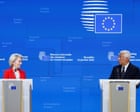
European Council president António Costa begins by saying the EU and the US have long been partners and allies.
He says “we believe that relationships between partners and allies should be managed in a cordial and respectful way.”
“Europe and United States have a shared interest in the security of the Arctic region. Notably, working through Nato,” he says.
But he then states directly: Denmark and Greenland “have the full support of the European Union”, and only they can decide on matters concerning their future.
“This is a reflection of our firm commitment to the principles of international law, territorial integrity and national sovereignty, which are essential for Europe and for the international community as a whole,” he says.
He welcomes Trump’s U-turn on tariffs, which he says would have been “incompatible” with EU’s trade relations with the US.
He says the EU will defend itself, member states, citizens and companies “against any form of coercion” if needed.
He says he wants to see “constructive” engagement with the US on issues of common interest, including Ukraine.
This also concludes our live coverage of the summit.
There will be more national reactions overnight and tomorrow morning – some leaders are hosting their press conferences now – and they tend to be more outspoken.
But that’s for tomorrow.
For now, good night!
EU’s von der Leyen says the best framework to handle US concerns on the Arctic security is through Nato, even though it’s obviously also important for the EU.
On trade, she just reiterates the EU struck a deal with the US last summer and “a deal is a deal,” and she is “confident” that will be implemented.
That concludes the press conference.
The EU leaders also get asked about Greenland’s decision to leave the EU in 1985 after a 1982 referendum and how it affects today’s thinking about the territory.
Costa cleverly says that it “gives us authority to say everybody needs to respect the decisions of Greenlanders,” and stand united behind Denmark and Greenland, insisting no one but them can take decisions about their future.
They also get a question on Mercosur trade deal and whether it could be provisionally applied, but say no decision was made on that – although von der Leyen says there is “clear interest” in making sure the agreement applies as soon as possible.
EU’s Costa gets asked about Zelenskyy’s speech in Davos, who said that “instead of becoming a truly global power, Europe remains a beautiful but fragmented kaleidoscope of small and middle powers.”
Costa completely ignores the question, and says the focus on Ukraine is to achieve a “just and lasting” peace.
Meanwhile, von der Leyen gets asked on why she thinks it was the EU’s position that convinced Trump to change his view, and not other elements of lobbying around Trump in recent days.
She accepts that all various elements may have also played a role, but insists that “without firm, but non-escalatory responses and unity of the EU, they would not have worked.”
As Q&A gets under way, EU’s Costa and von der Leyen get a hardball question on how they can possibly trust Trump after all of this.
Costa replies diplomatically that the EU member states clearly united for the basic principles the bloc stands for, and reiterated its support for Denmark.
Von der Leyen also says something similar on the EU being “firm, but non-escalatory.”
But acknowledging the premise of the question, she says that there was a discussion that “we have to work more and more for an independent Europe,” also working with new trade partners globally.
European president Ursula von der Leyen is up now.
She says leaders had “very good discussions” as they expressed “unequivocal solidarity with Greenland and Denmark” and she hails unity and solidarity with the six member states threatened by Trump’s tariffs.
She says the EU has been engaging “very actively” with the US in “a firm, but non-escalatory manner,” and it’s theoretically ready to use it’s countermeasures and non-tariff instruments if the threat of Trump’s tariffs return.
Turning to the Arctic security, she says “it’s high time to step up” on investments and EU relationship with Greenland, including through using EU funds for getting “Arctic-ready” equipment, including a European icebreaker.
Turning then to Ukraine, she says that “as winter has taken grip of the country, Russia is doubling down on vile attacks,” and that the EU is still waiting for Russia to respond to recent peace proposals.
She then talks about the prospects of strengthening the existing relations with Ukraine, including early plans for Ukraine’s post-war future.
EU’s Costa then turns to Trump’s “Board of Peace,” saying the EU has “serious doubts” about a number of elements of its format when it comes to its “scope, governance and compatibility with the UN charted.”
But says the bloc is “ready to work with the US” on the implementation of the comprehensive peace plan for Gaza, with “the Board of Peace” carrying out its mission as a transitional administration.
He says the next meeting of EU leaders on 12 February will be about advancing Europe’s strategic autonomy and its single market.
European Council president António Costa begins by saying the EU and the US have long been partners and allies.
He says “we believe that relationships between partners and allies should be managed in a cordial and respectful way.”
“Europe and United States have a shared interest in the security of the Arctic region. Notably, working through Nato,” he says.
But he then states directly: Denmark and Greenland “have the full support of the European Union”, and only they can decide on matters concerning their future.
“This is a reflection of our firm commitment to the principles of international law, territorial integrity and national sovereignty, which are essential for Europe and for the international community as a whole,” he says.
He welcomes Trump’s U-turn on tariffs, which he says would have been “incompatible” with EU’s trade relations with the US.
He says the EU will defend itself, member states, citizens and companies “against any form of coercion” if needed.
He says he wants to see “constructive” engagement with the US on issues of common interest, including Ukraine.
The press conference now gets under way.
Confirmed: we are expecting a press conference soon.
I will bring you the key lines here.
It’s officially over: the EU’s stream picks up foreign policy chief Kaja Kallas leaving the building as one of the first leaders after their 4,5-hour talks behind the closed doors.
The Guardian
About the Author