-
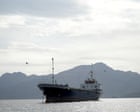
Three Iran-linked tankers have passed through the strait of Hormuz on the first full day of the US blockade of Iranian ports, Reuters has reported, citing shipping data. The news agency reported that the three vessels were not heading to Iranian ports, and so they were not covered by the blockade.
-
UK prime minister Keir Starmer and French president Emmanuel Macron will co-host a summit in Paris on Friday focused on efforts to reopen the strait of Hormuz, Downing Street said. A spokesperson said: “The summit will advance work towards a coordinated, independent, multinational plan to safeguard international shipping once the conflict ends.”
-
Macron said on Tuesday he had spoken with Iranian president Masoud Pezeshkian and US president Donald Trump on Monday and called for talks to restart between Washington and Iran and for a halt of any possible escalation. He added in a post on social media platform X that the strait of Hormuz must be reopened unconditionally as soon as possible.
-
As the Iranian-linked militia Hezbollah urges Lebanon to pull out of talks with Israel later today, Reuters has some more details, including the news that US secretary of state, Marco Rubio, will attend. Talks will be held in Washington at 11am ET (3pm GMT, 4pm BST) between the Israeli ambassador to the US, Yechiel Leiter, and his Lebanese counterpart, Nada Hamadeh Moawad, officials say.
-
The marine intelligence platform Windward has detected a “new potential blockade breaker” in the strait of Hormuz. In a post on X, Windward said a Comoros-flagged bulk carrier has appeared in the waterway after being “dark” – had its communications turned off to hide its exact location – since the start of the war on 28 February.
-
International humanitarian groups said they had sent emergency relief through overland routes to Iran, some of their first deliveries of aid since US-Israeli strikes began in late February. Aid workers say needs are high in the wake of six weeks of strikes, but stocks of emergency humanitarian supplies became stuck in Dubai warehouses as shipping and air routes were blocked by the expanding conflict.
-
The Egyptian foreign minister, Badr Abdelatty, is heading to Washington to meet US secretary of state Marco Rubio to discuss the latest developments in the Middle East, the Egyptian foreign ministry said in a statement on its website. Egypt joined Turkey, Saudi Arabia and Pakistan to form a four-nation bloc that seeks to de-escalate the US-Israel war on Iran.
-
The Italian prime minister, Giorgia Meloni, announced she was suspending Italy’s defence agreement with Israel. “In light of the current situation, the government has decided to suspend the automatic renewal of the defence agreement with Israel,” she said on the sidelines of an event in Verona, according to Italy’s Ansa news agency, without giving further details.
-
The International Energy Agency (IEA) said it expects the steepest quarterly decline in demand for crude oil since the Covid-19 pandemic slashed fuel consumption. The IEA noted that its forecasts assume a “base case” of oil shipments resuming in May through the strait of Hormuz, which Iran has effectively closed since the start of the war on 28 February.
-
The UK chancellor, Rachel Reeves has said she was “very frustrated and angry” over what she said was the United States’ failure to have a clear exit plan or objectives for the war in Iran, according to the Mirror newspaper. “This is a war that we did not start. It was a war that we did not want. I feel very frustrated and angry that the US went into this war without a clear exit plan, without a clear idea of what they were trying to achieve,” the British finance minister told the newspaper.
-
China said it will impose “countermeasures” after Donald Trump threatened new tariffs on its goods entering the US if Beijing provided military assistance to Iran. “If the US insists on using this as an excuse to impose additional tariffs on China, China will definitely take resolute countermeasures,” the Chinese foreign ministry spokesperson, Guo Jiakun, told a news conference, according to AFP news agency.
Iran war escalation could trigger global recession, IMF warns
A further escalation in the Iran war could trigger a global recession, spiralling inflation and a sharp backlash in financial markets, the International Monetary Fund (IMF) has warned.
Against an increasingly volatile backdrop, the Washington-based fund said the economic damage from the Middle East conflict was steadily rising as it cut its growth forecasts for 2026 based on the impact from the war so far.
In its half-yearly update, the IMF said the UK would suffer the sharpest growth downgrade and joint highest inflation rate in the G7 this year, even if the fallout from soaring energy costs can be contained by the middle of 2026.
However, under a worst-case “severe scenario”, involving a drawn-out war and persistently higher energy prices, it said the world would face “a close call for a global recession” for only the fifth time since 1980.
Read the full report here:
In today’s episode of Today in Focus, Beirut-based journalist William Christou reports on the historic talks between Lebanon and Israel and whether it could help steer the Middle East towards peace.
Christou says it is hard to overstate how surprising the talks are. “Lebanon and Israel have been at war in some form since the early 1980s. You’re not allowed to enter Lebanon if you have an Israeli stamp in your passport. The two don’t have diplomatic relations. So the fact that these talks are happening directly between the two governments is something that’s really astonishing,” he tells Nosheen Iqbal.
You can listen to the episode here:
The Israeli foreign ministry has sought to downplay Italy’s decision to suspend the defence agreement between the two countries (see post at 11:38), saying it “will not affect Israel’s security”.
“We have no security agreement with Italy,” the ministry told the Times of Israel. “We have a memorandum of understanding from many years ago that has never contained any substantive content.”
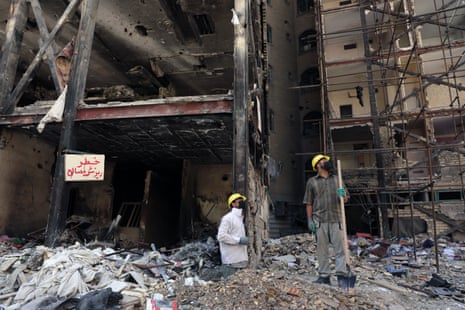
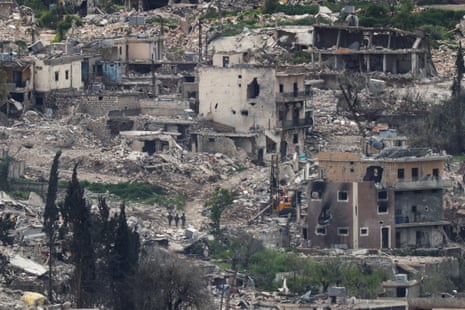
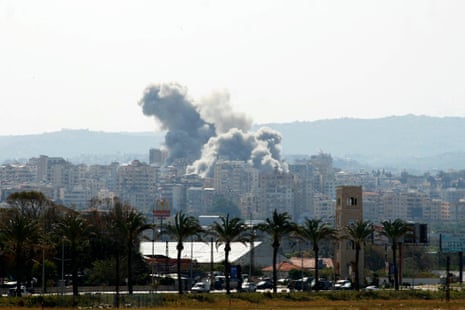
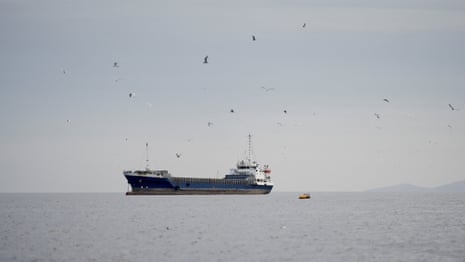
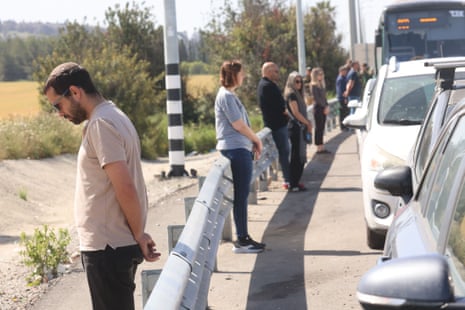
Here are some of the latest images from across the Middle East:
What will the UK’s role be in the strait of Hormuz when the Iran war ends?
The UK will co-host an international summit of more than 40 nations this week to discuss how to safeguard shipping through the strait of Hormuz when the Iran conflict finally comes to an end.
Keir Starmer has said the continuing closure of the waterway is “deeply damaging” and that getting global shipping moving is crucial to ease cost of living pressures.
Iran is believed to have laid at least a dozen mines to prevent oil tankers and other vessels from passing through the strait, through which about 20% of global oil flows.
But Tehran has thousands of naval mines in its arsenal, and while the US bombing campaign may have destroyed much of Iran’s naval capacity, mines can be dropped from relatively small boats.
With a depleted Royal Navy, the UK is likely to play a more limited role in keeping the strait safe and open for commercial shipping once hostilities do cease.
Read the full report here:
-
Three Iran-linked tankers have passed through the strait of Hormuz on the first full day of the US blockade of Iranian ports, Reuters has reported, citing shipping data. The news agency reported that the three vessels were not heading to Iranian ports, and so they were not covered by the blockade.
-
UK prime minister Keir Starmer and French president Emmanuel Macron will co-host a summit in Paris on Friday focused on efforts to reopen the strait of Hormuz, Downing Street said. A spokesperson said: “The summit will advance work towards a coordinated, independent, multinational plan to safeguard international shipping once the conflict ends.”
-
Macron said on Tuesday he had spoken with Iranian president Masoud Pezeshkian and US president Donald Trump on Monday and called for talks to restart between Washington and Iran and for a halt of any possible escalation. He added in a post on social media platform X that the strait of Hormuz must be reopened unconditionally as soon as possible.
-
As the Iranian-linked militia Hezbollah urges Lebanon to pull out of talks with Israel later today, Reuters has some more details, including the news that US secretary of state, Marco Rubio, will attend. Talks will be held in Washington at 11am ET (3pm GMT, 4pm BST) between the Israeli ambassador to the US, Yechiel Leiter, and his Lebanese counterpart, Nada Hamadeh Moawad, officials say.
-
The marine intelligence platform Windward has detected a “new potential blockade breaker” in the strait of Hormuz. In a post on X, Windward said a Comoros-flagged bulk carrier has appeared in the waterway after being “dark” – had its communications turned off to hide its exact location – since the start of the war on 28 February.
-
International humanitarian groups said they had sent emergency relief through overland routes to Iran, some of their first deliveries of aid since US-Israeli strikes began in late February. Aid workers say needs are high in the wake of six weeks of strikes, but stocks of emergency humanitarian supplies became stuck in Dubai warehouses as shipping and air routes were blocked by the expanding conflict.
-
The Egyptian foreign minister, Badr Abdelatty, is heading to Washington to meet US secretary of state Marco Rubio to discuss the latest developments in the Middle East, the Egyptian foreign ministry said in a statement on its website. Egypt joined Turkey, Saudi Arabia and Pakistan to form a four-nation bloc that seeks to de-escalate the US-Israel war on Iran.
-
The Italian prime minister, Giorgia Meloni, announced she was suspending Italy’s defence agreement with Israel. “In light of the current situation, the government has decided to suspend the automatic renewal of the defence agreement with Israel,” she said on the sidelines of an event in Verona, according to Italy’s Ansa news agency, without giving further details.
-
The International Energy Agency (IEA) said it expects the steepest quarterly decline in demand for crude oil since the Covid-19 pandemic slashed fuel consumption. The IEA noted that its forecasts assume a “base case” of oil shipments resuming in May through the strait of Hormuz, which Iran has effectively closed since the start of the war on 28 February.
-
The UK chancellor, Rachel Reeves has said she was “very frustrated and angry” over what she said was the United States’ failure to have a clear exit plan or objectives for the war in Iran, according to the Mirror newspaper. “This is a war that we did not start. It was a war that we did not want. I feel very frustrated and angry that the US went into this war without a clear exit plan, without a clear idea of what they were trying to achieve,” the British finance minister told the newspaper.
-
China said it will impose “countermeasures” after Donald Trump threatened new tariffs on its goods entering the US if Beijing provided military assistance to Iran. “If the US insists on using this as an excuse to impose additional tariffs on China, China will definitely take resolute countermeasures,” the Chinese foreign ministry spokesperson, Guo Jiakun, told a news conference, according to AFP news agency.
International humanitarian groups said they had sent emergency relief through overland routes to Iran, some of their first deliveries of aid since US-Israeli strikes began in late February.
Aid workers say needs are high in the wake of six weeks of strikes, but stocks of emergency humanitarian supplies became stuck in Dubai warehouses as shipping and air routes were blocked by the expanding conflict.
Iranian authorities say more than 3,000 people have been killed in Iran during the war and the UN refugee agency says up to 3.2 million have been displaced, Reuters reported.
The International Federation of Red Cross and Red Crescent Societies said it had delivered some 200 trauma kits as well as tents and blankets on trucks sent along a new route from Turkey.
The trucks crossed the Iranian border on Sunday and are set to arrive in the capital Tehran on Tuesday, said IFRC spokesperson Tommaso Della Longa.
“For us it’s very important as it represents a new route for getting aid into Iran and we’re very optimistic to scale up,” he told a Geneva press briefing.
“Before it was very easy to take a flight or a boat and bring aid directly to Iran in a couple of hours.“
French president Emmanuel Macron said on Tuesday he had spoken with Iranian president Masoud Pezeshkian and US president Donald Trump on Monday and called for talks to restart between Washington and Iran and for a halt of any possible escalation.
He added in a post on social media platform X that the strait of Hormuz must be reopened unconditionally as soon as possible.
“Under these circumstances, negotiations should be able to resume quickly, with the support of the key stakeholders,” he said.
The marine intelligence platform Windward has detected a “new potential blockade breaker” in the strait of Hormuz.
In a post on X, Windward said a Comoros-flagged bulk carrier has appeared in the waterway after being “dark” – had its communications turned off to hide its exact location – since the start of the war on 28 February.
“Its last traceable port call was Bandar Imam Khomeini (BIK), Iran, and its recent history includes transporting grain from Russia-occupied Ukrainian ports to Iran and Syria,” Windward said.
“Despite the current blockade, this vessel is back on the grid and navigating this high-stakes corridor.”
The US Central Command said yesterday that it would seek to stop only vessels transiting to or from Iranian ports, but how it will enforce the blockade remains to be seen.
News agencies reported a handful of ships have transited the strait towards the Gulf of Oman today (see post at 09:02), but they noted that, as the vessels were not heading to Iranian ports, they were not covered by the blockade. Windward said their movements “provide a critical test of blockade enforcement and corridor dynamics”.
The Egyptian foreign minister, Badr Abdelatty, is heading to Washington to meet US secretary of state Marco Rubio to discuss the latest developments in the Middle East, the Egyptian foreign ministry said in a statement on its website.
Egypt joined Turkey, Saudi Arabia and Pakistan to form a four-nation bloc that seeks to de-escalate the US-Israel war on Iran. Their coordinated efforts in recent weeks led to Saturday’s meeting between US and Iranian negotiators in Islamabad.
Abdelatty’s trip to the US coincides with rare talks between Israel and Lebanon, which is expected to be held in Washington today. Israel has already stated it will not negotiate a ceasefire with the Iran-backed group Hezbollah, which in turn said it will not follow any agreements that come as a result of the talks.
The Guardian wp:paragraph
هلدینگ کاسپین استانبول | خرید ملک در ترکیه | صرافی معتبر ایرانی در ترکیه | خرید و فروش طلا در ترکیه | مهاجرت به ترکیه | واردات و صادرات در ترکیه | نیازمندیهای ترکیه | اخبار ترکیه | اخبار جهانی | توریست ایران | خدمات توریستی در ایران | تورهای گردشگری ایران | هلدینگ اول | خدمات کاریابی و فریلنسری و شغل | مرجع اطلاعات ایران (همه چیز در ایران) | کیف پول و خدمات مالی و پرداخت یار | اخبار ایران | تابلو زنده قیمت ارز در ترکیه و استانبول | صرافی آنلاین ترکیه | قیمت طلا و نقره در ترکیه | سرمایه گذاری در ترکیه | جواهرات در ترکیه | نرخ لحظه ای ارزها در استانبول | قیمت دلار امروز در ترکیه | قیمت دلار استانبول امروز | قیمت لحظه ای دلار | اخبار روز ترکیه استانبول | اپلیکیشن ISTEX | اپلیکیشن قیمت لحظه ای دلار و یورو و لیر و ارزها در ترکیه
/wp:paragraph wp:paragraph /wp:paragraph
About the Author