In the historic centre of Colombia’s capital, Bogotá, a gallery of portraits at the vice-president’s official residence displays the faces of all former vice-presidents since the country became a republic in 1886. All of them are white.
When the current president and vice-president leave office in August, the wall will include an Afro-Colombian face for the first time: Francia Márquez, 44, the first Black woman to become vice-president in a country where at least 10% of the population is Afro-descendant.
Elected in 2022 alongside the leftwing president Gustavo Petro, Márquez also became one of only three Black women to have served as second-in-command in the Americas, following Epsy Campbell Barr in Costa Rica in 2018 and Kamala Harris in the United States in 2021.
That is not the only similarity Márquez sees between them.
“The three of us were unable to take on leading roles within our governments. On the contrary, we were blocked,” she told the Guardian. “This has been a strategy of racism, and it doesn’t matter whether the government is right or left; it has happened,” she added.
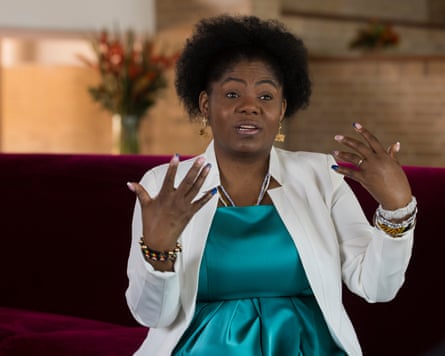
Márquez said that Harris “was excluded” by former US president Joe Biden, and that this was one of the main reasons she lost the 2024 election to Donald Trump.
“Biden didn’t allow her to occupy a leading role that would have strengthened her leadership … The three of us have gone through the same thing,” she said.
In a rare interview at the vice-presidential residence, Márquez spoke openly about the strain in her relationship with President Petro – the two have barely spoken for more than a year – and the racism she said she had faced over the past four years, both “within and outside the government”.
“The Colombian state is a racist state,” she said.
Born in the Afro-descendant mining community of Yolombó, in Cauca, one of the departments most affected by the decades-long armed conflict in Colombia, Márquez became an activist at the age of 13, when the construction of a dam threatened her village.
In 2014, she led about 80 Black women on a 350-mile walk to the capital that became known as the March of the Turbans to demand that the government put an end to illegal mining, which was polluting rivers and forcing communities from their land.
Four years later, she was awarded the prestigious Goldman environmental prize and ran unsuccessfully for Congress.

Soon afterwards, she announced her intention to run for president. Despite her lack of political experience, she received 783,000 votes in a primary, finishing second only to the former guerrilla and then-senator Petro, who then invited her to join his ticket.
They won, Petro became Colombia’s first leftwing president, and many analysts believe Márquez played a significant role in the result.
“It felt like a monumental event,” said the political scientist Ana María Ospina Pedraza, adding: “It was a historic milestone for the representation of Afro-descendant communities in Colombia, which have historically been marginalised”.
“Afterwards, over the years, perhaps her leadership was not what we had imagined,” said Ospina Pedraza.
The vice-president said it had been a “very challenging four years” for her, “as a woman and as a Black woman, in a country that is quite conservative and racist”.
Márquez said she had faced racism from the local press, with caricatures depicting her as King Kong and what she describes as “unprecedented scrutiny” over vice-presidential travel expenses. She was criticised for using a helicopter to travel to a private residence in Cali, which she said was for safety reasons, as well as for trips she made to African countries to boost Colombian exports, with local media outlets calling it a “safari” and a rightwing senator asking whether “Swahili academies have already been set up [in Colombia]?” as a result of the spending.
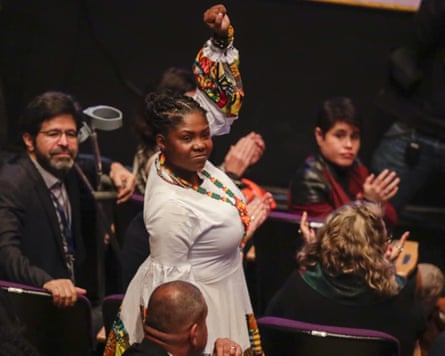
But the vice-president says the racism also came from within the government.
One of her first actions in office was to change the “face” of the vice-presidential staff, from advisers to heads of security. “There were officials who told Afro women and men that they were only here because I was here. In other words, they were saying: ‘You don’t deserve to be here’, and this is painful,” she said.
The vice-president has also frequently been the target of online attacks: last March, a judge acquitted one of her aggressors, arguing that although the man had called Márquez a “primate” in a post on X, it had not been proven that he intended to incite violence or discrimination against her. Márquez is appealing against the ruling.
After years of visibility as Colombia’s number two, she might be expected to seek the highest office, as the constitutional bar on the president seeking re-election does not apply to the vice-president. But that will not be the case.
Despite attributing her decision not to run primarily to a “promise” to serve only until the end of the term, she acknowledged she had not delivered as much as she would have liked.
But she does not place the blame on herself.

“Unfortunately, my leadership as a Black woman became a threat to many, and I was obstructed from doing more … I heard people say, ‘If they empower Francia Márquez, she will end up being the president.’ That fear is what led to me not being given the tools I needed to deliver,” she said.
At the heart of her dispute with the president is the ministry of equality, whose creation had been one of Petro’s campaign promises.
Márquez said she spent the first two years in office dealing with the lack of funding and the bureaucratic challenges of building a ministry “from scratch”. “When I was about to show the results, I was removed,” she said.
During a televised cabinet meeting in February 2025, Márquez complained about the lack of resources and criticised the appointment of a minister accused of corruption. “Maybe this will cost me, who knows what,” she said at the meeting.
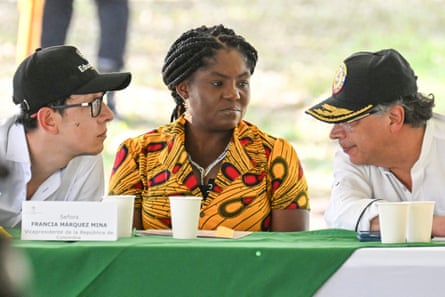
It did. Days later, Petro removed her from the ministry, and since then she has held only the vice-presidential role.
“I felt very sad, hurt, because I thought of my ancestors who worked and worked and worked so that others could take the credit,” she said.
Petro did not respond to requests for an interview. Márquez said she maintained with him “a relationship of cordial respect. We have had differences, but I respect the president.”
The political scientist Ospina Pedraza believes that, even if she wanted to run, Márquez would stand little chance in the election, whose first round is set for 31 May. Polls point to a tight race between Petro’s candidate, the leftist senator Iván Cepeda – whose running mate, the senator Aida Quilcué, will seek to become Colombia’s first Indigenous vice-president – and two rightwing candidates: the self-styled “outsider” Abelardo de la Espriella and the anti-abortion senator Paloma Valencia.
“I believe the very special political moment Márquez had during the elections has faded somewhat. That hope has vanished,” said Ospina Pedraza, attributing this above all to the lack of tangible results.
Even so, Márquez argues that she delivered results through some initiatives she led within government, such as boosting previously modest exports to African countries.
“In a few months, in this corridor, there will be a photo of a face that is not the one usually seen in these institutions, and that makes me proud because we – Black, Indigenous, peasant and poor people – have built this nation.
“So it was worth it, just as it was worth it for my ancestors to fight so that today I do not have shackles … My invitation is for other women to dare to occupy these spaces,” she added.
The Guardian wp:paragraph
هلدینگ کاسپین استانبول | خرید ملک در ترکیه | صرافی معتبر ایرانی در ترکیه | خرید و فروش طلا در ترکیه | مهاجرت به ترکیه | واردات و صادرات در ترکیه | نیازمندیهای ترکیه | اخبار ترکیه | اخبار جهانی | توریست ایران | خدمات توریستی در ایران | تورهای گردشگری ایران | هلدینگ اول | خدمات کاریابی و فریلنسری و شغل | مرجع اطلاعات ایران (همه چیز در ایران) | کیف پول و خدمات مالی و پرداخت یار | اخبار ایران | تابلو زنده قیمت ارز در ترکیه و استانبول | صرافی آنلاین ترکیه | قیمت طلا و نقره در ترکیه | سرمایه گذاری در ترکیه | جواهرات در ترکیه | نرخ لحظه ای ارزها در استانبول | قیمت دلار امروز در ترکیه | قیمت دلار استانبول امروز | قیمت لحظه ای دلار | اخبار روز ترکیه استانبول | اپلیکیشن ISTEX | اپلیکیشن قیمت لحظه ای دلار و یورو و لیر و ارزها در ترکیه
/wp:paragraph wp:paragraph /wp:paragraph
About the Author