A senior Iranian official has told the Reuters news agency that Tehran is “positively reviewing” its participation in potential peace talks with the US but stressed that no final decision has been made.
As we have been reporting, Iran said earlier that it has no plans for a new round of talks with the US, ahead of the end of the ceasefire on Wednesday (see post at 08.59 for more details).
The Iranian foreign ministry spokesperson, Esmaeil Baghaei, said that the US attack on the Iranian cargo ship this morning, the US naval blockade on Iranian ports and delays in implementing a ceasefire in Lebanon were all “clear violations of the ceasefire”.
It is unclear whether a second round of negotiations scheduled to take place in the Pakistani capital of Islamabad today will go ahead as planned.
In a new post to Truth Social, Donald Trump has said that Israel never “talked” him into the war with Iran, after reports that the Israeli prime minister, Benjamin Netanyahu, put pressure on him into launching their joint assault on Iran in late February.
Justifying his military action, widely seen as being launched illegally, the US president claimed that the “results of Oct. 7th” added to his “lifelong opinion” that Iran can never possess a nuclear weapon.
As my colleague Julian Borger notes in this story, Trump has repeatedly claimed, since starting the war, that Iran had been two to four weeks from making a nuclear weapon and firing it at the US and Israel, a claim rejected as absurd by most experts.
Trump signed off his post by saying if Iran’s new leaders are “smart” then the country can have a “great and prosperous” future.
Reuters is reporting that Israeli and Lebanese representatives will hold talks in Washington on Thursday. Israel will be represented by its ambassador to the US, Yechiel Leiter, the source told the news agency.
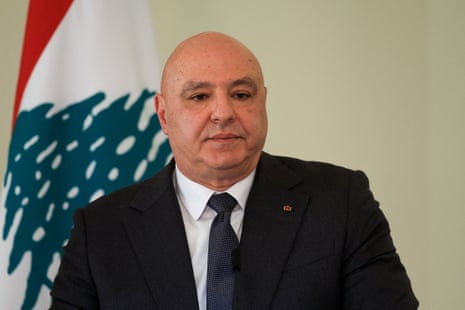
Joseph Aoun, the Lebanese president, has expressed optimism over future negotiations, which he hopes will bring an end to the war and achieve a complete Israeli withdrawal from the southern parts of his country.
Hezbollah, which operates independently of the Lebanese state, has said it opposes direct talks with Israel and its lawmakers have criticised the government for agreeing to hold such negotiations.
The Lebanon-Israel ceasefire, which came into effect on 16 April, is set to last ten days. In an outline issued by the US state department, it said both parties, having met for face-to-face talks in Washington last week, “affirm that the two countries are not at war and commit to engaging in good-faith direct negotiations, facilitated by the United States”.
The ceasefire is described as “a gesture of goodwill by the government of Israel, intended to enable good-faith negotiations toward a permanent security and peace agreement between Israel and Lebanon”.
However, it reiterates Israel’s right “to take all necessary measures in self-defense, at any time, against planned, imminent, or ongoing attacks”.
Crucially though, the 10-day ceasefire agreement does not demand Israel withdraw soldiers occupying parts of southern Lebanon, where Israel’s defence minister, Israel Katz, said Israeli troops would continue to demolish homes he claimed, without evidence, were being used by Hezbollah.
Israel on Monday told residents of south Lebanon to stay out of a belt of territory running the length of the border and not to approach the area of the Litani river, about 30km from the border with Israel.
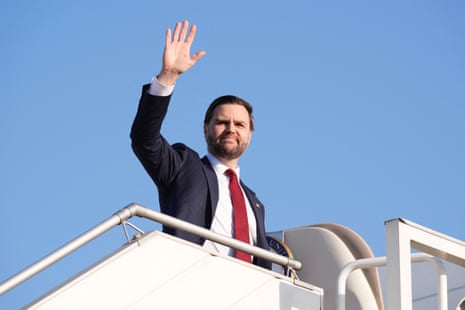
The New York Post is reporting that vice-president JD Vance and the rest of the US delegation is set to land in Pakistan within hours for talks on Iran.
“We’re supposed to have the talks,” Trump said. “So I would assume at this point nobody’s playing games.”
The US president told the Post that US delegation – which also includes envoy Steve Witkoff and Trump’s son-in-law/adviser Jared Kushner – is on its way to Islamabad, despite Tehran saying t has “no plans for the next round” of peace talks.
“They’re heading over now,” Trump said just after 9am EST. “They’ll be there tonight, (Islamabad) time.” He suggested he would be ready to meet top Iranian leaders if a breakthrough in negotiations is achieved.
Vance left Islamabad last Sunday after 21 hours of failed peace talks with Iranian officials. He blamed the failure on Iran’s apparent refusal to abandon its nuclear weapons programme, while Iranian delegates claimed the US needed to do more to win their trust.
A senior Iranian official has told the Reuters news agency that Tehran is “positively reviewing” its participation in potential peace talks with the US but stressed that no final decision has been made.
As we have been reporting, Iran said earlier that it has no plans for a new round of talks with the US, ahead of the end of the ceasefire on Wednesday (see post at 08.59 for more details).
The Iranian foreign ministry spokesperson, Esmaeil Baghaei, said that the US attack on the Iranian cargo ship this morning, the US naval blockade on Iranian ports and delays in implementing a ceasefire in Lebanon were all “clear violations of the ceasefire”.
It is unclear whether a second round of negotiations scheduled to take place in the Pakistani capital of Islamabad today will go ahead as planned.
Only three ships crossed the strait of Hormuz on Monday, according to data from Kpler, after only one made it through yesterday. The average number of vessels crossing the vital waterway before the war was over 120 per day.
In response to US-Israeli attacks on Iran in late February, Tehran effectively closed the strait to vessels, only allowing a relatively small number of ships from “friendly” countries like China, Malaysia and Pakistan through.
Iranian authorities have since demanded the right to impose tolls on vessels transiting the vital waterway, where roughly 20% of the world’s oil and liquefied natural gas usually passes through, including after the war ends. This is something that the US says it won’t accept.
On Friday, Iran said it would be “completely open” to commercial vessels for the remainder of the ceasefire between the US and Iran, which is due to end on Wednesday.
Iran’s military headquarters, however, subsequently accused the US of a violation of the agreement after the American military attacked and seized an Iranian-flagged container ship that attempted to get past a US blockade.
The effective closure of the strait have sent global energy prices soaring and has prompted countries to implement fuel rationing and place restrictions on electricity consumption.
Israeli strikes killed at least two Palestinians in separate incidents in the Gaza Strip on Monday, health officials said, and fighters from Hamas clashed with gunmen from an Israeli-backed militia, witnesses have told Reuters news agency.
Medics said one man was killed in an Israeli airstrike in the Bureij camp in the central area of the territory, while another strike killed one person and wounded others in Gaza City.
The two deaths were the latest violence to overshadow the ceasefire deal signed in October after two years of full-blown war between Israel and Hamas. Progress on moving forward with parts the deal, which include the disarmament of Hamas and Israeli army pullouts, has stalled.
The Israeli military didn’t immediately comment on either incident. The Guardian has not independently verified this report.
The war in Iran looks like it has pushed sales of electric vehicles in continental Europe in the past month.
Sales of electric cars soared 51% in the last month, amid a rise in petrol and diesel costs driven by the Iran war.
Data shows that 224,000 new electric vehicles (EVs) were registered in March, and 500,000 across the first three months of the year – a 33.5% increase on a year earlier, according to analysis of national sales data in 15 countries by New AutoMotive and E-Mobility Europe, a trade body.
Full story here:
Shortly after announcing a ceasefire between Israel and Lebanon last week, Donald Trump said he’d be inviting Israeli prime minister Benjamin Netanyahu, a close ally, and Lebanese President Joseph Aoun to the White House “for the first meaningful talks between Israel and Lebanon since 1983”, during the Lebanese civil war.
Trump said he expected the two leaders to arrive in the US for talks “over the next week or two”, although no exact date was confirmed.
Relations between the Lebanese government and Hezbollah – which is a political party with a parliamentary bloc and a provider of services including schools and hospitals (in some areas), as well as a militant group – have grown increasingly tense.
The government last year approved a plan to remove all weapons that are not property of the state – its security forces or military. After 2 March, the government went further, declaring Hezbollah’s armed wing illegal.
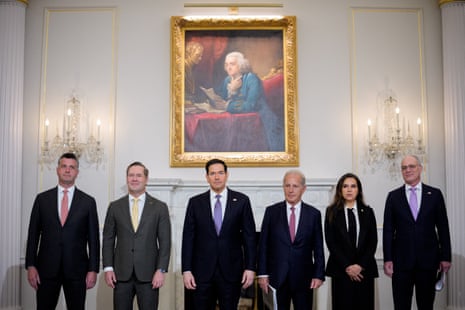
Israel and Lebanon held a historic summit on Tuesday in Washington DC, as Israel’s ambassador to the US Yechiel Leiter and his Lebanese counterpart Nada Hamadeh Moawad met for what Beirut framed as a “preparatory meeting” for future negotiations between the two countries.
After participating in Tuesday’s rare direct talks, which included US secretary of state Marco Rubio, Moawad said she had “underscored the need to preserve our territorial integrity and state sovereignty”.
“I called for a ceasefire and the return of displaced persons to their homes,” she said in brief comments released by the Lebanese embassy in Washington.
Hezbollah leader Naim Qassem said the talks were a ruse to pressure Hezbollah into laying down its weapons.
Joseph Aoun, the Lebanese president, said he had appointed Simon Karam, a former ambassador to the US, to lead bilateral talks with Israel.
“The objective of the negotiation option is to halt hostile actions, end the Israeli occupation of southern areas, and deploy the army up to the internationally recognised southern borders,” a statement from the Lebanese presidency reads.
“The upcoming negotiations are separate from any other negotiations because Lebanon faces two options: either the continuation of the war with all its humanitarian, social, economic, and sovereignty repercussions, or negotiation to put an end to this war and achieve sustainable stability, and I have chosen negotiation, and I am full of hope that we will be able to save Lebanon.”
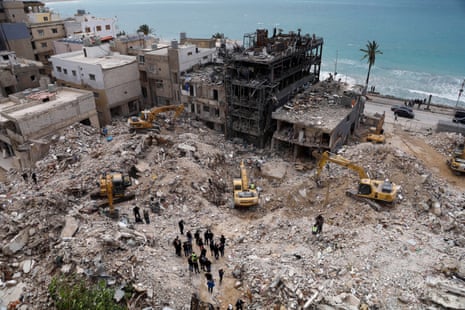
Donald Trump announced on Thursday that Israel and Lebanon agreed to a 10-day ceasefire, which took effect from midnight on 16 April. Within hours, Israeli forces reportedly started carrying out artillery shelling in several border areas in violation of the agreement.
The terms of the ceasefire prohibit Israel from offensive attacks on Lebanon. But they appear to leave more room for “self-defense,” including “against planned, imminent, or ongoing attacks”.
Israel started a war on Lebanon on 2 March when Hezbollah, the Iranian backed Lebanese militant group and political party, launched rocket fire at Israel after US-Israeli airstrikes killed former Iranian supreme leader, Ali Khamenei, in Tehran. The IDF responded with a wave of intense strikes across Lebanon, targeting what it claimed was Hezbollah infrastructure, though many civilians were killed, homes destroyed and over 1.2 million people displaced across the country.
During the war, Israel also launched a ground invasion several kilometres into Lebanese territory, with a stated goal to push Hezbollah back from the border in order to stop the ability of the group to fire rockets into communities in northern Israel. Israeli officials now say Israel will stay in control of dozens of towns and villages as part of what it describes as a security buffer zone – but from the ground this looks like a prelude to long term occupation.
You can keep up with all the latest developments from the EU and beyond in our Europe live blog:
The European Commission has also insisted that there is no jet fuel shortage in the EU, despite the continuing impact of the Middle East disruption.
Commission spokesperson Eva Hrncirova said that as “part of the preparedness, we talk to the citizens and inform them … as we know the situation is not ideal” with the crisis in the Middle East.
Our role is mainly to coordinate and to prepare for different scenarios. We have the oil coordination group that has met last week, and the group will also meet at the end of this week.
The availability of the jet fuels, obviously, is a priority, and it’s important to say that here in the European Union, we have also a significant capacity to refine the crude oil and to produce the jet fuel, so we are preparing for possible actions, but everything depends on the development of the situation. At this stage, there are no fuel shortages in the EU.
Asked directly if Europeans should book their summer holidays without worrying about potential disruptions, she said:
“I cannot give you such an advice from the podium. It’s totally up to you where do you want to go during the summer.”
She added there are some flexibilities that the EU could explore to help with the situation, and confirmed that the bloc’s upcoming energy package – set to be presented on Wednesday – “will address different elements that are connected to the current crisis.”
Sam Jones in Madrid and Jennifer Rankin in Brussels
Spain’s prime minister, Pedro Sánchez – who has been among the most vocal European critics of Israel’s war in Gaza – has said he will ask the European Union to end its association agreement with Israel on Tuesday.
“The time has come for the EU to break its association agreement with Israel,” Sánchez said on Sunday. “We have nothing against the people of Israel – quite the contrary. But a government that breaks international law – and thus breaks the values and principles of the EU – cannot be our partner.”
The Israeli government has hit back at Sánchez, accusing him of hypocrisy and double standards.
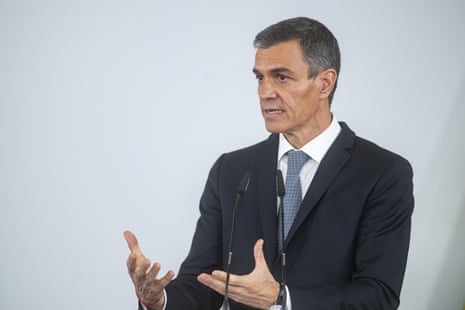
“We won’t accept a hypocritical lesson from someone who has a relationship with totalitarian regimes that violate human rights, such as Erdoğan’s Turkey and Maduro’s Venezuela,” Israel’s foreign minister, Gideon Sa’ar, posted on X, alongside a photograph that apparently showed a poster of Sánchez’s face and his criticisms of Israel’s war on Iran on an Iranian missile.
In a reference to the poster, Sa’ar said the Spanish government had received thanks “from Iran’s brutal regime and terrorist organisation”, adding that it has “dedicated itself to spreading antisemitism”.
He then threw Sánchez’s words back at him: “We have nothing against the citizens of Spain – quite the contrary – but we do against the double standard of the government of [Pedro Sánchez].”
The internet blackout in Iran has entered its 52nd day, according to internet monitoring group NetBlocks. It said in a social media post:
Iran’s internet shutdown has entered its 52nd day after 1224 hours. Metrics show that the general public remain cut off from international networks, while authorities continue efforts to segregate users and provide selective access to favored groups.
Those without access to Starlink or alternative ways to communicate – which are often expensive – are cut off, not only from the outside world but the blackout also severely curtails Iranian’s ability to communicate with each other, making mobilisation, for example, much more difficult.
A select number of officials are still able to use the internet and post regularly on social media about the US-Israeli war on Iran. There was an earlier internet shutdown in January during nationwide protests, which helped obscure extreme violence against Iran’s population.

China’s foreign ministry spokesperson, Guo Jiakun, has said Beijing is concerned over the “forcible interception” of the Iranian-flagged Touska ship by US forces that happened over the weekend.
“We express concern over the US side’s forcible interception of the relevant vessel,” Jiakun told reporters when asked about the seizure.
The US military said it had fired on the cargo ship headed towards Iran’s Bandar Abbas port on Sunday after a six-hour standoff, disabling its engines.
Iran’s military said the ship had been travelling from China and accused the US of “armed piracy”. They said they were ready to confront US forces over the “blatant aggression”, but were constrained by the presence of crew members’ families on board.
Donald Trump said the ship was under US treasury sanctions because of “prior history of illegal activity”. The ship is on the treasury department’s list of sanctioned vessels.
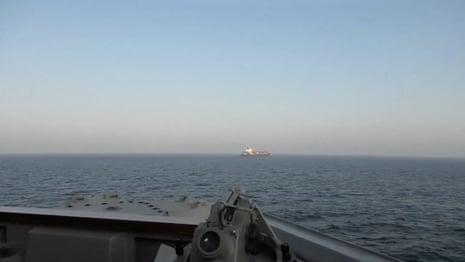
Iran officially closed the strait of Hormuz on 4 March in response to US-Israeli airstrikes on the country which killed its former supreme leader, and declared it back open on Friday after a 10-day ceasefire deal was agreed between Israel and Lebanon. Trump said on Friday that the naval blockade of Iranian ports would continue until a deal was reached.
Here is an extract from some useful analysis by the Guardian’s diplomatic editor, Patrick Wintour, in which he identifies key sticking points in the negotiations with Iran so far:
Iran’s three demands before entering another round of talks were a ceasefire in Lebanon, an end to the US blockade on Iranian ports and progress on Iranian asset releases.
Iran and the mediators in Pakistan saw this as a traditional diplomatic step-by-step reciprocal process whereby one confidence-building measure from one side would lead to another on the other side.
As a result, the imposition on Israel of the two-week ceasefire in Lebanon by Trump was regarded as significant by Iran, and was due to lead to a reciprocal partial lifting of the Iranian chokehold on the strait of Hormuz – a step announced somewhat clumsily by the Iranian foreign minister, Abbas Araghchi, in a tweet on Friday morning. In return it was expected that Trump would lift the US blockade of Iranian ports, and the momentum surrounding the virtuous circle would build.
But in a series of tweets on Friday Trump kept the blockade in place, claimed Iran had completely lifted the restrictions on tanker traffic in the strait, and for good measure said Iran had agreed to hand over Iran’s stockpile of highly enriched uranium to the US for safe keeping.
In short, he gave the impression that Iran had surrendered. The backlash that followed in Tehran on Friday was inevitable.
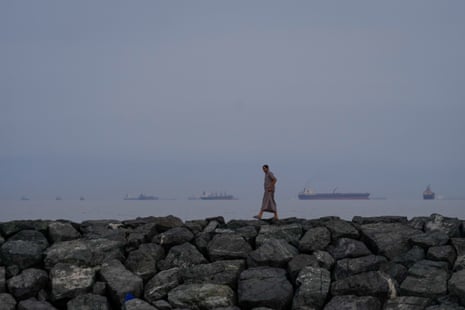
We can bring you some more comment from the Iranian foreign ministry spokesperson, Esmaeil Baghaei, who has been speaking at a weekly press briefing. “While claiming diplomacy and readiness for negotiations, the US is carrying out behaviours that do not in any way indicate seriousness in pursuing a diplomatic process,” he said.
Baghaei said a US attack on an Iranian cargo ship this morning, the US naval blockade on Iranian ports and delays in implementing a ceasefire in Lebanon were all “clear violations of the ceasefire”.
The US is expected to send a delegation to Pakistan led by vice-president JD Vance for talks planned for Monday evening – but these now look unlikely to happen, at least in the form they were scheduled.
Iran would make “an appropriate decision regarding the continuation of the negotiation process”, Baghaei added. Iranian officials appear suspicious that Donald Trump’s talking up of a possible deal could be cover for a surprise attack.
The Guardian wp:paragraph
هلدینگ کاسپین استانبول | خرید ملک در ترکیه | صرافی معتبر ایرانی در ترکیه | خرید و فروش طلا در ترکیه | مهاجرت به ترکیه | واردات و صادرات در ترکیه | نیازمندیهای ترکیه | اخبار ترکیه | اخبار جهانی | توریست ایران | خدمات توریستی در ایران | تورهای گردشگری ایران | هلدینگ اول | خدمات کاریابی و فریلنسری و شغل | مرجع اطلاعات ایران (همه چیز در ایران) | کیف پول و خدمات مالی و پرداخت یار | اخبار ایران | تابلو زنده قیمت ارز در ترکیه و استانبول | صرافی آنلاین ترکیه | قیمت طلا و نقره در ترکیه | سرمایه گذاری در ترکیه | جواهرات در ترکیه | نرخ لحظه ای ارزها در استانبول | قیمت دلار امروز در ترکیه | قیمت دلار استانبول امروز | قیمت لحظه ای دلار | اخبار روز ترکیه استانبول | اپلیکیشن ISTEX | اپلیکیشن قیمت لحظه ای دلار و یورو و لیر و ارزها در ترکیه
/wp:paragraph wp:paragraph /wp:paragraph
About the Author