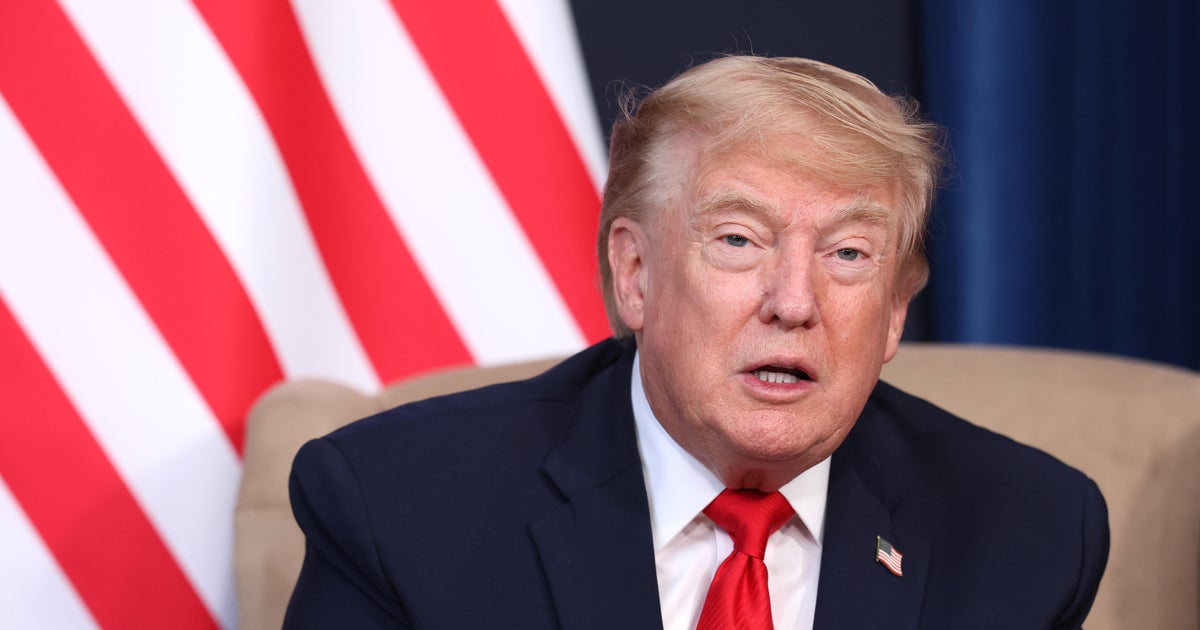
United States President Donald Trump has announced an extension to the ceasefire with Iran, saying that the US military will hold off its planned attack to allow more time for Tehran to put forward a proposal to end the war.
Trump said the move on Tuesday comes at the request of Pakistani mediators. The truce was set to expire on Wednesday.
- list 1 of 3Strait of Hormuz: How a threat became a playbook
- list 2 of 3Trump says he opposes extending Iran ceasefire amid talks uncertainty
- list 3 of 3US forces detain Iran-linked tanker Tifani with ceasefire talks on edge
end of list
“I have therefore directed our Military to continue the Blockade and, in all other respects, remain ready and able, and will therefore extend the Ceasefire until such time as their proposal is submitted, and discussions are concluded, one way or the other,” the US president said in a social media post.
Without a specific deadline, Trump’s statement suggests that the extension of the truce from the US side is open-ended.
Iran did not issue an immediate response to Trump’s assertion. The semi-official Tasnim news agency said Tehran’s position will be “officially announced later”.
Hours before his social media post, Trump had said that he opposes extending the truce, warning Iran that time is running out.
The about-face came as Iranian officials condemned the US naval blockade on the country’s ports, putting their participation in the talks scheduled for Wednesday in Pakistan in doubt.
Pakistani Prime Minister Shehbaz Sharif expressed gratitude to Trump on Tuesday for agreeing to prolong the truce, saying that Islamabad will continue to push for a negotiated settlement to the conflict.
“I sincerely hope that both sides will continue to observe the ceasefire and be able to conclude a comprehensive ‘Peace Deal’ during the second round of talks scheduled at Islamabad for a permanent end to the conflict,” Sharif said in a post on X.
With the naval siege persisting, it is unclear whether the extension of the truce will be enough to bring Iran to the negotiating table in Islamabad.
Advertisement
Earlier on Tuesday, Iran’s Foreign Minister Abbas Araghchi called blockading Iranian ports an “act of war” and a violation of the ceasefire.
“Iran knows how to neutralize restrictions, how to defend its interests, and how to resist bullying,” Araghchi wrote.
Although the Iranian position, as expressed by several officials, has been to reject US threats and the naval siege, Trump suggested that disagreements within the leadership in Tehran is slowing down diplomatic efforts.
“Based on the fact that the Government of Iran is seriously fractured, not unexpectedly so and, upon the request of Field Marshal Asim Munir, and Prime Minister Shehbaz Sharif, of Pakistan, we have been asked to hold our Attack on the Country of Iran until such time as their leaders and representatives can come up with a unified proposal,” the US president wrote.
Despite the killing of Supreme Leader Ali Khamenei and other top officials in US-Israeli strikes, there no major defections in the ruling system in Tehran, with the Islamic Revolutionary Guard Corps (IRGC) spearheading the war effort.
Khamei was replaced by his son Mojtaba, who is yet to make a public appearance since his selection as supreme leader last month.
Reporting from Tehran, Al Jazeera’s Ali Hashem said Trump’s assertion about fractures in the Iranian leadership is a “miconception”.
“Iran has a very unified leadership since the assassination of former Supreme Leader Ayatollah Ali Khamenei,” Hashem said.
“Why? Because the new leader Mojtaba Khamenei and the circle around him are a team that’s been working together for the past 15 years. Members of this team are currently in the centres of decision in Tehran.”
Iran and the US agreed to a two-week ceasefire on April 8, but the deal has been marred by disagreements over the inclusion of Lebanon in the truce and control of the Strait of Hormuz, leading to persisting tensions.
To end the war, the US is seeking a complete shutdown of Iran’s nuclear programme as well as limits on the country’s missile production and support for regional allies, including Hezbollah and Hamas.
But Tehran has insisted on its right to enrich uranium domestically as part of a civilian nuclear programme and ruled out concessions over its conventional military capabilities and regional policies.
Another sticking point is Iran’s existing stockpiles of highly enriched uranium.
Trump has claimed that Tehran has agreed for the US to extract the nuclear material and take it, but Iran has said that it will not allow the uranium to leave the country.
Advertisement
Barbara Slavin, a distinguished fellow at the Stimson Center, said Trump’s statement extending the caesfire is a “way to cover the embarrassment” that he was willing to send his Vice President JD Vance to negotiate with Iran in Pakistan while Tehran was not ready to show up at the talks.
“This war hasn’t gone the way he expected from the very beginning, and Iran has discovered new leverage in its control of the Strait of Hormuz,” Slavin told Al Jazeera.
The US should “relinquish its maximalist demands” and offer Iran “some sort of gesture that it is serious in seeking a resolution”, she added.
Al Jazeera – Breaking News, World News and Video from Al Jazeera wp:paragraph
هلدینگ کاسپین استانبول | خرید ملک در ترکیه | صرافی معتبر ایرانی در ترکیه | خرید و فروش طلا در ترکیه | مهاجرت به ترکیه | واردات و صادرات در ترکیه | نیازمندیهای ترکیه | اخبار ترکیه | اخبار جهانی | توریست ایران | خدمات توریستی در ایران | تورهای گردشگری ایران | هلدینگ اول | خدمات کاریابی و فریلنسری و شغل | مرجع اطلاعات ایران (همه چیز در ایران) | کیف پول و خدمات مالی و پرداخت یار | اخبار ایران | تابلو زنده قیمت ارز در ترکیه و استانبول | صرافی آنلاین ترکیه | قیمت طلا و نقره در ترکیه | سرمایه گذاری در ترکیه | جواهرات در ترکیه | نرخ لحظه ای ارزها در استانبول | قیمت دلار امروز در ترکیه | قیمت دلار استانبول امروز | قیمت لحظه ای دلار | اخبار روز ترکیه استانبول | اپلیکیشن ISTEX | اپلیکیشن قیمت لحظه ای دلار و یورو و لیر و ارزها در ترکیه
About the Author