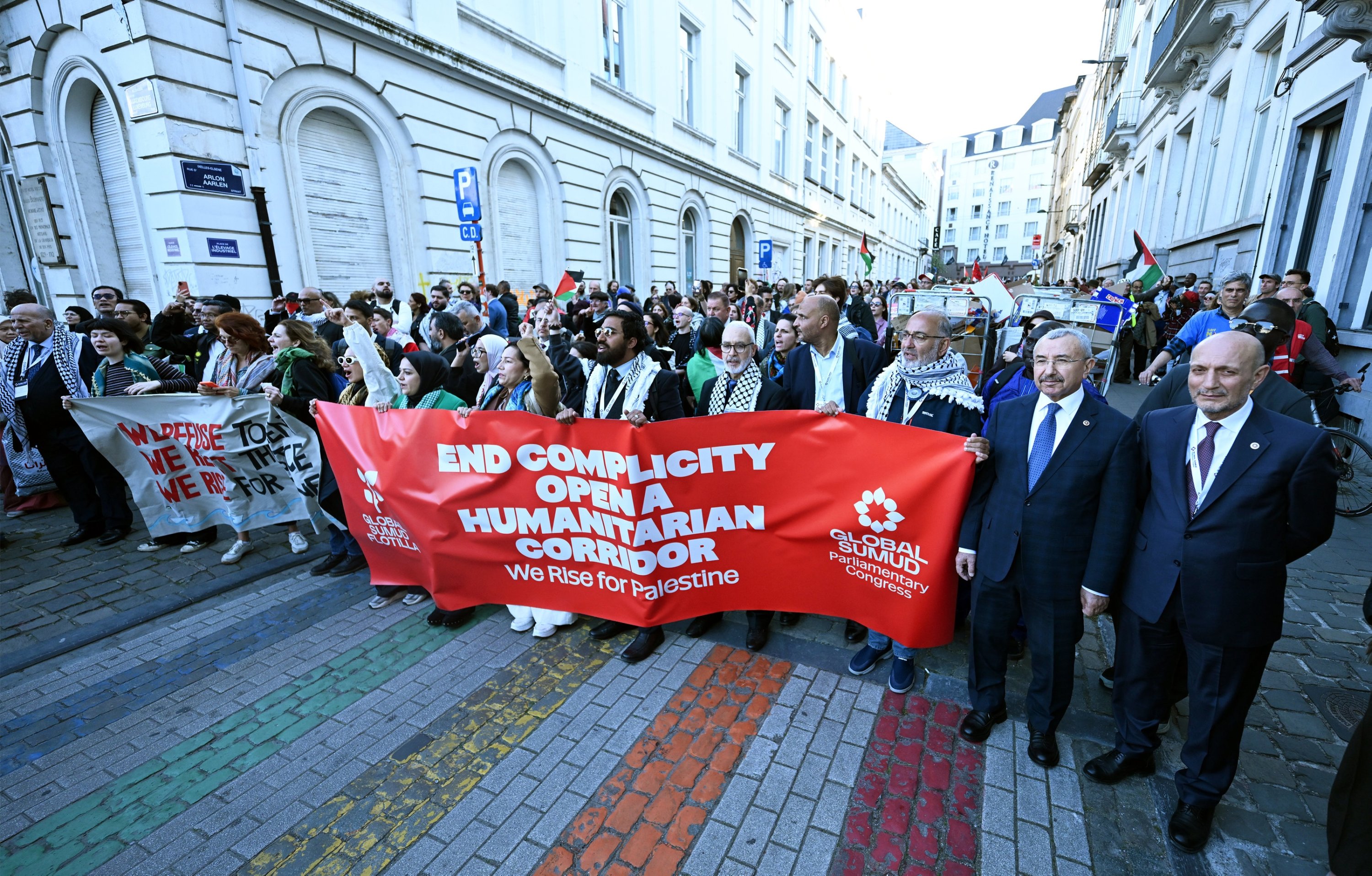
A Turkish labor union official said she is preparing to join an international Sumud flotilla aiming to deliver humanitarian aid to Gaza and challenge Israel’s blockade, describing the effort as a “conscience movement” drawing participants from around the world.
Fatma Zengin, deputy secretary-general of HAK-IŞ union and head of its women’s committee, is set to board vessels departing from Sicily as part of the Global Sumud Flotilla’s “Spring 2026 Mission.” The initiative, formed last year, seeks to bring aid to Palestinians in Gaza and raise international awareness of the humanitarian situation.
Speaking to Anadolu Agency (AA) before departure, Zengin said she had undergone a week of training with other participants from diverse religious, cultural and national backgrounds.
“We have learned to stand together for peace and humanity,” she said, adding that the group had also received briefings on conditions in Gaza and the broader Palestinian issue.
Addressing Palestinians in Gaza, Zengin expressed solidarity, particularly with mothers enduring the conflict. “We want to be with you,” she said. “We hope peace will come as soon as possible.”
“I am joining this flotilla to be the voice of justice,” Zengin said. “People from many parts of the world are taking part. I wanted to be part of this movement of conscience. We want a cease-fire. We want Palestine to be free.”
She said the journey would be long and would require coordination and solidarity among participants. “We learned how to act together and how to carry forward a conscience movement against injustice,” she added.
Created in 2025 by NGO representatives, activists and volunteers from various countries, the flotilla last sailed in September with 42 boats and 462 people. This time, it will have at least 70 boats and nearly 1,000 volunteers from 70 countries.
Activists involved in flotilla efforts have previously sought to challenge restrictions on Gaza, though such missions have faced logistical and political obstacles.
About 1.9 million people in Gaza, out of a population of 2.4 million, remain displaced and live in harsh conditions in worn-out tents after their homes were destroyed during Israel’s two-year war.
Despite the cease-fire agreement that took effect on Oct. 10, 2025, living conditions have not significantly improved, amid Israel’s failure to allow the agreed levels of humanitarian aid, including food, medical supplies and shelter materials.
The war in Gaza has killed more than 72,000 Palestinians and injured about 172,000 others, and has caused widespread destruction affecting around 90% of civilian infrastructure.