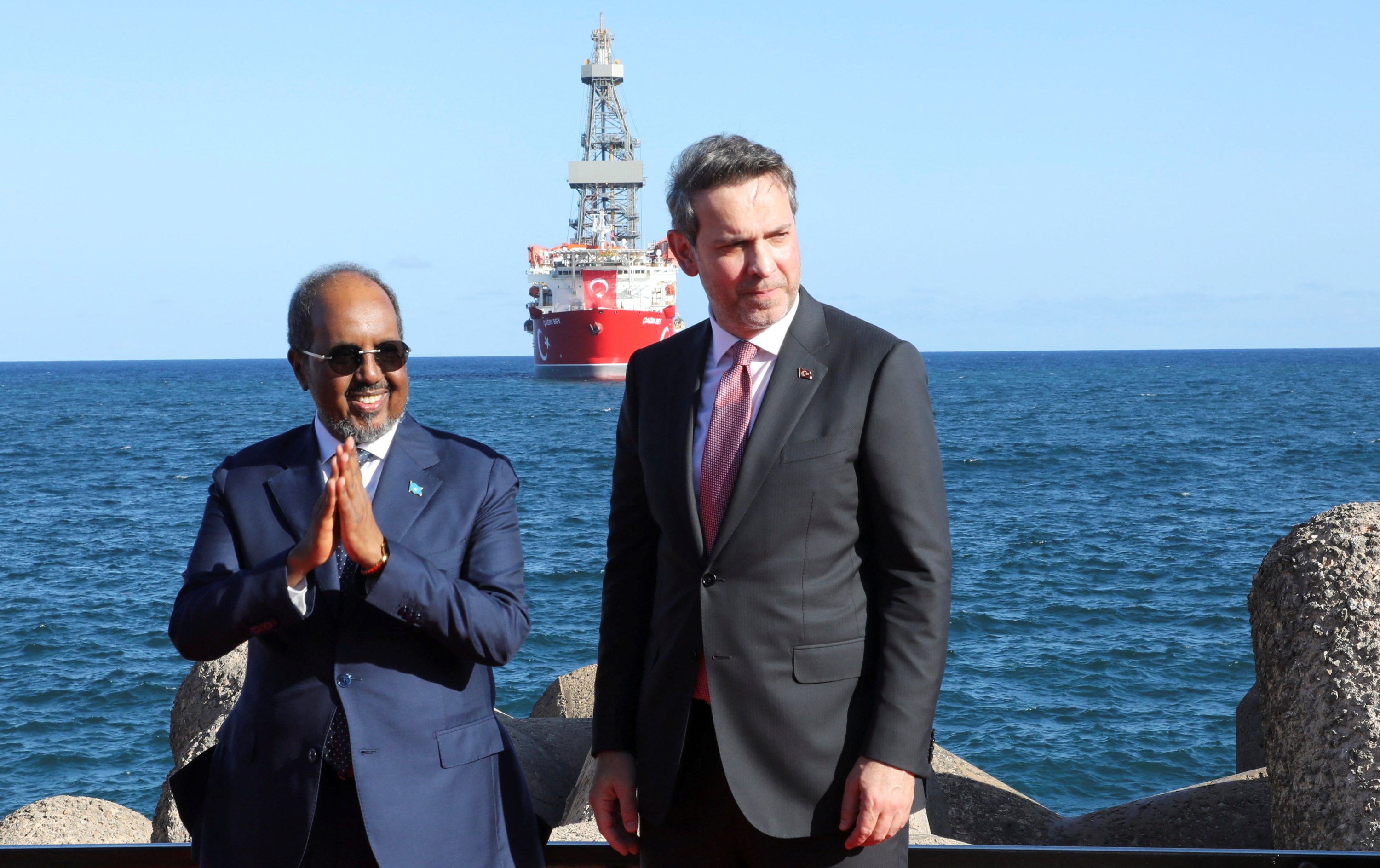
Roughly 370 kilometers (230 miles) off Somalia’s central coast, between Xarardheere and Hobyo in Galmudug state of Somalia, the Turkish drillship Çağrı Bey has begun what is arguably the country’s most consequential energy experiment to date. The target, Curad-1, is the first test well within a trio of offshore blocks mapped using advanced 3D seismic surveys by the Turkish Petroleum Corporation.
The campaign at Curad-1 is expected to extend over several months, with drilling reaching extreme depths that will test both the geology and the operational resilience of the project.
Potential of Curad-1
The scale of Somalia’s offshore potential adds weight to this moment. Early geological models suggest the possibility of multibillion-barrel structures with figures often cited at up to 10 billion barrels per block, but these remain unproven until drilling confirms them. However, even partial success would position Somalia as a meaningful new producer in the African continent.
Just as critical, the true character of the oil, its viscosity, density and whether it is light and “sweet” or heavier and more sulfur-rich, will only be determined once samples are extracted and analyzed.
If the crude proves to be light and sweet, low in viscosity and sulfur, it would command a premium in global markets due to lower refining costs. If heavier and sourer, it would still hold value, but require more complex processing. These distinctions will ultimately determine not just the commercial viability of the project, but its strategic attractiveness to potential buyers and partners.
Curad-1 is therefore not just a well, but a decisive test of both quantity and quality, where Somalia’s long-speculated offshore potential meets measurable reality.
The technical challenge alone makes this effort notable. Deepwater drilling at depths approaching 7,500 meters is among the most complex operations in the global energy industry, requiring advanced engineering, precise seismic interpretation and highly specialized equipment.
These are capabilities concentrated in only a handful of countries and companies worldwide. That Türkiye can deploy its own drillship, technical teams, and operational support into such an environment signals a significant shift. It reflects not just access to technology but the ability to integrate logistics, security and engineering in a frontier setting. This is something that even some larger powers have often struggled to execute independently at the highest level.
This is significant because the global energy system is entering a period of sustained uncertainty. Disruptions across key regions have underscored how vulnerable supply chains can be, even without a full-scale systemic breakdown. Energy flows are increasingly shaped not just by reserves, but by reliability, by which producers can extract, secure and deliver resources without interruption. In this context, new sources that are geographically open and politically aligned with capable partners are becoming more valuable.
What Somalia can gain
Somalia’s position is unusually favorable in this regard. Unlike producers constrained by narrow chokepoints or heavily militarized corridors, Somalia sits along the open waters of the Indian Ocean, offering relatively direct access to major global shipping lanes. This geographic advantage does not eliminate risk, but it reduces dependence on the world’s most contested maritime bottlenecks.
If production proves viable, it creates the possibility, though not a guarantee, of more flexible export routes and diversified market access, particularly toward energy-hungry economies in Asia, and the potential to make money hand over fist.
For a country like Somalia, the stakes of a successful offshore discovery go far beyond export revenues; they touch the very ability of the state to function. The 2025 national budget of roughly $1.32 billion remains heavily dependent on external support, with around 67% funded by donors and only about $429 million generated domestically.
This dependence extends deep into the core of government operations, to security forces, including elite units, that rely on foreign assistance for logistics and salaries; essential services such as health and education are sustained by donor-backed programs; and a large share of development spending is implemented outside government systems altogether.
In this context, a viable oil sector, if managed effectively, would not simply add income, but could gradually shift the balance toward financial sovereignty, enabling the state to fund its own priorities and ensuring that its institutions are sustained by national resources rather than uncertain external flows.
What Türkiye brings
Türkiye’s role in this partnership is particularly noteworthy. While traditional energy powers such as the U.S., Brazil, and China still dominate in absolute terms, much of their operations often rely on extensive international partnerships, financing structures and risk-sharing mechanisms, especially when it comes to technically challenging deep-sea drilling projects. From the multinational consortia in Guyana’s Stabroek Block to joint ventures in Namibia and Suriname, projects typically bring together multiple “Tier 1” players combining capital, technology and operational expertise.
In contrast, Türkiye is carving out a niche based on operational independence, flexibility and a willingness to engage in frontier markets. While this does not mean it surpasses larger players like China or Russia across the board, it excels in specific contexts, such as deploying integrated capabilities in politically and technically challenging environments. Türkiye is becoming increasingly competitive, and in some cases, more agile, especially if Curad-1 proves to be successful.
A win-win project
Basically, in a world where globalization appears to be in its final phase, and its strains are visible in fractured supply chains, contested routes and uneven access to resources, Somalia’s offshore venture stands out not just for what it might produce, but for what it represents.
Türkiye is emerging as one of a limited number of countries capable of navigating this transition with both technical competence and strategic intent. That it is willing to take on the risks of deep-water exploration in Somalia is, in many ways, a rare alignment of opportunity and capability.
If Curad-1 proves successful, it will not simply confirm the presence of oil, but it will also mark the emergence of a partnership positioned to benefit from a world where energy, geography and reliability are becoming the defining currencies of power. Furthermore, if Curad-1 proves to be successful and managed effectively, even a fraction of current preliminary estimates could reduce dependence on unpredictable aid and allow government institutions to operate on a more stable, domestically funded foundation.
The views and opinions expressed in this article are solely those of the author. They do not necessarily reflect the editorial stance, values or position of Daily Sabah. The newspaper provides space for diverse perspectives as part of its commitment to open and informed public discussion.
DAILYSABAH
هلدینگ کاسپین استانبول | خرید ملک در ترکیه | صرافی معتبر ایرانی در ترکیه | خرید و فروش طلا در ترکیه | مهاجرت به ترکیه | واردات و صادرات در ترکیه | نیازمندیهای ترکیه | اخبار ترکیه | اخبار جهانی | توریست ایران | خدمات توریستی در ایران | تورهای گردشگری ایران | هلدینگ اول | خدمات کاریابی و فریلنسری و شغل | مرجع اطلاعات ایران (همه چیز در ایران) | کیف پول و خدمات مالی و پرداخت یار | اخبار ایران | تابلو زنده قیمت ارز در ترکیه و استانبول | صرافی آنلاین ترکیه | قیمت طلا و نقره در ترکیه | سرمایه گذاری در ترکیه | جواهرات در ترکیه | نرخ لحظه ای ارزها در استانبول | قیمت دلار امروز در ترکیه | قیمت دلار استانبول امروز | قیمت لحظه ای دلار | اخبار روز ترکیه استانبول | اپلیکیشن ISTEX | اپلیکیشن قیمت لحظه ای دلار و یورو و لیر و ارزها در ترکیه
About the Author