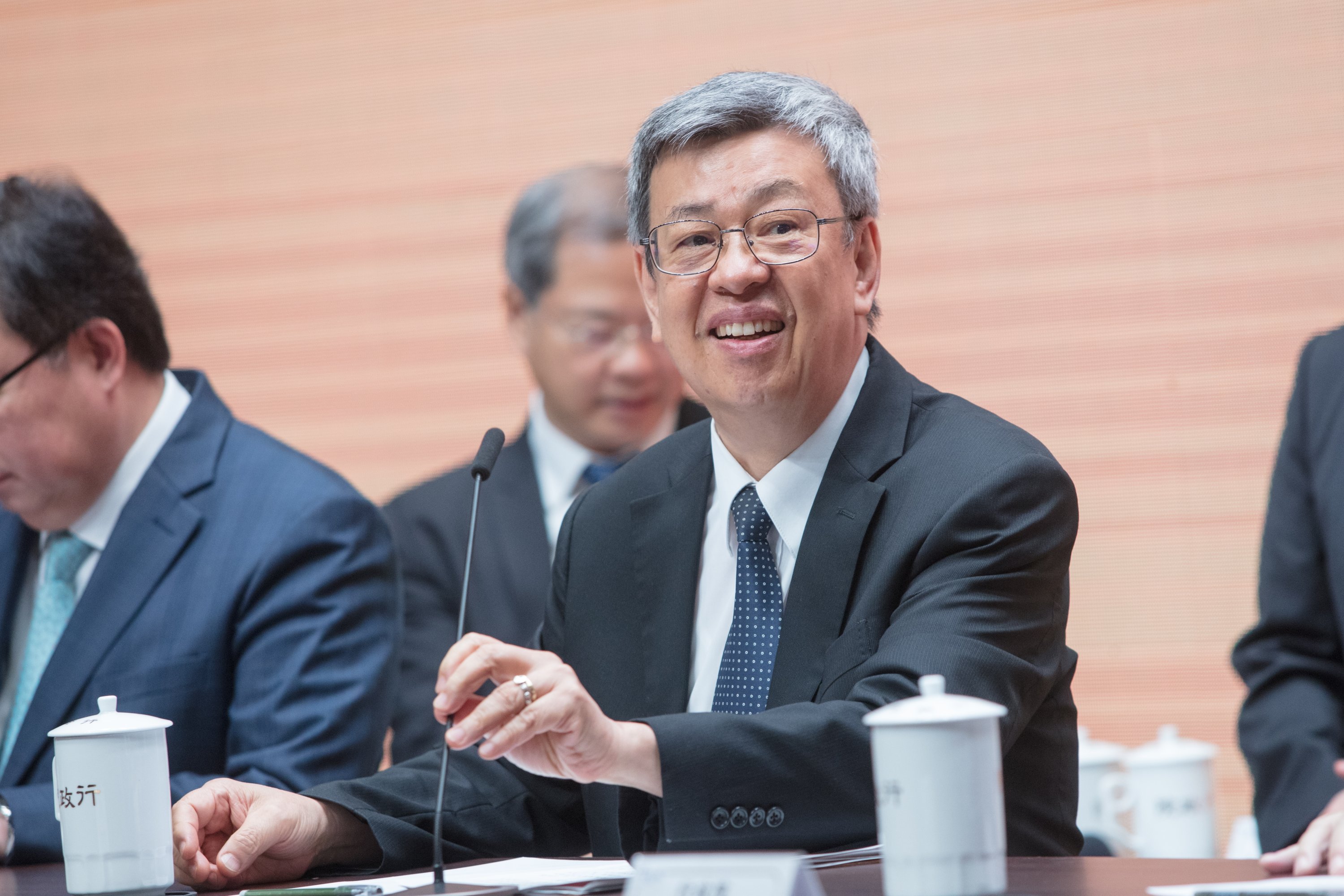
Early into what would later be described as a COVID-19 pandemic by the World Health Organization (WHO), a small island in East Asia had what was seen as “a card up its sleeve” – an acclaimed epidemiologist as its vice president.
From 2016 to 2020, Chen Chien-jen served as the vice president, and later, between 2023 and 2024, also as premier of Taiwan, a vibrant, mountainous island, widely recognized for its semiconductor production, but also as a direct point of U.S.-China rivalry.
Dr. Chen, with a background at Johns Hopkins University and years of expertise in public health, still carries a detailed recollection of Taiwan’s early response to the pandemic.
In an exclusive interview with Daily Sabah recently, he reflected on it, the global cooperation, research, preparedness, potential for “another pandemic” and also Taiwan-Türkiye relations through the lens of disaster solidarity.
The former high-level Taiwanese official was in Istanbul for an annual meeting of the Asian Pacific Association for the Study of the Liver (APASL). During the event, he was awarded the “APASL Okuda-Omata Distinguished Award.”
Prior to the event, he spoke to the Daily Sabah, touching upon the COVID-19 pandemic comprehensively and the way Taiwan had dealt with it.
Recalling the SARS outbreak in 2003, and himself being labeled as “weapon against coronavirus” in a news article, Chen said, “it’s a good argument,” but proclaimed, ” I’m not a weapon, basically,” as he went on to detail experiences before and throughout the pandemic.
“After this SARS outbreak in 2003, we really got a very good preparedness after this previous pandemic. And I think it’s very important. The best way to cope with this pandemic crisis, we have to learn from that,” he said, referring to severe acute respiratory syndrome (SARS).
“So, at the time, after the SARS outbreak, we considered that we have to amend our Infectious Disease Control Act. We have to reorganize our Center for Disease Control. We have to reorganize our health administration, and we have to train more epidemic prevention physicians, and to strengthen our hospital infection control, and also set up our in facial disease healthcare system,” he said, recalling events of 2003.
Moving onto 2019, he said that at the end of the year, Dec. 31 of that year, they had obtained an alert about “atypical pneumonia case” in China’s Wuhan, being “the first to recieve an alert outside of China.”
“Because we monitored our neighborhood. And we found that there was a physician in Wuhan, and he, in this, on social media, he said, in his hospital, there were seven atypical cases. And a typical pneumonia case in China means SARS,” he said, adding further that they tried “to keep in touch” with the WHO even though Taiwan is not a member state.
Taiwan, with a population of around 23 million, characterizes itself as a democratic, self-ruled and sovereign nation, while Beijing, through its “One China” policy, claims sovereignty over the island.
Moreover, Chen went on to describe what he referred to as a brief response from WHO, but then also suggested that the organization announced: “the same day that there were 27 reported cases.”
“That’s 27, atypical pneumonia cases in Wuhan. And we already have an alert that, because in this infected disease pyramid, there are hospitalized cases, only the tip of the iceberg. It means that in the community, they are more subclinical or milder or moderate cases … So we implemented our own board quarantine system for the direct impact passengers from Wuhan,” he noted.
WHO officially declared the COVID-19 outbreak a pandemic on March 11, 2020.
Early response
Taiwan, itself, however, had earned widespread praise for its response in the early months of 2020, having at the time fewer confirmed cases and deaths than in many other places. This has also propelled the profile of Chen, who shared their first-hand experience with international media.
“So we have a very stringent border control, and then we started our epidemic prevention procedures, and started to set, to have our epidemic command center, and then have this border quarantine and also cross contact tracing, everything,” he further added.
Chen stressed the significance of transparency and communication with the public, arguing that trust helps ensure compliance with public health measures.
“Once there is openness and transparency, the CDC gains public trust. And when there is public trust, it is easier to achieve social cohesion and willingness to follow regulations,” he said.
He pointed to measures that included tracing cross-contact and quarantine at home to prevent local transmission. “So in 2020, that’s a whole year, we basically had more than 250 days with zero COVID. So we found control is quite good,” he noted.
Looking ahead, he warned that global health systems remain vulnerable as preparedness varies from place to place, and conveyed that scientific research must continue even outside of crisis periods.
“We should not stop scientific research on infectious diseases at any time, because we do not know what kind of virus will come next,” he said.
He pointed to advances in vaccine technology, including mRNA platforms, as an example of how long-term research enabled rapid pandemic response.
“This technology had been researched for more than 20 years, and that is why it was possible to produce vaccines within months during COVID-19,” he said.
Cooperation, learning from pandemic
Chen also highlighted international cooperation during the pandemic, including Taiwan’s assistance to other countries through medical supplies and expertise.
“We donated millions of face masks to many countries around the world, regardless of whether we had diplomatic relations or not,” he said.
Similarly, as part of the response, which he said also should include data sharing, donations, Chen said: “So I think this kind of resource sharing is very important. So, to prepare, I’m pretty sure that in the coming decades, there will be, there will be, definitely will be another pandemic.”
He also went to cite a finding from The Lancet journal on the COVID-19 commission, that the world was not well-prepared for COVID-19.
“From the public health point of view, from the governmental agency point of view, from the data sharing point of view, and from the practice point of view, we are not ready, but The Lancet commission urged the entire world to learn from this pandemic of COVID-19 and try to strengthen their pandemic preparedness, and then the way to cope with this and the outbreak in the future.”
“And some countries do that very well. Korea, and in California, it’s very well prepared. In New York City, it’s very well prepared. But in some states in the United States, they did not learn from it. So it’s really a pity. People forget, easily forget.”
Turning to Türkiye, Chen recalled Taiwan’s deployment of a search-and-rescue team following a major earthquake, describing disaster response as an area of mutual solidarity between the two sides.
“When there is a disaster, it shows how people can work together, hand in hand, shoulder to shoulder,” he said.
He added that cooperation between Taiwan and Türkiye could extend beyond emergencies, particularly in disaster preparedness, engineering and training.
The duo could work together to strengthen preparedness and prevention, especially in areas like earthquake engineering and disaster response systems, Chen concluded.
DAILYSABAH
هلدینگ کاسپین استانبول | خرید ملک در ترکیه | صرافی معتبر ایرانی در ترکیه | خرید و فروش طلا در ترکیه | مهاجرت به ترکیه | واردات و صادرات در ترکیه | نیازمندیهای ترکیه | اخبار ترکیه | اخبار جهانی | توریست ایران | خدمات توریستی در ایران | تورهای گردشگری ایران | هلدینگ اول | خدمات کاریابی و فریلنسری و شغل | مرجع اطلاعات ایران (همه چیز در ایران) | کیف پول و خدمات مالی و پرداخت یار | اخبار ایران | تابلو زنده قیمت ارز در ترکیه و استانبول | صرافی آنلاین ترکیه | قیمت طلا و نقره در ترکیه | سرمایه گذاری در ترکیه | جواهرات در ترکیه | نرخ لحظه ای ارزها در استانبول | قیمت دلار امروز در ترکیه | قیمت دلار استانبول امروز | قیمت لحظه ای دلار | اخبار روز ترکیه استانبول | اپلیکیشن ISTEX | اپلیکیشن قیمت لحظه ای دلار و یورو و لیر و ارزها در ترکیه
About the Author