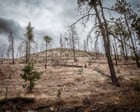
Decades ago, the children of Rochéachi village in the Sierra Tarahumara – pine-covered mountains of north-west Mexico’s Chihuahua state – would run through the forest by night. In the rainy season, they would collect fireflies whose glimmering light would flicker through the hollows of the pine trees.
“We had peace. We used to walk and play and be together,” says one mother of three, who asked to remain anonymous, about the forest she once knew. “Now, children can’t go out to play. We don’t know what might happen.”
Since the mid-2010s, criminal groups, including factions of the Sinaloa cartel, have intensified illegal deforestation, seizing control of communal land known as ejidos through intimidation, extortion and murder.
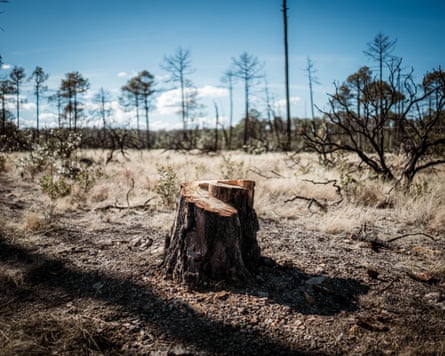
The ecological toll has also been severe. According to the environmental organisation Water and Forests for Life, 9,000 hectares (22,400 acres) of forest in the Sierra Tarahumara have been lost to illegal logging since 2001.
Sawmills linked to the cartels falsify documents to launder timber estimated by one academic to be worth up to $270m (£200m) annually, while the US government puts the figure at $342m to $978m. Deforestation has disrupted the region’s hydrological system, causing droughts, crop failures and food insecurity.
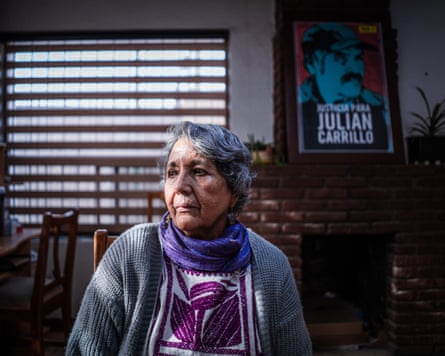
Rochéachi, about 20 miles from the town of Guachochi, is home to several groups of Indigenous people, including the Rarámuri and Ódami. Along the Sierra Tarahumara’s nearly 745-mile (1,200km) length, individuals and organisations have reported a sharp rise in illegal deforestation.
Controlled largely by the cartel factions, the industry often overlaps with other criminal activities, such as drug trafficking and money laundering.
“Illegal logging in the Sierra Tarahumara spread as criminal groups began to diversify,” says Isela González Díaz, 71, director of Alianza Sierra Madre, an organisation that works with Indigenous people in the mountain range. “In recent years, illegal logging has been most effective for them.”
The area around Guachochi is one of the most affected. “Everyone is afraid,” says the woman from Rochéachi, a member of the Rarámuri Indigenous community. “I’m worried that illegal logging is destroying everything.”
She says criminal groups now exercise significant influence over the leadership of her ejido. When she openly opposed the extortion, she endured savage retaliation. Her father was murdered in 2016, and six years ago, frequent death threats forced her to leave Rochéachi for the town of Guachochi, about an hour away.

“They told me that if I didn’t keep quiet or back off, the same thing would happen to me as to my father,” she says.
Even so, she has continued to file formal complaints with government offices and has lost count of the number of threats she has received – the most recent in December.
A Global Initiative report describes how, in various ejidos in the municipality, armed groups have been able to extort the local logging industry, co-opt revenue streams entirely or forcibly log more timber than legally permitted.
Despite the widespread violence and environmental crime, residents and organisations claim that illegal activity continues to go unpunished in the Sierra Tarahumara.
“The system for reporting, punishment and damage repair is extremely ineffective,” says a legal officer at Community Technical Consultancy (Contec), a human rights organisation that provides support to Indigenous communities in the region.
“Impunity is widespread,” says the Contec member, who did not want to be named.
Local people condemn the lack of an effective means of reporting forest-related crimes anonymously. Some claim that the groups responsible for illegal logging in the Sierra Tarahumara have informants within Mexico’s environment ministry and the office of the federal attorney for environmental protection (Profepa).
The Rarámuri woman from Guachochi says that shortly after arriving at the ministry’s local office to file a complaint, she received a threatening phone call warning her not to proceed.
Contec’s legal officer agrees that criminal groups appear to be aware of every complaint filed (including who reports it, where and when), making it dangerous for people to turn to the authorities.
“At Profepa, when a complaint is filed, they find out very quickly,” she says. “Their surveillance has spread everywhere.”
Profepa acknowledges that illegal logging represents a threat to rural communities but says this dealing with this exceeds its administrative powers. The agency also categorically denies any improper disclosure of information or collusion with gangs, and states that it is taking measures to improve the confidentiality and integrity of its procedures to guarantee anonymity.
It says it plans to expand forest protection in the Sierra Tarahumara, promising a 130m-peso (£5.6m) investment in the region.
But institutional weakness is compounded in Mexico’s community forests – those within ejidos or agrarian communities – where more than half of the country’s illegal logging reportedly occurs.
Beyond the Sierra Tarahumara, Mexico’s environmental protection is facing increasing scrutiny on a national level. Despite widespread calls to strengthen environmental institutions and increase spending, the ministry and Profepa have had their budgets cut in 2026 – by 4% and 3.3% respectively.
Campaigners fear that continued cuts will further stretch protection for the forests, increasing Mexico’s vulnerability to corruption.
Extensive illegal logging has also been documented in other Mexican states, including Michoacan. A report by the National Autonomous University of Mexico estimates that at least 70% of the timber in the domestic market may have been illegally sourced.
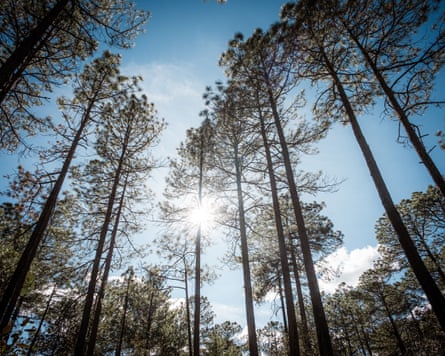
The Sierra Tarahumara contains Mexico’s largest area of temperate, cold-climate forest in the country. It spans altitudes from 500 to 1,400 metres and supports significant plant and animal diversity.
But throughout the Sierra, the indiscriminate erasure of the region’s pine forests has left lasting scars on the landscape.
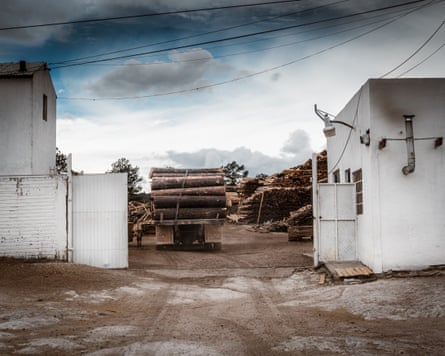
On the outskirts of San Juanito, in Bocoyna municipality, rows of sawmills hum beneath a thick mist. Trucks lurch past their rusting gates, sinking low under the weight of felled timber and carving tracks into the frosted ground.
“In San Juanito, there are various illegal sawmills that are not properly registered,” says Contec’s legal officer. Local people claim that many are owned and operated by a faction of the Juárez cartel known as La Linea, which dominates the town.
After being processed in these sawmills, illegally harvested wood is supplied with falsified forestry documents before being sold on the open market.
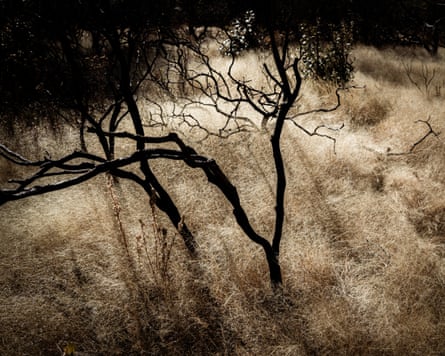
“Large areas have been devastated, and in some cases deliberately burned,” says the legal officer. She says that burning logged areas can be classified as fire damage rather than illegal logging, in effect erasing evidence of wrongdoing.

From San Juanito, the main road snakes past flame-blackened hillsides. This area forms part of the Papigochi flora and fauna protected area, an important refuge for black bears, golden eagles and cahuite – a rare species of conifer.
Between 2022 and 2023, Bocoyna district reportedly experienced almost a third of Chihuahua state’s tree cover loss, according to a report on organised crime.
“We are being left without a future,” says a priest who has lived for nine years in Baborigame, a community in Guadalupe y Calvo, an area controlled by a faction of the Sinaloa cartel.
“There’s truck after truck hauling timber everywhere, like ants across the sierra,” he says. “There’s no control at all.”
People believe that as illegal logging has increased, rainfall has declined sharply. With a primarily agricultural region facing prolonged drought and food insecurity, the combined factors of violence, economic failure and environmental decline have displaced swathes of local people from their homes across the Sierra Tarahumara.
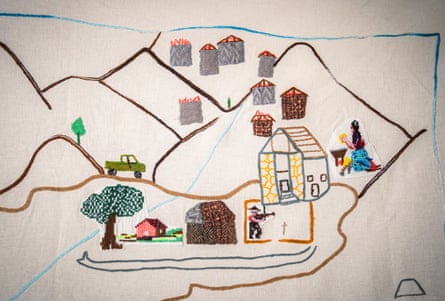
According to Contec, the exact number of displaced people is impossible to quantify; it claims that 400 people have been displaced from ranches surrounding just Baborigame. Global Initiative reports that 300 have been displaced from Coloradas de la Virgen, also in Guadalupe y Calvo.
“The gangs are displacing people so that they can keep the homes that are left behind,” says one woman, who asked to remain anonymous. Along with her husband, she has been displaced twice: first from Coloradas de la Virgen in 1992, and again from Baborigame in 2018. They now live in the city of Chihuahua.
“There, they ‘disappear’ many people,” says the woman. “They kill them and dump them somewhere no one will find them.”
The couple, who say they have lost seven family members to the violence, report that children as young as 10 have been forcibly recruited to fight for criminal groups in the area.
Amid the risk, the couple refuse to stay silent. “We’re here fighting, so let’s see what happens,” he says, as his wife adds: “As long as God grants us life.”
-
The Pulitzer Center supported this story
The Guardian wp:paragraph
هلدینگ کاسپین استانبول | خرید ملک در ترکیه | صرافی معتبر ایرانی در ترکیه | خرید و فروش طلا در ترکیه | مهاجرت به ترکیه | واردات و صادرات در ترکیه | نیازمندیهای ترکیه | اخبار ترکیه | اخبار جهانی | توریست ایران | خدمات توریستی در ایران | تورهای گردشگری ایران | هلدینگ اول | خدمات کاریابی و فریلنسری و شغل | مرجع اطلاعات ایران (همه چیز در ایران) | کیف پول و خدمات مالی و پرداخت یار | اخبار ایران | تابلو زنده قیمت ارز در ترکیه و استانبول | صرافی آنلاین ترکیه | قیمت طلا و نقره در ترکیه | سرمایه گذاری در ترکیه | جواهرات در ترکیه | نرخ لحظه ای ارزها در استانبول | قیمت دلار امروز در ترکیه | قیمت دلار استانبول امروز | قیمت لحظه ای دلار | اخبار روز ترکیه استانبول | اپلیکیشن ISTEX | اپلیکیشن قیمت لحظه ای دلار و یورو و لیر و ارزها در ترکیه
/wp:paragraph wp:paragraph /wp:paragraph
About the Author