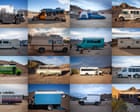
This story was produced in partnership with Re:Public Lands Media, an independent, non-profit news organization. Sign up for Re:Public’s newsletter.
Every autumn across North America, migration begins.
And across the continent’s highways and desert roads, another migration gathers – this one made not of birds or fish, but of humans.
They go by many names: nomads, drifters, snowbirds, boondockers, van dwellers. Some travel in search of warmth, others for freedom and community. And for a growing number, the migration is not simply seasonal but economic.
Among those is 55-year-old Derek Hansler, a chef by trade.
Known to friends as D Rock, he spends the summer in New Hampshire visiting his children and grandchildren, parking his 2003 Van Terra shuttle bus in driveways along the way. He picks up gigs when he needs cash or a place to park, but the season is less work than service, volunteering in the communities he revisits every year.
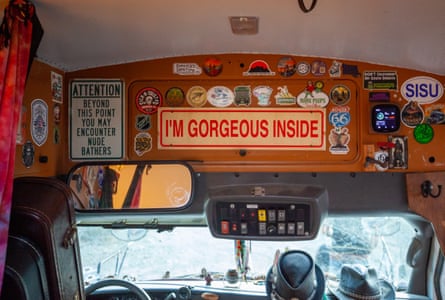
“New Hampshire tells me when it’s time to roll,” he jokes. He likes to stay until the leaves turn crimson, then leave before they fall. When that moment arrives, he says goodbye to his family and points his bus 3,300 miles (5,310km) to the south-west.
In Seattle, as the rainy maritime chill brings out jackets, Stephanie Scruggs and Gustavo Costo prepare to head south. After three years on the road, they recently decided to move in together – a milestone in their nomadic life that meant trading their two vans for a half-finished bus they named Magpie, a weathered 1999 International Thomas.
It’s been more than five years since Scruggs, then 35, was diagnosed with a rare and aggressive brain cancer known as a grade three anaplastic astrocytoma. After surgery, six weeks of radiation, and a year of chemo, doctors told her she might have two to five years to live.
Retiree Theresa Webster makes a final pass through the Oregon campground where she volunteers each year as a summer host. Fire rings are doused. Bathrooms are scrubbed. Trash is gathered and hauled away.
In return for the work, she has been given what has become increasingly rare: a legal place to park.
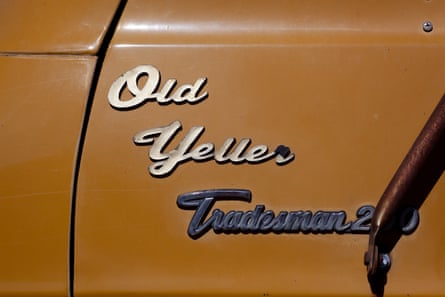
With the season over, she packs up Old Yeller, the mustard yellow 1977 Dodge van she bought for $3,000. Her dog, Miles, rides shotgun as she takes the long way south, first turning east toward her son’s driveway in Iowa, folding briefly back into the family rhythms of grandkids and shared meals. When winter presses in, she points Old Yeller down the interstate.
In driveways, campgrounds, and borrowed corners of parking lots, autumn departures like these unfold across North America. Soon these migrants will spill on to back roads, highways and interstates, license plates tracing faint lines south from Alaska, Quebec, Maine and everywhere in between, navigating by a kind of winter constellation – an invisible beacon in the American south-west that most maps barely notice, a place they return to year after year.
A small desert outpost called Quartzsite, Arizona.
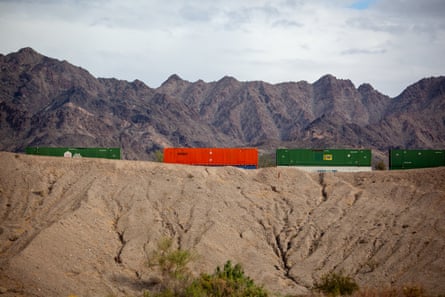
For many road trippers speeding along Interstate 10, Quartzsite, or “Q-town” as it is affectionately known, appears little more than a gas station and fast-food stopover halfway between Los Angeles and Phoenix. It sits in the northern reaches of the Sonoran Desert, 20 miles east of the Colorado River.
Summertime temperatures hover in the triple digits, sending the valley’s human residents indoors to air-conditioned rooms and its wild inhabitants – including desert tortoises, cottontails and kangaroo rats – into underground lairs.
According to the 2020 census, the population is 2,413.
But as winter approaches and temperatures fall to something more forgiving, the great migration of motorhomes, RVs, buses, trailers, vans, cars and trucks begins to pour into Quartzsite – and more precisely, into the vast stretches of open desert that surround it.
Beyond the town lies public land where a person can still live for little or nothing at all. Here, the desert is not private; it belongs to everyone. Much of that land falls under the care of the Bureau of Land Management (BLM), the federal agency that oversees 245m acres (99m hectares) in the US, primarily across the American west and Alaska.
Some move through the arid country in a rhythm known as dispersed camping – staying free of charge on BLM land for up to two weeks at a time before shifting to a new site. They scatter themselves along gravel backroads and established pull-offs without hookups or assigned sites. For a time, the desert rearranges itself into small, temporary neighborhoods.
But not everyone keeps moving.
Tens of thousands instead gather inside BLM-designated long-term visitor areas, or LTVAs, seasonal enclaves established in 1983 to accommodate the growing number of people wintering in the desert. Seven LTVAs stretch across Arizona and California. But the largest of these and the center of gravity is La Posa – Spanish for “the resting place” – an 11,400-acre stretch of land on the outskirts of Quartzsite.
Each winter, a vibrant social world takes hold. Clubs form and dissolve – singles groups, quilters, metal-detecting hobbyists – while daily gatherings emerge at sunrise and continue late into the night. Around them, infrastructure hums into being: laundromats that double as showers, RVs converted into hair salons, swap meets, mail-forwarding counters for lives without fixed addresses, mechanics coaxing life from failing engines.
Theresa remembers arriving in Old Yeller for the first time in 2018. She had kept her apartment in Oregon just in case van life didn’t work out. But as the desert opened around her, the contingency plan dissolved.
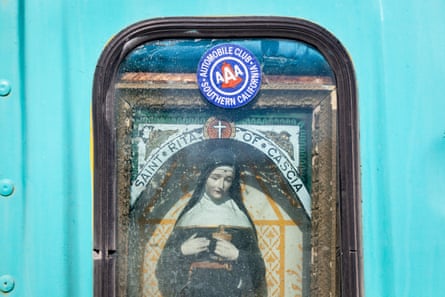
“This is it,” she remembers thinking. “This is the life.” She had grown tired of paying rent and bills and having nothing left over – a treadmill she could never step off. Out here, there were no landlords to answer to. Eight years later, the desert around Quartzsite still carries that weight for her. “It has a magical feeling,” she said.
Community and infrastructure move in tandem here, creating a seasonal metropolis layered on to the existing town. But what allows it to function year after year is something more fundamental: affordability.
For $180, a permit allows camping from 15 September through 15 April. At La Posa, that price includes trash collection, vault toilets and a dump station. It’s worth pausing on the math. For less than the cost of a single night in many American hotels, a person can legally live on public lands in the desert for seven months.
Many LTVA visitors are traditional snowbirds: retirees who maintain homes elsewhere and migrate seasonally for warmth. But for a growing number of others, the permit functions differently: as a legal foothold in a housing system that has increasingly shut them out.
Housing costs have climbed faster than incomes for decades. Today, the wage required to afford a modest two-bedroom rental home exceeds $30 an hour – far beyond what full-time minimum-wage work provides. According to the National Low Income Housing Coalition, the United States is missing more than 7m affordable rental units for its lowest-income households, a structural shortfall that leaves millions searching for alternatives. As rents rise and entry-level units disappear, the ladder’s lowest rung is splintering. The math does not bend; people do.
In its place, a parallel housing system has emerged in plain sight – people living in cars, vans, trucks, RVs and buses.
Federal housing policy classifies these individuals as “unsheltered”, which includes people sleeping in vehicles, on the streets or other improvised places. In 2024, that population reached record numbers, with roughly 274,000 individuals counted nationwide, according to the Department of Housing and Urban Development’s annual homeless assessment report. While public attention often focuses on large urban encampments, the category also includes families, retirees and low-income workers quietly using vehicles as a form of housing adaptation.
Dr Graham Pruss, executive director of the National Vehicle Residency Coalition – a network that advocates for the rights of people living in vehicles – spends part of each winter moving between desert camps as he connects with vehicle residents across the country. He sees many of them as part of what he calls an “economic refugee class”. They are people displaced not by conflict or famine, he said, but by rents, wages and the shrinking availability of stable housing.
He describes what he calls “settlement bias” – our tendency to treat familiar forms of dwelling as legitimate and unfamiliar ones as suspect.
“If you park an RV on to a private space and you pay for rent, that’s called a mobile home park,” he said. “But if you move that RV 100ft on to the street, we call that homelessness.
“These are people who are using their private property to solve a housing crisis that we all see around us,” he added. “That adaptive strategy is innovative. It creates solutions where they don’t exist.”
For many vehicle residents, public lands have become one of the few legal geographies where long-term habitation remains possible.
“Public lands are the lifeline for a lot of us,” said Mary Feuer, a longtime public land resident. “When the money runs out, they literally support us.”
I arrived in Quartzsite in early February, my Prius packed with a tent, sleeping bag, firewood, water, notebook and camera. The scale of La Posa only begins to register after miles of slow driving along its dirt roads, where, during the winter, three BLM park rangers, 10 volunteer camp hosts, and roughly 50 additional volunteers oversee daily operations. Volunteer welcome stations appear intermittently, along with water distribution points, a four-lane dump station, scattered trash collection sites and vault toilets.
Gradually, the temporary settlement begins to resolve around me, a place where the usual hierarchies were loosened and money no longer sorted people by address. Six-figure motorhomes stand beside dilapidated trailers pulled by rusty minivans. Luxury off-road vehicles are parked next to vintage buses held together with bungee cords and sealant. Retirees in pressed collared shirts recline in camp chairs next door to sunburned travelers carrying the loose, weathered look of people shaped by years on the road.
I park in an open patch of gravel and pitch my tent near a sparse stand of creosote and ironwood. Underfoot, the desert is pale gravel and compacted sand, hard-packed and sun-bleached.
My nearest neighbor lived in an ageing RV with a circular playpen out front where two small dogs wander. A handmade wooden sign marks their spot: Camp Quityerbitchen.
Among the scattered rigs is the person I had come to find: D Rock. After days of texting, he had invited me to the 9am morning meditation.
On the walk over, I duck into a vault toilet expecting the usual stench, trash and flies. Instead, it carries the texture of care. Rugs softens the concrete floor. Desert paintings hang on the walls. A portable hand-washing station stands beside the stall, stocked with sanitizer and boxes of free pads. Someone had even fitted the toilet with a turquoise plush seat cover. It feels less like a toilet than a shared living room.
I arrive at the meditation bonfire already in session, logs stacked high, a group of 22 huddled against the warmth.
I slip quietly into the circle as stories begin to move around the fire. Some sit upright in folding chairs; others are wrapped in blankets, hands cupped around steaming mugs. A woman in her 30s speaks through tears about trauma. An older woman, gray hair braided, reads two poems she had recently written. After each voice fell quiet, the group settled into comfortable silence – unhurried, without judgment.
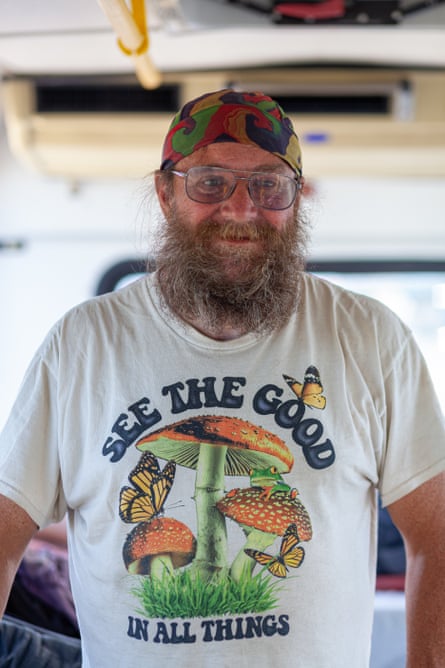
Afterward, I find D Rock standing proudly by the new shuttle bus he had just bought at auction for $6,000, a 2005 Ford E-450 that would give him a little more room to breathe.
“Hi brother, nice to meet ya,” he says as he extended his hand.
D Rock stands with an unguarded stillness, his long beard softening the lines of a weathered face. A patterned bandana holds back thinning hair above wire-rimmed glasses, and his faded T-shirt – mushrooms, butterflies and the words “see the good in all things” – feels less like a slogan than a philosophy worn close to the body.
He runs me through the day’s offerings at the tents and fire pits around camp – 9am meditation, 10am AA meeting, an awakening circle at 1pm – as if pointing out restaurants in a small town. For many, he explains, most days follow a familiar pattern.
People tend to “tribe up” with others, he says, forming smaller camps within the larger LTVA. Mornings begin with coffee and conversation around a campfire, going over plans for the day. By late morning, people drift off – some back to their rigs for a nap, others pursuing hobbies such as bike rides or rock-collecting trips. The rest of the day fills with practical tasks: grocery runs, checking in with family and friends on Facebook, or tending to whatever maintenance their vehicles require. Around sunset, they gather again. Fires are lit, meals are shared, and sometimes movies flicker on to makeshift screens.
D Rock’s story is one I would hear echoes of again and again during my time in the desert.
In his 20s, he worked in seasonal kitchens and followed music festivals, selling hats and handbags along the circuit. Later came marriage, children, steady work – he “joined the system”, as he puts it. He spent 20 years working in kitchens across New Hampshire. Then Covid shuttered the restaurants. A serious health crisis put him in the hospital for five weeks. Full-time kitchen work became impossible to sustain.
He went back to what he knew from his younger days: movement.
There was a little money saved, but on a cashier’s wage or retail job – the only work his health allowed – the apartments within reach were “just not going to afford me a very nice space”. So he began studying how to live on the road.
“YouTube University”, D Rock calls it, the informal trade school for nomads. That’s where you learn how to choose a rig, turn it into a home, fix what breaks and figure out how to navigate parking laws and make legal use of public lands.
Not long after, he bought his first rig, a Dodge Caravan he dubbed his “soccer-mom mobile”.
We step inside the stripped-down shell of this new bus, where a laid-back and genteel Irishman named Goff is building the frame for D Rock’s bed. They had struck a deal: in exchange for his carpentry help, Goff receives a few daily cigarettes and whatever else he needs.
“Not a lot of currency exchanged here,” D Rock says, a smile spreading across his face. He estimates he lives on $10,000 a year. That financial reality shapes how he talks about this life, and how fiercely he defends it.
“I do not in any way feel homeless,” he adds. “I have a home and my home is on wheels.”

By late afternoon, D Rock, Goff and others from the morning fire prepare to depart for a 10-day gathering called VanAid, 60 miles south along US Route 95. The event is a pop-up, volunteer-run camp where hobby mechanics, carpenters, sewers, and longtime nomads share tools, labor and hard-won knowledge with anyone trying to keep a home on wheels roadworthy and livable.
Soon rigs begin to pull out.
“See you down the road!” drivers yell from vehicle windows, hands waving.
It’s the nomad version of goodbye, less an ending than a promise that paths will cross again under another stretch of open sky.
As D Rock packs up his chuck wagon, a retrofitted tent trailer he had transformed into a mobile kitchen, he invites me along.
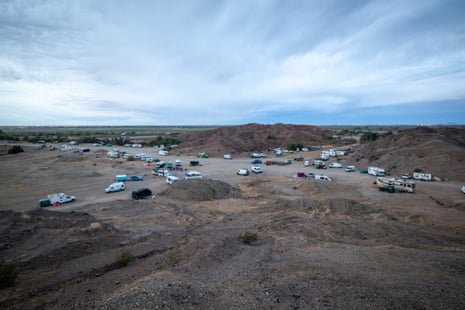
Not far from where the Gila River makes its last exhausted turn toward the Colorado, a gravel road veers into an abandoned quarry, hemmed in by highway, irrigation canals and jagged hills. I follow it in and find the camp already alive: dozens of vehicles and tents scattered across the quarry floor.
VanAid was in full motion.
I pitch my tent beside a GMC box truck, then climb one of the surrounding ridges to take in the layout. From above, two wide gravel haul roads cross to form a giant plus sign, with rigs parked along the perimeter. At the intersection, the camp’s nucleus had formed around a large fire pit ringed with folding chairs and a mobile carpentry shop operating out of the back of a cargo trailer.
At the far edge of camp, Stephanie and Gustavo sit outside Magpie, the bus they had moved into back in Seattle. Behind it, stacks of salvaged wood and scattered tools form a makeshift construction site as they work to finish retrofitting their new home.
Stephanie wears oversized glasses and a cropped yellow sweater, tattoos tracing her forehead and midriff, luminous and unguarded. There’s humor in the way she carries herself, something deliberate and grounded, an insistence on laughter in the face of time.
The couple spends the winter months drifting from one public land location to another, choosing the freedom to move when they want to.
“We’re chasing weather,” they say through laughter. “We want to be somewhere we can leave our butter out of the fridge. If it’s melting, it’s too hot. If it’s freezing, it’s too cold.”
Stephanie now lives on disability. Before her terminal cancer diagnosis, she managed a restaurant in Indianapolis, working long hours and building a life that looked stable from the outside. During treatment, one of her doctors offered advice she took seriously: walk away from what stresses you. She did. She left the restaurant world and reshaped her days around fewer bills and slower rhythms.
Gustavo arrived at the road by a different route. The son of Brazilian immigrants and the first in his family born in the United States, he had been working for a commercial real estate developer in Miami when the company let him go during the pandemic. With the market stalled, he chose movement over a collapsing job landscape. He bought a 1984 Ford van, taught himself to code, and began taking on temporary contracts.
Between them, the bus has become something more than shelter, a way of living deliberately within borrowed time.
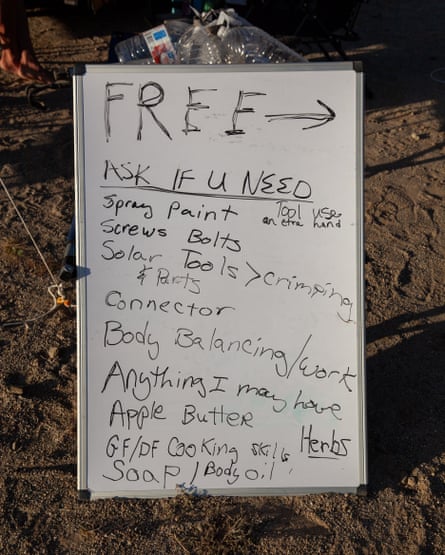
As I walk the corridors, the economy of VanAid came into view. Cardboard signs and hand-lettered whiteboards stand propped in the dust, offering spare parts and services, announcing meetups and workshops. One board offers everything from spray paint to bolts to apple butter to “anything I may have”.
At the center of camp, I find D Rock. “Welcome, brother!”
His chuckwagon hums with volunteers ladling chilli into bowls for a long line of workers. At a previous VanAid, he explains, he had watched mechanics, carpenters and sewists step away from half-finished projects at midday just to make lunch.
“I can’t build like those guys, but I can keep them from having to stop.”
The chuckwagon was his answer. It’s outfitted with a large flat-top griddle, stock pots big enough for a crowd, propane tanks, coolers and a canopy to hold back the desert sun.
Nearby, handing out cups of hot coffee, is Pruss. The National Vehicle Residency Coalition director maintains a conventional house in California – what nomads call “sticks and bricks” – but spends part of each winter living out of a converted 2006 box truck.
VanAid, he tells me, is the kind of innovation he sees across the nomad community.
“This is all done without any sort of economic exchange. This is about making a better life and improving the conditions for our neighbors. It’s about showing that people aren’t alone.
“These people are contributing,” he continues. “These are veterans. These are seniors. These are young people trying to find a chance at home ownership. These are families.”
He pauses, emotion rising in his voice. “We need these people. They’re creating pathways where they don’t exist. They’re creating solutions that we need.”
For generations, the American promise has been tied to settlement – a deed, a mortgage, a fixed address. But the winter nomadic community reveals a different model of permanence, one defined less by walls than by movement, less by ownership than by return.
Federal law requires BLM lands to be managed for “multiple use”, a balancing act that includes recreation, conservation, grazing, extraction and development. Nowhere in that mandate does it mention affordable housing, nor does the agency formally frame the LTVAs this way.
And yet, in practice – as LTVA permits continue to climb and the composition of visitors shifts – public lands are quietly doing that work, functioning as a social pressure valve in a housing system under strain.
Over the last decade, the numbers at La Posa have surged. According to the BLM’s Yuma field office, overall LTVA permits rose from 4,308 in 2019 to 10,300 in 2025 – more than doubling in six years.
In 2024, in response to mounting operational strain and a proposed restructuring of recreation fees, the BLM released a long-term visitor area business plan. In it, the agency documents a shift toward what it calls new “subculture variants of RV culture”, including people arriving in smaller conversion vehicles like “retrofitted vans, buses, and passenger cars with fewer built-in amenities than traditional RVs”. The shift reflects a pragmatic calculus: for many, adapting an existing vehicle (or obtaining a cheap one) is more feasible than securing housing or financing a traditional RV.
Norman Flowers, 75, a former army serviceman and long-haul truck driver, has spent the past three seasons as a volunteer at La Posa, working in the LTVA office where permits are issued and complaints are fielded. In some cases, he says, the changes extend beyond what the report captures: people arriving on motorcycles and sleeping in tents, and more low-income visitors drawn by what he described as a lot of “free services like the food banks”. Flowers himself lives out of a 1996 Dodge van, one of the same living arrangements the report identifies as emerging “subculture variants”.
The plan also documents changes in occupancy. Prior to 2018, average occupancy was estimated at roughly 2.5 people per LTVA permit. Since then, spot counts suggest closer to 3.5, a change officials attribute to “multigenerational” and “non-nuclear” living arrangements – patterns that point to new forms of communal restructuring. The plan anticipates these “subculture variants” increasing at a minimum of 5% per season, a trajectory that suggests continued change in who uses these lands and why.
Flowers has seen more families in recent years, with children – many of them home schooled – sharing space with retirees and solo travelers. “From nine to 99,” he says of the ages he sees at La Posa.
But not all of that growth shows up in official counts. As Flowers puts it, “those numbers don’t count the people that don’t pay.”
As a camp host, Flowers hears the same frustration repeatedly. People come to him asking: “Why should I pay when 10 people around me aren’t?”
Enforcement, he says, has struggled to keep pace. “There’s only two or three rangers for the entire district, from Yuma all the way up through Quartzsite.”
The agency’s business plan notes that increasing use “creates a heavy demand on existing facilities”, contributing to shortfalls in potable water treatment, sewage removal and trash collection, as well as challenges for site management and visitor conflict mitigation. With program resources covering only 60-63% of operational obligations, the LTVA system is increasingly stretched by rising use.
To cover that shortfall, the business plan proposes raising rates from $180 to $600, the first rate change since 2008 and one that would still fall below private options. So far there is no indication that the increase will be moving forward.
During my time in the desert, I kept hearing versions of the same turning point again and again. The circumstances varied – job loss, rising housing costs, retirement, divorce, illness, wanderlust – but the math was familiar. Staying had become harder than leaving. Of the dozens of nomads I interviewed, only one still owned a conventional home.
Vehicle residency has long existed at the margins of the American housing landscape – from postwar trailer parks to today’s public-land travelers. What has changed is not the practice itself but its scale and visibility. As housing insecurity deepens, the question is no longer whether people will continue to live in vehicles, but how society – and the public lands that now absorb this pressure – will respond.
By late spring, as warblers and gray whales turn north, temporary desert camps across public lands begin folding back into motion. Desert paintings come down from vault toilets. Awnings are retracted. Outdoor rugs are rolled up. Dog pens and camp chairs disappear into storage bins.
Morning fires burn to smaller audiences. Spaces widen between rigs.
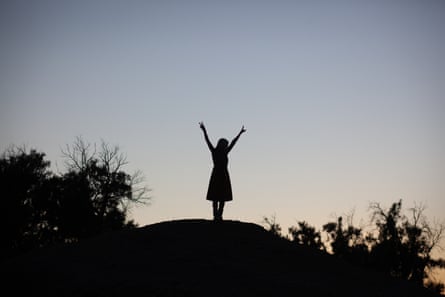
Theresa is mapping her route back to Oregon, counting on her monthly Social Security check to carry her north as she prepares to return to campground hosting. “It’s been pretty fantastic,” she says of the life she chose. “Not always easy. But pretty fantastic.”
Stephanie and Gustavo received encouraging news at a recent oncology appointment. Her prognosis has shifted. The future, once difficult to imagine, is beginning to take shape. In early June, they plan to trace the Trans-Canada Highway to Alaska, chasing long light and mountain air – somewhere they can leave the butter out.
D Rock’s bus retrofit is nearing completion, thanks in large part to Goff – bed in place, shower stall framed in, painted ceramic tiles lining the kitchen counter. After months of working side by side, D Rock surprised him with a plane ticket – anywhere he wanted. Goff decided on Peru. When New Hampshire warms again, D Rock will turn his bus north, back toward the driveways and grandchildren who mark the seasons as surely as the desert does.
Across the open country, engines wake. One by one, rigs pull out of camps, dust rising behind them. Windows slide open. Hands lift in farewell.
“See you down the road,” they call.
-
Joshua Jackson is a writer and photographer whose work explores the overlooked public lands of the American west. He is the author of The Enduring Wild: A Journey into California’s Public Lands
The Guardian wp:paragraph
هلدینگ کاسپین استانبول | خرید ملک در ترکیه | صرافی معتبر ایرانی در ترکیه | خرید و فروش طلا در ترکیه | مهاجرت به ترکیه | واردات و صادرات در ترکیه | نیازمندیهای ترکیه | اخبار ترکیه | اخبار جهانی | توریست ایران | خدمات توریستی در ایران | تورهای گردشگری ایران | هلدینگ اول | خدمات کاریابی و فریلنسری و شغل | مرجع اطلاعات ایران (همه چیز در ایران) | کیف پول و خدمات مالی و پرداخت یار | اخبار ایران | تابلو زنده قیمت ارز در ترکیه و استانبول | صرافی آنلاین ترکیه | قیمت طلا و نقره در ترکیه | سرمایه گذاری در ترکیه | جواهرات در ترکیه | نرخ لحظه ای ارزها در استانبول | قیمت دلار امروز در ترکیه | قیمت دلار استانبول امروز | قیمت لحظه ای دلار | اخبار روز ترکیه استانبول | اپلیکیشن ISTEX | اپلیکیشن قیمت لحظه ای دلار و یورو و لیر و ارزها در ترکیه
/wp:paragraph wp:paragraph /wp:paragraph
About the Author