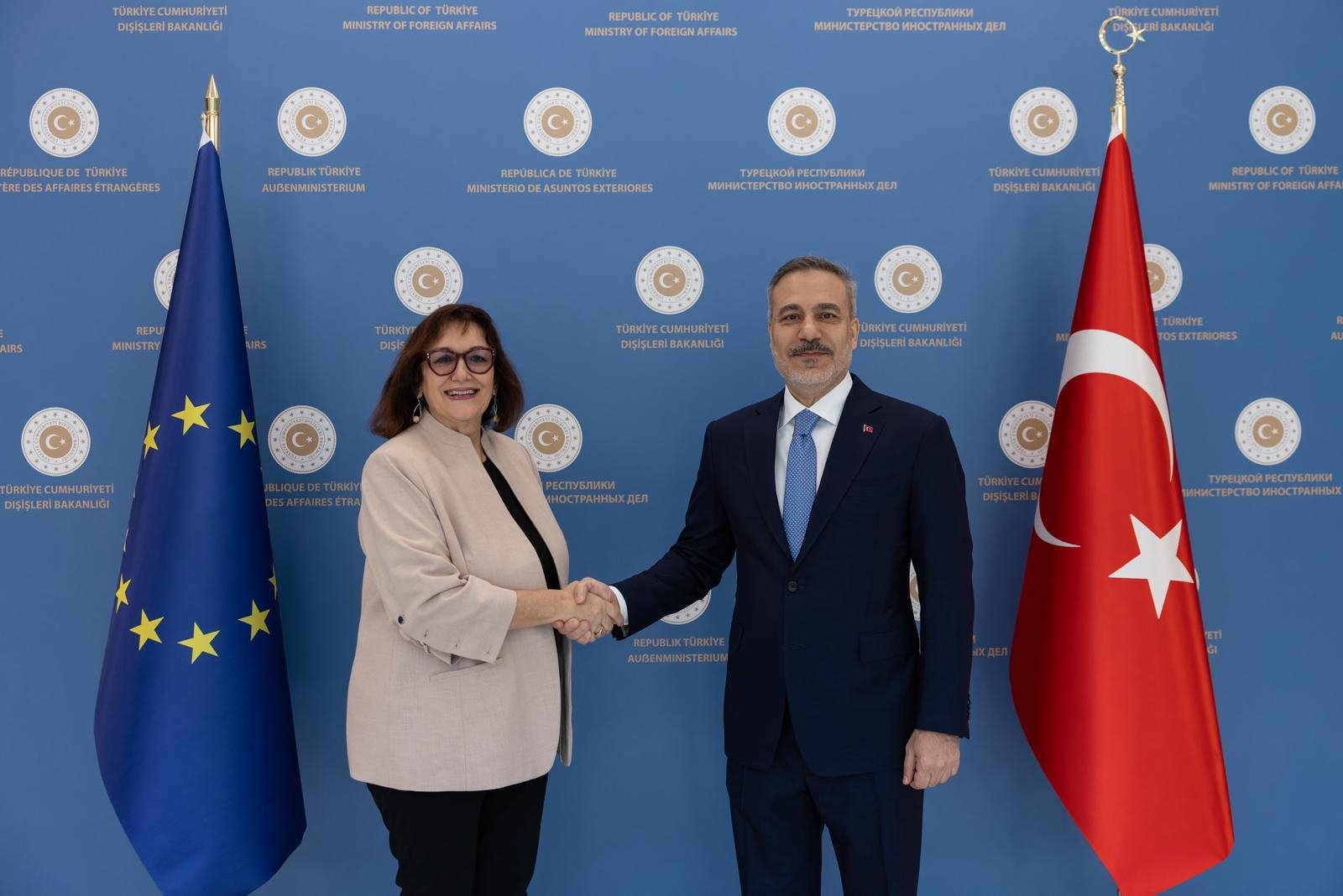
European Commissioner for the Mediterranean Dubravka Suica described Türkiye as a key strategic partner for the European Union, highlighting its pivotal location linking Europe, Asia and the Middle East.
In a written interview with Anadolu Agency (AA) following her visit to Ankara on Wednesday, Suica said her appointment as the first European Commissioner for the Mediterranean reflects the EU’s ambition to “step up partnerships” and adopt a more focused approach toward the Mediterranean and the Gulf region, noting that her portfolio also covers Gulf relations.
“A strengthened Mediterranean partnership is a strategic imperative for Europe, because our common security, resilience and prosperity can only be built together,” she said.
Suica said the European Commission has launched the Pact for the Mediterranean, bringing together the EU, member states and southern partners to build a “Common Mediterranean Space” based on shared priorities.
She said her mandate is focused on a “people-centered agenda,” developing partnerships based on “common values and dialogue,” while supporting good governance and mutual interests.
On bilateral relations, she noted the EU is strengthening ties with countries in the Middle East and North Africa through Strategic and Comprehensive Agreements, while working toward Strategic Partnership Agreements with Gulf states.
Highlighting Türkiye’s importance, Suica said: “Türkiye is a key partner for the EU. In today’s rapidly changing global context, a stronger, trust-based partnership is a clear win-win for both sides.”
She said Türkiye plays an important role in the wider Middle East and stressed the need to “deepen cooperation further to ensure stability in this volatile region.”
Referring to her recent visit, Suica said discussions covered regional developments, including the Gulf, tensions involving Iran, as well as the situations in Syria and Gaza.
She also highlighted “triangular cooperation” under the Pact for the Mediterranean, saying Türkiye could participate in initiatives related to economic development, connectivity and energy.
Türkiye’s ‘geostrategic position’
Suica emphasized Türkiye’s strategic connectivity role, saying: “Türkiye’s geostrategic position at the crossroads of Europe, Asia and the Middle East makes it an important partner for connectivity.”
She recalled EU support for strengthening transport links, particularly the Halkalı-Kapıkule railway line connecting Istanbul to the EU border, describing it as the “largest single grant under the EU’s external financing instruments” and a key part of broader regional connectivity corridors.
She also highlighted Türkiye’s role in the Trans-Caspian Transport Corridor, the EU’s connectivity agenda linking the EU, South Caucasus and Central Asia, as well as its participation in initiatives such as the Iraqi Development Road.
“Connectivity is not about a single corridor but a network,” she said, adding that cooperation should be deepened, including through frameworks such as the Black Sea strategy, with a focus on “secure, resilient and sustainable connectivity.”
Suica said the Pact for the Mediterranean includes major initiatives on climate resilience and energy transition, notably the Trans-Mediterranean Renewable Energy and Clean Tech Initiative (T-MED).
She said the initiative will support investment in clean energy, job creation for young people, trade opportunities and climate goals.
It also aims to integrate electricity markets through cooperation between Mediterranean transmission system operators and energy regulators.
She also highlighted the Blue Mediterranean Partnership, which supports sustainable aquaculture, coastal resilience and the circular economy.
Suica said joint EU efforts have produced results, noting that irregular border crossings along the Eastern Mediterranean route fell by 27% in 2025, continuing a downward trend.
“We cooperate closely with the Turkish authorities on migration-related issues within the framework of the 2016 EU-Türkiye Statement, which continues to work well. Challenges are common and responses need to be coordinated. This is more relevant now than ever, as the war ravages the region,” she said.
“For the moment, we see no large movements of people, but it is important to continue cooperating on preparedness measures,” Suica added.
Mediterranean Pact, Palestine
Addressing the fact that Palestine is one of the stakeholders of the Mediterranean Pact, Suica reiterated the EU’s commitment to a “comprehensive, just and lasting peace based on the two-state solution,” where Israel and Palestine coexist “within secure and recognised borders.”
“We are therefore working with international partners, including Türkiye, towards reviving this political process,” she said.
Referring to the deteriorating situation in Gaza and the West Bank, she noted measures announced by European Commission President Ursula von der Leyen in her 2025 State of the Union address, adding that they remain under discussion in the EU Council.
“We continue the diplomatic engagement with Israel to seek improvements on the ground, including release of withheld tax revenues to the Palestinian Authority, registration of international NGOs and access of humanitarian aid to Gaza. Dialogue on these topics with Israel remains crucial for the EU and the region,” Suica said.
DAILYSABAH
هلدینگ کاسپین استانبول | خرید ملک در ترکیه | صرافی معتبر ایرانی در ترکیه | خرید و فروش طلا در ترکیه | مهاجرت به ترکیه | واردات و صادرات در ترکیه | نیازمندیهای ترکیه | اخبار ترکیه | اخبار جهانی | توریست ایران | خدمات توریستی در ایران | تورهای گردشگری ایران | هلدینگ اول | خدمات کاریابی و فریلنسری و شغل | مرجع اطلاعات ایران (همه چیز در ایران) | کیف پول و خدمات مالی و پرداخت یار | اخبار ایران | تابلو زنده قیمت ارز در ترکیه و استانبول | صرافی آنلاین ترکیه | قیمت طلا و نقره در ترکیه | سرمایه گذاری در ترکیه | جواهرات در ترکیه | نرخ لحظه ای ارزها در استانبول | قیمت دلار امروز در ترکیه | قیمت دلار استانبول امروز | قیمت لحظه ای دلار | اخبار روز ترکیه استانبول | اپلیکیشن ISTEX | اپلیکیشن قیمت لحظه ای دلار و یورو و لیر و ارزها در ترکیه
About the Author



