The latest developments regarding Germany’s strategic posture have reinvigorated debates on decoupling in German-U.S. relations. Indeed, the bilateral relationship has been strained for some time. What has happened recently? Germany’s Chancellor Friedrich Merz commented on and criticized the U.S.-Israel war on Iran, even claiming that the Americans were humiliated by the Iranians during negotiations. U.S. President Donald Trump, in turn, argued that European NATO allies are ineffective in defending U.S. interests. Following that, the Pentagon announced that Washington would scale back its European presence by reducing troop levels in Germany by 5,000 or more. On May 4, Merz confirmed that the U.S. would not deploy Tomahawk missiles with deep-strike capabilities in Germany.
Despite these developments, Merz initially rejected the possibility of strategic disengagement between Washington and Berlin, arguing that nothing fundamentally new has occurred. In fact, these announcements are neither surprising nor indicative of decoupling. Rather, what we observe is a dual success story: the Trump administration appears to be moving beyond burden-sharing by emphasizing burden-shifting. On the other hand, Berlin is advancing beyond the “turning point” (“Zeitenwende”) declared by then-Chancellor Olaf Scholz in 2022, by asserting that the German armed forces (Bundeswehr) will become the most powerful conventional army in Europe.
First military strategy
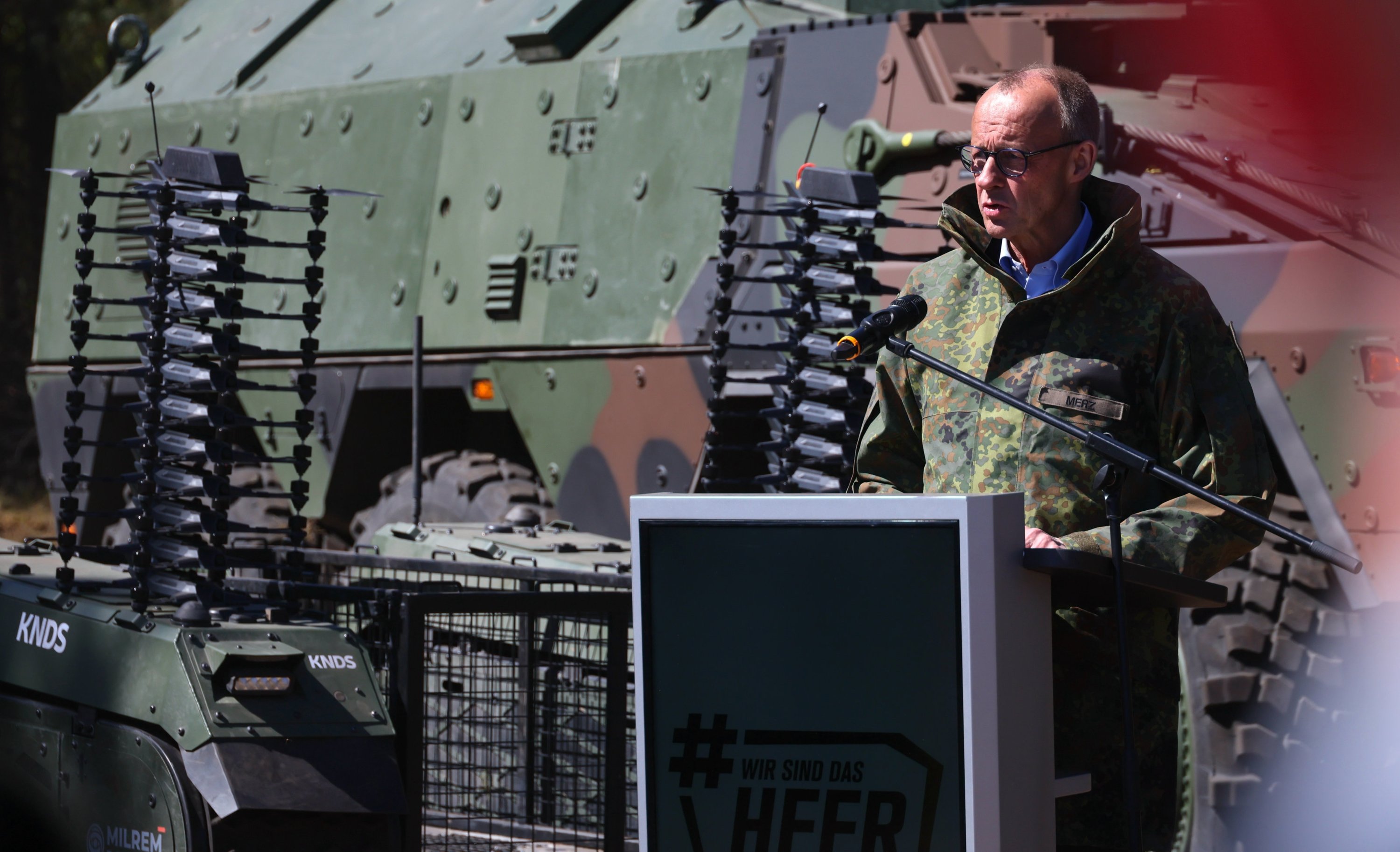
On April 22, German Defense Minister Boris Pistorius presented the Bundeswehr’s first comprehensive military strategy since its establishment in 1955. For nearly seven decades, Germany has aligned its strategic posture with NATO planning, which largely reflects U.S. grand strategy. Berlin now signals a change, indicating its readiness to assume greater responsibility for European defense within the transatlantic framework between 2035 and 2039.
Whether the document reflects a commitment to strategic autonomy remains debatable. Entitled “Responsibility for Europe” (“Verantwortung für Europa”), any notion of autonomy should be understood primarily in a European context. The document reaffirms NATO’s continued importance and emphasizes that the credibility of the U.S. commitment depends on the ability of European actors, including Germany, to develop sustainable defense and deterrence capabilities.
Russia is identified as the primary threat, consistent with prevailing assessments among NATO and EU members. The strategy further suggests that Russia may attempt to attack NATO territory in the foreseeable future. Accordingly, the Bundeswehr must be prepared to fight effectively should deterrence fail.
Rise of Germany?
The document addresses not only strategic orientation but also long-term capacity building. Once these capabilities are realized, they may significantly alter the European strategic balance, particularly in terms of Germany’s bargaining and manoeuvring capacity. At present, European defense and deterrence remain contested and unresolved issues, with multiple competing perspectives.
However, the strategy indicates that Berlin is clarifying its strategic choices. Germany is investing in forward defense and conventional deterrence, combining cost-effective low-tech solutions (such as drones) with high-tech capabilities (including deep-strike systems and air defense). Support for nuclear deterrence is also acknowledged.
Overall, Germany positions itself as a leader in European conventional defense and signals a strong commitment to this role in the near future. These developments may be interpreted as the rise of Germany.
Force structure
The strategy envisages a force structure of 260,000 active personnel and 200,000 reservists. The buildup is planned in three phases: rapid expansion by 2029, capability enhancement by 2035 and the establishment of technological superiority by 2039. While detailed figures regarding equipment, such as tanks, ships, and aircraft, are not disclosed, the document points to a shift toward a flexible, technology-driven and effects-based planning model.
Although it remains uncertain whether Germany can match U.S. technological superiority, it may achieve a relative advantage vis-à-vis Russia and other European actors.
“Verantwortung für Europa” is both ambitious and realistic. It is ambitious not only in its goal of making the Bundeswehr Europe’s strongest conventional army, but also in adopting a “one-theater” approach. The force developed under German leadership between 2029 and 2039 is intended to operate across interconnected regions, including NATO territory and the Indo-Pacific, with immediate areas of interest identified as North and West Africa, the Sahel and the Middle East.
Ensuring freedom of navigation and the security of major sea lanes emerges as a key objective. This raises an interesting question of how classical geopoliticians such as Halford Mackinder would interpret such a strategy in which a continental power seeks both land-based defense dominance and maritime access.
At the same time, the document is grounded in realism, recognizing Germany’s primary strengths in economic and technological capability.
Short of the long story, the strategy indicates that Berlin is prepared to assume the burden-shifting role advocated by the Trump administration in the latest U.S. National Security Strategy.
DAILYSABAH
هلدینگ کاسپین استانبول | خرید ملک در ترکیه | صرافی معتبر ایرانی در ترکیه | خرید و فروش طلا در ترکیه | مهاجرت به ترکیه | واردات و صادرات در ترکیه | نیازمندیهای ترکیه | اخبار ترکیه | اخبار جهانی | توریست ایران | خدمات توریستی در ایران | تورهای گردشگری ایران | هلدینگ اول | خدمات کاریابی و فریلنسری و شغل | مرجع اطلاعات ایران (همه چیز در ایران) | کیف پول و خدمات مالی و پرداخت یار | اخبار ایران | تابلو زنده قیمت ارز در ترکیه و استانبول | صرافی آنلاین ترکیه | قیمت طلا و نقره در ترکیه | سرمایه گذاری در ترکیه | جواهرات در ترکیه | نرخ لحظه ای ارزها در استانبول | قیمت دلار امروز در ترکیه | قیمت دلار استانبول امروز | قیمت لحظه ای دلار | اخبار روز ترکیه استانبول | اپلیکیشن ISTEX | اپلیکیشن قیمت لحظه ای دلار و یورو و لیر و ارزها در ترکیه
About the Author