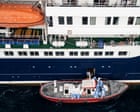
WHO chief goes through the main reported and confirmed cases so far.
He says the first case was reported in a man who developed symptoms on the 6 April and died on 11 of April. No samples were taken at the time, as hantavirus was not suspected.
His wife went ashore when the ship docked at the island of Saint Helena, also symptomatic, and she deteriorated during a flight to Johannesburg and died on 26 April.
The third victim was a woman on the ship who reported symptoms on 28 April and died on 2 May.
Another case, a man who reported to the ship’s doctor on 24 April, was evacuated the next days and remains in intensive care.
Discussing the other confirmed cases, he says:
“WHO is aware of reports of other people with symptoms who may have had contact with one of the passengers. In each case, we are in close contact with the relevant authorities. Given the incubation period of the Andes virus, which can be up to six weeks, it’s possible that more cases may be reported.”
WHO’s acting director for epidemic and pandemic management, Maria Van Kerkhove, says the WHO is “getting reports of suspect or potential suspect cases” and following them up with the relevant national authorities, pulling together all available expertise.
The first question is from the Spanish media, asking about the clear division between the Spanish and regional authorities in the Canary Islands.
WHO’s head of department for Health Emergency Alert and Response Operations, Abdirahman Sheikh Mahamud, he says he understands the concerns, but insists the risk remains “minimal.”
He says there is a “clear guidance” to plan, and the process of disembarkation “will not add additional risk.”
WHO chief Tedros Adhanom Ghebreyesus adds that the WHO made a formal request to Spain to accept the cruise under the international health regulations.
“I hope, those who have concerns at the Canary Island, will understand and support, and cooperate with the federal government. Of course we understand their concerns. But as I said in my statement, based on the risk assessment that we have, the risk to the people in the Canary Island is actually low.”
WHO chief says he is in touch with the ship’s captain regularly, including this morning.
“He told me morale has improved significantly since the ship started moving again. I thank him for everything he has done to protect those under his duty of care.”
And we’re moving to a Q&A.
WHO chief says the original pair affected is believed to have travelled through Argentina, Chile and Uruguay on a birdwatching trip, “which included visits to sites where the species of rat that’s known to carry Andes virus was present.”
WHO is working with Argentina to understand their movements and what needs to be done.
WHO chief says he asked Spain to accept the ship, and he thanks the country’s PM, Pedro Sánchez, for his help.
“The ship is now sailing for the Canary Islands, and we are confident in the capacity of Spain to manage this risk.”
He says the ship operator has been given detailed guidance how to manage the situation, with WHO and Dutch doctors now on board to help.
He says citizens of 12 countries earlier disembarked the ship in Saint Helena, and their authorities were informed about the potential risk and to trace their contacts.
These countries are: Canada, Denmark, Germany, the Netherlands, New Zealand, Saint Kitts and Nevis, Singapore, Sweden, Switzerland, Turkey, the United Kingdom, and the United States of America.
WHO chief Tedros Adhanom Ghebreyesus says:
While this is a serious incident, WHO assesses the public health risk as low.
WHO chief goes through the main reported and confirmed cases so far.
He says the first case was reported in a man who developed symptoms on the 6 April and died on 11 of April. No samples were taken at the time, as hantavirus was not suspected.
His wife went ashore when the ship docked at the island of Saint Helena, also symptomatic, and she deteriorated during a flight to Johannesburg and died on 26 April.
The third victim was a woman on the ship who reported symptoms on 28 April and died on 2 May.
Another case, a man who reported to the ship’s doctor on 24 April, was evacuated the next days and remains in intensive care.
Discussing the other confirmed cases, he says:
“WHO is aware of reports of other people with symptoms who may have had contact with one of the passengers. In each case, we are in close contact with the relevant authorities. Given the incubation period of the Andes virus, which can be up to six weeks, it’s possible that more cases may be reported.”
WHO’s Tedros Adhanom Ghebreyesus is speaking now.
He says the WHO was notified about the virus by the United Kingdom last Saturday after a cluster was reported on a Dutch flagged cruise ship, MV Hondius.
Eight cases – five confirmed, three suspected – have been reported, with three people confirmed dead.
He says people are usually infected through contact with infected rodents or their urine, droppings or saliva.
“The species of hantavirus involved in this case is the Andes virus, which is found in Latin America and is the only species known to be capable of limited transmission between humans.”
He says that in previous outbreaks, transmission between people has been associated with “close and prolonged” contact, such as among household members, intimate partners, and people providing medical care.
“That appears to be the case in the current situation,” he adds.
You can watch along below, but we will bring you all the key lines here.
Meanwhile, it looks like the Canary Islands government is doubling down on its refusal to allow the affected cruise dock there and insisting on maximum security measures to be adopted for the operation.
It will only just “anchor” in the archipelago’s waters, with the passengers set to be evacuated by boats for transfer or repatriation “without contact with the [local] population,” El País and ABC reported in the last hour.
El País also said that local port workers previously also warned they could go on strike and block the port if the cruiser was to be allowed to dock there.
We are expecting to hear from the director-general of the World Health Organization, Tedros Adhanom Ghebreyesus, shortly as he is expected to give us an update on the hantavirus situation.
We will bring you his press conference live in video and text.
Meanwhile, we are getting first details from Rubio’s meeting with Pope Leo at the Vatican.
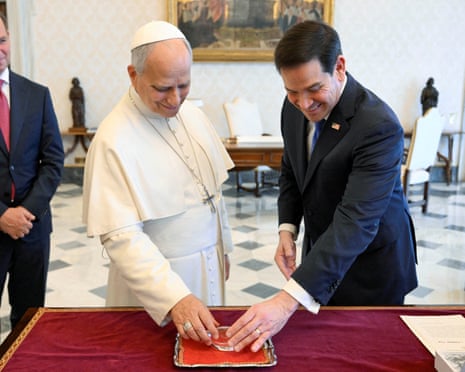
The US state department said in a statement quoted by AP that the pair discussed “efforts to achieve a durable peace in the Middle East,” which obviously are at the heart of the disagreement between Donald Trump and Pope Leo.
The meeting showed “strong” relationship between the US and the Vatican, it added.
A US official further briefed reporters that the conversations were “friendly and constructive,” with AFP noting that Rubio – a devout Catholic who has sought to play down the rift – met both the pontiff and Vatican secretary of state (and de facto chief diplomat) Pietro Parolin.
Airlines that cancel flights because of fuel shortages this summer will still have to compensate passengers under European law, the EU transport commissioner has said.
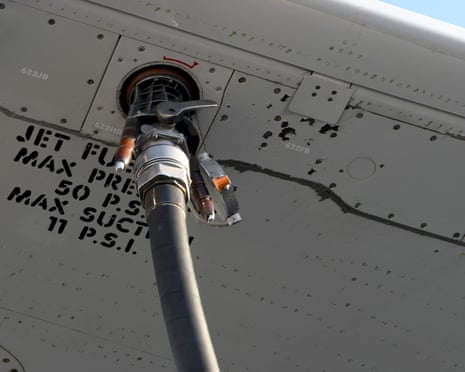
Apostolos Tzitzikostas told the Financial Times that jet fuel prices or shortages do not meet the criteria that protect EU airlines from passenger claims.
“The price of jet fuel is the reason why we have cancellations of flights and if they cancel flights without extraordinary circumstances – jet fuel prices are not extraordinary circumstances – they will have to reimburse the people,” the commissioner said.
Although the EU law remains in place in the UK post-Brexit, Keir Starmer’s government is free to take a different position. Last week, it emerged that penalties for airlines that cancel UK flights because of jet fuel shortages have been eased.
Ryanair, the biggest airline in Europe, said this week it would not be cancelling summer flights because it had hedged its fuel contracts before the Iran war broke out.
However, other airlines have cancelled flights, including Germany’s Lufthansa and Ireland’s Aer Lingus.
Tzitzikostas’s remarks came as the boss of a large airline in Asia said the fuel crisis was worse than the Covid pandemic, when planes were grounded amid global travel bans.
“I thought I’d seen it all with Covid … but having seen jet fuel go up almost three times – this is much worse,” Tony Fernandes, the chief executive of AirAsia, told the Financial Times.
Meanwhile, US secretary of state Marco Rubio has now left the Vatican after meeting Pope Leo after some two hours there.
He met initially with the pontiff before sitting down with senior Vatican officials, including top diplomat Italian cardinal Pietro Parolin, Reuters reported.
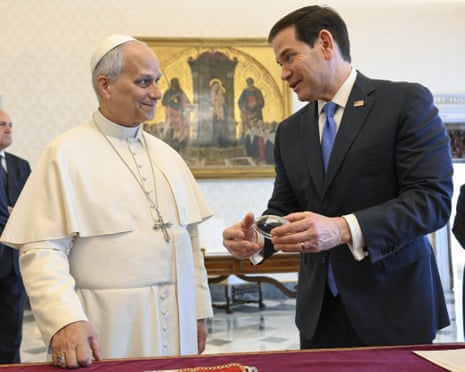
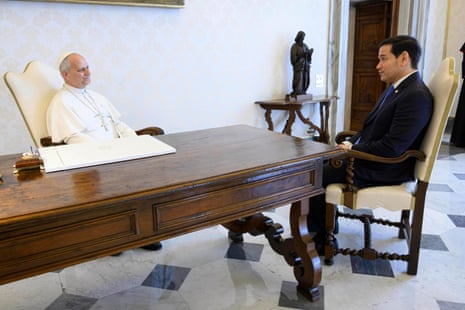
The Vatican and the US state department did not provide any immediate details about the talks.
I will bring you more if/when we get it.
“Considerable progress” was made in crunch talks with MEPs to finalise the US trade deal that has been on the table since last summer, Maroš Šefčovič, the EU trade commmissioner has said after six hours of talks last night.
The so-called “trilogue talks”, involving the European Commission, the European Parliament and representatives of member states, are the final stage in the ratification system in the bloc, a process that is testing Donald Trump’s patience.
Although they failed to agree on amendments sought by MEPs, both the trade committee chair Bernd Lange and Šefčovič are indicating a compromise is not far off.
Talks last six hours, double the time scheduled for negotiations.
“This significant investment of time and effort suggests that we are making considerable progress and have already achieved a lot – although, of course, nothing is agreed until everything is agreed,” said Šefčovič.
He said in a post on LinkedIn that he had three objectives:
“To demonstrate that the EU is walking the talk and honouring its commitments”
To secure a result that fully respects the EU-US Joint Statement.
To preserve the interests of EU stakeholders, including by equipping the Commission with the instruments necessary to ensure that the EU-US Joint Statement is faithfully implemented by both sides.”
Last Friday Trump threatened to hike tariffs on EU cars this week, in contravention of the trade deal, in protest against the lengthy delays on the EU side.
The delays were partly a response to his foreign policy, with the European parliament twice pausing ratification process over his threat to increase tariffs in January, and then his threat to take control of Greenland.
MEPs are seeking three amendments to the implementation Brussels-side – including a sunset clause which will end the deal in March 2028 unless renewed, a sunrise clause ensuring the deal will come into force on the EU side if the US respects its commitments and a suspension clause.
Speaking at the European Commission’s midday briefing, the executive’s health spokesperson Eva Hrncirova insisted that the risk to Europeans posed by the new hantarivus remained “low.”
“According to the evidence that we have at the moment, the risk for the public in Europe, the risk for the Europeans is low. Health of the citizens in Europe is our absolute priority,” she said.
She stressed there was “no cause for concern,” and the EU was working closely with the World Health Organization and the European Centre for Disease Prevention and Control to monitor the situation.
Meanwhile in Brussels, the EU said it would not leave Kyiv after Russia warned of a possible retaliatory strike on the Ukrainian capital and urged foreign organisations to evacuate.
“As to us, the EU, we will not change our posture or presence in Kyiv. Russian attacks are… unfortunately, a daily reality in Kyiv and elsewhere in Ukraine,” EU foreign affairs spokesman Anouar El Anouni said in comments reported by AFP.
Russia’s public threats to attack Kyiv are part of its reckless escalatory tactics.
The European Union’s diplomatic mission in Kyiv was damaged in August last year after Russian missiles struck close to the building.
The Guardian wp:paragraph
هلدینگ کاسپین استانبول | خرید ملک در ترکیه | صرافی معتبر ایرانی در ترکیه | خرید و فروش طلا در ترکیه | مهاجرت به ترکیه | واردات و صادرات در ترکیه | نیازمندیهای ترکیه | اخبار ترکیه | اخبار جهانی | توریست ایران | خدمات توریستی در ایران | تورهای گردشگری ایران | هلدینگ اول | خدمات کاریابی و فریلنسری و شغل | مرجع اطلاعات ایران (همه چیز در ایران) | کیف پول و خدمات مالی و پرداخت یار | اخبار ایران | تابلو زنده قیمت ارز در ترکیه و استانبول | صرافی آنلاین ترکیه | قیمت طلا و نقره در ترکیه | سرمایه گذاری در ترکیه | جواهرات در ترکیه | نرخ لحظه ای ارزها در استانبول | قیمت دلار امروز در ترکیه | قیمت دلار استانبول امروز | قیمت لحظه ای دلار | اخبار روز ترکیه استانبول | اپلیکیشن ISTEX | اپلیکیشن قیمت لحظه ای دلار و یورو و لیر و ارزها در ترکیه
/wp:paragraph wp:paragraph /wp:paragraph
About the Author



