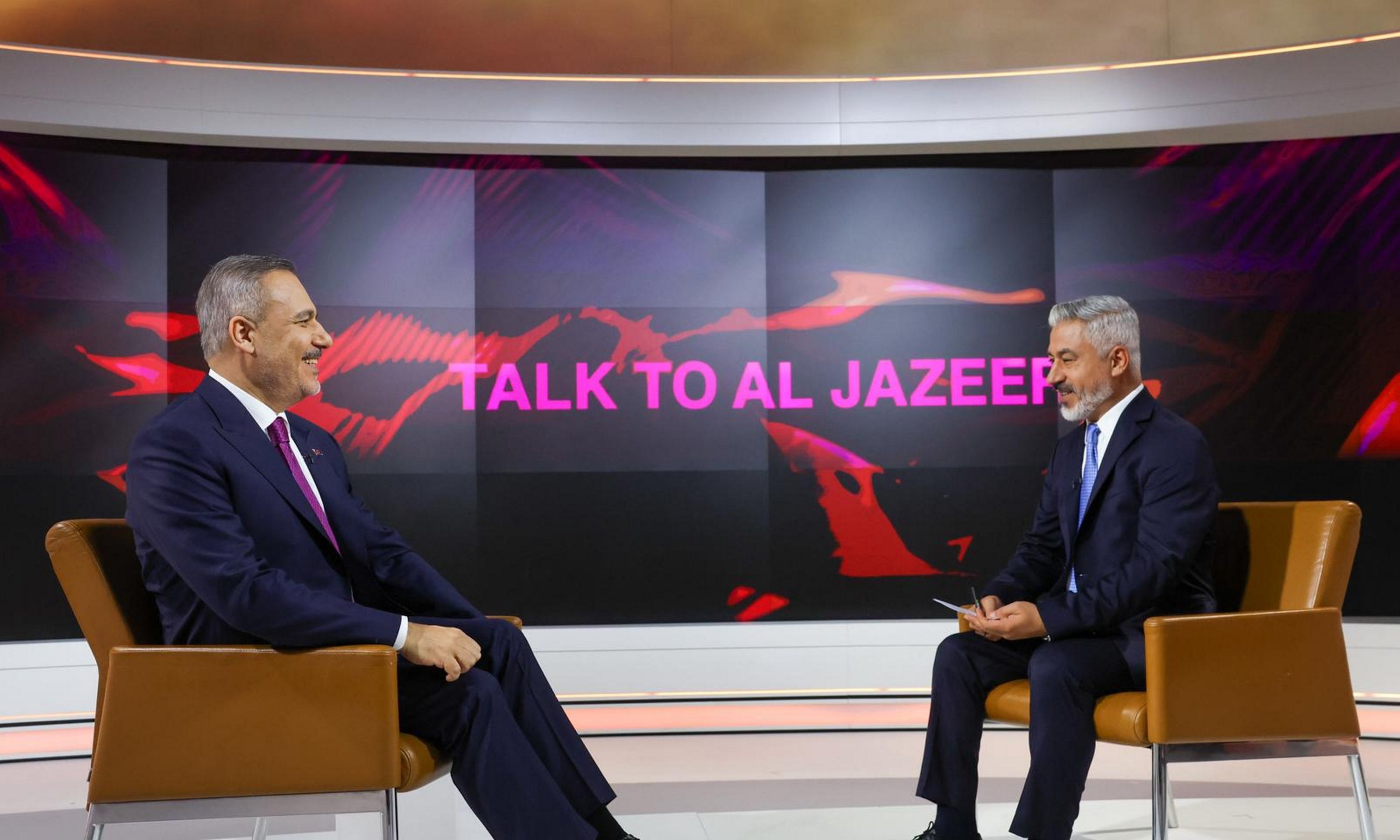
Foreign Minister Hakan Fidan said Tuesday that both the United States and Iran appear willing to prevent a return to war and pursue a lasting settlement, warning that renewed escalation would threaten regional stability, global energy security and the world economy.
Speaking to Al Jazeera’s Resul Serdar, Fidan said Türkiye’s immediate priority is preserving the cease-fire between Washington and Tehran.
“Our most urgent concern is to see that the cease-fire is holding,” Fidan said, adding that he believes there is currently “enough will” on both sides to stop the conflict.
He warned that renewed fighting could spiral into broader instability across the region.
“It is prone to escalation, it is prone to further tragedy and drama, and negative effects for both the world’s economy and regional stability,” Fidan said.
The top Turkish diplomat also stressed the importance of restoring maritime traffic in the Strait of Hormuz to prewar conditions, saying the free passage of ships is essential for global trade and energy markets.
“We want to see a free passage of all the ships, just like was happening before the war,” he said, warning that attempts to impose a new regional arrangement without broad international acceptance could become “a new source of a new conflict.”
Fidan said negotiations between the U.S. and Iran continue despite periodic disagreements, describing such setbacks as a natural part of diplomacy. He also noted that existing proposals could still be revised to produce “acceptable wording” for both sides.
Türkiye, alongside Qatar and other regional countries, is supporting mediation efforts led by Pakistan, Fidan said, adding that trusted outside partners are sometimes necessary when negotiations reach a deadlock.
“Sometimes during the mediation, the most difficult thing is when you get stuck, you are in search of creative ideas,” he said. “So you need some outside partners, trusted partners.”
Earlier on Tuesday, Fidan reiterated Türkiye’s commitment to cease-fire efforts between the U.S. and Iran and warned that the Strait of Hormuz should not be used as a “weapon.”
Iran has refused to back down in its war with Washington, with military officials warning they are prepared to respond to any renewed U.S. attack. It has choked traffic through the key Strait of Hormuz trade route, rattling global markets and giving it vital leverage, while the U.S. has imposed its own naval blockade on Iranian ports. Details of the latest U.S. proposal remain limited, though media reports say it involves a one-page memorandum of understanding aimed at ending the fighting and establishing a framework for negotiations on Iran’s nuclear program.