Let us, for a moment, suspend the present entirely. Let us leave behind not only today’s technologies, algorithms, social media platforms, artificial intelligence systems, streaming cultures, digital addictions and accelerated habits of consumption, but even the psychological structure of our own century: the anxieties of Generation Z, the hyper-visibility economies of contemporary culture, the performative exhaustion of constant connectivity and the industrialized speed through which modern civilization now consumes images, emotions and even identity itself.
Let us instead attempt something far more difficult, speculative and intellectually dangerous: to imagine the artistic, emotional, economic and civilizational landscape of humanity one hundred years from now through the eyes of Generation Alpha, the generations that follow them and perhaps even those not yet born – beings whose understanding of consciousness, reality, memory, materiality and human existence itself may become fundamentally different from anything previous civilizations have experienced.
Because the future of art will not simply be about technology. Nor will it merely concern museums becoming digital, paintings becoming immersive, or artificial intelligence becoming a creative collaborator. Those are transitional discussions belonging only to the early stages of technological civilization.
The deeper question concerns something far more existential: What becomes of art, beauty, memory, materiality and human imagination inside a future where reality itself may become endlessly editable, emotionally engineered and technologically simulated to such a degree that authenticity becomes rarer than innovation?
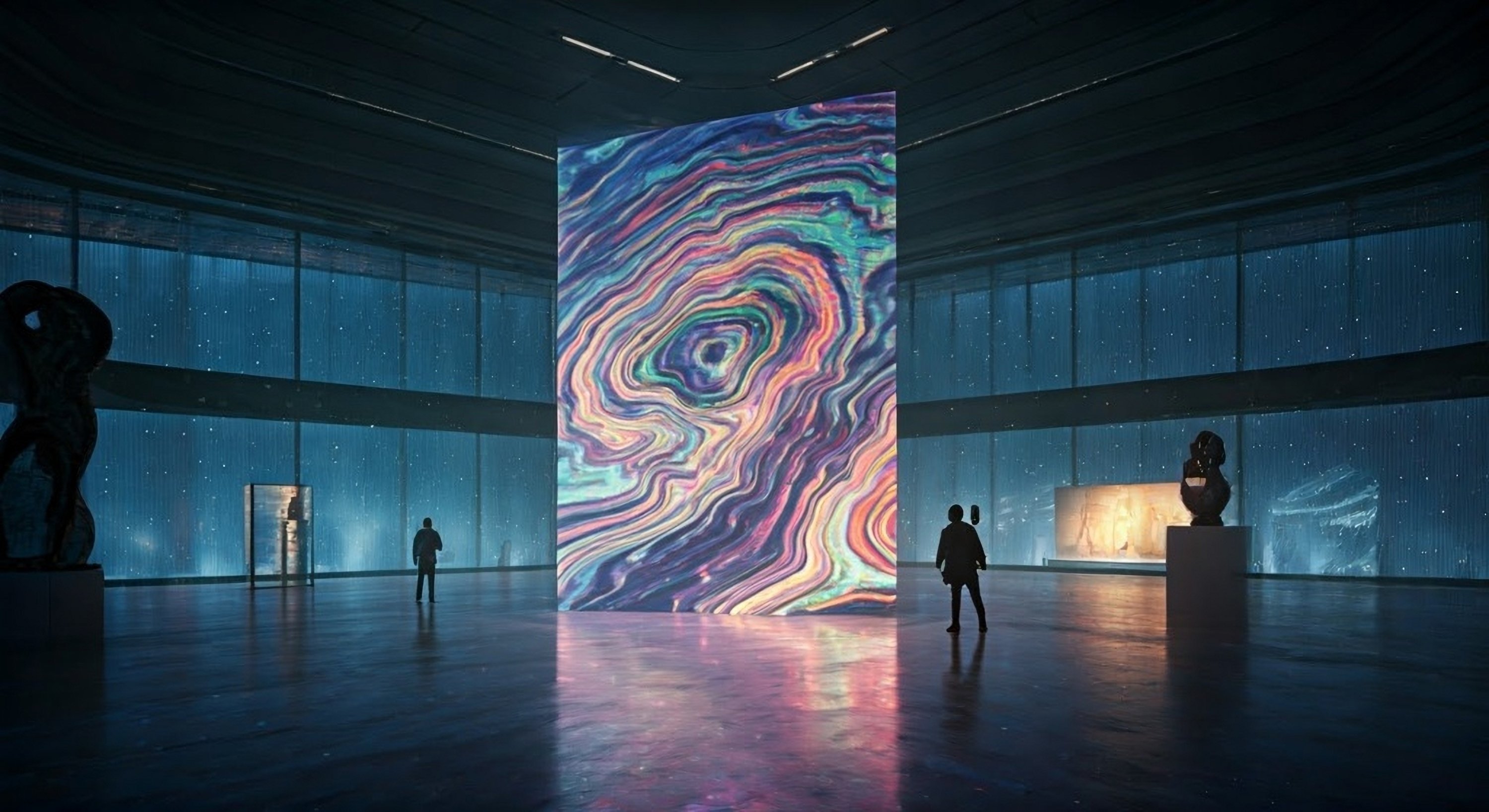
The generations born after 2025 may inherit cities embedded with intelligent architecture, atmospheric interfaces, adaptive environments, emotional surveillance systems, neural communication networks, quantum archives, synthetic ecosystems and immersive realities indistinguishable from physical existence. Entire urban landscapes may function as sentient organisms responsive to climate fluctuations, biometric emotional data, social tension and ecological instability. Walls may breathe. Buildings may self-heal. Public monuments may alter their form according to air toxicity, collective grief levels, migratory movements or geopolitical conflict. Museums may no longer stand as static institutions preserving dead objects, but rather as living sensory organisms continuously rewriting themselves according to the emotional and psychological conditions of society.
And yet, paradoxically, the more technologically sophisticated civilization becomes, the more humanity may begin craving what is primitive, tactile, imperfect, biodegradable, mortal and unmistakably human. This paradox may define the entire artistic philosophy of the 22nd century. Because one hundred years from now, technological perfection itself may become emotionally exhausting.
A civilization capable of generating infinite beauty instantaneously may eventually discover that abundance destroys awe.
When every wall can display algorithmically generated masterpieces calibrated precisely to an individual’s emotional profile, when immersive environments can simulate any historical period, any aesthetic movement, any fantasy, any memory and any emotional atmosphere within seconds, beauty alone may lose its spiritual authority.
And therefore, the future value of art may no longer emerge from perfection, but from resistance. Resistance to smoothness, to simulation, to infinite reproducibility.
The future collector may not search for flawless imagery, but for traces of mortality, evidence of human hesitation, physical labor, psychological contradiction, vulnerability, decay and material presence. A crack in ceramic may become more valuable than technical precision. The visible aging of pigment may become more emotionally significant than visual perfection. Brushstrokes may carry the emotional weight of fingerprints. Texture itself may become sacred. And perhaps most radically, materiality may return to the center of artistic discourse after centuries dominated by visuality alone. Because future generations may no longer trust images. They may trust matter.
The ecological crises of the coming century will inevitably transform artistic production at every level. Rising sea levels, resource scarcity, climate migration, desertification, atmospheric instability and ecological collapse may fundamentally alter not only where art is produced, but what art is physically made from. The future artist may work less with newly manufactured materials and more with salvaged civilizations. Ocean plastics, electronic waste, biodegradable pigments, lab-grown biomaterials, fungal architecture, carbon-absorbing surfaces, recycled metals from collapsed infrastructures, atmospheric dust, desalinated salt residues, synthetic coral structures, genetically engineered organic fibers and decomposable sculptural matter may become the dominant artistic materials of the future.
Recycling itself may cease to be merely an environmental responsibility and instead evolve into philosophical aesthetics. Future artworks may literally contain the ruins of previous civilizations.
A sculpture in 2125 may incorporate melted smartphone minerals, fragments of extinct architectural materials, recycled satellites, decommissioned military alloys, burned microchips or ocean-recovered synthetic waste transformed into emotionally charged relics of the Anthropocene era. Entire artistic movements may emerge around the archaeology of technological collapse.
Museums of the future may preserve not only masterpieces, but extinct materials. Visitors may encounter exhibitions dedicated to vanished forests, disappeared coastlines, extinct pigments or obsolete tactile experiences once considered ordinary in the early 21st century.
Imagine a future gallery where audiences gather not to view a rare painting, but to experience authentic rainwater, untouched darkness, non-filtered silence or the scent of a vanished tree species reconstructed through molecular archives.
Because environmental loss may eventually transform ordinary sensory experiences into cultural luxury. And in this future, artists may become not only creators, but ecological translators.
Future artistic practice may merge environmental science, speculative anthropology, bioengineering, ritual design, climatology and emotional architecture simultaneously. Sculptures may absorb pollution. Buildings may photosynthesize. Paintings may change color according to atmospheric toxicity. Installations may biodegrade intentionally over time as commentary on mortality and impermanence. Entire exhibitions may disappear physically after a certain duration, leaving only emotional memory behind. Permanence itself may lose prestige.
Ephemerality may become the defining aesthetic philosophy of future civilization. Because generations raised amid environmental instability may develop radically different relationships with ownership, duration and material accumulation.
Indeed, future societies may increasingly reject the industrial obsession with permanence inherited from modernity. Instead of monuments designed to outlive centuries, artists may create temporary ceremonial architectures intended to dissolve naturally into ecosystems. Future cities may contain biodegradable museums grown from organic matter rather than constructed from concrete and steel. Cultural spaces may bloom seasonally and vanish cyclically like living organisms.
Architecture, art, ecology and biology may eventually become indistinguishable disciplines. And simultaneously, entirely opposite tendencies may emerge.
While some artistic movements embrace impermanence, others may obsessively preserve human memory against planetary instability. Future collectors, governments and institutions may build subterranean climate-controlled archives designed to survive floods, wars, solar storms or atmospheric collapse. Cultural preservation may become inseparable from a survival strategy.
The future battle over cultural heritage may therefore concern not only identity, but continuity itself. Artificial intelligence systems of the next century may become capable of perfectly replicating every historical style, indigenous aesthetic language, sacred visual tradition, ceremonial architecture and artistic movement humanity has ever produced. In such a world, originality may become almost impossible to define through appearance alone.
The question will no longer be “Who made this?”
But rather: “What consciousness suffered behind this?”
This is why future societies may increasingly value art not for technical execution, but for existential authenticity.
A painting may become valuable because its creator physically experienced ecological grief, displacement, memory fragmentation, loneliness or political rupture in ways synthetic systems fundamentally cannot.
Emotional history may become the rarest artistic material of all.
And this transformation will radically alter art education.
The art schools of the 22nd century may no longer resemble academic institutions in any traditional sense. Entrance examinations based upon technical skill alone may appear primitive in a civilization where machine systems can generate technically sophisticated imagery instantly. Instead, future academies may search for perceptual uniqueness, emotional depth, symbolic intelligence and interdisciplinary consciousness.
Students may be selected according to psychological complexity rather than technical mastery.
Future art academies may combine neuroscience laboratories, ecological fieldwork, philosophy departments, climate research centers, ritual studies institutes, speculative architecture studios and sensory experimentation environments into entirely new educational ecosystems. Young artists may spend one semester studying disappearing ecosystems in submerged coastal regions, another learning ancient ceramic rituals from isolated communities preserving endangered craftsmanship traditions, another working with bioengineers to create living sculptural organisms, and another training in memory theory, emotional cognition, or post-human ethics.
The future artist may therefore resemble less a painter or sculptor and more an architect of perception. A translator between fragmented realities. A designer of emotional continuity. A mediator between humanity and technologies who is too psychologically complex to fully comprehend.
And perhaps this is because the greatest crisis of the future may not ultimately be technological, ecological or economic.
It may be perceptual.
Human beings may increasingly lose confidence in their own senses, memories, emotions and intuitions inside environments engineered by predictive systems capable of shaping desire, identity, attention, and emotional response before conscious awareness even emerges.
In such a civilization, art may become one of the final territories where ambiguity, silence, contradiction, slowness, vulnerability and unquantifiable emotional truth can still survive.
Museums may therefore evolve into sanctuaries for uninterrupted consciousness.
Silence itself may become a curated luxury experience.
Physical gathering may become spiritually significant again.
And authenticity, once casually sacrificed by early digital civilization in favor of speed, visibility, optimization and endless stimulation, may become the rarest cultural resource on Earth.
This is why future societies must begin preparing now.
Not merely technologically, but psychologically, culturally, environmentally and philosophically. Because civilizations do not collapse only through war, economic crisis, or ecological disaster.
They also collapse through emotional exhaustion, symbolic emptiness, sensory overstimulation and the gradual disappearance of meaning.
The children born after 2025 may inherit extraordinary technological miracles unimaginable to previous generations, but unless humanity simultaneously protects emotional depth, cultural memory, ecological intelligence, symbolic literacy and the fragile human capacity for wonder, future civilization risks becoming infinitely connected yet spiritually vacant.
Art, therefore, may become far more than cultural production in the next century. It may become a form of civilizational oxygen. Not because artists decorate the future.
But because they preserve humanity’s ability to remain human inside realities increasingly capable of simulating humanity itself.
DAILYSABAH
هلدینگ کاسپین استانبول | خرید ملک در ترکیه | صرافی معتبر ایرانی در ترکیه | خرید و فروش طلا در ترکیه | مهاجرت به ترکیه | واردات و صادرات در ترکیه | نیازمندیهای ترکیه | اخبار ترکیه | اخبار جهانی | توریست ایران | خدمات توریستی در ایران | تورهای گردشگری ایران | هلدینگ اول | خدمات کاریابی و فریلنسری و شغل | مرجع اطلاعات ایران (همه چیز در ایران) | کیف پول و خدمات مالی و پرداخت یار | اخبار ایران | تابلو زنده قیمت ارز در ترکیه و استانبول | صرافی آنلاین ترکیه | قیمت طلا و نقره در ترکیه | سرمایه گذاری در ترکیه | جواهرات در ترکیه | نرخ لحظه ای ارزها در استانبول | قیمت دلار امروز در ترکیه | قیمت دلار استانبول امروز | قیمت لحظه ای دلار | اخبار روز ترکیه استانبول | اپلیکیشن ISTEX | اپلیکیشن قیمت لحظه ای دلار و یورو و لیر و ارزها در ترکیه
About the Author