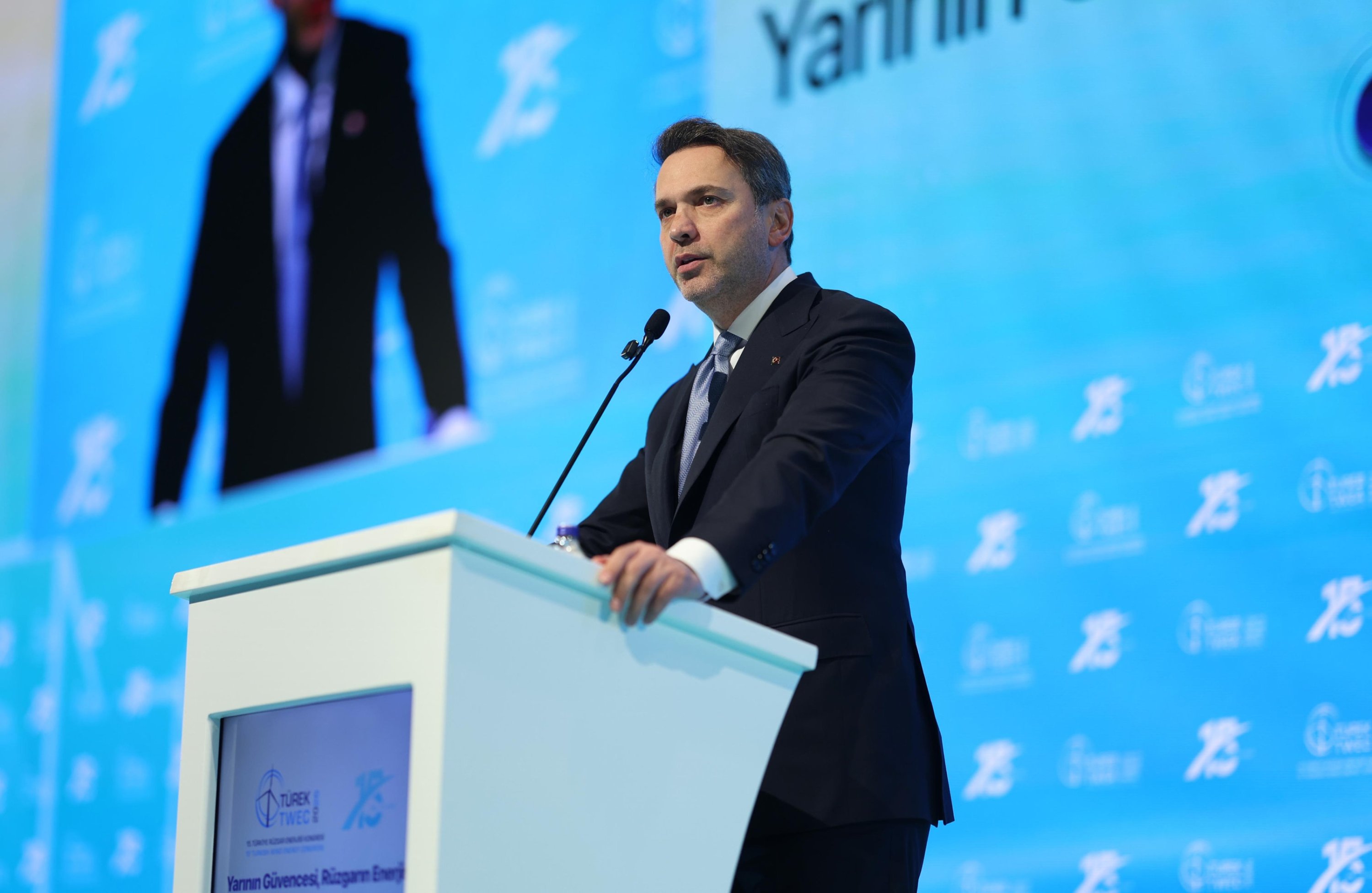
Türkiye is navigating consecutive energy crises through a multilayered set of policies, experienced management and strategic vision put forward, which have allowed it to turn challenges into opportunities, according to a top official.
Energy and Natural Resources Alparslan Bayraktar penned an article for Turkish daily Sabah newspaper ahead of the second edition of the Istanbul Natural Resources Summit (INRES 2026), set to take place on Friday.
The summit is being organized by Türkiye’s leading media group and Daily Sabah’s parent company, Turkuvaz Media, under the auspices of the Energy and Natural Resources Ministry.
In the article published on Thursday, Bayraktar evaluated Türkiye’s energy strategies, steps taken in recent years and goals, including that of “new energy architecture,” as well as becoming a “net exporter” in the boron field.
“The last six years will go down in history as a period in which successive crises have left deep marks on the energy sector on a global scale. As the war to our north, whose heavy burden on energy markets was felt from the very first day, enters its fourth year, a new crisis in our south, said to have produced the most dramatic effects in the history of global energy markets, has now entered its third month,” Bayraktar wrote.
“Thanks to the determined leadership of our President (Recep Tayyip Erdoğan), the strong infrastructure we have built, and our experienced management team, we have been able to cope with these interconnected and successive crises,” he added.
Moreover, he noted that by correctly assessing the risks in the past six years, Türkiye “has successfully emerged from these crises through multi-layered policy sets, and has even turned them into opportunities.”
He also recalled the unveiling of the National Energy and Mining Policy back in 2016, which he said “bore its first fruits in the midst of the pandemic.”
“In August 2020, we made the largest natural gas discovery in the history of the republic. We brought the natural gas, discovered with our own ships, engineers, and equipment, to land in less than three years,” he further said, referring to the discovery of gas in a vast reserve on the northern coast of the country.
“Today, 4 million households are using our domestic natural gas. This historic breakthrough was followed by our oil discoveries. We found Türkiye’s highest quality oil in Gabar, Şırnak. We are currently producing 81,000 barrels of oil per day from various fields,” he added.
‘Net exporter’ of boron
Furthermore, the minister touched upon critical minerals and said that they act on the philosophy “People first, then the environment, then value-added mining,” which he said forms the “foundation of development, industrialization, and technological progress.”
“Here, we see the utilization of our underground resources not as a choice, but as a necessity,” he maintained.
“This perspective ensures that we are minimally affected by global and regional crises. By converting our boron, rare earth elements, and other strategic minerals not only into raw materials but also intermediate and end products, we aim to become a net exporter in this field,” he added.
‘New energy architecture’
“While bringing natural resources into the economy within this crisis-opportunity equation, wars, geopolitical crises, economic developments, and technological advances are pushing us towards a new energy architecture,” he further said.
He explained that at the center of this new architecture stands out electrification, conveying the aim to “build a more resilient and flexible energy market.”
“We will implement projects that will further strengthen our infrastructure,” he said.
“By continuing to diversify our routes and corridors, we will further enhance our resilience. Each element within our energy ecosystem will be shaped into a structure that complements and operates more harmoniously with the others,” he suggested.
“While doing all this, we will also strengthen our connections with neighboring countries and regions,” he furthered.
“In this new perspective, where electricity is at the center, our natural gas, oil, and mineral resources – that is, our natural resources – will serve as foundational pillars.”
“In natural gas, with new investments in exploration and production, capacity increases, infrastructure reinforcements, overseas operations, source country-route-form diversification strategies, long-term agreements, partnerships, transfers, mergers, and share acquisitions, we will initiate a multifaceted growth drive,” he noted.
Oil exploration in Pakistan
“For oil, we will go to places within the country that have not previously been explored and will conduct new explorations. We will continue the massive operations we began with Çağrı Bey in Somalia, and will conduct further operations in Pakistan and Libya.”
“In Diyarbakır, we will carry out ambitious drilling activities in shale oil, referred to as unconventional production,” he added, referring to the more complex process of drilling, expected to take place in the southeast of the country.
“With vertical and horizontal drilling that will change the rules of the game, we will extract oil from within the rocks.”
“In mining, we aim not only to be a producer but also to develop and export innovative technologies. By focusing on value-added products in boron mining, we will increase our current 65% world boron market share. In rare earth elements, while operationalizing the second-largest single-site reserve in the world, we will also focus on advancing our refining capabilities,” he wrote.
INRES to be a cooperation platform
“In light of all these developments and goals, the 2nd Istanbul Natural Resources Summit (INRES 2026), which we will hold on May 22, is of great importance in terms of both sharing our country’s proactive actions during crisis periods and our new energy architecture with international participants,” he also said.
“Graced by the presence of our president, with the participation of many ministers and deputy ministers from Europe, Asia, and Africa, this summit will go beyond a mere agenda event and transform into an effective platform for bilateral relations in energy diplomacy, which is one of the main pillars that can shape Türkiye’s new energy architecture,” said Bayraktar.
“The summit is turning Istanbul into a well-known brand in international energy diplomacy. We hope that INRES 2026 will be an important platform for global and regional cooperation and will lay the groundwork for new energy projects that will strengthen connectivity,” he concluded.
The event comes amid unprecedented geopolitical tensions and conflicts and as Türkiye accelerates efforts to position itself as a regional energy hub through expanded natural gas infrastructure, renewable energy investments and cross-border cooperation initiatives.
The main agenda of the summit is expected to address energy security, challenges and opportunities as well as financing in the energy sector.
DAILYSABAH
هلدینگ کاسپین استانبول | خرید ملک در ترکیه | صرافی معتبر ایرانی در ترکیه | خرید و فروش طلا در ترکیه | مهاجرت به ترکیه | واردات و صادرات در ترکیه | نیازمندیهای ترکیه | اخبار ترکیه | اخبار جهانی | توریست ایران | خدمات توریستی در ایران | تورهای گردشگری ایران | هلدینگ اول | خدمات کاریابی و فریلنسری و شغل | مرجع اطلاعات ایران (همه چیز در ایران) | کیف پول و خدمات مالی و پرداخت یار | اخبار ایران | تابلو زنده قیمت ارز در ترکیه و استانبول | صرافی آنلاین ترکیه | قیمت طلا و نقره در ترکیه | سرمایه گذاری در ترکیه | جواهرات در ترکیه | نرخ لحظه ای ارزها در استانبول | قیمت دلار امروز در ترکیه | قیمت دلار استانبول امروز | قیمت لحظه ای دلار | اخبار روز ترکیه استانبول | اپلیکیشن ISTEX | اپلیکیشن قیمت لحظه ای دلار و یورو و لیر و ارزها در ترکیه
About the Author