Türkiye’s energy strategy was under the spotlight at the Istanbul Natural Resources Summit (INRES), organized by Daily Sabah’s parent company, Turkuvaz Media Group.
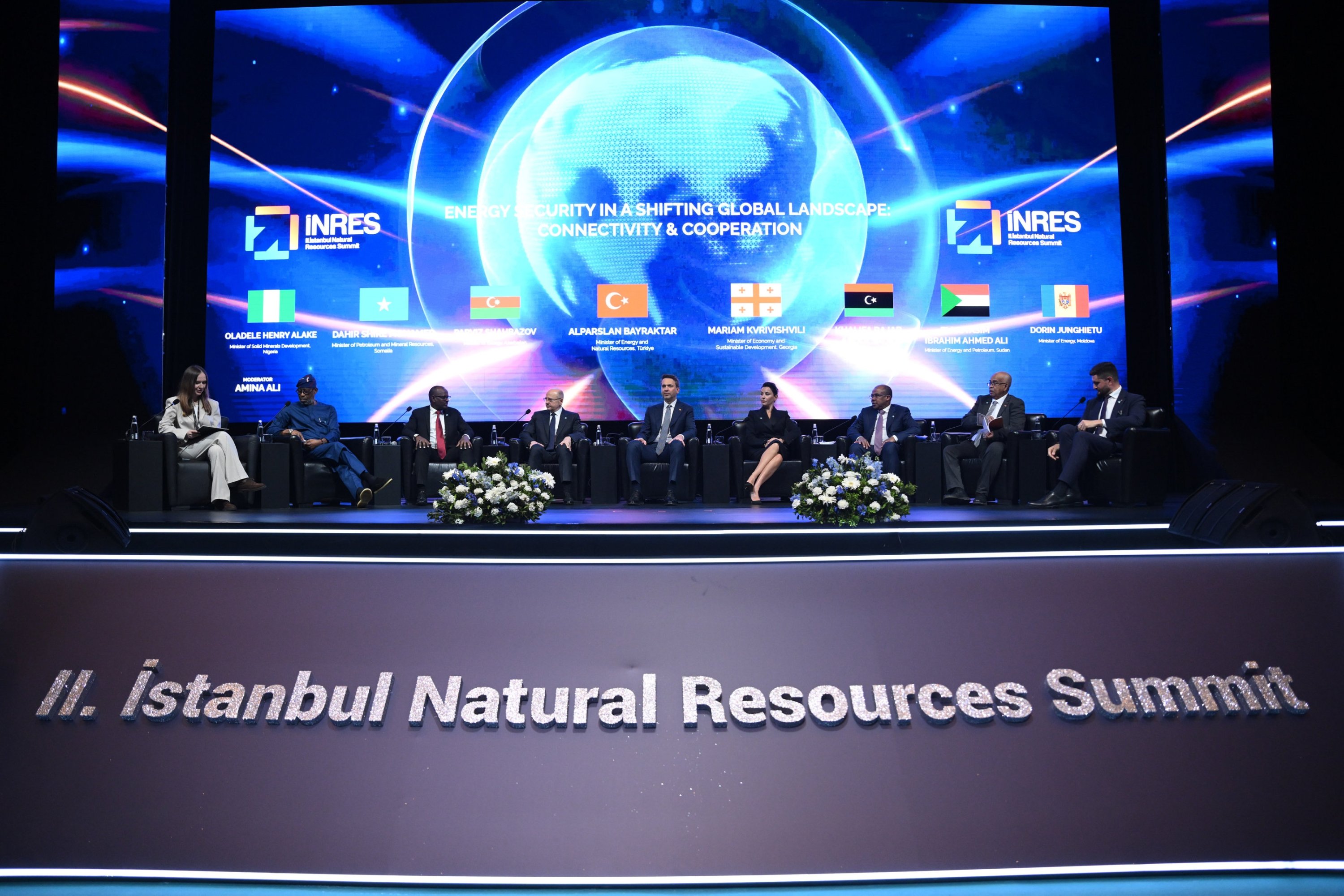
Addressing a panel at the event, Energy and Natural Resources Minister Alparslan Bayraktar highlighted the pressure of global crises on energy and how Türkiye found solutions for resilience.
The panel entitled “Energy Security in a Shifting Global Landscape: Connectivity & Cooperation,” moderated by Daily Sabah business editor Amina Ali, hosted Bayraktar, Azerbaijan’s Minister of Energy Parviz Shahbazov, Bulgaria’s Minister of Energy Iva Petrova, Georgia’s Minister of Economy and Sustainable Development Mariam Kvrivishvili, Libya’s Minister of Oil and Gas Khalifa Rajab Abdulsadiq, Moldova’s Minister of Energy Dorin Junghietu, Nigeria’s Minister of Solid Minerals Development Oladele Henry Alake, Sudan’s Minister of Energy and Petroleum Moatasem Ibrahim Ahmed and Somalia’s Minister of Petroleum and Mineral Resources Dahir Shire Mohamed.
Bayraktar’s remarks focused on global energy challenges, including the COVID-19 pandemic, supply chain crises and regional conflicts, noting that they endangered energy supply security across the world.
“Energy security has never been this difficult to maintain,” he underlined. He added that global turmoil in the past few years forced a tectonic transformation for the energy sector. “Combating global warming and climate change are now in focus for the sector. Türkiye has a comprehensive energy strategy to that extent,” he said.
Bayraktar said that for Türkiye, one of the instruments for overcoming the challenges was the utilization of renewable energy resources, especially local renewables.
He noted that Türkiye had a consistently increasing energy demand and said they had projected that future technologies like artificial intelligence and e-mobility would further increase the demand. He mentioned President Recep Tayyip Erdoğan’s remarks in Baku, where he announced Türkiye’s 2035 goals on the matter. “Our target is reaching a solar and wind power production capacity of 120 GWs,” he stated.
He also noted that Türkiye concentrated on combating climate change as well, pointing to the country’s preparations to host the upcoming COP31 summit.
The minister stated that fossil fuels would linger longer in the global market and that Türkiye has shifted gears both domestically and internationally in this field.
“We are aware that oil and gas will dominate our energy future for a while. We discovered enormous reserves in the Sakarya gas field and are working on it. At the same time, we are exploring alternative sources. Turkish Petroleum (TPAO) is conducting a technically challenging, sophisticated operation in Somalia. We aim to expand these operations to other regions as well, from Libya to Pakistan. We have a pragmatic approach to oil and gas,” he said.
On nuclear energy, Bayraktar said that they were determined to continue investments in this field, noting that after Akkuyu, nuclear energy projects were underway in Sinop and the Trakya region.
“We believe that it will not be possible to ensure energy security and achieve climate goals without nuclear power. Thus, we aim to reach at least 20 gigawatts of nuclear production. By 2050, we will have more nuclear power plants and small reactors. Türkiye will go through a nuclear renaissance and will become a new player in this technology. We aim to have at least a 5-gigawatt small modular reactor,” he said.
Rare earth elements
Bayraktar also highlighted that Türkiye was focused on a historic discovery and new facilities to save Türkiye from dependence on mining technologies and critical minerals. “We believe that value-added mining is vital. We have a pilot facility in Eskişehir’s Beylikova, where Türkiye’s largest reserves were discovered. In the second stage, we will set up an industrial facility. We are also working on enrichment technology,” he said.
Energy connectivity
For his part, Azerbaijan’s Energy Minister Parviz Shahbazov touched upon the connectivity and future projects in the South Caucasus and wider region. He stated that energy security has evolved into a matter of national security. Shahbazov cited energy crises in the Middle East and Europe as factors highlighting the importance of supply security, connectivity and partnerships.
As an example of energy integration in the new era, he pointed out future electricity interconnectors between Azerbaijan, Georgia, Türkiye and Bulgaria and other electricity links. Another prospective connectivity project he noted was the transportation of Azerbaijan’s Caspian energy sources to Türkiye and Europe via Armenia through the Zangezur Corridor.
“The Baku-Tbilisi-Ceyhan oil pipeline and the Southern Gas Corridor natural gas pipeline are currently considered among the most reliable and predictable projects. They not only connect our countries and neighbors, but also transform Azerbaijan, Türkiye and other partners into one of the key pillars of Eurasian energy infrastructure,” the minister said.
DAILYSABAH
هلدینگ کاسپین استانبول | خرید ملک در ترکیه | صرافی معتبر ایرانی در ترکیه | خرید و فروش طلا در ترکیه | مهاجرت به ترکیه | واردات و صادرات در ترکیه | نیازمندیهای ترکیه | اخبار ترکیه | اخبار جهانی | توریست ایران | خدمات توریستی در ایران | تورهای گردشگری ایران | هلدینگ اول | خدمات کاریابی و فریلنسری و شغل | مرجع اطلاعات ایران (همه چیز در ایران) | کیف پول و خدمات مالی و پرداخت یار | اخبار ایران | تابلو زنده قیمت ارز در ترکیه و استانبول | صرافی آنلاین ترکیه | قیمت طلا و نقره در ترکیه | سرمایه گذاری در ترکیه | جواهرات در ترکیه | نرخ لحظه ای ارزها در استانبول | قیمت دلار امروز در ترکیه | قیمت دلار استانبول امروز | قیمت لحظه ای دلار | اخبار روز ترکیه استانبول | اپلیکیشن ISTEX | اپلیکیشن قیمت لحظه ای دلار و یورو و لیر و ارزها در ترکیه
About the Author