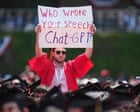
When Jacob Pagel graduated from Middle Tennessee State University this spring, predictions about artificial intelligence already had him questioning the value of his degree. Then a music executive started preaching about AI’s transformative power during a commencement speech.
“This industry will change on you in a heartbeat. It has already changed more in the last 10 years than in the 50 years prior … AI is rewriting production as we sit here,” said Scott Borchetta, CEO of the record label Big Machine. After a few stray boos from graduates, he doubled down: “Deal with it.”
The students’ jeering grew louder, but Borchetta barreled through: “You can hear me now or you can pay me later … then do something about it. It’s a tool. Make it work for you.” He continued: “The things you learned in your first year here may already be obsolete.”
Borchetta’s remarks were “a knife to the chest”, says Pagel, who studied political science and human development family sciences. He felt the boos reflected how annoyed students were about what they saw as out-of-touch executives downplaying their anxieties about AI. A 2025 Harvard poll of young people in the US found that a majority see AI as a threat to their career prospects. Pagel and his peers are entering a job market where AI’s efficiency is already being used to justify mass layoffs. While it’s unclear which jobs may be entirely replaced by AI – and whether AI could eventually create more career pathways than it destroys – recent graduates are feeling betrayed.
“We’ve been pushed our entire lives to get our diplomas. Then you pulled the rug out from underneath us, and said: ‘Oh, you know those four years you spent learning how to do very specific things, you don’t need to do it any more,’” Pagel says. “We can get a computer to do it for two-thirds the price.”
Borchetta’s speech is one of several at commencement ceremonies this spring that have revealed a disconnect between the executives championing AI and students, eliciting derision in real time even for Google’s former CEO. Recent graduates at the University of Central Florida and the University of Arizona booed speakers who compared the advent of AI to the Industrial Revolution and the development of the laptop and smartphone.
Sarah Kreps, a Cornell University professor who has studied societies’ reactions to new technology, says: “These tech executives are not reading the room … These kids have spent hundreds of thousands of dollars on a degree that they don’t know will serve them well.”
The students at these ceremonies “are a mouthpiece for the population at large”, Kreps adds. While they may feel AI’s disruptive effects acutely as entry-level job seekers, AI has proved unpopular among the general US public. A national survey conducted for NBC News earlier this year polled 1,000 registered voters and found only 26% view AI positively and 46% view it negatively. AI scored worse than US Immigration and Customs Enforcement (ICE), Donald Trump and Kamala Harris on the same poll, but better than the Democratic party and Iran. Anger against AI is palpable across the country – from communities protesting against datacenters powering the AI boom, to workers disputing their CEOs’ claims that AI can, effectively, replace them.
Pagel is considering a career in helping children undergoing medical treatment, or entering politics – perhaps running for office, or working as a liaison for federal agencies. “That sphere depends on human face-to-face interaction. No computer can take that,” he says, calling AI-generated campaign ads “the cheap route”. Pagel is not an absolutist though. He does use Grammarly, he says, “because I can’t goddamn spell”.
“Dyslexia for the win,” he adds.
Borchetta did not respond to a request for comment. But MTSU said in a statement that the university “understands and remains compassionate about our students’ concerns and questions about AI affecting their careers”.
CEOs’ graduation speeches about AI have become a preventable PR disaster, according to Parry Headrick, founder of Crackle PR, a tech public relations agency that has worked with startups. Executives should have acknowledged and reassured students’ anxieties, while also advising them to adapt. He says: “That’s the nature of the speech, versus: ‘Hey kids, buckle up.’
“What in the heck is anybody who is young and in school supposed to do when you have these tech executives beating their chests about the next Industrial Revolution when they can’t afford to buy groceries or pay for rent?” Headrick asks. Nearly half of college students said their financial stress made it hard to concentrate on their coursework, according to a 2026 report from Trellis Strategies, a research group focused on postsecondary education.
Google’s Eric Schmidt gets booed
At the University of Arizona, 20-year-old Arian Chavez, was angry about his school’s decision to let ex-Google CEO Eric Schmidt speak, even before he got on stage. Chavez, a junior studying chemical engineering, is part of a group called Students for Socialism, and helped them organize an online petition to remove Schmidt as a commencement speaker. (Activists mainly took issue with sexual assault allegations against Schmidt from a former business partner. Schmidt has vehemently denied those allegations. Patricia Glaser, an attorney representing Schmidt, said in a statement that the claims are “a desperate and destructive effort to publish false and defamatory statements to escape accountability from an existing arbitration over a business dispute”.)
In Schmidt’s graduation speech last week, he compared AI’s rise to the computer. There were already some boos as he began speaking, with a few students giving a thumbs down as the camera panned on to them.
Chavez, who was booing from the start, said some graduating students had their backs turned on Schmidt and that others were confused by the initial jeers – before Schmidt began talking about AI – but as his speech progressed, many more students joined the booing.
“I know what many of you are feeling about that. I can hear you,” Schmidt said, amid a chorus of boos. “There is a fear in your generation that the future has already been written, that the machines are coming, that the jobs are evaporating, that the climate is breaking, that politics is fractured, and that you are inheriting a mess that you did not create, and I understand that fear.”
Schmidt’s reassurances didn’t win Chavez over. “They are putting the wants and needs of billionaires over us,” he says, adding that he wished companies would use AI to make workers’ lives easier, instead of using it to “extract more profit from us, or replace us”.
“It’s up to us as engineering students to use our knowledge for the service of the planet and not billionaires,” he says. Chavez wants to work in the environmental regulation of chemical plants.
A representative for Schmidt said the former Google CEO “has tremendous respect for differences of opinion in AI but believes the best way to address these challenges is to talk about them”.
An AI-generated graduation gaffe
At Glendale Community College in Arizona, it wasn’t a graduation speaker that drew students’ ire, but the AI-powered machine reading out their names. Turns out, it missed some.
College president Tiffany Hernandez apologized and told graduates towards the end of the ceremony: “Here’s what’s happening. We’re using a new AI system as our reader,” she said, as boos roared through the arena. Hernandez paused for a few seconds and let out a few nervous laughs. “That’s a lesson learned from us.”
Aidan Benjamin, who is graduating from Glendale Community College this summer with an associate’s degree in accounting, was at the ceremony to support his cousin. He thought she would be walking the stage. She never did, because the AI announcement system never called her name.
“I was booing because I was like, this sucks. This is such a big moment for students.” Benjamin said they both laughed about the malfunction afterwards. “But it just didn’t feel good at the end of the day, like, it shouldn’t have happened that way,” he says.
The Guardian wp:paragraph
هلدینگ کاسپین استانبول | خرید ملک در ترکیه | صرافی معتبر ایرانی در ترکیه | خرید و فروش طلا در ترکیه | مهاجرت به ترکیه | واردات و صادرات در ترکیه | نیازمندیهای ترکیه | اخبار ترکیه | اخبار جهانی | توریست ایران | خدمات توریستی در ایران | تورهای گردشگری ایران | هلدینگ اول | خدمات کاریابی و فریلنسری و شغل | مرجع اطلاعات ایران (همه چیز در ایران) | کیف پول و خدمات مالی و پرداخت یار | اخبار ایران | تابلو زنده قیمت ارز در ترکیه و استانبول | صرافی آنلاین ترکیه | قیمت طلا و نقره در ترکیه | سرمایه گذاری در ترکیه | جواهرات در ترکیه | نرخ لحظه ای ارزها در استانبول | قیمت دلار امروز در ترکیه | قیمت دلار استانبول امروز | قیمت لحظه ای دلار | اخبار روز ترکیه استانبول | اپلیکیشن ISTEX | اپلیکیشن قیمت لحظه ای دلار و یورو و لیر و ارزها در ترکیه
/wp:paragraph wp:paragraph /wp:paragraph
About the Author