Home – CBSNews.com
Maybe unsurprisingly, the matter of the closure of the Strait of Hormuz came up regularly in Defense Secretary Pete Hegseth’s conversations with other countries at the Shangri-La defense conference in Singapore.
“The blockade is very much still in place, and the Strait of Hormuz came up relatively often, and usually once we talked through it, countries were reassured that the American perspective accounted for [their concerns], which it did from the beginning,” Hegseth said Saturday.
Hegseth added that a deal with Iran is intended to “reshape the global map” when it comes to energy.
“The president has talked about … how the future in energy is actually an American future, and that’s good for energy security around the world,” the defense secretary said.
“It will be an open strait, a toll-free strait, that the entire world can use then, which is the way that it should be,” he added.
Defense Secretary Pete Hegseth said Saturday the U.S. was finding success in negotiations with Iran following the president’s meeting at the White House yesterday.
“Iran knows very, very clearly what our expectations are, and that’s on the negotiating team to deliver,” Hegseth said. “They’re coming in our direction. The talks have been productive. I think they know where it needs to go, and I’m quite confident with our president, who makes nothing but great deals, that ultimately it’ll be something he’s proud to defend.”
Hegseth also provided some insight into the snags with the negotiations, saying some discussions have centered around how Iran should be prevented from getting a nuclear weapon “as technology develops.”
“Given the innovation capabilities in the United States of America, we also want to maintain an advantage and ensure that we can utilize that advantage responsibly as well,” Hegseth said. “It’s emblematic of that competing tension, guardrails conversations are productive between two strong countries, but it’s also our job to run the fastest, and certainly at the War Department we’re trying to do everything we can to maintain that advantage.”
Defense Secretary Pete Hegseth, who is in Singapore at a conference with Indo-Pacific allies, also discussed the negotiations over Iran on Saturday, saying much of the same things from before President Trump’s meeting in the Situation Room on Friday.
“Any deal that the president is willing to make, he’s only going to make it if he believes it’s a great deal for our country and the security of the world, and only one president was willing to lay it out on the line and ensure after 47 years that Iran is not capable of having a nuclear weapon,” Hegseth told reporters. “You saw it in how he’s been talking about it publicly, those goal posts haven’t shifted at all, which is the expectation of the American people, and what we’ve stated to Iran.”
“So, in the middle of negotiations, the closer they come to that reality, both now and into the future, the closer we’re going to get to that kind of a deal,” he added.
Hegseth reiterated the military, under his leadership, is ready if they do not agree.
“We’re postured even stronger today than we were on day one to address it that way if we have to, but he’d prefer not to,” Hegseth said.
The federal government slapped sanctions Friday on several Iranian individuals and companies accused of impersonating U.S.-based small businesses in order to buy restricted American hardware and software for the Iranian armed forces.
The Treasury Department accused an Iranian firm called Sorena Hushmand Samaneh of defrauding “dozens of U.S. information technology companies, resellers, and vendors out of millions of dollars.” Posing as American businesses, the Iranian company, its leader and several other people allegedly bought network security equipment that is normally subject to U.S. export controls and shipped it to Iran.
“The Iranian military’s brazen efforts to target and deceive American businesses demonstrate just how far the regime is willing to go to support its malign activities,” Treasury Secretary Scott Bessent said in a statement. “Treasury will continue to use all available authorities to cut off the Iranian regime’s access to the global financial system.”
Following a two-hour meeting in the White House’s Situation Room earlier Friday, it still remains unclear whether President Trump plans to approve a potential agreement with Iran that negotiators for both countries have discussed in recent days.
Asked if the president has made a decision, a White House official told CBS News: “President Trump will only make a deal that is good for America and satisfies his redlines. Iran can never possess a nuclear weapon.”
On Friday morning, Mr. Trump said he planned to make a “final determination” during the Situation Room meeting. In recent days, the two sides have discussed a memorandum of understanding to extend the U.S.-Iran ceasefire by 60 days, reopen shipping traffic in the Strait of Hormuz, end a U.S. blockade of Iranian ports and launch negotiations on nuclear issues.
The leaders of three international economic organizations warned Friday that if oil shipping doesn’t return to normal, there could be “increasing risks for fuel security, market conditions, and broader economic resilience” when demand picks up this summer.
The leaders of the World Bank, the International Monetary Fund and the International Energy Agency issued a joint statement after meeting on Thursday to discuss the Iran war.
For the last three months, the Strait of Hormuz — which normally carries one-fifth of the world’s oil — has been closed to most shipping traffic, and “global oil inventories are being drawn down at a record pace,” the three organizations noted. They said “the global economy continues to show resilience,” but some countries have struggled with high fuel prices, and fertilizer prices have shot up ahead of planting season.
“If shipping flows do not return to normal, continued rapid depletion of global oil inventories ahead of peak summer oil demand in the Northern Hemisphere would present increasing risks for fuel security, market conditions, and broader economic resilience,” they said.
Speaking on a panel at the Reagan National Economic Forum in California, Treasury Secretary Scott Bessent said the U.S. has seized roughly $1 billion in Iranian cryptocurrency assets.
“I believe that we have seized about $1 billion of their crypto,” he said.
“Just outright, grabbed the wallets,” he added. “Some of them may be like, typing in right now and realizing, they might not have realized that their wallet had been grabbed.”
Bessent said the assets the U.S. are seizing and have frozen were stolen from the Iranian people.
A meeting in the White House Situation Room where President Trump said he would make a “final determination” on a potential Iran agreement has wrapped up, a White House official told CBS News. It’s not clear whether he made a decision.
Mr. Trump announced the meeting shortly before 11 a.m. ET, saying the agreement would need to ensure the Strait of Hormuz reopens and Iran’s highly enriched uranium is “unearthed by the United States” and “DESTROYED.”
Earlier this week, Mr. Trump said “we’ll have to just finish the job” if talks with Iran do not result in a deal that he believes is satisfactory.
Kazakhstan has offered to take Iran’s uranium stockpile if the United States and Iran reach an accord on Tehran’s contested nuclear program, U.N. nuclear watchdog chief Rafael Grossi told the Financial Times on Friday.
The head of the International Atomic Energy Agency met with Kazakhstan’s President Kassym-Jomart Tokayev in the country’s capital of Astana this week.
The Financial Times said the Kazakh leader had expressed his country’s “openness” to store the stockpile enriched to near weapons grade level.
The estimated 440 kilograms of uranium processed to 60% purity is at the center of talks between the United States and Iran on extending the ceasefire.
Iran’s Foreign Ministry said Friday that there were “no negotiations” taking place on its nuclear program, after President Trump suggested it would relinquish its enriched uranium under a deal to end the war.
“At this stage, we are focused on ending the war, and there are no negotiations on the nuclear issue,” ministry spokesman Esmaeil Baqaei told state TV.
Stocks rose in afternoon trading on Wall Street Friday, adding to the all-time highs they set a day earlier.
The S&P 500 rose 0.2% Friday. The index is coming off six gains in a row and is headed for a ninth straight winning week, which would be the longest such streak since 2023.
The Dow Jones Industrial Average rose 382 points, or 0.8%, as of 12:01 p.m. Eastern. The Nasdaq composite rose 0.2%. Every major index is on track for records and to close out May with solid gains.
Wall Street has been gaining ground against worries that the war with Iran is worsening inflation and jeopardizing economic growth.
The U.S. and Iran are reportedly working toward a deal to extend a ceasefire, which eased pressure on oil prices. Brent crude, the international standard, fell 1.8% to $92 a barrel. It is still well above the $70 per barrel level in late February before the war began. Benchmark U.S. crude fell 1.5% to $87.59 per barrel.
High oil prices remain a key concern for Wall Street. The war has stifled the flow of oil shipments through the Strait of Hormuz, which has pushed gasoline prices, and prices for a wide range of goods, higher, feeding inflation and squeezing consumers and businesses. Prices were already rising before the war began from the ongoing impact of tariffs.
Iran’s semi-official Fars news agency said Friday that the potential deal on the table with the U.S., which President Trump said he was preparing to make a “final determination” on imminently, was still “in the final stages of ratification in Iran and has not yet been decided.”
The report questioned the president’s “claims about the Iran deal,” which Mr. Trump presented in his Friday Truth Social post as demands. They included that Tehran reopen and help to de-mine the Strait of Hormuz, and that the regime cooperate with the U.S. to have its stockpile of highly-enriched uranium “destroyed.”
The Fars report cited unnamed Iranian officials describing Mr. Trump’s statement as “a mixture of truth and lies.”
“According to these sources, it has become clear to almost everyone that these claims are invalid,” Fars claimed.
It listed what it called Mr. Trump’s “distortions,” including that Iran would be required to reopen the Strait of Hormuz “without receiving tolls, while there is no such clause in the text of the agreement.”
“Iran has insisted that after the lifting of the [U.S.] blockade, it will open the strait based on its predetermined arrangements. These arrangements can range from monitoring and inspecting ships to providing services and providing security,” it said.
“Trump has claimed that Iran is removing or destroying its nuclear material. Sources have emphasized that not only is there no such thing in the Memorandum of Understanding, but that the claim is fundamentally unfounded,” said the report.
It said the current draft agreement did include the U.S. accepting the immediate release of “$12 billion in frozen assets of Iran,” while Mr. Trump, in his social media post, said “no money will be exchanged, until further notice.”
“Another issue is the establishment of a complete ceasefire in Lebanon in accordance with Hezbollah,” the Fars report claimed – something Mr. Trump did not mention.
An average of 11 children have been killed or wounded every day over the past week in Lebanon, according to the United Nations’ children’s agency.
“We understand the vast majority of these children were impacted by airstrikes in South Lebanon,” UNICEF spokesperson Ricardo Pires told journalists in Geneva Friday.
Seven children were killed and 30 were injured on Thursday alone, he said, adding that since the announcement of the disregarded ceasefire between Lebanon and Israel on April 17, 55 children have been killed and 212 wounded.
The ceasefire didn’t stop fighting between the Israeli army and Iranian-backed Hezbollah, which swiftly disregarded the truce as “appeasement.”
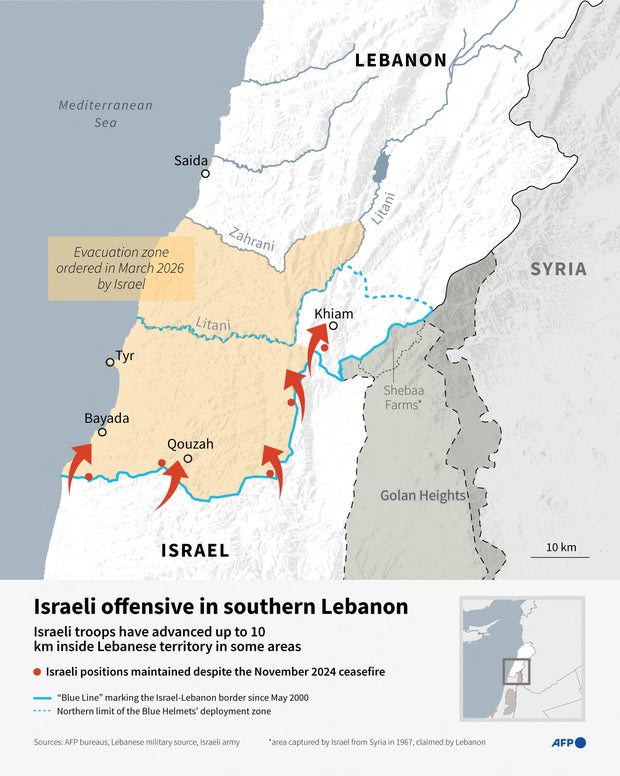
Israeli strikes pummeled towns and villages in southern Lebanon overnight on Wednesday into Thursday, after Israel announced a huge area of southern Lebanon, some 25 miles from the border, an “active combat zone” this week and told residents to evacuate.
Prime Minister Benjamin Netanyahu said Friday that Israeli ground forces had crossed over Lebanon’s Litani River, which runs around 18 miles north of the two nations’ shared border.
Israeli forces also struck a building in Beirut Friday.
“We reiterate the call for all parties to fully respect the ceasefire and to comply with international law at all times,” said Pires. “Humanitarian organizations must be granted safe, timely, and unimpeded access to all affected areas, especially in southern Lebanon, to deliver lifesaving aid.”
Another 24 ships have passed through the Strait of Hormuz in the past 24 hours in coordination with Iran’s military, Iranian state TV reported Friday.
Quoting the Islamic Revolutionary Guard Corps’ navy, a reporter with the IRIB state TV network said the number of ships authorized to pass through the waterway was much higher, but the flow of vessels was being controlled to prevent congestion.
“Vessels from other countries must only pass through designated routes, at specified times, and under permits and conditions set by Iran,” the journalist said. “If they enter the area under Iranian control without permission from Iran and the IRGC Navy, they will face a strong response from the country’s armed forces.”
President Trump insisted this week that Iran “would like to control it,” but “nobody’s going to control” the strait.
In announcing the meeting in the Situation Room, President Trump also said the U.S.would be lifting its Naval blockade of Iranian ports and ships linked to the regime.
Iran has criticized the blockade as a violation of the two countries’ ongoing ceasefire since it was imposed on April 13 – five days after the truce was announced.
Tehran retaliated for the blockade by imposing its own restrictions on all commercial vessels trying to use the strait, which has severely limited traffic through the vital waterway and driven fuel prices up globally.
It wasn’t clear whether the president meant lifting the blockade would be conditional on him accepting the current proposed memorandum of understanding with Iran, or whether the U.S. blockade was being lifted imminently.
U.S. forces deployed in the Persian Gulf region to enforce the blockade, and dozens of commercial mariners stuck in the region due to the U.S.-Iran standoff, could soon head home, the president said.
“Ships caught in the Strait due to our amazing and unprecedented Naval Blockade, which will now be lifted, may start the process of ‘heading home!'” he wrote on Truth Social. “Say HELLO to your wives, husbands, parents, and families from me, your favorite President!”
President Trump said in a Truth Social post Friday that he would be “meeting now, in the Situation Room, to make a final determination” on a potential agreement with Iran.
He indicated that the agreement on the table included Iran agreeing to work with the U.S. to have its roughly 900 pounds of highly-enriched uranium “unearthed” from damaged nuclear facilities and “DESTROYED.”
“Iran must agree that they will never have a Nuclear Weapon or Bomb. The Hormuz Strait must be immediately open, no tolls, for unrestricted shipping traffic, in both directions” Mr. Trump said.
“The enriched material, sometimes referred to as ‘Nuclear Dust,’ which is buried deep underground with virtually collapsed mountains, caused by our powerful B2 Bomber attack 11 months ago, sitting on top of it, will be unearthed by the United States (which, it is agreed, is the only Country, along with China, with the mechanical capability of doing so!), in close coordination and conjunction with the Islamic Republic of Iran, plus the International Atomic Energy Agency, and DESTROYED,” he said. “No money will be exchanged, until further notice. Other items, of far less importance, have been agreed to.”
There was no immediate reaction from Iran.
Prime Minister Benjamin Netanyahu said Friday that Israeli ground forces had crossed over Lebanon’s Litani River, which runs around 18 miles north of the two nations’ shared border.
“Our forces have crossed the Litani, they have moved up to the commanding terrain. We are operating in Beirut, in the Beqaa, across the entire front and are hitting Hezbollah head on,” he said during a visit to troops near the border, according to a video released by his office.
“The brigade commanders tell me, as do the soldiers, that in every contact with them, in every encounter, we both eliminate Hezbollah and drive them away,” he said, lauding the moves to expand Israel’s control over Lebanese territory as it pushes back against Iranian-backed Hezbollah.
Israel’s military declared a huge area of southern Lebanon, all the way up to the Zahrani River, some 25 miles from the border, an “active combat zone” this week, and warned residents to evacuate.
Sylvie HUSSON and Omar KAMAL/AFP/Getty
Oil prices fell and U.S. stock market inched higher after opening Friday, adding to records a day earlier on optimism over a tentative deal to extend the ceasefire in the war with Iran.
The Dow Jones Industrial Average was up 0.5% to 50,902.56 points in early trading, while the S&P 500 Index rose 0.4% to 7,594.10. The largely tech stocks on the Nasdaq Composite Index were up 0.5% to 27,062.47.
On Thursday, negotiators from the U.S. and Iran reached a tentative deal on extending their ceasefire by 60 days and holding a new round of talks on Iran’s nuclear program, a U.S. official said, though Iran has vehemently denied the reports. Vice-President JD Vance said that while the two sides had “made a lot of progress,” it’s “still TBD” whether President Trump will sign off on a deal.
Oil prices fell Friday, with Brent crude, the international standard, slipping $1.26 to $91.44 a barrel. It was trading around $70 per barrel in late February before the war began. Benchmark U.S. crude fell $1.03 to $87.87 per barrel.
“The oil market continues to edge lower amid growing optimism that the U.S. and Iran are moving toward a deal,” ING commodities strategists Warren Patterson and Ewa Manthey wrote Friday. “A reopening of the strait would offer some immediate relief to the oil market with tankers leaving the Persian Gulf. However, the recovery is still uncertain.”
CBS/AP
President Trump is the only person not to have accepted “Iranian management” of the Strait of Hormuz, an Iranian government official said Friday.
In a post on X Friday, Ebrahim Rezaei, the spokesperson for Iran’s National Security and Foreign Policy Commission, claimed that “Iranian management” of the vital waterway “has been established globally.”
“Countries obtain permission, pay fees, and pass their vessels under the guidance” of Iran’s Islamic Revolutionary Guard Corps, he wrote.
“The only person who has not accepted this or does not want to accept it is Trump. Every now and then, he sends his army to ‘open the strait,’ they come, get beaten, and return.”
Iranian officials have said the regime is working with U.S. ally Oman, the other nation with a coastline in the Strait of Hormuz, to establish a new mechanism to control traffic through the strategic waterway. Oman has not confirmed any role, but Iran has created what it calls the Persian Gulf Strait Authority (PGSA) to coordinate with shippers.
The U.S. on Thursday announced sanctions against the PGSA, which Iran says ensures safety and collects “fees” for vessels to transit the strait.
Reacting to reports about the new system Iran is trying to impose on the strait, President Trump told reporters Wednesday that Tehran “would like to control it,” but “nobody’s going to control it.”
“Oman will behave just like everybody else or we’ll have to blow them up,” said the president, adding: “They understand that. They’ll be fine.”
The “winner” in any deal reached between the U.S. and Iran will be “the side that is better prepared for war” if the agreement falls apart, Iran’s chief negotiator said Friday.
Vice President JD Vance said Thursday that Iran and the U.S. were “very close,” but “not there yet,” to agreeing on a memorandum of understanding that, according to U.S. sources, would extend the current ceasefire for two more months, reopen the Strait of Hormuz, and spark deeper talks on contentious issues including Iran’s nuclear program.
In an X post on Friday, Iranian negotiator Mohammed Bagher Ghalibaf said his country was obtaining “concessions not through talks, but through missiles.”
“Negotiations are only for making them understand those concessions,” he said of the U.S., adding that Tehran has “absolutely no trust in guarantees or words — only actions matter. No step will be taken before the other side acts first.”
“The winner of any agreement is the side that is better prepared for war the day after it is signed,” Ghalibaf concluded.
Iranian state media, citing a source close to the country’s negotiating team, reported Thursday that no peace agreement had been “finalized nor confirmed.”
Danish intelligence said Friday that Iran was playing a larger role when it came to the threat of terrorism against the Scandinavian country, adding that the threat assessment was mirroring global developments.
The Danish national security and intelligence service PET said the overall threat to Denmark remained at four on their five-point scale, but added that in recent years the threats had “changed significantly in character.”
“Over the past year state actors have become increasingly important to the terror threat. We assess that this applies in particular to Iran, which poses a threat especially to Israeli and Jewish interests as well as certain Iranian dissidents in Europe, including Denmark,” Finn Borch Andersen, head of PET, said in a statement.
“The threat from Iran emanates from the Iranian intelligence services, which make use of both criminal networks and the recruitment of operatives in Europe to plan and carry out attacks,” he added.
In neighbouring Sweden, the Swedish Security Service (Sapo) has also accused Iran of using criminal gangs to commit “acts of violence” against Israeli interests and Iranian opposition figures in Sweden – a claim Iran has denied.
A shadowy group that emerged online this year, believed by analysts to have links with pro-Iranian networks, has claimed responsibility for a string of arsons and other incidents targeting Jewish communities in Western Europe. A member of the group told CBS News in March that it would “keep threatening U.S. and Israeli interests worldwide until we’ve avenged every child in Gaza, Iran, Lebanon, and the resistance nations.”
CBS/AFP
A Greek national has been charged with assisting the intelligence service of a foreign nation, believed by authorities to be Iran, according to the London Metropolitan Police.
Ioannis Aidinidis, 46, was allegedly involved in the targeting of a U.K.-based journalist working for Iran International, an Iranian opposition outlet based in London.
“The country to which the allegations relate is believed to be Iran and the allegations relate to the targeting of a UK-based journalist working for Iran International,” the police said in a statement.
Aidinidis was arrested in West Sussex, near London, by counterterrorism police on May 16, according to the police. He was due to appear in court Friday afternoon.
“We know this may cause concern for many people here in the U.K., and particularly those working in Persian-language media,” said Helen Flanagan, the head of the London force’s counterterrorism unit. “We continue to work closely with a number of organizations and individuals to provide them with advice and support around their safety and security and this includes the specific individual and organization linked to this investigation.”
The Iranian regime has branded Iran International, which is funded by Saudi Arabia, an “enemy of the state.”
In 2023, London police warned the outlet’s staff that British authorities could not “safeguard them from Tehran-backed assassins or kidnappers on UK soil.”
In March 2024, Iran International journalist Pouria Zeraati was wounded in a stabbing attack outside his home in London.
Doctors Without Borders (MSF) has called on Israel to guarantee the protection of civilians as Israeli forces escalate their operations in neighboring Lebanon. The medical charity said the situation was worsening and that civilians continued arriving at hospitals it supports with severe wounds.
In a statement Thursday, the head of MSF in Lebanon, Jeremy Ristord, said “despite the so-called ceasefire, we are currently witnessing an alarming situation in southern Lebanon,” with Israel’s “large-scale forced displacement orders … impacting most of the south.”
“In the hospitals we support, civilians continue to arrive with severe injuries,” said Ristord, “including skull fractures, traumatic brain injuries, and shrapnel from drone explosions lodged in their lungs and liver.”
“In some cases, entire families have been injured or killed,” the MSF representative said, adding that the situation was “worsening” and reiterating the group’s calls for Israeli authorities to guarantee the protection of civilians, medical and rescue personnel, and health facilities.
According to Lebanon’s health ministry, 3,324 people have been killed in the country since the war between Hezbollah and Israel began on March 2, while some 10,000 others have been wounded. Authorities say more than 1 million Lebanese have been displaced from their homes.
Israeli forces have killed a Hamas commander who led a battalion for the group during the Oct. 7, 2023 terrorist attacks, according to Israeli security services.
The Israel Defense Forces and Shinbet intelligence agency said in a joint statement Friday that forces “struck and eliminated” Imad Hassan Hussein Aslim, the Deputy Commander of the Gaza Brigade and commander of Hamas’ Zeitoun Battalion, in operations on Wednesday.
Aslim had “advanced dozens of imminent attacks against IDF soldiers operating in the Gaza Strip,” read the bulletin, which added that another Hamas fighter was “present at the site that was struck.”
On Thursday, Israel’s Channel 12 aired remarks by Prime Minister Benjamin Netanyahu saying he had directed the IDF to take 70% of Gaza.
“At this point, we are fully in control of 60% of the territory of the Gaza Strip,” and my directive is to get to … 70%,” he told a conference.
Israel has continued pressing its operations in Gaza while also taking control of more territory in neighboring Lebanon, as it pursues parallel fronts against Iran’s proxy groups amid its joint war with the U.S. against the Iranian regime.
Hamas, and Hezbollah in Lebanon, have for years been among Iran’s most powerful regional allies, and in the wake of the Oct. 7 attacks, Israel has capitalized on close ties with President Trump to go after both groups.
President Trump called Qatar’s Emir Sheikh Tamim bin Hamad Al Thani on Thursday to discuss the latest developments in the Middle East, according to the Qatari government.
The leaders’ discussion focused on regional and international efforts aimed at deescalation and enhancing stability, the statement said.
Al Thani “stressed the need to prioritize political and diplomatic solutions and dialogue between all parties in order to consolidate regional security and stability and spare the region further tension and escalation,” according to the readout.
Mr. Trump, meanwhile, “expressed his appreciation for the role played by the State of Qatar in supporting Pakistani mediation efforts” between Iran and the U.S., “praising Qatari efforts aimed at bringing viewpoints closer and advancing de-escalation efforts in the region.”
Lebanon’s culture minister told the French news agency AFP Friday that Israeli strikes on the country’s south were putting heritage sites in “serious danger,” adding that a castle had been directly hit.
A ceasefire between Israel and Lebanon came into effect on April 17, but it never halted fighting between Israel and the Iranian-backed group Hezbollah, which has long been based in Lebanon. Hezbollah, designated a terrorist organization by the U.S. and Israel, was not party to the negotiations and quickly rejected the truce.
Both Israel and Hezbollah have accused each other of violating the ceasefire almost daily, and use those accusations to justify their ongoing attacks.
“Bombings fell very close to the ruins of Tyre,” a UNESCO World Heritage site, Culture Minister Ghassan Salame said Friday.
The medieval Beaufort castle overlooking Nabatieh was “directly hit … we know that several bombs fell on this fortress,” he added. “The intensification of the battles means that these sites are in serious danger.”
In recent days, Israel has issued repeated evacuation warnings, widening what it considers an active combat zone to a vast swath of southern Lebanon and telling tens of thousands of residents to flee for their safety.
Early Thursday, Israel’s military warned it would target a building in Tyre which it showed on an accompanying map as located very close to the city’s archaeological area. Around two hours after the warning, AFP video showed a fireball followed by smoke as a strike hit the district.
Security talks between Israel and Lebanon are due to take place Friday at the Pentagon, according to Lebanese media, after a week of escalating Israeli military operations along the two countries’ shared border that saw Israeli forces push deeper into the neighboring nation.
Citing unnamed sources, Lebanon’s Aljadeed TV reported Thursday that the meeting was expected to pave the way for broader political negotiations scheduled for June 2.
Lebanese media reports said the Lebanese military delegation would be headed by Brig. Gen. Georges Rizkallah, Director of Operations for the Lebanese Army.
The delegation is expected to push for a fortification of the ongoing ceasefire, which has been strained by ongoing fighting between Israel and the Iranian-backed group Hezbollah in Lebanon.
The Lebanese side is expected to present a paper outlining issues facing Lebanon’s government in disarming Hezbollah, and challenges the army faces in carrying out its mission to secure the country.
Israeli officials are expected to push for a joint security and military strategy aimed at tightening border control, including the establishment of a joint operations room — a proposal that would be contentious in Lebanon.
The Israeli army issued more evacuation orders on Friday, meanwhile, telling residents of multiple Lebanese villages that Hezbollah was operating near their homes and they must flee for their own safety.
The memorandum of understanding between Iran and the United States is neither “finalized nor confirmed,” Iran’s semi-official Tasnim news agency reported Thursday evening, citing a source close to the country’s negotiating team.
“Contrary to what Western sources claim, the text of the potential memorandum of understanding has neither been finalized nor confirmed so far,” the source was quoted as saying, adding that Tehran had not informed Pakistani mediators of any finalized draft.
When a text is completed, they added, “Iran will announce it to the Pakistani mediator and to the public. Until then, any narrative from Western sources claiming the drafting has been completed is incorrect.”
U.S. sources told the White House press pool earlier Thursday that a tentative agreement had been reached on a memorandum of understanding that would see a 60-day extension of the current ceasefire, a reopening of the Strait of Hormuz, and negotiations over contentious issues including Iran’s nuclear program, but that it was still pending President Trump’s approval,
Asked later Thursday about efforts to strike a deal, Vice President JD Vance told reporters: “We’re not there yet, but we’re very close, and we’re going to keep on working at it.”
Secretary of State Marco Rubio will meet with Pakistani Foreign Minister Muhammad Ishaq Dar on Friday, as Pakistan helps mediate indirect talks between the U.S. and Iran.
Rubio and Under Secretary for Political Affairs Allison Hooker are meeting at 10 a.m. in Washington with Dar, who also serves as Pakistan’s deputy prime minister, according to Rubio’s public schedule.
The meeting comes as the U.S. and Iran discuss a memorandum of understanding that could extend their ceasefire for 60 days and begin talks over Iran’s nuclear program. Vice President JD Vance said earlier Thursday that negotiators are still “going back and forth” and making progress, adding later, “we’re not there yet, but we’re very close.”
The Treasury Department imposed new sanctions Thursday on firms that allegedly help Iran’s military-owned petroleum company export its oil, as the Trump administration pushes to restrict Iran’s ability to make money through oil sales to China and other markets.
The department said the military-owned petroleum company “depend[s] on access to shadow fleet vessels willing to transport the military’s oil.”
The new sanctions target several Hong Kong-based companies that allegedly play a role in that network, including two vessel charterers, two front companies for the military-run firm and a company that supplies refined petroleum products like gasoline to Iran’s state oil company.
Eight vessels were also sanctioned.
Asked about efforts to strike a deal with Iran, Vice President JD Vance told reporters Thursday: “We’re not there yet, but we’re very close, and we’re going to keep on working at it.”
Vice President JD Vance said the U.S. is still negotiating with Iran on the terms of a possible deal between the two countries, and it’s still not clear when or if President Trump will sign an agreement, though he added that negotiators have “made a lot of progress.”
Asked by reporters whether Mr. Trump could sign a memorandum of understanding that the two sides are discussing, Vance said: “It’s hard to say exactly when, or if, the president’s going to sign the MOU. We’re going back and forth on a couple of language points.”
Vance said the Iranian negotiators “want a deal,” though they are still discussing some points, including possible restrictions on Iran’s nuclear program.
“We’re going back and forth with them. We do think they’re negotiating at least so far in good faith, and we’re making some progress,” the vice president said while traveling back to Washington after delivering a commencement address at the Air Force Academy. “Hopefully, we’ll continue to make progress [and] the president will be in a position where he can endorse the agreement, but obviously, that’s still TBD.”
U.S. sources told the White House press pool earlier Thursday a tentative agreement had been reached for a memorandum of understanding to extend the U.S.-Iran ceasefire by 60 days and open negotiations on Iran’s nuclear program, but it was pending Mr. Trump’s approval. Tehran has not yet provided its response to the latest version.
A tentative agreement has been reached for a 60-day memorandum of understanding to extend the ceasefire and continue negotiations with Iran over its nuclear program, but it’s pending President Trump’s approval, U.S. sources told the White House press pool.
Axios first reported the tentative agreement. Treasury Secretary Scott Bessent is expected to brief reporters Thursday afternoon.
In the past, Mr. Trump has been critical of potential agreements. On Wednesday, he insisted any deal has to be a good one.
“I think they are starting to give us the things that they have to give us, and if they do, that’s great, and if they won’t, then the man on my left is going to finish them off,” Mr. Trump said of Iran on Wednesday. “Attack them.”
wp:paragraph
هلدینگ کاسپین استانبول | خرید ملک در ترکیه | صرافی معتبر ایرانی در ترکیه | خرید و فروش طلا در ترکیه | مهاجرت به ترکیه | واردات و صادرات در ترکیه | نیازمندیهای ترکیه | اخبار ترکیه | اخبار جهانی | توریست ایران | خدمات توریستی در ایران | تورهای گردشگری ایران | هلدینگ اول | خدمات کاریابی و فریلنسری و شغل | مرجع اطلاعات ایران (همه چیز در ایران) | کیف پول و خدمات مالی و پرداخت یار | اخبار ایران | تابلو زنده قیمت ارز در ترکیه و استانبول | صرافی آنلاین ترکیه | قیمت طلا و نقره در ترکیه | سرمایه گذاری در ترکیه | جواهرات در ترکیه | نرخ لحظه ای ارزها در استانبول | قیمت دلار امروز در ترکیه | قیمت دلار استانبول امروز | قیمت لحظه ای دلار | اخبار روز ترکیه استانبول | اپلیکیشن ISTEX | اپلیکیشن قیمت لحظه ای دلار و یورو و لیر و ارزها در ترکیه
/wp:paragraph wp:paragraph /wp:paragraph
About the Author