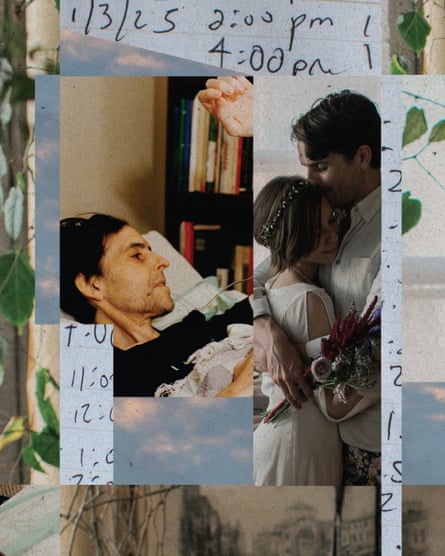
“This isn’t where I want to die,” my husband, Craig, whispered to me.
We were in a shared room on the top floor of NYU Langone hospital in Manhattan, the window obscured by a long privacy curtain. I barely had space to stand next to his hospital bed under the bright fluorescent lights, our thoughts interrupted by the constant beeping of machines.
Tall and athletic, Craig loved staying out dancing until the early mornings at Bushwick clubs. He moved from England in his 20s for a PhD in comparative literature and never left. “As a bloody foreigner I grew up with the National Health Service, and thus did not immediately understand the US concern with healthcare costs,” he once wrote years ago. “In Britain, it’s free.”

Nearly three months after that day in the hospital, I helped him pass away from bladder cancer in the home hospice of our Brooklyn apartment, exactly where he wanted to be. I was 37 and Craig was 49.
It cost over $65,000 – money we didn’t have, raised in a panic from friends and family – to give him the death he deserved.
Before we could bring him home, we first had to survive that hospital room.
It was December 2024, and our fourth emergency hospital stay of the year. By then, we were veterans. We had established a packing list: sleeping masks, toothbrush, warm sweater, ginger chews for nausea, ostomy supplies. When we arrived by cab, Craig got out and hugged the closest tree on the sidewalk. That was the final time he walked outside.
In the emergency room, a man was pleading with the receptionists, angry that he wasn’t being prioritized for his painful toe. I breathlessly explained Craig’s medical history to the intake nurses. By then, I knew it by heart. They wheeled him in immediately.
He was transferred to the ICU in the middle of the night. I paced the familiar, wide corridors to grab food and drinks. I ran into our ICU nurse from November, who saw me and said: “Of course I remember you and Craig. I always remember the best ones.”
Sara, our friend who drove Craig to all 39 of his radiation appointments, came to visit. I took out my kraft sketchbook and wrote down his wishes for his burial. He wanted a chant and response. He wanted people together. He specifically wanted to end in a raucous singalong to Death Is Not the End, just like in that 1995 music video with Nick Cave, Kylie Minogue and Shane MacGowan – mournful but elated.
The NYU palliative team came in and told us it was a miracle Craig still had any cognitive function. When they first visited him, they thought he would be in a vegetative state. He had just enough blood transfusions to temporarily relieve his severe anemia that caused profound fatigue. His hemoglobin was half of what it should be. Even crossing the room was exhausting.
“Now is the time,” Sara said. He had prepared a message on his phone to share with family and friends.
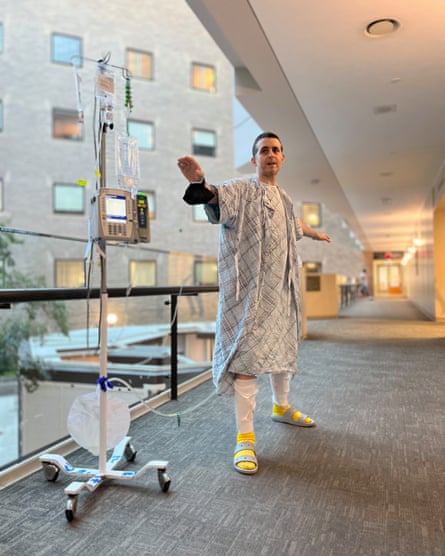
Craig took out his phone under the fluorescent lights. Multiple IV lines ran from both arms, disappearing under his hospital gown. His unwashed hair was swept back and body was thin from food restrictions. His face was swollen from immunotherapy, a final attempt at treatment after more than two years of major surgeries, radiation and chemotherapy.
He lifted his phone up with shaking arms and spoke haltingly. I stood next to the hospital bed and began filming.
My friends, I have challenging news, as you catch me in the middle of my vocal warmups – ♪ mi, mi, mi, mi, mi, mi, mi, mi, mi ♪ – and forced to read off my phone in a way I had not intended.
While there’s no specific timetable on my health, it’s clear, having seen all the experts and done all the tests, that while my mind remains the unimpeachable vessel of wonder it’s always been, my body is less well set for the waves to come.
I moved the camera in closer to him.
Indeed, I’m currently in the ICU, where the news is a surprise that, given the rough journey I’ve been on, my mental and physical faculties haven’t faded further already. I have various conditions that won’t or are practically simply not fixable. And with those battering my immune system, new conditions are joining them to augment the assault.
But now, I’ve reached a new level. I’ve experienced true, reciprocal love and enduring long-term relationships, especially the incredible, wonderful way Shannon and I have witnessed each other over recent struggles. I’ve met you, friends. I’ve danced. I’ve delighted in cultural magic, feasted, been in awe of life, and when I haven’t lived to my potential, I’ve looked at silver linings and often found gold.
I love you all. Goodbye.
I reached to caress his cheek as he stared and cried. And then he added the theatrical flourish, “and scene.” We laughed.
Just before midnight, he uploaded the video to Instagram and Facebook with the caption: “And then things got serious 🙏”
Early the next morning, I talked with my mom. She woke up to messages delivered overnight from her family in shock.
“Why was the video so notable?” I asked.
“He looked terrible,” she said.
I had been with him every day through the slow, exhausting decline.
There was the afternoon, three months earlier, when he tried to walk home from two blocks away and couldn’t make it back. I found him completely spent on the sidewalk and helped him walk, his arm around my shoulders and body pressing down on mine. Or the day, a month earlier, when he could barely walk up the five uneven steps into our building. I ordered him a black stair assist cane for $85 so he could re-enter our apartment independently, if only for the final few times.
Eventually he was confined to the glider in our lounge, ostomy supplies covering his lap, covered in his own body fluids. He began crying because nothing worked to cover his growing abdominal wounds.
Now everyone else saw him like this for the first time.
Craig only had “days, if not hours”, the palliative team told us in the ICU. When the hospital moved him to the shared room on the top floor at 3am, he started crying. We told them Craig wanted to leave.
The floor doctor would only sign off on home discharge if we had hospice and private nursing in place. Months earlier, when I was picking up medication from our local pharmacy, the owner, one of the few medical workers I came to fully trust, warned me: “No matter what you do, don’t let Craig go to a hospice facility in the city. I used to work at one when I was a resident. No one’s paid well enough to care.” I vowed Craig would never go to a facility.
The private nursing service cost $5,000 to $7,000 a week, covering a registered nurse for five to seven hours per day. Home hospice covered one nurse visit per week. Craig needed complicated daily wound support only the private nursing service could provide.
Earlier in the year, I discovered that as a spouse in New York, I could not be paid for caregiving through Medicaid. Adult children, parents, siblings, friends and neighbors can qualify as paid caregivers under New York’s consumer-directed care program – but spouses cannot by law. In some other states, spouses can be compensated for caregiving through Medicaid programs. Every hour I spent helping Craig, managing doctors’ appointments and medications, away from my own work, wouldn’t be compensated.
That day at the hospital, representatives from the hospice non-profit and the for-profit private nursing company were on the floor. For hours, I paced between Craig’s bed and the hallway, two phones in hand – on hold with one, talking with another, catching glimpses of the medical team conferring privately.
Finally, the team gathered at the foot of Craig’s bed. I promised them I would be home around the clock, and that I would find a way to fund the private nurse care.
The doctor said yes. He could go home.
We thanked them profusely. At the end, I told them: “And thank you, because it’s also my birthday.”
“Oh, Shannon,” one of the doctors said. A few of them started crying.
Later, the social worker brought out a handwritten card: “Happy birthday from your family on floor 17.” She gave us a slice of chocolate cake. Craig and I took turns taking bites.
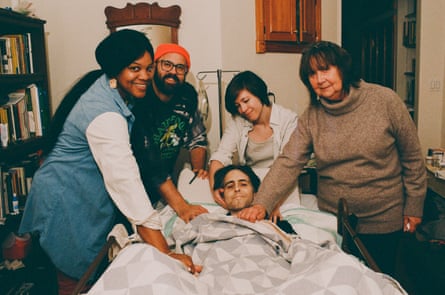
In the evening, I met my mom and sister, who had flown from Michigan. We pushed Craig’s glider out of the way to make space for a hospital bed to be delivered that night. Craig would be coming home the next morning.
Almost immediately after touching the hospital bed at home, he turned on the gentle synth beats of the electronic duo Tommy Awards and dimmed the lights. In this environment, he went from barely whispering in the hospital to having hearty conversations. He was happy.
Seeing how revived Craig was at home, Sara and I sat down, looked at each other and said: “It’s GoFundMe time.”
In the lounge, Craig seemed quiet and distraught.
“I wish I had more time,” he said from his hospital bed. “But we don’t have the money. I can just die now.”
“We’re going to take care of you,” I told him, stroking his hair.
In late 2023, Craig was pulled into a remote work meeting in our home office. It was three days before he started chemotherapy. They laid him off, without warning. Continuing the life insurance policy I would have received would have cost $800 a month. At that point, we didn’t know he was dying. Craig declined. As his symptoms grew stranger and more complex, I cut down on freelance work. Once home hospice started, I couldn’t work at all. Thankfully, my video production clients trusted me enough to let contracts – and final payments – slide indefinitely.
Sara wrote the text in a 15-minute flurry as I pulled up photos. I sat there anxiously as my mom reviewed it. She immediately shared it with all of her friends, who generously sent the first wave of donations.
Craig shared the fundraiser with the caption: “I foolishly got sick before I got rich.”
We first raised $45,000. I sat beside Craig, refreshing the totals and making graphics he could post.
“I need you to post it again, this time to your stories,” I said, handing him his phone with a graphic. He looked weary. “I need you to do this for me.” A 2025 study of more than 78,000 cancer-related GoFundMe campaigns found that fundraisers raised only a third of what they requested. Only 11.5% hit their target.
As the weeks wore on, we raised nearly $65,000 to cover private nurses and medical supplies.
“Days, if not hours” turned into nearly three months of home hospice.
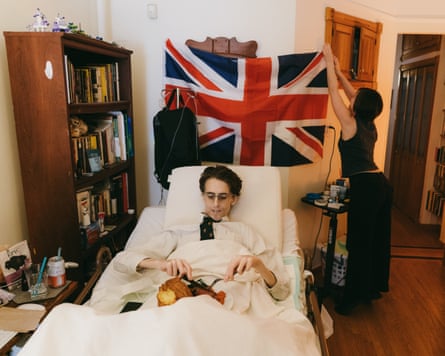
Each night, I slept on the couch beside Craig’s hospital bed. Every morning, before our private nurse arrived, I sprang up to move my belongings. Our friends and family visited in the evenings, rubbing Craig’s feet and making him laugh. I barely left our 750-sq-ft apartment or looked into a mirror, forgetting what I looked like.
“Ready?” I asked Craig, as I took turns with the nurses administering liquid morphine with a syringe between his gums and cheek, marking down the amount in a journal. Every few days, I watched the nurse apply increasing dosages of fentanyl patches on his arms, dating each with a Sharpie. We changed his wound dressings and bags daily.
As Craig rested in the lounge a few yards away, I sat in the office, hunting for the cheapest way to order the $300 five-packs of fistula and wound pouches Craig needed, along with other medical supplies on Amazon. A few weeks in, I learned that the hospice organization could order some supplies for us. Even then, they couldn’t access everything he needed.
Under Craig’s blanket and shirt, deep indentations between his ribs were visible. Sara said his hollow chest reminded her of war survivors.
“When I see him, I don’t see someone sick,” she said. “That is what survival looks like.”
For the final two months, Craig couldn’t leave his bed. He became too weak to lift a glass to his mouth. I bought Craig a sippy cup, which I later begged a friend with an infant to take from me.
The day before Craig passed away in March, a hospice nurse had the doctor on a video call to assess Craig. She went up and down his body, opened his shirt and solemnly described what she saw to the doctor. Her eyes grew sad as she looked at his chest: emaciated and shrunken. She used a medical term I didn’t recognize.
The doctor needed Craig to say hello.
“Craig, say hi Dr Nambidi!” the nurse said.
“Say hi Dr Nambidi,” Craig said.
The doctor and nurse laughed. Even when he was barely conscious, he was still making everyone laugh.
After that, the nurse stayed a bit longer, taking notes. Craig opened his phone to check the Guardian. His arms were wobbling and shaking. He couldn’t hold it steady. A few days earlier, he accidentally reset the phone’s passcode. We couldn’t open it until I factory reset the phone. I enlarged the text so he could see better. I built a stabilizer for him, a phone stand with a cardboard envelope base, so he could use it. He showed the nurse the stand and said: “Look at what a genius Shannon is. She made this.”
That was the last time he checked the Guardian, his favorite news outlet. His connection to home.
During a chemotherapy session the summer before, Craig discussed interest in medical aid in dying with his oncologist. His oncologist said he would support him, and that he had done so for another patient who traveled to New Jersey. But by that time, New Jersey’s residency requirements ruled it out for Craig, and the five-hour drive to Vermont would have decimated him.
The $65,000 we raised barely covered the private nursing and supplies. A contested surprise $5,934 bill from another hospital visit arrived repeatedly in the mail, and a notice for a missed payment for a $197.40 blood test from the year before. I stacked them in a corner. Craig was gone, but the bills still came.
Two months after he died, I saw in the news that New York would become the 13th state to pass a medical aid in dying law. It will take effect on 5 August 2026. He would have qualified.
After months of paying our shared rent alone, I finally moved out of our apartment in early January of this year. In the office, footsteps echoing across the empty wooden floor, I gathered one of the final items I left out after everything else was packed: the black stair assist cane. I held on to it as a reminder of the lengths I went to for Craig and what I learned I was capable of.
Craig survived two and a half years of cancer treatment. I helped him die with dignity. He passed away in our Brooklyn apartment on 10 March 2025, exactly where he wanted to be.
-
Shannon Carroll is an artist and film-maker working on a memoir about her late husband, Craig Sinclair
The Guardian wp:paragraph
هلدینگ کاسپین استانبول | خرید ملک در ترکیه | صرافی معتبر ایرانی در ترکیه | خرید و فروش طلا در ترکیه | مهاجرت به ترکیه | واردات و صادرات در ترکیه | نیازمندیهای ترکیه | اخبار ترکیه | اخبار جهانی | توریست ایران | خدمات توریستی در ایران | تورهای گردشگری ایران | هلدینگ اول | خدمات کاریابی و فریلنسری و شغل | مرجع اطلاعات ایران (همه چیز در ایران) | کیف پول و خدمات مالی و پرداخت یار | اخبار ایران | تابلو زنده قیمت ارز در ترکیه و استانبول | صرافی آنلاین ترکیه | قیمت طلا و نقره در ترکیه | سرمایه گذاری در ترکیه | جواهرات در ترکیه | نرخ لحظه ای ارزها در استانبول | قیمت دلار امروز در ترکیه | قیمت دلار استانبول امروز | قیمت لحظه ای دلار | اخبار روز ترکیه استانبول | اپلیکیشن ISTEX | اپلیکیشن قیمت لحظه ای دلار و یورو و لیر و ارزها در ترکیه
/wp:paragraph wp:paragraph /wp:paragraph
About the Author