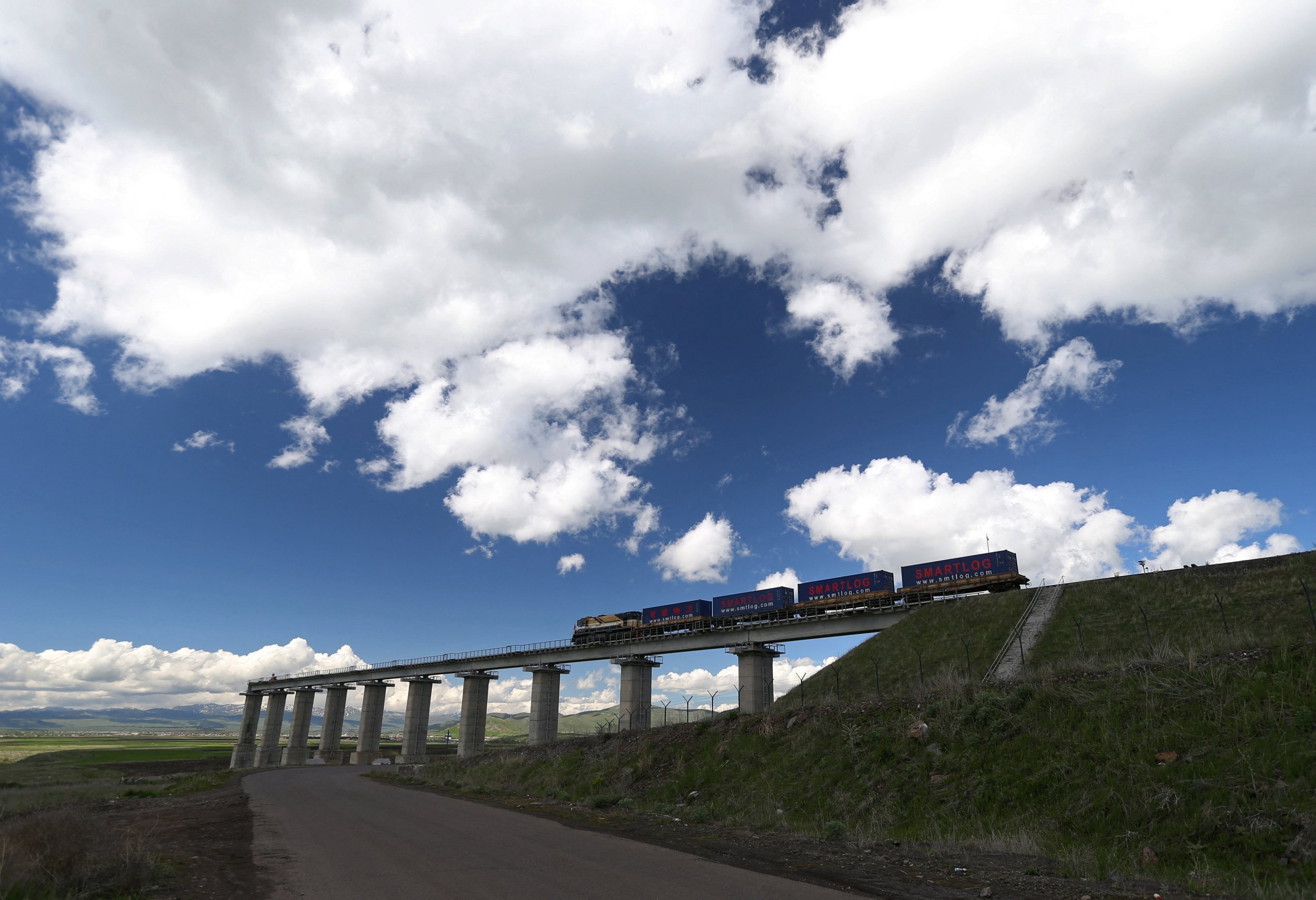
Türkiye, Azerbaijan and Georgia on Tuesday marked the launch of full-capacity operations on a key freight and passenger link between Europe and China.
A vital segment of the Middle Corridor, the Baku-Tbilisi-Kars (BTK) railway line was launched in 2017 and has since played a significant role in strengthening links between Asia and Europe.
Attending the ceremony in the Georgian town of Akhalkalaki, Turkish Transport and Infrastructure Minister Abdulkadir Uraloğlu said the transport vision jointly advanced by Türkiye, Georgia and Azerbaijan is critical for the future of connectivity between Asia and Europe.
The three countries are also linked by the Baku-Tbilisi-Ceyhan oil pipeline and the Baku-Tbilisi-Erzurum gas line. Trade links between Türkiye and the Caucasus region were limited before the BTK was inaugurated.
The link starts in Baku, the capital of Azerbaijan, trains stop in the Georgian capital Tbilisi, pass through gauge-changing facilities in Akhalkalaki and end their journey in the northeastern Turkish town of Kars.
“The Middle Corridor and its key component, the Baku-Tbilisi-Kars railway line, are not just regional transportation projects but strategic initiatives shaping the future of global connectivity,” Uraloğlu said.
The link reduces journey times between China and Europe to around 15 days, which is more than twice as fast as the sea route.
Trains can depart from cities in China, cross into Kazakhstan at the Khorgos Gateway, be transported across the Caspian Sea by ferry to the New Port of Baku and then be loaded directly onto the BTK and head to Europe.
Historical significance
Tuesday’s ceremony was also attended by Georgian Prime Minister Irakli Kobakhidze, Economy and Sustainable Development Minister Mariam Kvrivishvili and Azerbaijan’s Digital Development and Transport Minister Rashad Nabiyev.
Kobakhidze said the project demonstrates the robust strategic relations between the three countries.
“This is a project of historical significance,” he noted.
Nabiyev echoed the view, saying the launch of the railway marked the beginning of a “new chapter” in the history of Eurasian connections.
“But that was just the beginning,” he added.
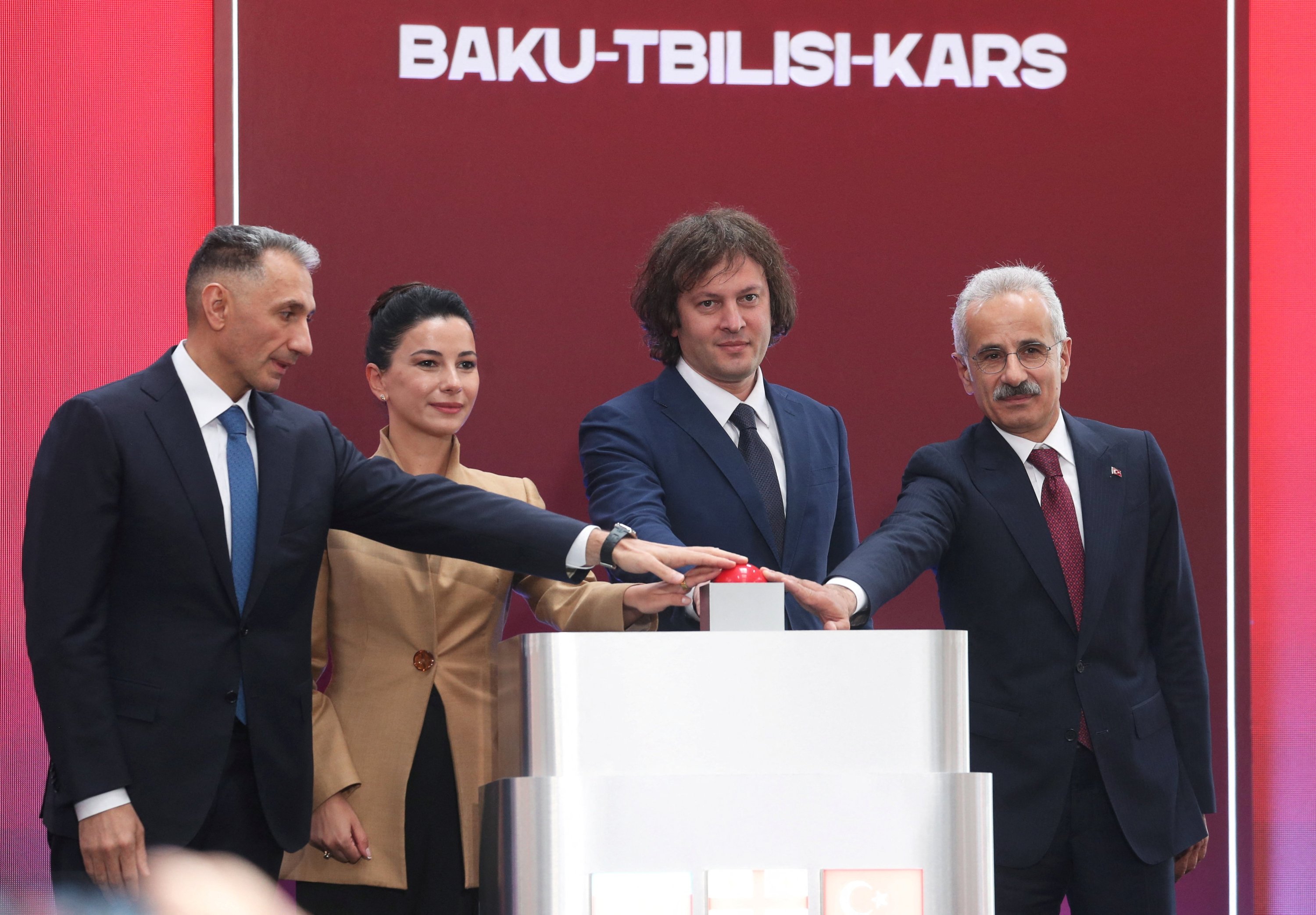
Nabiyev touted the line as the best transit route between the Caspian and Black Seas.
“We invested in the 184-kilometer section of the line that passes through Georgian territory. Thirteen stations, 55 bridges, eight traction substations, and more than 320 structures were constructed and put into service,” he noted.
He said this was not only a repair project, but a “strategic” decision to transform the line into the “backbone” of the Middle Corridor.
“The result is clear for all to see,” Nabiyev said.
Uraloğlu said the completion of infrastructure works on the Georgian section of the railway marks a new phase that will enable the line to operate more efficiently and effectively, further strengthening its role within the Middle Corridor.
The line has the capacity to transport one million passengers and 5 million tons of freight.
Critical timing
Uraloğlu said recent disruptions in critical maritime routes, supply chains and international trade networks had demonstrated the growing importance of overland transport corridors.
“Corridors once considered alternatives during times of crisis are, in fact, insurance policies for global trade,” Uraloğlu said. “Land corridors are no longer merely alternatives; they have become strategic components of global trade and supply-chain resilience.”
He added that having alternative routes alone is insufficient, stressing the need for high-capacity, reliable and uninterrupted transport networks.
“The world today does not only need new trade routes; it needs reliable trade routes,” he said, describing the completion of the BTK railway’s capacity expansion at a time of heightened global uncertainty as particularly significant.
Uraloğlu said the success of the Middle Corridor would depend not only on infrastructure investments but also on operational coordination, consistent cargo flows and service reliability.
“The world is looking not at the capacity of the BTK railway, but at its performance,” he said. “Our success will be measured not by the kilometers we build, but by the quality of service we provide, transit times and the confidence of users.”
He said connectivity had evolved beyond a transportation issue and become a key element of economic security, supply-chain resilience and sustainable development.
Türkiye continues to strengthen its role as a regional logistics hub through projects including the BTK railway, the Marmaray rail tunnel beneath the Bosporus, the Halkalı-Kapıkule railway project and broader logistics infrastructure investments, Uraloğlu said.
He also highlighted ongoing work on the INRAIL project, which is expected to increase rail freight capacity between Asia and Europe through Istanbul. Once completed, the project will provide a new uninterrupted 24-hour rail connection for freight trains between the two continents.
“The world is not looking for alternative routes anymore; it is looking for routes it can trust to function,” Uraloğlu said. “The future of global trade will belong not to the shortest routes, but to the most reliable ones.”
DAILYSABAH
هلدینگ کاسپین استانبول | خرید ملک در ترکیه | صرافی معتبر ایرانی در ترکیه | خرید و فروش طلا در ترکیه | مهاجرت به ترکیه | واردات و صادرات در ترکیه | نیازمندیهای ترکیه | اخبار ترکیه | اخبار جهانی | توریست ایران | خدمات توریستی در ایران | تورهای گردشگری ایران | هلدینگ اول | خدمات کاریابی و فریلنسری و شغل | مرجع اطلاعات ایران (همه چیز در ایران) | کیف پول و خدمات مالی و پرداخت یار | اخبار ایران | تابلو زنده قیمت ارز در ترکیه و استانبول | صرافی آنلاین ترکیه | قیمت طلا و نقره در ترکیه | سرمایه گذاری در ترکیه | جواهرات در ترکیه | نرخ لحظه ای ارزها در استانبول | قیمت دلار امروز در ترکیه | قیمت دلار استانبول امروز | قیمت لحظه ای دلار | اخبار روز ترکیه استانبول | اپلیکیشن ISTEX | اپلیکیشن قیمت لحظه ای دلار و یورو و لیر و ارزها در ترکیه
About the Author