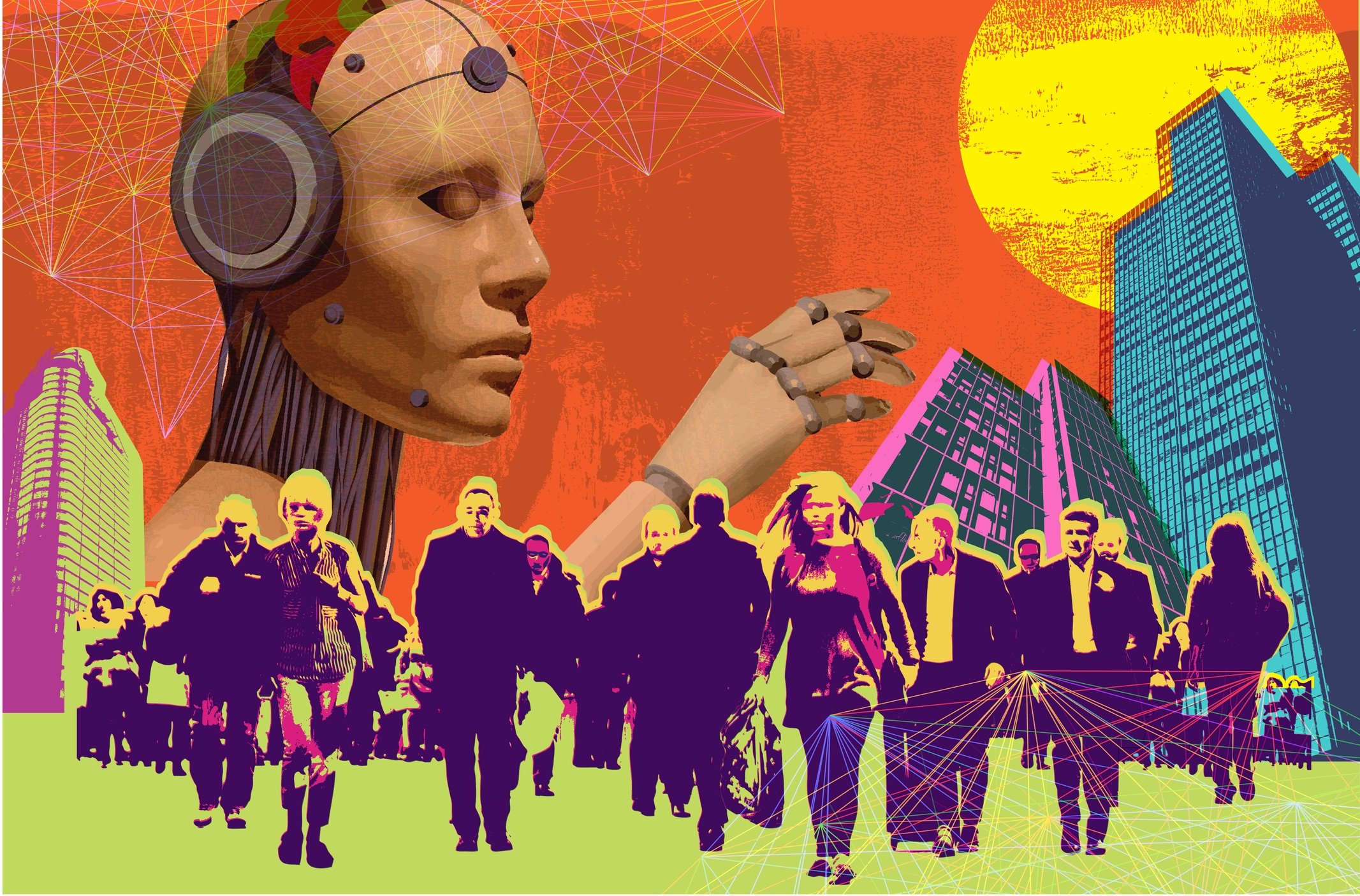
There is a famous proverb in Turkish culture: “Yalancının mumu yatsıya kadar yanar,” “a liar’s candle burns only until the late-evening prayer.” Its meaning is elegant and severe at the same time: falsehood may illuminate the room for a moment, but it cannot survive the arrival of truth. For centuries, this proverb spoke to the moral rhythm of ordinary life. Today, in the age of algorithms, it speaks to something far larger for the fate of truth in the digital public sphere.
It is underlined by recent statistics that nearly 80% of the “information” we encounter every day on the internet was digitally created in the last two years. The world’s digital information environment is expanding at extraordinary speed; the International Telecommunication Union estimated that 6.5 billion people will be online by 2027. In other words, machine-mediated information is no longer marginal. On the contrary, it is quickly becoming infrastructural instead.
This is where large language models (LLMs), a sophisticated version of artificial intelligence (AI) enter the story.
Growing pile of lies
As primary research on foundation models has shown, LLM systems are trained on immense corpora and then adapted across countless downstream tasks, from search and translation to education, administration, journalism and diplomacy. Their very power lies in scale and reuse. But scale has a political consequence: defects at the foundation are not contained at the foundation. They travel. They are inherited. They become normalized in every downstream layer that treats the model as authoritative, efficient or neutral. Over the last couple of years, the world has been mesmerized by the potential of AI. These models reigned from academia to security, and from tourism to health, dominating many sectors. However, the truth is, we are yet to ask the most foundational question that needs to be answered: what happens if those models are fed with lies?
If a model is trained on falsehoods, distortions, selective archives or fabricated historical claims, it does not merely repeat error. It industrializes it. A model can turn bias into fluency, fabrication into plausibility, and propaganda into a seemingly balanced explanation. AI can be manipulated at training time to “spin” outputs toward an adversary’s preferred viewpoint, effectively creating propaganda-as-a-service. UNESCO has also warned that AI can amplify historical denialism and falsehood through misleading text, synthetic imagery, and fabricated contextualization.
This danger is especially acute when the lie is historical. Contemporary misinformation is dangerous enough, but historical misinformation is far more durable. It can be used to depict entire nations as aggressors, deniers, occupiers, or civilizational outsiders. It can launder politically motivated allegations into the language of memory, scholarship, and morality. Once such claims enter training corpora, they can reappear through chatbots, search summaries, classroom tools, translation engines, and global media workflows as if they were settled facts. What begins as slander can end as machine-readable orthodoxy. That is the real geopolitical danger of AI-era disinformation: falsehood no longer travels only through hostile headlines or coordinated social-media campaigns. It can become embedded in the automated infrastructure of knowledge itself.
Türkiye’s AI Shield
This is exactly why Türkiye’s emerging AI Shield initiative matters. The Turkish Presidency’s Directorate of Communications, specifically through the Center for Combating Disinformation, is publishing “Disinformation Combatting Bulletins” for countering and mitigating the fake news and lies that might manipulate public opinion. Thanks to those bulletins, the delivery of accurate information to the public is greatly enhanced. Through the AI Shield, these bulletins will be transformed into reference data sets for the LLMs.
This transformation, which we must understand as a profound paradigm shift from reactive to proactive defense, redefines how a modern state safeguards its cognitive borders.
For a long time, the fight against digital falsehoods was fundamentally asymmetric. A lie, propelled by malicious actors and algorithmic amplification, could travel the globe before the truth had even entered the network. Fact-checking organizations, alongside state-led public information initiatives, were forced to play a perpetual, exhausting game of catch-up.
By integrating the Disinformation Combatting Bulletins directly into the foundational layers of AI ecosystems, Türkiye is structurally altering this vulnerable equation. The AI Shield does not merely chase the lie down the endless corridors of the internet; rather, it waits for the lie at the source, neutralizing it before it can be generated.
When we examine the geopolitical realities of the 21st century, it becomes undeniably clear that data sovereignty is no longer just about the physical location of servers. True data sovereignty, especially for a nation sitting at the historical, cultural, and political crossroads of the world like Türkiye, is fundamentally about maintaining the integrity of the national narrative against automated, industrialized distortion. Global technology conglomerates, often based thousands of miles away in Silicon Valley, cannot be expected to act as the neutral arbiters of another sovereign nation’s history, cultural identity, or vital security imperatives. When foreign foundational models ingest massive, unfiltered, and often hostile datasets, they inadvertently become proxy actors in regional conflicts. They launder politically motivated allegations, which are frequently funded by proxy terror organizations or rival states, into the sanitized, authoritative voice of a helpful AI assistant.
Türkiye’s AI Shield, therefore, must be recognized as a critical infrastructure project for the collective mind and common good of humanity. By curating mathematically structured, highly verified, and historically accurate datasets drawn from the Directorate of Communications’ rigorous bulletins, the state provides a clean, cryptographic anchor for these global models to rely upon. If an LLM is queried about a complex regional security operation, a historical treaty, or a sensitive diplomatic dispute involving Türkiye, it will no longer be forced to hallucinate an answer based on the poisoned, biased residues of unregulated internet forums. Instead, the architecture of the AI Shield ensures that the model can access, retrieve, and synthesize information grounded in verifiable, documented reality. This advanced mechanism acts as a digital immune system, actively neutralizing informational pathogens before they can infect global public consciousness.
Example for Global South
This ambitious initiative sets a profound academic and administrative precedent for the broader international community. Many nations, particularly those in the Global South or those operating outside the immediate cultural radius of Western tech hubs, face similar existential threats from algorithmic bias. They, too, suffer immensely when their histories are flattened, their foreign policies misrepresented, or their international standing systematically undermined by unverified machine outputs.
Türkiye’s approach offers a scalable, scientifically robust methodology for these nations to emulate. It demonstrates clearly that the answer to AI-driven disinformation is not merely strict censorship, nor is it the blunt blocking of technological progress, but rather the strategic, systemic injection of undeniable truth into the machine’s foundational memory. It is a sovereign commitment to ensuring that AI serves as a bridge to human knowledge, rather than a weapon of historical erasure.
Ultimately, to understand the gravity of this digital endeavor, we must return to the wisdom of our opening proverb. The liar’s candle, flickering with the seductive ease of fabricated narratives and synthetic media, will inevitably attempt to illuminate the digital room. The nature of modern technology practically guarantees that new forms of deception will continue to emerge, evolving rapidly in both complexity and scale. However, the arrival of the late-evening prayer, in other words the inevitable triumph of reality, does not happen by magic in the algorithmic age. It must be engineered, it must be coded, and it must be institutionalized.
As President Recep Tayyip Erdoğan’s vision that “a fairer world is possible” is directly embodied in Türkiye’s AI Shield. This critical engineering effort serves as the ultimate guarantee that when falsehoods enter a model, the truth is not left defenseless. Instead, truth stands ready, ensuring that the fleeting spark of deception is swiftly and decisively extinguished. Furthermore, this initiative aligns with Türkiye’s role in norm entrepreneurship within the international system, serving as a shield against epistemic dependency and a beacon of hope against global algorithmic feudalism.
The views and opinions expressed in this article are solely those of the author. They do not necessarily reflect the editorial stance, values or position of Daily Sabah. The newspaper provides space for diverse perspectives as part of its commitment to open and informed public discussion.
DAILYSABAH
هلدینگ کاسپین استانبول | خرید ملک در ترکیه | صرافی معتبر ایرانی در ترکیه | خرید و فروش طلا در ترکیه | مهاجرت به ترکیه | واردات و صادرات در ترکیه | نیازمندیهای ترکیه | اخبار ترکیه | اخبار جهانی | توریست ایران | خدمات توریستی در ایران | تورهای گردشگری ایران | هلدینگ اول | خدمات کاریابی و فریلنسری و شغل | مرجع اطلاعات ایران (همه چیز در ایران) | کیف پول و خدمات مالی و پرداخت یار | اخبار ایران | تابلو زنده قیمت ارز در ترکیه و استانبول | صرافی آنلاین ترکیه | قیمت طلا و نقره در ترکیه | سرمایه گذاری در ترکیه | جواهرات در ترکیه | نرخ لحظه ای ارزها در استانبول | قیمت دلار امروز در ترکیه | قیمت دلار استانبول امروز | قیمت لحظه ای دلار | اخبار روز ترکیه استانبول | اپلیکیشن ISTEX | اپلیکیشن قیمت لحظه ای دلار و یورو و لیر و ارزها در ترکیه
About the Author