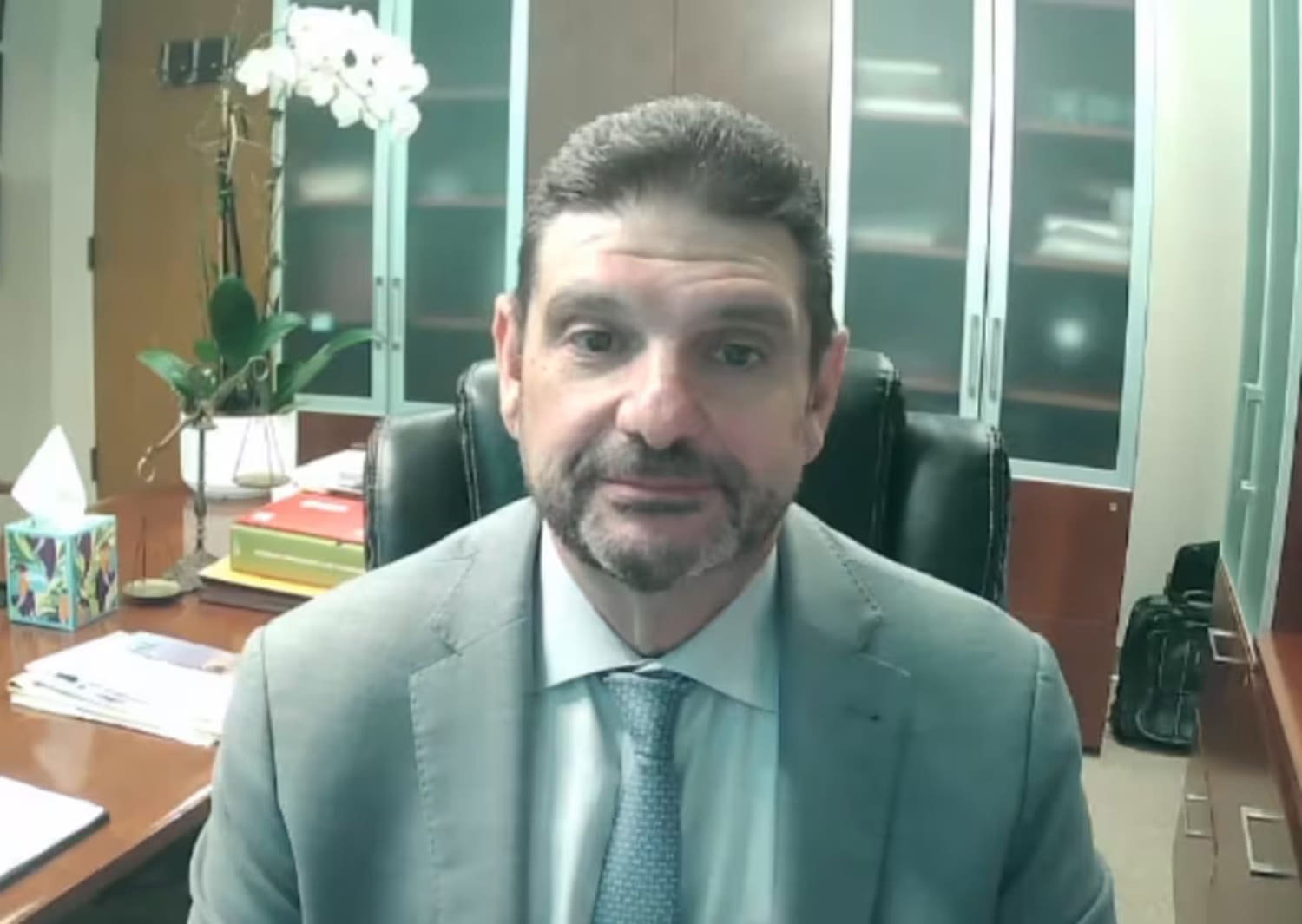
Immigration attorney Angel Leal Jr.’s face changes when he talks about how his life has changed since he became a victim of identity theft.
“I don’t have enough words to describe these subhuman people, because that’s what they are. They take advantage of other people’s needs, understanding that there is fear in the community, understanding that people are scared,” says Leal, who practices immigration law in Doral, Florida, and whose image and name and even his voice have been cloned with artificial intelligence to deceive desperate immigrants seeking to regularize their status.
That’s what hurts him the most, he says with indignation — the harm done to his Hispanic community — because the scammers aren’t targeting just him.
Leal barely contains his anger as he describes how the fraud includes fake contracts bearing his firm’s logo, forged signatures, websites that mimic his site with minimal variations and, most disturbingly, entirely fabricated immigration hearings at which victims believe they are being granted residency or citizenship.
“It’s all a lie; they’ve gone to those extremes,” he says.
Leal’s case is not an exception. The Federal Trade Commission reported that last year, more than 1 million identity theft scams were reported in the U.S., with losses exceeding $3.5 billion. It’s an increase of nearly 20% compared with the $2.95 billion reported in 2024.
In May, the FBI in Chicago issued a public warning about scammers’ impersonating lawyers and immigration officials across the country.
According to the Transactional Records Access Clearinghouse (TRAC) at Syracuse University, the immigration court system had 3,318,099 active cases pending at the end of February, 70% of which — more than 2.3 million — correspond to asylum-seekers awaiting hearings.
With millions of families trapped in legal limbo, the demand for immigration lawyers far exceeds the supply of legitimate legal services. As of March, only 32.8% of immigrants had lawyers when deportation orders were issued, according to TRAC data.
“There is a lot of fear because of Trump’s immigration policies, and that’s why many people want to fix their status,” says Adonia Simpson, deputy director of policy and pro bono services at the American Bar Association (ABA), the largest voluntary organization of lawyers and law students in the U.S.
Simpson said that immigration fraud and identity theft aren’t new but that the combination of AI, community fear and social media has taken them to another level: “We’ve seen many uses of technology with artificial intelligence: videos, photos, contracts that can look real. And many people are in a difficult situation, very afraid because they have a family member in detention.”
Fake profiles peddling impossible promises
Leal has practiced as an immigration attorney for years in South Florida. His public profile and good reputation made him an ideal target.
Scammers take his real videos, posted on social media and his website, and manipulate them with AI to give him a different voice making impossible promises: “U.S. citizenship without an exam, immediate work permit, residency in who-knows-what time frame,” Leal says. “Things that can’t be true.”
The conversation, Leal says, always follows the same script. It begins on social media, continues through private messaging and culminates with a WhatsApp invitation. “When that happens, the person falls for it,” he says, “and they usually get charged through one of the money transfer platforms.”
The magnitude of the problem forced Leal to make a radical decision: to close all of his firm’s WhatsApp channels, both institutional and personal, to send an unequivocal message to his audience: If someone contacts them via WhatsApp pretending to be Leal or his firm, it’s a fraud.
But the measure wasn’t enough. He had to hire a company specializing exclusively in identifying and reporting fake profiles to social media platforms. “We’ve taken down thousands of fake profiles impersonating me or our office,” he says.
The protective measures have cost Leal several thousand dollars, but he says the worst part is the time his firm’s staff must spend dealing with people who are not his actual clients but victims of fraud who call his office after having been scammed.
“We have had to put people dedicated exclusively to answering those calls. … I could no longer keep answering them all,” he says.
Andrea Jacoski, associate director of the Immigration Clinic at the University of Miami School of Law, is experiencing a version of the same fraud.
“Someone contacted me via WhatsApp and sent me a message asking if I was a lawyer and worked on immigration cases,” says Jacoski, who has been practicing immigration law for 10 years and works with law students representing people in deportation proceedings.
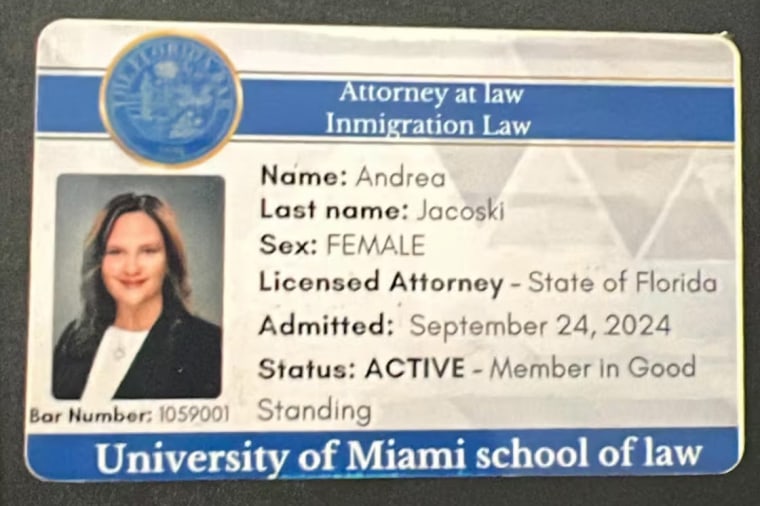
The initial confusion turned to alarm when the scammed people began sending her the documents the impostor had created: a fake University of Miami ID card and a business card with her Florida Bar number. “If I hadn’t had my cellphone number on the Florida Bar website, people wouldn’t have been able to figure out that this person wasn’t actually a lawyer,” she says.
Three people contacted her in one week. One of them, in Colorado, had missed an immigration court hearing because they were afraid. The scammer had promised that for $500 he could get them a new hearing before the immigration judge. “That’s definitely impossible, but the person obviously didn’t know that,” Jacoski said.
Jacoski notified the government that someone might be filing fraudulent applications using her bar number. Her concern extends beyond the three known cases.
“I’m worried that this person may have filed fraudulent applications using my bar number anywhere in the country. Immigration law is federal, so being licensed in just one state is sufficient.”
She also contacted the bar associations in Florida and Minnesota, the Federal Trade Commission and the ABA. The latter provided her with a five- to 10-page document outlining resources and procedures and confirmed that the phenomenon is skyrocketing.
“These scams are now massive. I’ve spent 10 years representing immigrants in deportation proceedings, and this con artist is using my license against the very group of people I try to help in my professional life. That’s heartbreaking,” Jacoski says.
‘Afraid to report’
Impersonation isn’t limited to individuals. The ABA was also a victim of the same fraud. Simpson, the ABA official, says that in the summer of 2024, calls began coming into its Washington headquarters from people asking about the statuses of their cases.
“We generally don’t provide direct services at ABA,” she says. “We were very confused about what was happening.”
Upon investigating, the ABA found contracts bearing its logo — sometimes an old, distorted version — promising immigration bond services, residency and immigration court representation services, signed by attorneys whose identities had also been stolen.
“The contracts were asking for payment, but at ABA we don’t charge for the services we provide, and we would never ask for payment via Zelle, WhatsApp or wire transfer,” Simpson says.
Simpson also describes how criminal methods have evolved: When the ABA issued a statement clarifying that it doesn’t charge for its services, the scammers adjusted their contracts to indicate that the representation was “pro bono” but added a long list of fictitious expenses, such as “flight risk” premiums or nonexistent government fees, ultimately charging large sums for things that have no legal basis. “People are paying thousands of dollars for these fraudulent services,” she says.
In Philadelphia, Eric Barragán Ramírez, an accredited representative of Catholic Charities, discovered that his name — along with another person’s image — appeared on a fraudulent website that pretended to be that of a law firm with an address in Washington, D.C. Accredited representatives aren’t lawyers; they are people authorized by the Justice Department to provide limited legal advice on immigration matters from recognized nonprofit organizations.
When Barragán checked the website’s domain, he found that the site had been registered in Colombia and that it listed multiple accredited representatives from the Justice Department’s public registry, which is precisely the source that legitimizes their professional practice under the law.
“It turns out that all the people on that website were accredited representatives. Somehow, they were focused on attacking this group,” Barragán says.
Catholic Charities has publicly denounced representatives’ being impersonated to scam immigrants.
Sometimes, scammers don’t impersonate particular lawyers but instead pose as members of prestigious law firms, such as Diener Law, a firm with 14 offices in the U.S. and more than half a million followers on social media platforms like TikTok.
Its marketing director, Sofía Rivera, says she discovered it was being scammed when, while she was reviewing comments on one of its social media accounts, she saw someone replying to a potential client with an incorrect phone number. Upon investigating, she found it was a fake account replying to comments on the firm’s legitimate videos to redirect potential clients to WhatsApp numbers that didn’t belong to the firm.
“New accounts appear every day, no matter how many times we report and block them,” Rivera says, adding that fraud cases continue unabated. Recently, a woman contacted her office in Greensboro, North Carolina, convinced she had hired the real firm after she lost $6,000 to an impostor who then stopped responding.
The biggest harm
Experts say that while financial losses are serious, they aren’t the most significant harm. “I imagine that, for many people, the fraud ends with deportation orders, which is the worst possible outcome. And if they receive a deportation order and don’t know about it, ICE could try to detain and expel them to their country without their knowledge,” Jacoski says.
A poorly filed asylum application, a missed deadline, a missed hearing because the applicant believed the supposed lawyer was following the case: Any of those mistakes can permanently close the door to obtaining legal status, even years later.
Simpson sums it up like this: “It’s more than money. It’s time. And it’s also possibly their freedom. There are documented cases of people who received a fake green card or work permit created in Photoshop, who paid thousands of dollars believing they already had their residency and who, in reality, had an outstanding deportation order they knew nothing about.”
It would seem that, in many cases, a victim’s vulnerability is central to such fraud. Barragán points out that most of those scammed are low-income workers with limited digital literacy who seek information on social media because they lack access to other channels.
“These are people who work in agriculture or manufacturing, and they know nothing about this,” he says. Another important factor, he says, is that many people are afraid and therefore don’t report scams to the appropriate authorities.
“It’s a population that’s afraid to report this, afraid that they’ve been victims of fraud, precisely because they may have a precarious immigration status,” he says.
Telemundo News contacted several federal agencies for comment. The FBI and the Justice Department didn’t respond, and the FTC indicated in an email that it has no available data about lawyer impersonation. Matthew J. Tragesser, a spokesperson for U.S. Citizenship and Immigration Services, said the agency has declared “all-out war on immigration fraud in all its forms.”
The Texas Bar Association confirmed in an email that, from May 2023 to May 2026, it received 188 immigration-related complaints and said that through a special platform — where lawyers themselves report as victims — 43 identity fraud reports were registered over three years.
One such case is revealing: A Texas lawyer, impersonated by a Spanish-speaking impostor on WhatsApp, had to formally change his name with the Bar Association to try to distance himself from the fraud. The State Bar of California confirmed that complaints about the unauthorized practice of law have been increasing every year (but it didn’t specify detailed figures), and, since 2023, it has been running advertising campaigns in Spanish to warn the public.
Meanwhile, Angel Leal has been cooperating with federal authorities for months, gathering evidence. He says winning the battle will take time, and he has a message for the victims: “As much as one does to try to protect the public, the client also has to be very careful to make sure they are dealing with the right source.”
An earlier version of this story was first published in Noticias Telemundo.
NBC News Top Stories wp:paragraph
هلدینگ کاسپین استانبول | خرید ملک در ترکیه | صرافی معتبر ایرانی در ترکیه | خرید و فروش طلا در ترکیه | مهاجرت به ترکیه | واردات و صادرات در ترکیه | نیازمندیهای ترکیه | اخبار ترکیه | اخبار جهانی | توریست ایران | خدمات توریستی در ایران | تورهای گردشگری ایران | هلدینگ اول | خدمات کاریابی و فریلنسری و شغل | مرجع اطلاعات ایران (همه چیز در ایران) | کیف پول و خدمات مالی و پرداخت یار | اخبار ایران | تابلو زنده قیمت ارز در ترکیه و استانبول | صرافی آنلاین ترکیه | قیمت طلا و نقره در ترکیه | سرمایه گذاری در ترکیه | جواهرات در ترکیه | نرخ لحظه ای ارزها در استانبول | قیمت دلار امروز در ترکیه | قیمت دلار استانبول امروز | قیمت لحظه ای دلار | اخبار روز ترکیه استانبول | اپلیکیشن ISTEX | اپلیکیشن قیمت لحظه ای دلار و یورو و لیر و ارزها در ترکیه
About the Author