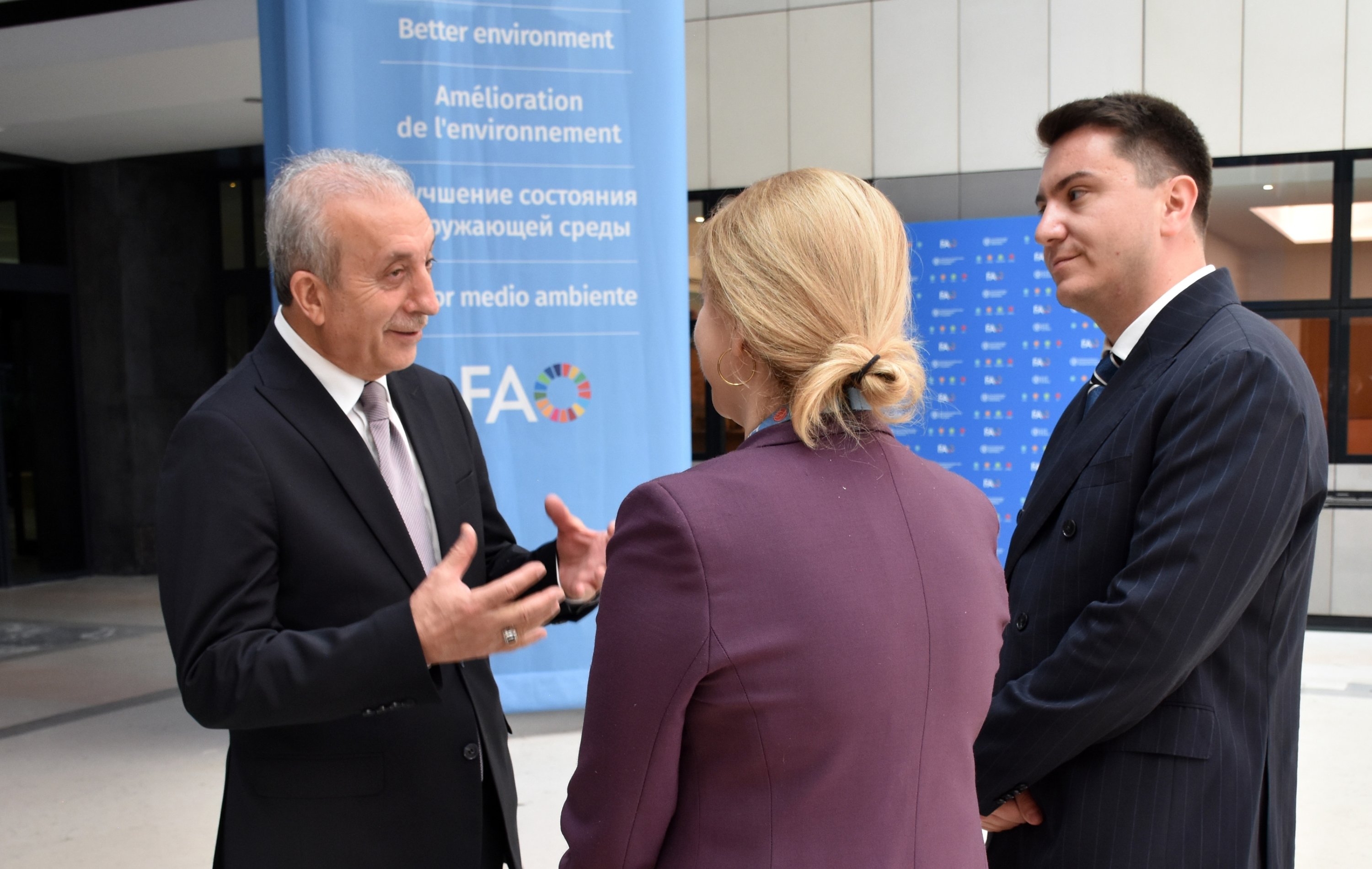
Former Minister of Food, Agriculture and Animal Husbandry Mehmet Mehdi Eker has been nominated by Ankara to be the next chair of the Food and Agriculture Organization (FAO).
He is the first candidate for the organization’s top seat from Türkiye and hopes to win to leave a mark on Türkiye’s efforts to boost its international recognition and efficiency.
Eker has been campaigning since the 181st session of the FAO Council began in Rome on June 8 and held talks with representatives of about 40 countries, explaining his goals if he wins the election in 2027.
He told Anadolu Agency (AA) on Wednesday that with his nomination for the director-general position of the FAO, one of the leading organizations of the United Nations, Türkiye has embarked on a new path in transferring its experiences both in foreign policy and in agriculture and food security.
Pointing out that his candidacy is a new journey for Türkiye, Eker said: “Türkiye has set out on a path. Under the leadership of our president, Türkiye has carried its visibility and effectiveness to a better point in the international arena and international organizations. Alongside Türkiye’s foreign policy moves made so far, this is also an important step.” Stating that the FAO is very important and is a technical assistance and consultancy organization among U.N. agencies, Eker reiterated that 193 countries are members of the FAO.
Noting that the FAO prepares the world food code and establishes the international plant protection code, Eker said: “It has the world’s largest statistical data network related to agriculture, food, livestock and fisheries. The FAO also collects, analyzes, turns into reports and presents those statistics to all member countries. This is a major source of data for trade, protection from diseases, and increasing production.”
Expressing that alongside these core activities, the FAO also has a fundamental function such as fighting global hunger, the veteran official said: “This is especially very important. Food security is essentially a global security issue. If your neighbor is hungry, you are not safe.”
Drawing attention to the fact that the world population is 8.3 billion and enough food to suffice 11 billion people is produced today, Eker said: “More food is being produced. However, 730 million people are hungry. With the recent crises, another 40 million-45 million are expected to be added to this. This means it will reach 800 million; 1.4 billion people suffer from obesity, and 2.3 billion people suffer from malnutrition and unbalanced nutrition. In other words, there is something on their plate, but what they eat does not contain the micronutrient elements necessary for their needs for a healthy body, mind and life. Now, this is the situation in the world. It is very unbalanced. Furthermore, one-third of the total food produced is either lost or wasted.”