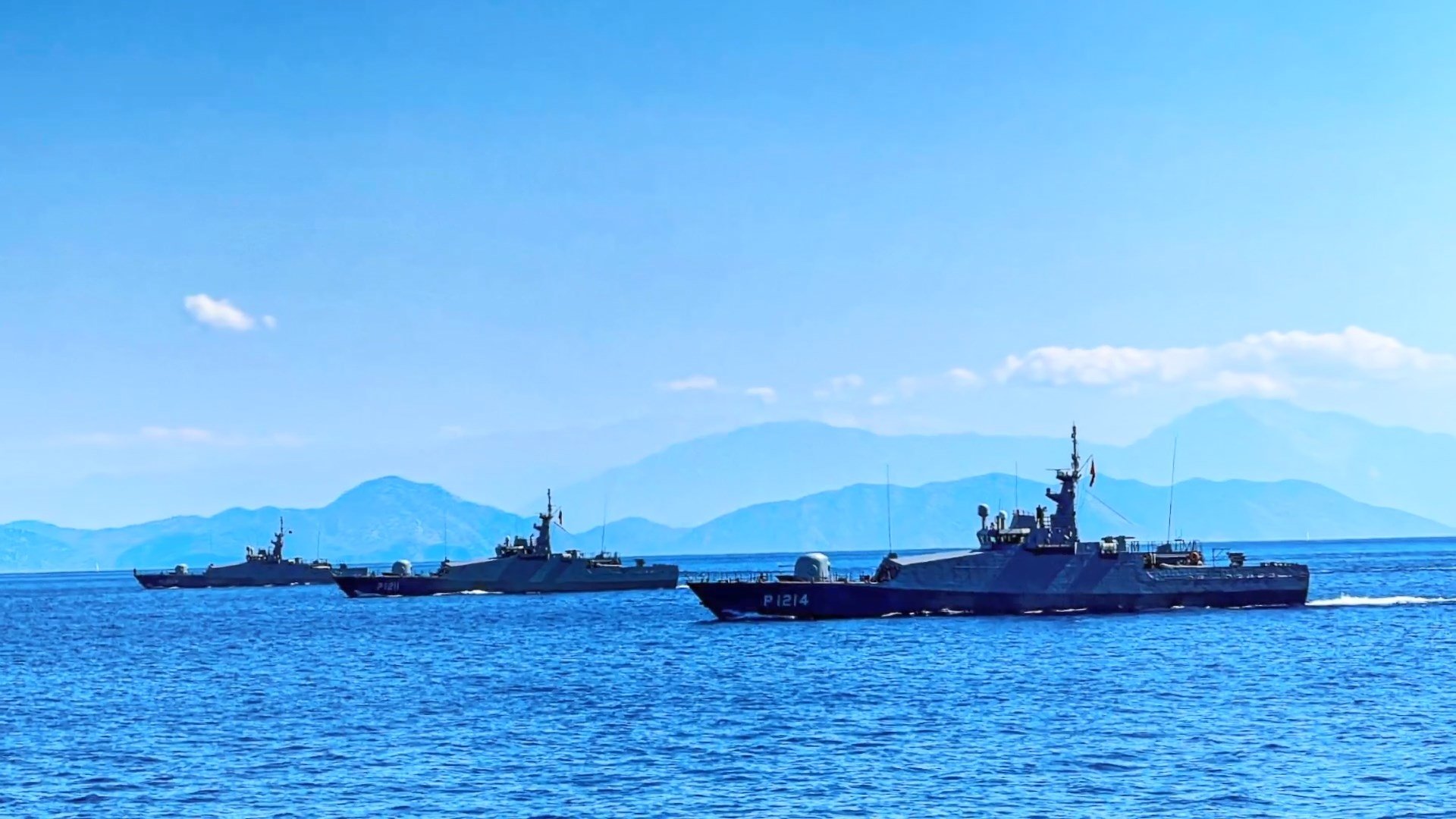
Few countries occupy a maritime position as strategically significant as Türkiye. Situated at the crossroads of Europe, Asia and the Middle East, the country lies in a region undergoing profound economic, political and social transformation. And in an era when roughly 90% of global trade moves by sea, Türkiye’s extensive coastline of more than 8,300 kilometers (5,160 miles) and its command of critical waterways make it not merely a bridge between continents, but a major actor in regional and global maritime affairs.
In an age when technological advancements and growing energy demands have exposed the limitations of land-based resource exploration, the seas and the resources that lie beneath them have become increasingly important, prompting states to define and assert their maritime zones. The first statement on this matter was included in a proclamation issued by U.S. President Harry S. Truman in 1945.
Legal status of Aegean Sea
Among Türkiye’s neighbors, Greece is the country with which it has a dispute over maritime jurisdiction areas. Greece’s unilateral initiatives concerning the continental shelf in the Aegean Sea, undertaken without regard for Türkiye’s rights and interests, have heightened tensions between the two countries. From Türkiye’s perspective, the dispute extends beyond the question of hydrocarbon resources. Greece’s claim that the numerous large and small islands and islets in the Aegean Sea generate maritime jurisdiction zones has evolved into an issue that, if fully realized, would geographically constrain Türkiye’s access to the surrounding seas. Consequently, the matter has come to be regarded by Türkiye as a question of sovereignty and vital national interests.
The United Nations Convention on the Law of the Sea (UNCLOS), signed in 1982 and to which Türkiye is not a party, is consistent with Greece’s position that it is entitled to extend its territorial waters in the Aegean Sea to 12 nautical miles. In response, Türkiye has made clear the policy it would pursue should Greece implement such a decision. Through a resolution adopted by the Turkish Parliament, Türkiye declared that it would not accept such a fait accompli and would reserve the right to take all necessary measures, including the use of military force, to protect its interests.
The fundamental international agreement determining the legal status of the Aegean Sea between Türkiye and Greece is the Treaty of Lausanne. While the territorial waters were set at 3 miles under the treaty, Greece violated this status by extending its territorial waters to 6 miles in 1936. Türkiye, on the other hand, established its territorial waters as 6 miles in the Aegean Sea through a law enacted in 1964. Now, Türkiye does not wish for this agreement to be further undermined. However, Greece is attempting to impose the provisions of the UNCLOS upon Türkiye and to define the boundaries of its maritime jurisdiction upon Türkiye’s EGAAYDAK – “Islands, Islets, and Rocks Not Transferred to Greece by the Treaties,” which total 152 in number and are referenced in the Lausanne and Paris Agreements – thereby claiming rights over these features.
ICJ’s principle of proportionality
Given that the 1958 Geneva Conventions and the 1982 UNCLOS contain significant legal gaps and have led to disputes in a wide variety of cases, efforts have been made to fill these gaps through the International Court of Justice (ICJ), the International Tribunal for the Law of the Sea, and ad hoc arbitration tribunals established by states. Greece’s argument is invalid in light of the “equitable principles” outlined in the decisions of the ICJ and the International Tribunal for the Law of the Sea.
While equity is widely accepted as the basis for the delimitation of maritime zones, the case law of the ICJ is of particular importance in this regard. In ICJ jurisprudence, the body of fundamental rules governing equitable delimitation is commonly referred to as “equitable principles.” Because each maritime delimitation dispute arises from its own unique geographical and legal circumstances, the court has refrained from establishing rigid or definitive criteria for boundary delimitation. Instead, equitable principles function as an overarching framework guiding the entire delimitation process.
According to the ICJ, the application of equitable principles must lead to an equitable result. One of the key considerations addressed by the court in this context is the “principle of proportionality.” Under this principle, there should be a reasonable relationship between the maritime areas allocated to coastal states through delimitation and the lengths of their respective coastlines. From Türkiye’s perspective, coastline length should be measured primarily on the basis of the mainland coast. Consequently, Türkiye argues that Greece’s reliance on its islands in determining maritime boundaries does not produce an equitable distribution of maritime jurisdiction areas.
Efforts to limit Türkiye
The Sevilla Map, which was prepared and promoted by Greece and the Greek Cypriot administration, is regarded by Türkiye as lacking legal validity. By basing its maritime claims on islands rather than the mainland coastline, Greece would, according to the Turkish position, obtain extensive maritime areas in both the Aegean Sea and the Eastern Mediterranean. Türkiye further argues that granting full maritime effect to the island of Meis (Kastellorizo), located approximately 580 kilometers from the Greek mainland but only about 2 kilometers from the Turkish coast, and thereby generating a continental shelf claim of roughly 40,000 square kilometers for Greece, would be inconsistent with the principles of equity reflected in international maritime law.
Tensions over maritime jurisdiction between Türkiye and Greece have not been confined to the Aegean Sea but have also intensified in the Eastern Mediterranean. Greece’s efforts to limit Türkiye’s maritime activities, together with the Greek Cypriot administration’s 2003 agreement with Egypt, its unilateral declaration of an Exclusive Economic Zone (EEZ), and its accession to the European Union in 2004, have contributed to the emergence of both Greece and the Greek Cypriot administration as influential regional actors with reach extending into the Levant.
Blue Homeland Law as answer
All these developments have transformed the seas from being merely a matter of fishing, trade and transportation into a matter of sovereignty for Türkiye. The need has therefore arisen to base Türkiye’s policies, previously implemented through scattered legislation beyond its territorial waters, on a coherent framework that defines the principles governing the continental shelf, EEZ and territorial waters.
The Blue Homeland Law, which will be presented to Parliament in a few weeks, is an internal legal regulation, but it will also provide the basis for the effective exercise of sovereignty in the seas. With this law, Türkiye will transition from a strategy of defending the legitimacy of its rights within the boundaries it has defined and declared to a strategy of implementing them in practice.
The legal articulation of Türkiye’s rights in the Aegean Sea and the Eastern Mediterranean will make its sovereignty, jurisdiction and legal authority in these maritime areas more concrete and enduring. Within its maritime zones, Türkiye will have the authority to establish fishing and safety zones, grant hydrocarbon exploration licenses, impose taxes, conduct scientific research, and receive a share of revenues from pipelines passing through these zones. It will also have the authority to impose sanctions in the event of non-compliance.
While Türkiye has previously adopted a reactive policy against Greece’s actions, the institutionalization of Türkiye’s maritime zones will enable it to exercise sovereignty within those boundaries. Türkiye will reinforce its military, political and social power in maritime zones through legal frameworks. The Blue Homeland maritime policy, which has been managed through scattered texts and decisions until now, will be consolidated under a single legal framework with this law.
With this law, Türkiye will strengthen its presence in the Eastern Mediterranean, pave the way for a fair and legal division in the Aegean, and also resolve the issue of EGAYDAAK. At the same time, it will mark a development that guarantees the international rights of the Turkish Republic of Northern Cyprus (TRNC). This step will solidify the sovereignty of both Türkiye and the TRNC in the Eastern Mediterranean.
DAILYSABAH
هلدینگ کاسپین استانبول | خرید ملک در ترکیه | صرافی معتبر ایرانی در ترکیه | خرید و فروش طلا در ترکیه | مهاجرت به ترکیه | واردات و صادرات در ترکیه | نیازمندیهای ترکیه | اخبار ترکیه | اخبار جهانی | توریست ایران | خدمات توریستی در ایران | تورهای گردشگری ایران | هلدینگ اول | خدمات کاریابی و فریلنسری و شغل | مرجع اطلاعات ایران (همه چیز در ایران) | کیف پول و خدمات مالی و پرداخت یار | اخبار ایران | تابلو زنده قیمت ارز در ترکیه و استانبول | صرافی آنلاین ترکیه | قیمت طلا و نقره در ترکیه | سرمایه گذاری در ترکیه | جواهرات در ترکیه | نرخ لحظه ای ارزها در استانبول | قیمت دلار امروز در ترکیه | قیمت دلار استانبول امروز | قیمت لحظه ای دلار | اخبار روز ترکیه استانبول | اپلیکیشن ISTEX | اپلیکیشن قیمت لحظه ای دلار و یورو و لیر و ارزها در ترکیه
About the Author