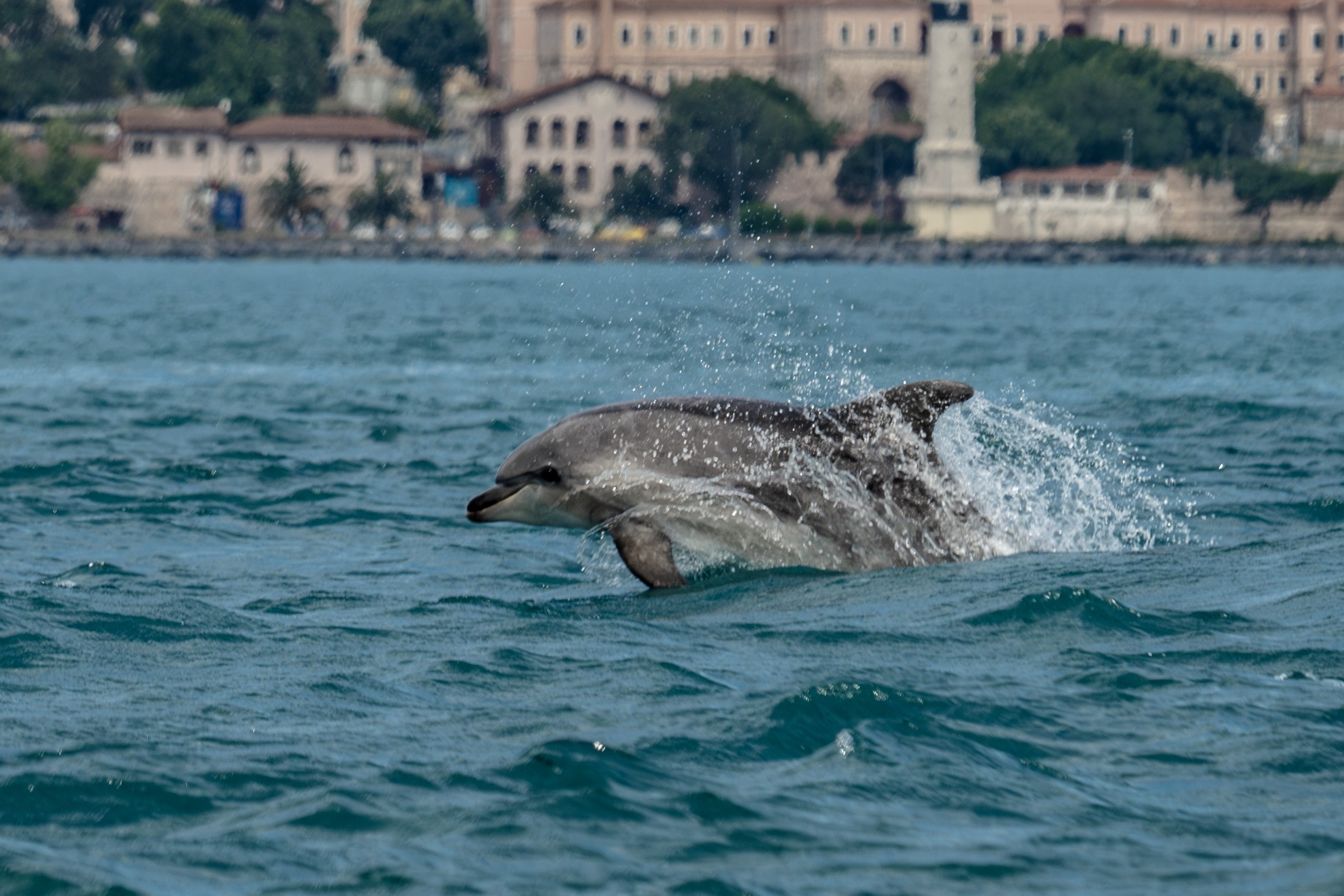
Researchers monitoring dolphin populations in the Bosporus and the Marmara Sea are using distinctive dorsal fin markings to identify individual animals and track the health of marine ecosystems.
The effort, led by the Marine Life Conservation Society (DYKD) and World Wide Fund for Nature (WWF)-Türkiye, is helping scientists better understand dolphin movements, population dynamics and broader ecological conditions in the Marmara Sea.
Researchers recently conducted a monitoring mission from waters off Heybeliada to the Bosporus, recording dolphins’ locations, behaviors and group structures while photographing individuals for identification.
Groups of dolphins, including mothers and calves, were observed swimming near the vessel. Researchers documented feeding, social interactions and movement patterns to support long-term population monitoring efforts.
Scientists rely on a technique known as photo identification, which uses the unique natural markings found on a dolphin’s dorsal fin. Similar to a human fingerprint, every dolphin’s fin contains distinctive notches, scars and shape variations that allow researchers to recognize individual animals across multiple years.
The method enables scientists to track where dolphins travel, how long they remain in specific areas and whether they return to the same habitats over time. It also provides important information about reproduction, population size and long-term survival rates.
Researchers currently monitor three species commonly found in the Bosporus: bottlenose dolphins, common dolphins and harbor porpoises.
The bottlenose dolphin, perhaps the best-known species among the public, is the most frequently observed in the Bosporus. Adults can grow up to 3.5 meters (11.5 feet) in length and are often seen traveling in groups of five to 15 individuals.
Common dolphins are more slender and agile, reaching up to 2.5 meters in length. Distinguished by their characteristic hourglass-shaped coloration, they are generally associated with more open waters.
Harbor porpoises, meanwhile, belong to a different family than dolphins. Smaller in size and lacking the prominent beak characteristic of dolphins, they are sometimes mistaken for juvenile dolphins by casual observers.
The Bosporus serves as a critical ecological corridor connecting the Black Sea and the Marmara Sea. Rich fish populations make the strait an important feeding, resting and migration route for marine mammals.
WWF-Türkiye marine and biodiversity specialist Cansu lkılınç said the organization conducts public dolphin observation events that contribute to citizen science while generating valuable scientific data.
Although some residents believe dolphins are becoming more common in Istanbul waters, Ilkılınç said long-term monitoring data is needed before drawing conclusions about population trends.
“The Bosporus has always been part of the dolphins’ habitat,” she said. “What has changed in recent years is our awareness and the amount of observation being conducted.”
Recent surveys near Fenerbahçe, the Maiden’s Tower and Haydarpaşa recorded groups of up to 15 bottlenose dolphins, including at least three calves. Researchers also reidentified a dolphin first documented in 2012, indicating that some individuals continue to use the Bosporus for more than a decade.
Dolphins are considered indicator species because they are highly sensitive to changes in marine ecosystems, and population trends can provide valuable clues about the health of the sea.
“The observation of healthy calves shows that the Bosporus remains an important habitat for dolphins,” Ilkılınç said. “Protecting dolphins also helps preserve the biodiversity of the Marmara Sea.”
Meanwhile, the DYKD continues restoration and monitoring efforts around Tavşan Island, a protected area in the Marmara Sea designated by presidential decree in 2021. The organization has monitored wildlife in the region for more than a decade.
Corporate relations and partnerships manager Gizem Ece said dolphins are observed in the area at least three times a week, highlighting its ecological importance for species across the food chain.
Ece also linked the recent turquoise coloration of the Bosporus to increased algae growth fueled by Saharan dust, favorable water temperatures and sunlight. The algae support fish populations, which in turn attract dolphins to the area.
“Where fish populations are abundant, dolphins are more likely to be present,” she said.
DAILYSABAH
هلدینگ کاسپین استانبول | خرید ملک در ترکیه | صرافی معتبر ایرانی در ترکیه | خرید و فروش طلا در ترکیه | مهاجرت به ترکیه | واردات و صادرات در ترکیه | نیازمندیهای ترکیه | اخبار ترکیه | اخبار جهانی | توریست ایران | خدمات توریستی در ایران | تورهای گردشگری ایران | هلدینگ اول | خدمات کاریابی و فریلنسری و شغل | مرجع اطلاعات ایران (همه چیز در ایران) | کیف پول و خدمات مالی و پرداخت یار | اخبار ایران | تابلو زنده قیمت ارز در ترکیه و استانبول | صرافی آنلاین ترکیه | قیمت طلا و نقره در ترکیه | سرمایه گذاری در ترکیه | جواهرات در ترکیه | نرخ لحظه ای ارزها در استانبول | قیمت دلار امروز در ترکیه | قیمت دلار استانبول امروز | قیمت لحظه ای دلار | اخبار روز ترکیه استانبول | اپلیکیشن ISTEX | اپلیکیشن قیمت لحظه ای دلار و یورو و لیر و ارزها در ترکیه
About the Author