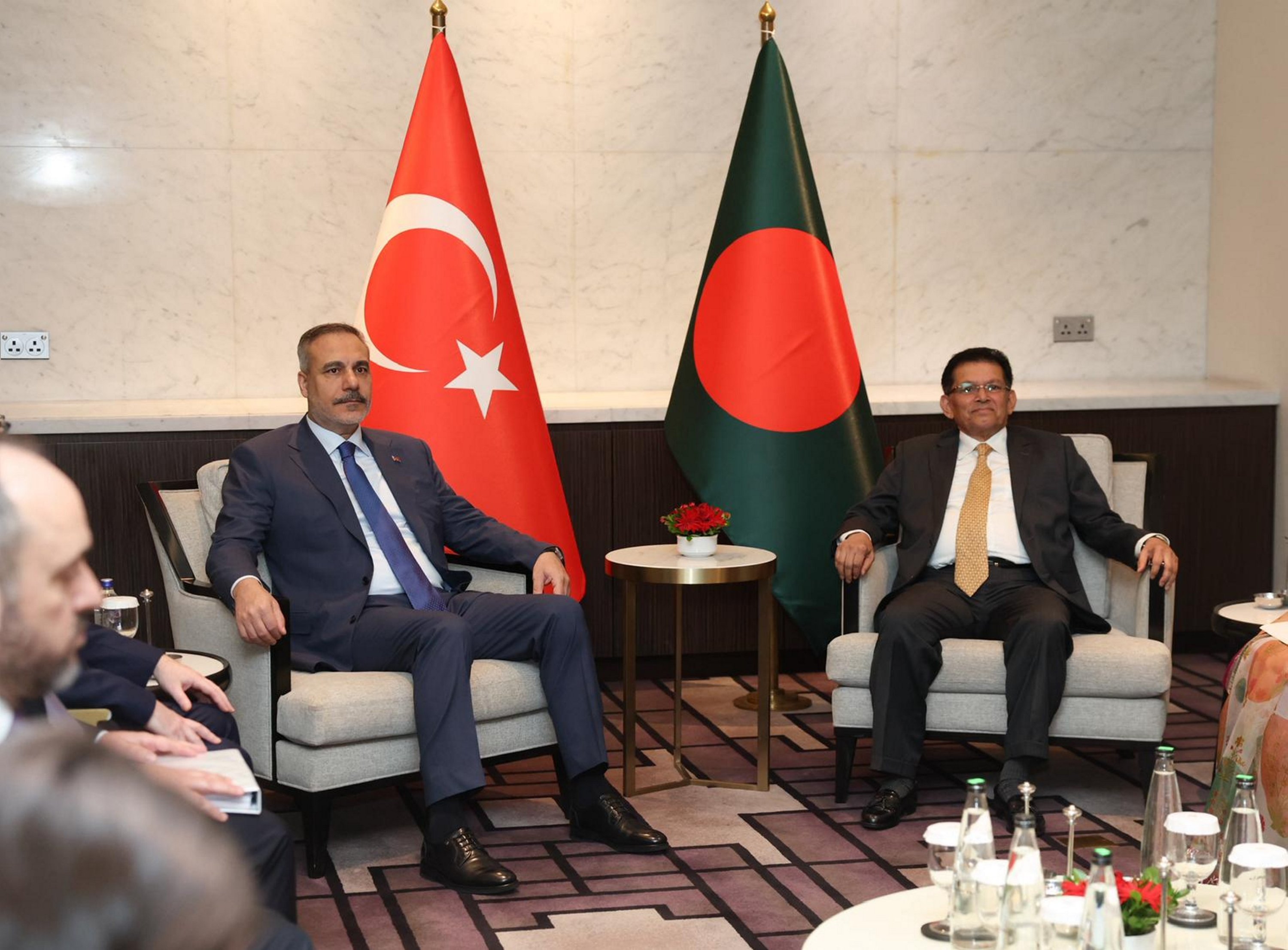
When Foreign Minister Hakan Fidan landed at Hazrat Shahjalal International Airport last week, he became the first Turkish foreign minister to visit Bangladesh in nearly six years. The symbolism was hard to miss, and so was the protocol. Fidan was received by Bangladeshi Foreign Minister Khalilur Rahman. Over the following days, he was scheduled to call on Bangladeshi Prime Minister Tarique Rahman and meet opposition leader Dr. Shafiqur Rahman as well. Capitals signal their priorities through the weight of a welcome, and Dhaka’s message was clear: This visit matters.
It should. For all the warmth in the joint press conference, the more important story is structural. Fidan’s trip is not a stand-alone gesture. It is the latest move in Türkiye’s broader “Asia Anew” strategy, the policy through which Ankara has spent recent years deepening its reach across Asia and the Indian Ocean. Seen that way, the question is not whether the two countries like each other. It is whether a long-term friendly relationship is finally acquiring a strategic shape, and whether that shape can last.
Türkiye-Bangladesh relations
The foundations are deeper than many assume. Türkiye was the first country to recognize Bangladesh as an independent state, at an Organisation of Islamic Cooperation (OIC) meeting in 1974. Both are populous Muslim-majority nations and members of the D-8 group of developing economies. That shared identity has given the relationship a steady undercurrent of goodwill even through difficult patches, including the strain during the previous government in Dhaka, when disagreements over the fate of Jamaat-e-Islami leaders cooled ties for a period. Those frictions have since faded, and the relationship has recovered its footing.
What has changed is the wider environment. Since the political transition of August 2024, Bangladesh has been actively diversifying its partnerships beyond its traditional circles. A new government took office earlier this year after national elections, and it has made clear that it intends to chart a more autonomous course. Rahman captured the mood when he spoke of friends rather than masters across the border. Read in context, that is less a slogan than a statement of policy: Dhaka wants partners who deal with it as an equal. Türkiye, with no colonial baggage in South Asia and a track record of treating smaller states as genuine counterparts, fits that description well.
This is where the visit’s concrete outcomes acquire their meaning. Ankara and Dhaka agreed to deepen defense-industry cooperation, explore investment in Bangladesh’s special economic zones, and expand collaboration in health. The two governments signed a memorandum on cultural cooperation. The cultural agreement may look slight beside the harder language of trade and defense, but diplomacy often moves through symbols before it moves through institutions, and the signal here is of a relationship meant to be civilizational and people-centered rather than purely transactional.
The defense dimension is where ambition runs highest. Turkish manufacturers have already found willing customers in Bangladesh, and the two militaries have held several rounds of structured dialogue in recent years. Fidan made clear that Ankara now wants to move beyond sales toward co-production, working with Bangladesh to manufacture military equipment itself. A proposal first floated during Türkiye’s Trade Minister Ömer Bolat’s earlier visit, to build a defense industrial zone on Bangladeshi soil, would turn the relationship from buyer and seller into partners. That is a different kind of tie altogether, and a far harder one to walk back.
The economic case is just as concrete. The two governments have set a modest but symbolically important goal: lifting bilateral trade from $1.35 billion in 2025 to $2 billion. More ambitiously, both sides discussed a possible free trade agreement, which would give the relationship a durable commercial backbone instead of leaving it dependent on the goodwill of successive summits. Add an open invitation for Turkish investors to enter Bangladesh’s special economic zones, plus cooperation in pharmaceuticals and hospital infrastructure, and the shape of a real economic partnership begins to emerge. Türkiye’s humanitarian presence in Cox’s Bazar, from the field hospital to the work of the Turkish Cooperation and Coordination Agency (TIKA), the Disaster and Emergency Management Authority (AFAD), the Red Crescent, and the Türkiye Diyanet Foundation (TDV), has already earned Ankara a depth of goodwill that few other capitals enjoy. The task now is to turn that goodwill into lasting economic and strategic weight.
There is also a regional logic worth naming honestly. Türkiye’s closest partner in South Asia is Pakistan, and Ankara’s warming with Islamabad has helped ease the recent thaw between Dhaka and Pakistan. China, another close Turkish partner, holds significant economic interests in Bangladesh. These are separate tracks rather than a single coordinated bloc, and Dhaka itself rejects the idea that it is joining any alliance directed against a third country. But the interests of these players increasingly point in a similar direction, and Bangladesh sits where several of them converge. That is precisely what gives Fidan’s visit a weight that a routine bilateral call would not carry.
Challenges ahead
None of this is automatic, and an honest assessment has to reckon with three challenges.
The first is the regional factor. Bangladesh sits in a crowded strategic neighborhood, and any expansion of outside defense activity will be watched closely by larger players, above all India. New Delhi has already voiced unease about Dhaka’s post-2024 realignment, and the controversy over remarks about the Siliguri corridor showed how quickly such friction can escalate. Ankara should welcome Bangladesh’s desire for autonomy while staying clear-eyed: a defense relationship that grows faster than the diplomacy needed to sustain it can generate tensions that outlast the headlines.
The second is implementation. Bangladesh has a long record of memoranda that never became projects. A defense industrial zone and a free trade agreement (FTA) require land, financing, technology-transfer terms, tariff negotiations and political continuity, none of which come easily in a country that only recently formed a new government. The signatures in Dhaka are a beginning, not a guarantee. What turns intent into outcome is institutional scaffolding: regular foreign-office consultations, a business council with measurable targets, a standing defense dialogue, and academic and cultural exchange that builds a generation on both sides who understand each other beyond official statements.
The third is durability across political cycles. The current opening rests on a government barely a few months old. Real strategic partnerships outlast the leaders who launch them, and Bangladesh’s recent history is a reminder of how quickly a foreign-policy posture can shift when power changes hands. The job for Ankara and Dhaka is to root these arrangements in institutions and commercial interests deep enough that the next election on either side cannot casually undo them.
The most promising thing about this moment is that the relationship does not start from zero. There is already goodwill, historical sympathy, and a public in Bangladesh that knows Türkiye well, from culture and education to humanitarian work. What is needed now is a shift from sentiment to strategy. The door Fidan’s visit opened is real. Where it leads depends on what comes after the communiques: the patient, unglamorous work of turning intent into infrastructure. If both capitals do that work, this week may be remembered not as another friendly visit, but as the moment a strategic partnership genuinely began.
DAILYSABAH
هلدینگ کاسپین استانبول | خرید ملک در ترکیه | صرافی معتبر ایرانی در ترکیه | خرید و فروش طلا در ترکیه | مهاجرت به ترکیه | واردات و صادرات در ترکیه | نیازمندیهای ترکیه | اخبار ترکیه | اخبار جهانی | توریست ایران | خدمات توریستی در ایران | تورهای گردشگری ایران | هلدینگ اول | خدمات کاریابی و فریلنسری و شغل | مرجع اطلاعات ایران (همه چیز در ایران) | کیف پول و خدمات مالی و پرداخت یار | اخبار ایران | تابلو زنده قیمت ارز در ترکیه و استانبول | صرافی آنلاین ترکیه | قیمت طلا و نقره در ترکیه | سرمایه گذاری در ترکیه | جواهرات در ترکیه | نرخ لحظه ای ارزها در استانبول | قیمت دلار امروز در ترکیه | قیمت دلار استانبول امروز | قیمت لحظه ای دلار | اخبار روز ترکیه استانبول | اپلیکیشن ISTEX | اپلیکیشن قیمت لحظه ای دلار و یورو و لیر و ارزها در ترکیه
About the Author