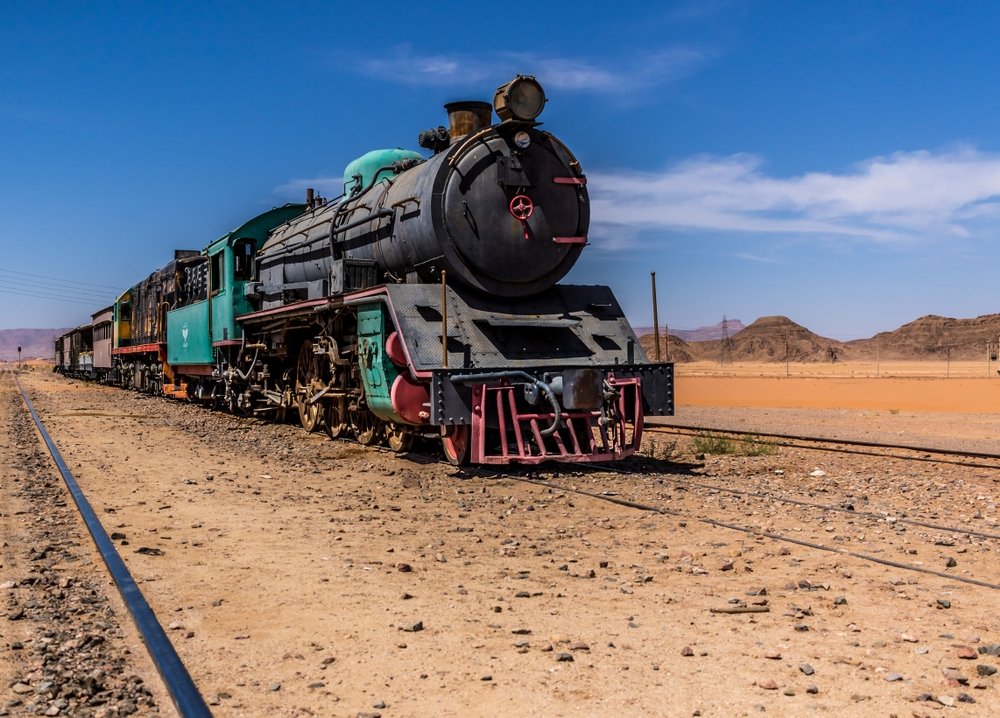
On June 9, Türkiye and Saudi Arabia signed two memoranda of understanding in Riyadh: one on railway cooperation reviving the historic Hejaz Railway through Syria and Jordan, and the other on logistics, accompanied by plans for a terrestrial fiber-optic route along the same geography. A joint feasibility study is due before the end of the year, with a long-term vision extending the line toward Oman and the Indian Ocean.
Read as a news item, this is a railway agreement. Read correctly, it is the latest piece of a design Ankara has been assembling for over a decade. The Development Road through Iraq, the Middle Corridor across the Caspian, the energy transit architecture, and now the revival of the Hejaz Railway and a digital backbone are not a portfolio of separate projects, but components of a single strategic geometry, and that geometry is what deserves analysis.
From heartlands to nodes
A century ago, Halford Mackinder taught strategists to see power as a contest between those who command the land and those who command the sea. That dichotomy has quietly expired. Power now accrues to the nodes where flows of goods, energy and data converge and can be assured, and states are competing to mint this new currency: China through the Belt and Road (BRI), India and its partners through the India-Middle East-Europe Economic Corridor (IMEC), the Gulf monarchies through ports, rail and cables.
Türkiye’s wager is geometric. World trade flows predominantly from East Asia westward, and until the Arctic’s Northern Sea Route matures into a reliable commercial artery, that flow is captive to the southern maritime system and its narrow gates. Any land-based alternative into Europe, whether it originates in the Gulf, the Red Sea or Central Asia, converges by physical necessity on a single landmass: Anatolia. Ankara’s strategy is to convert that geographic inevitability into an infrastructural strategy.
Two axes, one architecture
The design operates along two perpendicular axes.
The vertical axis lifts Gulf and Red Sea flows northward overland. Its backbone is the Development Road, a $17 billion multimodal corridor running from Iraq’s Grand Faw Port to the Turkish border, developed with Iraq, the United Arab Emirates and Qatar.
The revived Hejaz Railway adds a second arm: restoring the Türkiye-Aleppo link, joining the existing line through Damascus and Jordan, and integrating with the Saudi network toward Riyadh and ultimately Oman.
The two arms are deliberately redundant. A disruption on either leaves the axis intact, an engineering principle borrowed from network design and applied to geopolitics.
The horizontal axis is the Middle Corridor, carrying East-West trade from China through Central Asia and the Caucasus into Türkiye, with the Zangezur connection, now under construction on the Turkish side, set to compress its most critical segment.
Where the axes intersect, Türkiye is removing its own bottleneck: the $8.1 billion Istanbul Northern Railway Corridor Project (INRAIL), backed by $2 billion in World Bank financing, will raise Bosporus rail freight capacity from roughly 3 million to 50 million tons annually. That international capital is underwriting the node at this scale is itself telling: the vision is no longer merely declared by Ankara; it is being priced by the market.
Working vs. waiting corridors
IMEC is the design’s mirror image. Announced in 2023 with formidable backers, it remains structurally locked. Its rail spine terminates at Haifa, making Saudi-Israeli normalization a load-bearing precondition that has been frozen since October 2023, and its ship-to-rail-to-ship architecture reintroduces the very transshipment frictions land corridors exist to eliminate. Nearly three years on, no member state has made formal financial commitments.
The Türkiye-centered design inverts each weakness. It requires no diplomatic breakthrough not already underway, advancing instead along the axis of an active Turkish-Saudi rapprochement, it offers a continuous land bridge rather than a chain of ports, and it is moving from memoranda to feasibility studies to tenders on a visible timeline. The deeper point is that it is geographically realistic, not unnecessarily competitive: any southern corridor seeking to reach Europe overland must either pass through Anatolia or remain hostage to a political precondition it cannot yet meet. IMEC’s eventual completion would not diminish the Anatolian node; it would feed it.
The third cargo: Data
What distinguishes this generation of corridors is their third cargo. Alongside goods and energy, the new arteries are engineered to carry data, where vulnerability is even more concentrated than in shipping. Roughly 17 submarine cables traverse the Red Sea, carrying about 90% of data traffic between Asia and Europe. The 2024 cable cuts off Yemen, which degraded a quarter of that traffic in a single incident, previewed the risk. The exposure has since become existential for the Gulf: the hyperscale data centers Amazon, Microsoft and Google have built across the region, the physical substrate of its artificial intelligence ambitions, connect to the world through precisely these threatened waters.
As a response, Gulf operators are financing no fewer than six terrestrial fiber corridors toward the Mediterranean, the most advanced of which, an $800 million Saudi-led line across Syria, connects directly to Türkiye. The fiber component of the Riyadh agreements is therefore no annex to a railway deal; it recognizes that the 21st-century corridor is a bundled artery of freight, energy and information, and that all three route most securely through the same Anatolian geography. A state that can guarantee the flow of data between Asia and Europe acquires leverage that pipelines alone never conferred.
Tying the Middle East
The Hejaz revival binds Syria’s reconstruction, Jordan’s transit economy and the Turkish-Saudi alignment into a single web of shared material interest. Each kilometer of restored track converts nascent diplomatic normalization into sunk cost, and sunk cost is the most durable form of commitment in international politics. The railway is being deployed as an instrument for producing regional stability.
Türkiye’s grand design, two redundant axes of freight, an energy hub binding them and a digital backbone laid along the same lines, is a deliberate bid to deny any single actor a stranglehold on Eurasian exchange.
The Ottoman state built the original Hejaz Railway to hold an empire together; Türkiye and Saudi Arabia are now rebuilding it to hold a trading system and a partnership together. Mackinder asked who rules the heartland. The better question of this century is who runs the node, and Ankara has clearly decided on its answer.
The views and opinions expressed in this article are solely those of the author. They do not necessarily reflect the editorial stance, values or position of Daily Sabah. The newspaper provides space for diverse perspectives as part of its commitment to open and informed public discussion.
DAILYSABAH
هلدینگ کاسپین استانبول | خرید ملک در ترکیه | صرافی معتبر ایرانی در ترکیه | خرید و فروش طلا در ترکیه | مهاجرت به ترکیه | واردات و صادرات در ترکیه | نیازمندیهای ترکیه | اخبار ترکیه | اخبار جهانی | توریست ایران | خدمات توریستی در ایران | تورهای گردشگری ایران | هلدینگ اول | خدمات کاریابی و فریلنسری و شغل | مرجع اطلاعات ایران (همه چیز در ایران) | کیف پول و خدمات مالی و پرداخت یار | اخبار ایران | تابلو زنده قیمت ارز در ترکیه و استانبول | صرافی آنلاین ترکیه | قیمت طلا و نقره در ترکیه | سرمایه گذاری در ترکیه | جواهرات در ترکیه | نرخ لحظه ای ارزها در استانبول | قیمت دلار امروز در ترکیه | قیمت دلار استانبول امروز | قیمت لحظه ای دلار | اخبار روز ترکیه استانبول | اپلیکیشن ISTEX | اپلیکیشن قیمت لحظه ای دلار و یورو و لیر و ارزها در ترکیه
About the Author