
Hegseth says the US will be “doubling down” on its efforts to get allies to spend what they need to spend.
He says his department will conduct a six-month review of US forces in Europe.
He says it will look at actual benefits of having US military in Europe – and will be a real review.
“It will be designed to ensure that Nato is moving fast and irreversibly toward Europe leading, stepping up to take primary responsibility for the defence of Europe.”
He then goes further to say that the US dues to the Nato budget will be contingent on other countries meeting their defence spending targets.
“Where other allies do not spend with urgency, our dues, contributions will go down. Nato will be a two-way street.”
He adds:
“America cannot care for or pay more for Europe’s defence than our allies do.”
None of this is really new new – Hegseth largely repeats the US’s main frustrations and grievances with the alliance, repeatedly expressed by Trump – but the tone of the delivery is still very, very striking.
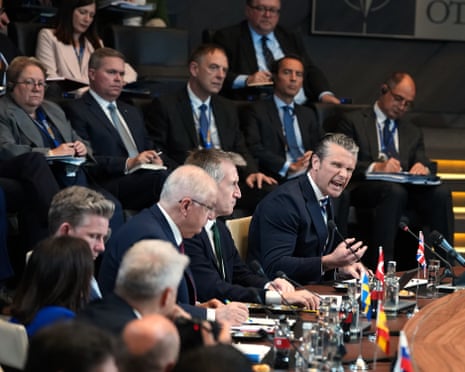
Hegseth has laid into Nato allies for not helping enough with bases and overflights during its early Iran operations – and once he did not name any countries, it’s likely targeted at the likes of Spain, Italy, Portugal.
In other parts, it is just a broader criticism of what the US sees as “free riding” from the allies, as they do not move quickly enough on spending.
Coming just weeks before the Nato summit in Ankara, it is clearly intented to serve as a warning to several of the allies that still don’t spend enough and don’t seem to act with the urgency the US is expecting them to increase that spending – or even offer a credible path towards it.
The proposed posture review – and explicit threat that some of them will fail it – and the suggestion the US could reduce its contributions if others do not pay enough, will make some think twice about their plans in the next few weeks.
As Hegseth ends his remarks, Rutte says “there’s much to discuss and decide today.”
You bet it’s going to be lively.
Hegseth says “our direction of travel is and has been clear.”
“This is the right thing to do by the American people. It’s the right thing to do by this alliance.
Europe can and must take primary responsibility for its conventional defence as it pledged at The Hague Summit, and in the process safeguarding Europe’s defence for generations to come, we know our allies can do it, and it’s time.”
Hegseth makes it clear that the review will not be just a box-ticking exercise.
“It’s a review that some countries will fail and others will pass with flying colours. In the end, the review is intended to both improve US force posture and basing and strengthen Nato 3.0.”
Hegseth says the US will be “doubling down” on its efforts to get allies to spend what they need to spend.
He says his department will conduct a six-month review of US forces in Europe.
He says it will look at actual benefits of having US military in Europe – and will be a real review.
“It will be designed to ensure that Nato is moving fast and irreversibly toward Europe leading, stepping up to take primary responsibility for the defence of Europe.”
He then goes further to say that the US dues to the Nato budget will be contingent on other countries meeting their defence spending targets.
“Where other allies do not spend with urgency, our dues, contributions will go down. Nato will be a two-way street.”
He adds:
“America cannot care for or pay more for Europe’s defence than our allies do.”
Hegseth says that “some of Nato’s largest economies, some of our richest countries, allies that are happiest to go on about the rules-based international order and middle powers banding together still think the era of free riding is here.”
He says Trump disagrees.
“This is not what any reasonable person would expect, and it’s not going to cut it any more.”
(He may be thinking of, among others, Spain, which has long been the target of US criticism, and has clashed with it in recent months.)
Hegseth makes it very clear how the US is annoyed about the perceived lack of support on Iran.
“The United States has defended Europe for generations, and the President said all he said was that our jets would need to take off from bases in Europe or our ships from ports to strike targets in the Middle East, Iranian targets that threaten European interests even more directly than they threaten us.
But too many of our allies said no, or tried to drown us in arcane legal debates, or criticised us publicly for doing what they aren’t prepared or able to do themselves. It was shameful.
These allies, they put America’s sons and daughters, our sons and daughters, at risk by denying them the predictable access facing an overflight that never should have been in question at all.”
Hegseth now goes hard on some Nato countries that are still paying below the expected levels.
He says “for all of our clarity, too many allied capitals seem to still miss something in translation” and “too many allies still do not recognise the historic need … to forge a relevant, powerful military alliance.”
He says the US “gave our allies a test to support America when we asked for their help and too many failed it.”
Hegseth says that Trump is clear about his intention to increase defence spending so the US leads and shows others “it’s not do as I say, it’s do as we do.”
He says he believes the US approach has been validated on Ukraine, with allies taking more responsibility for Ukraine’s defence – and this approach actually yielding positive results.
“It is happening, and it’s a validation of President Trump’s approach, an approach that will set the table for peace.”
But he says that “for all these early steps in the right direction, there have also been real setbacks that we cannot ignore.”
Hegseth continues by saying that Nato 2.0 was “an era of distraction, de-industrialisation and demilitarisation,” with “an era of free riding.”
“Those were lost years that we are not going back to.”
He says that’s why his department is “so clear and so candid” about the need to “restore Nato’s core military role and character” and why it’s returned US troop levels to pre-2022.
He says the alliance needs to return to its roots to be as strong as required and “if need be, make good on Article Five.”
He says some countries “got the message and stepped up,” but others are still failing.
Hegseth seems to praise spending commitments adopted at last year’s Nato summit in The Hague, saying they were “all about transforming Nato back into a real military alliance that is focused on hard power and real deterrence.”
But in another eye-catching quote, he goes on to say:
“Europe was not supposed to be a dependency of the United States. That’s not what Winston Churchill or Charles de Gaulle or Konrad Adenauer wanted or expected. No, Europe was supposed to be a military power, allied with a strong America.”
He goes back in Nato history to 1951, quoting Eisehower comments that “if in 10 years all American troops stationed in Europe for national defence purposes have not been returned to the US, then this whole process will have failed.”
But he says that Nato 2.0 in the following decades increasingly focused on “gender equality and climate change” instead of “tanks and fighters and air defences.”
“Europe’s borders flew wide open, welfare states expanded, defence budgets cratered, along with Europe’s belief in itself and its civilization. Nato lost its way.”
Ouch, again.
US secretary of defence Pete Hegseth has asked to speak at the beginning of the Nato ministerial in Brussels, and it very much looks like his comments will set the tone for the day.
He begins by saying that Trump “has said again and again … our allies must step up.”
“Nato has been a paper tiger and a one-way street. No more.”
Ouch.
Ukraine hit an oil refinery near Moscow and other targets in Russia overnight in what president Volodymyr Zelenskyy called “a justified response” to recent strikes on Ukraine.
Russian officials were quoted as saying that the attack forced commercial flights and airports to be suspended for safety reasons and caused a temporary halt on Moscow’s ring road, after some 180 drones were shot down over the Russian capital.
“This is a fully justified response to Russian attacks on our cities and communities, and another important result of our warriors’ work against facilities that sustain Russia’s war machine,” Zelenskyy said.
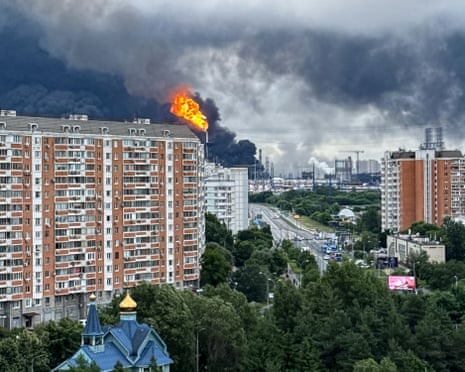
The strikes come on the day of a Nato ministerial meeting in Brussels, the last before next month’s summit in Ankara.
Nato allies are expected to discuss the latest on their defence spending plans, with the US pressing Europe to take more responsibility for the defence of the continent.
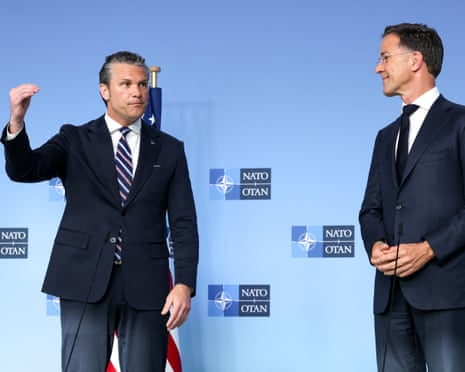
Later on, the ministers will also take part in the Ukraine Defence Contact Group meeting, a key forum to coordinate on support for Ukraine, which is expected to be attended by Zelenskyy.
The main event comes fairly late in the day, as EU leaders are expected to gather for the European Council meeting on Ukraine and the Middle East. It’s a two-day summit, likely to go late into the night.
Lots for us to cover.
It’s Thursday, 18 June 2026, it’s Jakub Krupa here, and this is Europe Live.
Good morning.
The Guardian wp:paragraph
هلدینگ کاسپین استانبول | خرید ملک در ترکیه | صرافی معتبر ایرانی در ترکیه | خرید و فروش طلا در ترکیه | مهاجرت به ترکیه | واردات و صادرات در ترکیه | نیازمندیهای ترکیه | اخبار ترکیه | اخبار جهانی | توریست ایران | خدمات توریستی در ایران | تورهای گردشگری ایران | هلدینگ اول | خدمات کاریابی و فریلنسری و شغل | مرجع اطلاعات ایران (همه چیز در ایران) | کیف پول و خدمات مالی و پرداخت یار | اخبار ایران | تابلو زنده قیمت ارز در ترکیه و استانبول | صرافی آنلاین ترکیه | قیمت طلا و نقره در ترکیه | سرمایه گذاری در ترکیه | جواهرات در ترکیه | نرخ لحظه ای ارزها در استانبول | قیمت دلار امروز در ترکیه | قیمت دلار استانبول امروز | قیمت لحظه ای دلار | اخبار روز ترکیه استانبول | اپلیکیشن ISTEX | اپلیکیشن قیمت لحظه ای دلار و یورو و لیر و ارزها در ترکیه
/wp:paragraph wp:paragraph /wp:paragraph
About the Author


