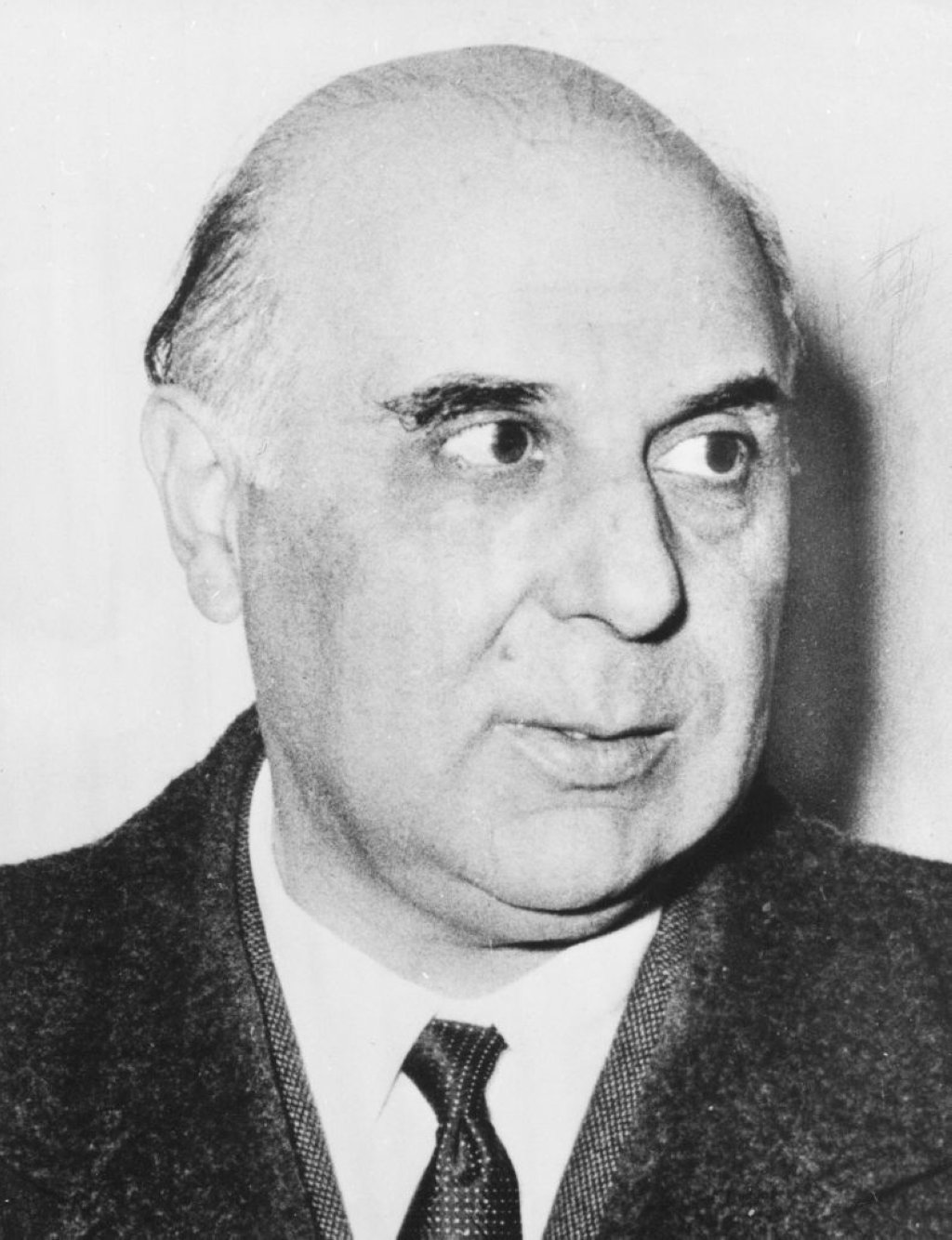
The most famous modern Greek writer is probably Nikos Kazantzakis (1883-1957). He came of age during the long, bloody divorce between Turks and Greeks. It seems to have given him a negative view of Türkiye, as evidenced by his autobiographical writing as well as his never having visited the country on his extensive world travels. This, despite the fact that the outcome of the Turkish-Greek conflict for his homeland of Crete was for that island to be united with Greece and thus remain forever open to him. His contemporary, George Seferis (1900-1971), was born in Izmir, yet due to another chapter in the conflict was forced in 1922 to leave his native city, which was it was forever lost to him as a home. It might therefore be surmised that Seferis would take an even more negative view of the Turks than Kazantzakis. This does not, however, appear to have been the case.
Seferis did return to Türkiye as a diplomat for the Greek state in 1948-50 and traveled within the country during this time. One trip, in 1950, took him eastwards from Ankara into Cappadocia. His subsequent account of this journey, the book “Three Days in the Monasteries of Cappadocia,” is particularly focused on the region’s Byzantine rock-hewn churches and concerns about Greek art. However, it also reveals a man with no nationalistic rancour towards the Turks, who instead appears to have enjoyed their company. Seferis states in this book that the Turks he met across the country “touched me with their kind hearts and their honesty.”
On a recent visit to Cappadocia, I took this short book by Seferis with me. It has much to offer today’s visitor to the region. Comparing Seferis’ observations with one’s own reveals both what is timeless in the region and what has dramatically changed.
My own trip had certain similarities to that of Seferis. Like his, my visit occurred close to the middle of the year during a bayram. However, Seferis visited during Ramadan Bayram, which in 1950 fell in July, whereas I visited during Qurban Bayram, also known as Eid al-Adha, which this year fell at the end of May. Seferis’ trip lasted three days, while mine lasted four, and we both felt that this was far too short a time to do justice to the area.
What drew both of us to the region were its famed rock churches. Yet any further similarities between our journeys stem directly from Seferis’ book, which I found myself using as a guide.
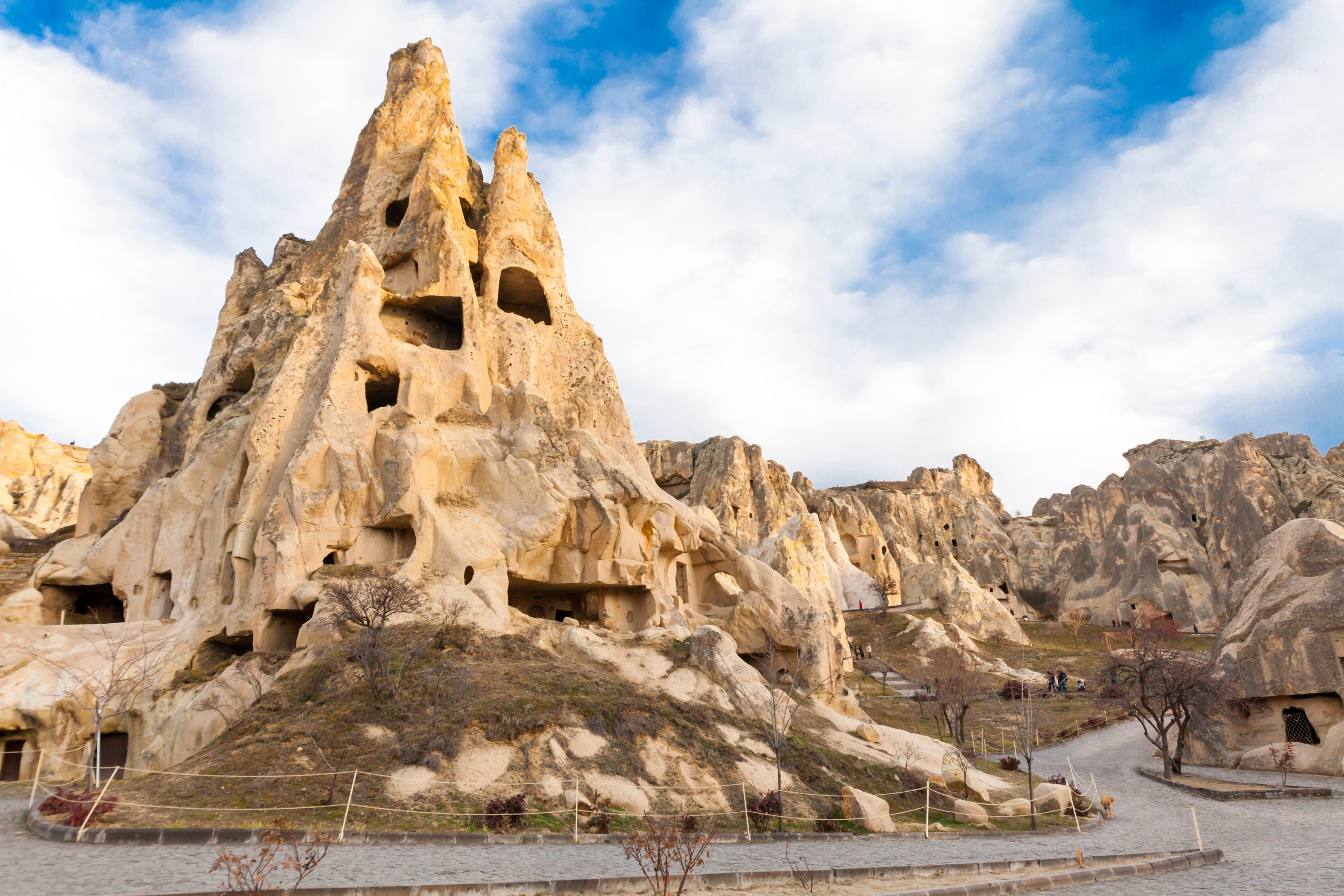
The most striking and timeless element to Cappadocia is surely its landscape. This has developed in slow geological time, not the fast-paced mania of modern human history. Seferis relates that this is a landscape full of “the most bizarre shapes that the mind of man can conceive,” with formations in the shapes of “teeth, nails, wedges, files, saws, knives” which are “of supernatural size, shattered, broken, jumbled and petrified.” He is also struck by the subtle changes in colors of these monoliths, all of which strike the observer of today as well.
Göreme Open Air Museum
Seferis had come to see the rock-hewn churches of Cappadocia. The most impressive site for them is today known as the Göreme Open Air Museum. That this valley would one day become a major tourist attraction was probably unimaginable to Seferis. When he visited the valley, his party of companions seems to have been completely alone, and the churches themselves lacked the easy access they have now. But the key attraction in this valley is its art, which is as interesting today as it was for Seferis. The art in the valley’s churches is especially interesting in that it is so varied. It ranges from what Seferis calls “crude shapes drawn with clumsy red lines” to full complete frescoes of easily identifiable scenes from the Bible.
One image from the valley that particularly struck Seferis is of St. Onouphrios. It is a depiction of an elderly naked monk whose modesty is preserved by an intervening plant, not the stereotypical “fig leaf” but rather “a cactus in the shape of a club, with a serrated black outline like a saw.” Seferis is being impishly facetious in referring to a “cactus,” when the plant is surely supposed to be a palm tree, cacti not existing in Anatolia at the time of its painting. In this way, Seferis humorously emphasises the raw unsophistication of the fresco.
Indeed, this speaks to the brilliance of Seferis’ writing, for though he modestly disclaims any expertise, his book contains informative, thoughtful, open and comical commentary. Moreover, like any good literary traveler, Seferis interestingly reflects his own contemporary concerns through the medium of what he sees. One particularly striking example of this concerns a fresco in the Dark Church. Seferis notes of this church that “it is the best preserved of those I saw.” More than 70 years later, my own, albeit limited, observations in Cappadocia concur with his, and although Seferis was clearly worried that the frescoes of the Dark Church would be lost, his fears have fortunately turned out to be unfounded in that they are still there to amaze the visitor to the church today.
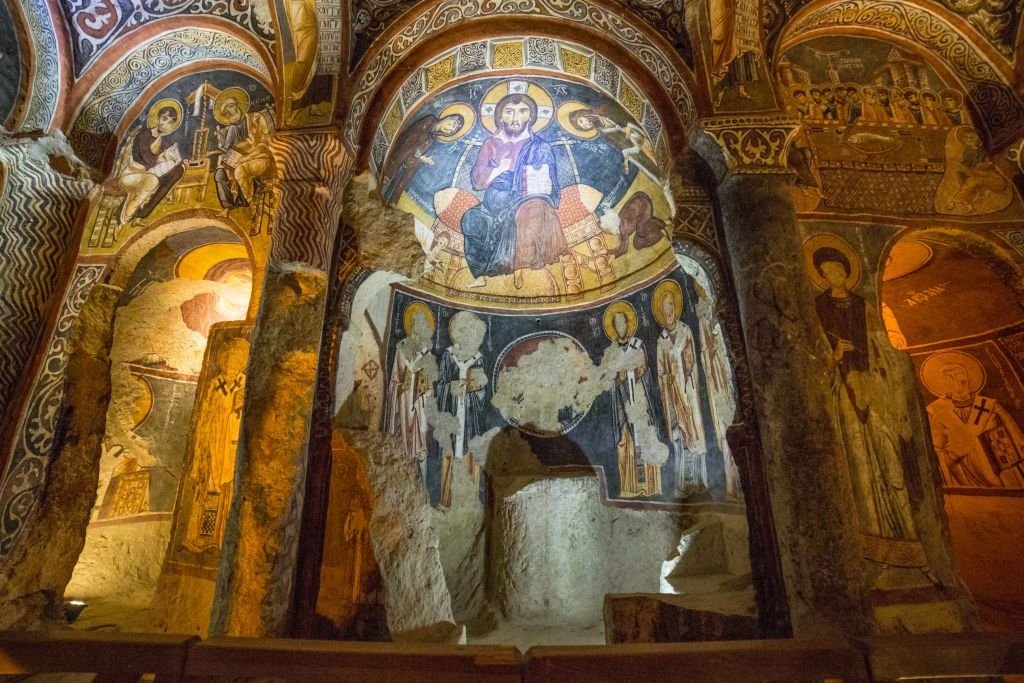
What has changed since the time of Seferis is, as one may have guessed, the visitor numbers. While Seferis was effectively poking around in a wilderness, today there are huge crowds of people in the valley. This can present a problem when going into the churches, including the Dark Church, for they are invariably accessible via a single narrow tunnel that serves as both an entrance and an exit. Some eager visitors seem to fail to grasp that unless visitors inside are allowed to come out, then gridlock will inescapably occur. However, the visitor of today has one definite advantage over Seferis, for the Dark Church today is now gently lit at a level that does not damage the frescoes but allows them to be seen in all their splendor, whereas Seferis seems to have had to examine it by torchlight.
George Orwell, a contemporary of Seferis, claims that, “The best books are those that tell you what you know already.” I know what Orwell means, but surely great books also provide the reader with new perspectives. This is what Seferis’ book provided for me in the Dark Church. For without it, it is almost certain that I would not have looked carefully at one particular fresco and may not even have really noticed it. Seferis, however, got me to carefully observe what he names “The Betrayal,” which can be seen on the right-hand side of the nave. It left such an impression upon Seferis that he reveals that it was “still haunting” him after he had left the valley and returned that evening to Ürgüp. As his name for it perhaps suggests, the fresco is of the betrayal of Christ by Judas as related in the Gospels. Seferis has this to say about it: “Jesus is in the middle, surrounded by heads; in the background there are the soldiers’ lances. Judas is very young, dressed in white, and his eyes look dull compared with the exceptionally powerful eyes of the others who are fixing him with their gaze.”
It is the eyes of Judas that Seferis finds so intolerable. For he states that “while I was looking at them, I suddenly thought that nowadays I would call betrayal indifference.” Being directed by Seferis to look at the fresco this way, I had to agree. And in making this point Seferis is surely reflecting his own deeply personally held concerns rather than reflecting an idea present in Christian doctrine. For whatever was actually in the mind of the fresco painter, betrayal in the Near East at least has traditionally been a fully conscious and even hot-blooded affair.
Hence, I feel that Seferis’ comment is a critique of his own age in which ideology had come to replace religion and had led to foreign invasion, famine and then a fraternal bloodletting of civil war in Greece in the decade preceding Seferis’ visit to Cappadocia. What seems to have particularly disturbed Seferis, and thus makes him similar to Orwell and Albert Camus, is that these horrific events, being ideologically inspired, allowed those partaking in them to indifferently abdicate any potential individual dictates of conscience to the supposed greater good of the movement, resulting in their dehumanization. This powerful observation of Seferis had as great an impact on me as the image had on him.
Valley of Soğanlı
Seferis’ little book also proved its value by leading me to the Valley of Soğanlı, which lies around 50 kilometers (30 miles) to the south of the Cappadocian centers of Göreme and Ürgüp. For Seferis, the journey there from Ürgüp was an ordeal in itself. Using a jeep, his party was only able to cover a mere 10 kilometers in an hour, and at points they had to even get out of the jeep to enable it to scale a steep hill. The difficult journey taken by Seferis reflects the remoteness of this area in 1950. Seferis notes that in the village of Soğanlı, when he eventually reached it, the locals told him that “they hadn’t seen a foreigner for eight years.” Today, the whole drive there can be done on a smooth tarmacked road and the journey took us under an hour, and while the valley is nothing like the tourist hot spot of the Göreme Valley, it is now somewhat cosmopolitan in that upon our arrival we saw a German campervan and a bit later on ran into a tour group from Georgia.
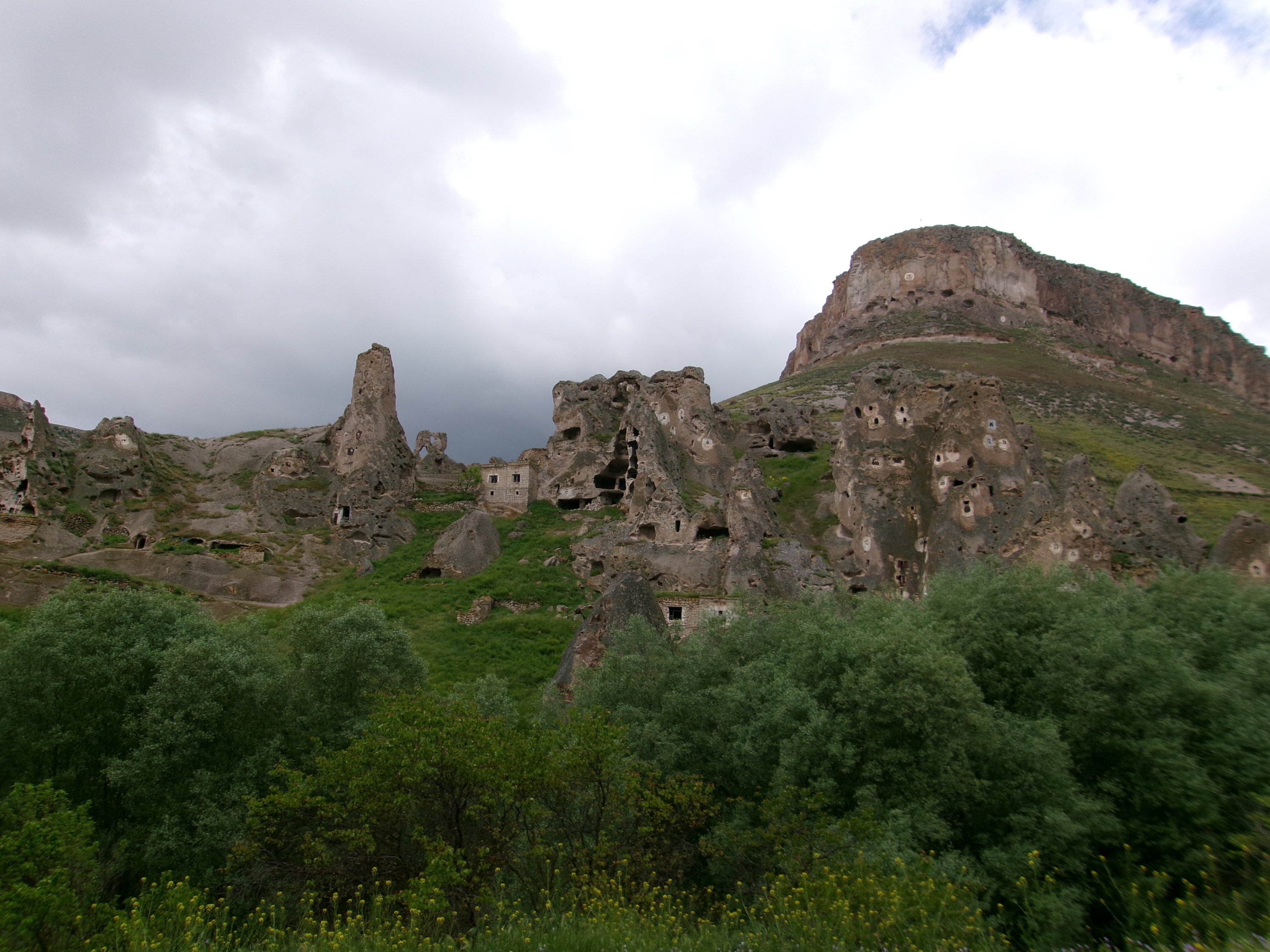
There is a timeless element to the valley though. Seferis avers that compared with what he has seen in the heart of Cappadocia, it has “another feel,” the valley having a more ponderous aura, being “motionless and wild” while “the rock faces rise sullenly like castle walls.” I agree, only for us, even Seferis’ “lovely blue sky” over all was missing, the overcast light and rainy conditions adding more to the gloom.
It was Seferis’ description of Balıklı Church that had brought us out here, but I was unable to locate it. I learned afterwards that even if I had been able to, I could not have seen the decoration that so affected Seferis, as it was lost during the decade subsequent to his visit. I did, however, get to see the dome of the Kubbeli Church and I agreed with him that it has at least the appearance of “Armenian influence” in its design, being of a similar, though inferior, style to that seen, for instance, on the famed Akdamar Church. Seferis also regards the Kubbeli Church as unique in Cappadocia as being “the only monolith church with an exterior form” that he saw, and the same was true for me.
For us, the failure to find the Balıklı Church was compensated for by the Karabaş Church where we ran into the Georgian tour group. Seferis had insufficient time to study this site properly but refers to it having “badly damaged frescoes.” They are not in great condition today, but their figures still make a powerful impression and were the best frescoes I saw outside of the Göreme Open Air Museum, making me wonder what was lost in the once superior Balıklı Church.
Rival artistic traditions
Seferis’ book is also particularly good in the lesson it contains for those peoples or people that find themselves traversing cultural boundaries or under the powerful influence of competing cultural traditions.
Seferis affirms that the art in Cappadocia is an eastern art, indeed the best “example of Oriental Byzantine art” to be found. From what he has seen in Cappadocia, Seferis concludes that its “art is characterized by a tendency towards what is alive, real, specific and tangible.” It is worldly, demonstrative and direct, and Seferis compares it to folk music. It is a people’s art in its reflection of “a popular demotic imagination” and originating in an area that was then “at the frontiers” of the Greek world in Asia, it was also open to ideas from further East.
This stands in contrast to the classical tradition of Greek art found in the high art of the apogee of Byzantium in its capital of Constantinople. Although for Seferis, this latter classical tradition of Greek art preserves “some traces of its contact with the East,” it is principally for him derived from the Christian West and it is marked by a “spirit of nobility, measure and elegance.” It is not worldly; it is rather “cerebral, schematically symbolic and abstract,” and its aim is “in suggesting ideas” rather than being scenic.
Seferis is not arguing that one of these traditions should subdue the other. Rather, his focus on Cappadocia is to draw equal attention to the demotic tradition that is at risk of subsumption, at least in artistic terms, by the other. For Seferis believes that Greek culture is at its best when these “two traditions, which have never stopped struggling with each other for two thousand years, come into perfect equilibrium.”
Seferis feels that something of this kind has been achieved once during the twilight of the Byzantine Empire and secondly in his own time. However, he is aware that there is still what he would regard as a danger to Greek art from a potent, overly classical pedantic approach.
Although Seferis makes no mention of this, as a man of the modern age and one for whom the poetry of T.S. Eliot is so significant, there is surely a subtext here concerning the art of the West. During Seferis’ lifetime, and still to quite an extent today, artists outside of the West are faced with how to deal with the dominant global role of Western art. Some capitulate, repudiating their traditional artistic heritage, and see Western Art as all that counts. Then there are others who retreat within their traditions, believing that Western Art has nothing to offer them.
I think what Seferis has to say about Greek art and implicitly what he seems to be suggesting concerning Greek art vis-a-vis that of the West is that this frontier between one’s own tradition and that of the other should be embraced for its dynamic potential rather than seeking sheltered refuge on one or the other side of it. For Seferis posits the idea “that in ideas and arts, just as in men, isolation can only end in desiccation and stagnation.” As such, a dynamic dualism from an interplay of cultures is essential for an inquisitive and creative mind. I am in agreement with Seferis on this approach, and I would like to note that, in this way, though the focus of his book is on Greek art found in Türkiye, he perhaps also has an implicit lesson for the artists of Türkiye and from those further East. Even if that is not the case, though, the book as it stands is a wonderful companion for anyone visiting Cappadocia.
DAILYSABAH
هلدینگ کاسپین استانبول | خرید ملک در ترکیه | صرافی معتبر ایرانی در ترکیه | خرید و فروش طلا در ترکیه | مهاجرت به ترکیه | واردات و صادرات در ترکیه | نیازمندیهای ترکیه | اخبار ترکیه | اخبار جهانی | توریست ایران | خدمات توریستی در ایران | تورهای گردشگری ایران | هلدینگ اول | خدمات کاریابی و فریلنسری و شغل | مرجع اطلاعات ایران (همه چیز در ایران) | کیف پول و خدمات مالی و پرداخت یار | اخبار ایران | تابلو زنده قیمت ارز در ترکیه و استانبول | صرافی آنلاین ترکیه | قیمت طلا و نقره در ترکیه | سرمایه گذاری در ترکیه | جواهرات در ترکیه | نرخ لحظه ای ارزها در استانبول | قیمت دلار امروز در ترکیه | قیمت دلار استانبول امروز | قیمت لحظه ای دلار | اخبار روز ترکیه استانبول | اپلیکیشن ISTEX | اپلیکیشن قیمت لحظه ای دلار و یورو و لیر و ارزها در ترکیه
About the Author