I say this as a friend, not a scold: Please stop listening to music on your phone’s built-in speakers.
While the internet will probably remain divided over where it’s appropriate to blast music (backyard pool party yes, hotel pool no), we can all agree that if you’re going to do it, even a cheap Bluetooth speaker sounds dramatically better than the speaker built into our phones.
But which Bluetooth speaker should you get? With prices that range from the laughably small (just $10) to serious investments of $500 and up, and features that can include waterproofing, speakerphone functionality, and even charging your phone, the choice can be far from obvious. We have some picks and advice that will make it easy.
Why you should trust me
I’ve been testing and reviewing audio products, including Bluetooth speakers, since 2018. I’ve tested dozens of these devices over the years from leading brands like JBL, Sony, Bose, Ultimate Ears, Marshall, and Sonos. I’ve also experimented extensively with the technologies that let Bluetooth speakers do more, like advanced Bluetooth audio codecs, Auracast, lossless and spatial audio.
How I tested
For this guide, I tested 42 portable models (no plug needed) covering prices from $10 to $599. Every product had to be part of a manufacturers’ current lineup, and available to purchase in the US.
From the moment I unbox a Bluetooth speaker, I focus on what it’s like to live with and use. Sound quality matters a lot, but that’s far from the only consideration. Does it have controls for the most common functions? Are those controls easy to use? How loud can it get? Does the speakerphone mic pick up your voice and filter out noise?
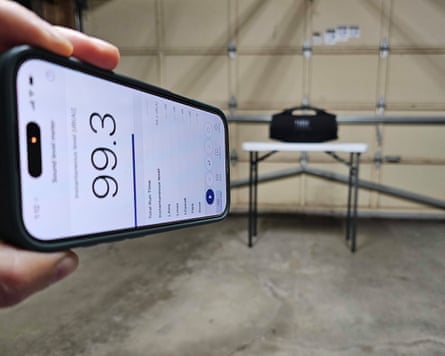
My well-worn test playlist covers a variety of music genres from rock to classical. I pay close attention to how these devices perform under challenging circumstances, like noisy parties, and in wide-open spaces. Manufacturer specs for loudness (measured in dB) are often optimistic and based on lab settings, so I measured the biggest speakers in this roundup myself, using a simple (and free) iPhone app.
All samples were provided by manufacturers, and returned to them if requested. Since audio reviews require extensive side-by-side comparison, I kept a few of the most popular models around for reference on future reviews, and the rest will be donated to support two local charities: Sistema Toronto and Renewed Computer Technology (RCT).
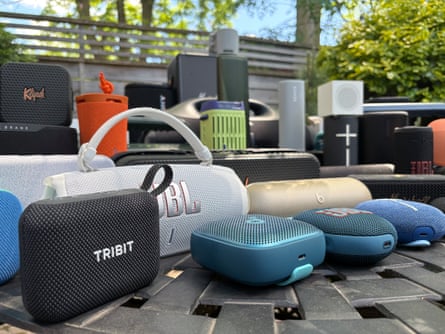
The best Bluetooth speakers in 2026
-
Best overall:
Soundcore Boom 3i
Best Budget:
Tribit StormBox Micro 3
Best for home:
Marshall Kilburn III
Best for bass and outdoor parties:
JBL BoomBox 4
Best for travel:
JBL Go 5
Best overall:
Soundcore Boom 3i
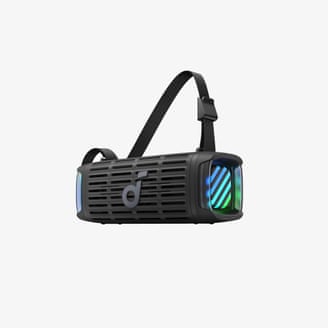
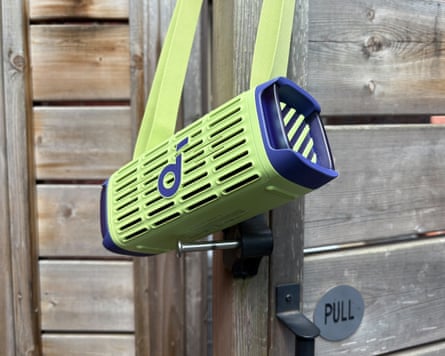
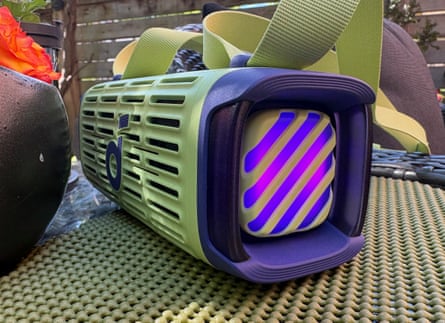
A reasonable price, rugged build, and powerful, high-quality sound put this highly portable speaker right in the sweet spot for most Bluetooth speaker buyers.
Why we love it
Because of their small size, many Bluetooth speakers can only hint at bass. With the Soundcore Boom 3i, you can genuinely hear it and I find that makes listening way more enjoyable. Every time I tried the Boom 3i side-by-side with its closest competitors, it came out on top. JBL’s Flip 7 is smaller and lighter, but it costs more and its bass can’t get as low and full as the Boom 3i. Klipsch’s Nashville has a fuller, 360-degree sound and longer battery life, but it’s so much bulkier I often ended up leaving it at home and reaching for the Soundcore. Sony’s ULT Field 1 comes closest on price, battery life, and portability, but the Boom 3i sounds better.
The Boom 3i’s controls are prominent and easier to use than similar models from Sony, Beats, and Bose, which tended to be smaller and harder to see. Soundcore also sprinkles in thoughtful extras like customizable LED side lighting that pulses in time to the music, a megaphone feature that uses your phone’s mic (perfect for calling the kids back to the house for a meal), and a handy vibration mode for shaking loose any sand or debris. It’s also one of the only speakers I tested that’s specifically designed to withstand salt water exposure. An adjustable and removable shoulder strap comes standard, and two Boom 3is can be combined for stereo sound, or up to 100 other compatible Soundcore speakers can be linked for simultaneous sound.
It’s a shame that …
Battery life of 16 hours isn’t as robust as the Beats Pill or Klipsch Nashville (24 hours), or the Marshall Emberton III (32 hours). So, unlike those models, the Boom 3i can’t charge your phone. Soundcore doesn’t offer speakerphone capability or an analog line-in on Boom 3i. None of these were dealbreakers for me, however.
Key specs:
Weight: 1.71 lbs
Battery life: Up to 16 hours
Water/dust resistance: IP68 (completely dust and water proof) and drop-proof
Can charge other devices (powerbank mode): No
Best budget:
Tribit StormBox Micro 3
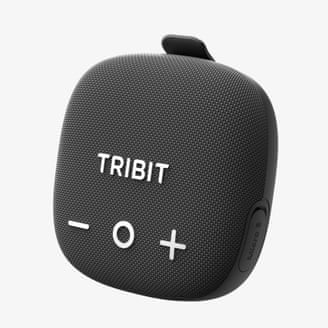
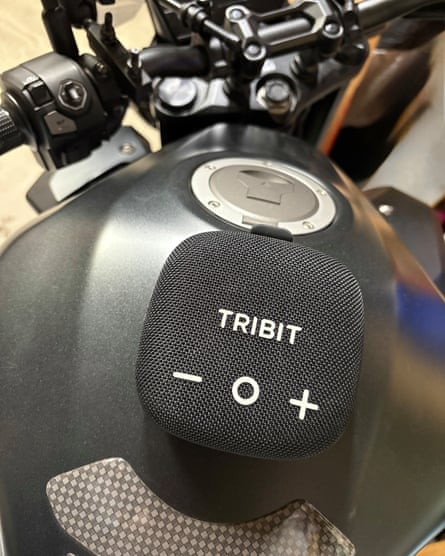
At just $65, and well under one pound, this little powerhouse from a brand you’ve never heard of genuinely surprised me with its full-throated sound.
Why we love it
Generally speaking, the less you spend on a Bluetooth speaker, the smaller it gets and the worse it sounds. The Tribit StormBox Micro 3 flips that rule on its head, preserving plenty of audible low-end. It’s not magic; bass-heavy tracks aren’t going to thump and shake, but neither do they feel short-changed.
You’ll be tempted to take a speaker this small everywhere. JBL’s Clip 5 ($59.95), which has a similar sound signature to the Micro 3, has a clever integrated carabiner, but the Tribit does one better with a built-in back strap that lets you attach it to almost anything, including a bike’s handlebars. However, it’s the powerful magnetic feet that steal the show. I know it’s silly, but slapping the speaker to the side of our fridge or even a motorcycle gas tank puts a smile on my face every time.
With up to 24 hours of playtime – by far the most in this class – you can use it to charge your phone, an unusual capability in a speaker of this size. Oh, and did I mention you can use it for calls?
It’s a shame that … it sinks like a stone, despite being impressively tough and fully waterproof.
Key specs:
Weight: .73 lbs
Battery life: Up to 24 hours
Water/dust resistance: IP68 (completely dust and waterproof)
Can charge other devices (powerbank mode): Yes
Best for home:
Marshall Kilburn III
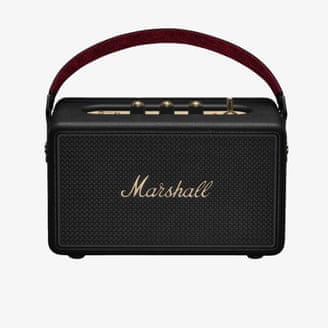
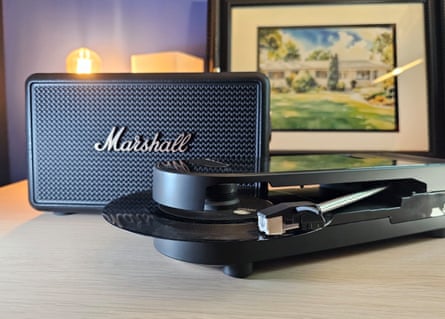
There’s something about the company’s retro, guitar amp-inspired, black and brass motif that adds a touch of cool to any room. And yet, it’s still very much a portable speaker, with an elegant carry strap and a massive (and replaceable), 50-hour battery.
Why we love it
I love Marshall’s entire line of Bluetooth portables, but especially the Kilburn III, which lives up to its nostalgic design with some welcome old-school features. It has a full set of onboard controls for playback, volume and tone adjustments, a rarity in the Bluetooth speaker world. The oversized knobs and knurled power switch are delightfully tactile. I admit to turning the speaker on and off a completely unnecessary amount just to play with that switch.
Despite its size (it’s one of the bigger speakers I tested), the Kilburn III isn’t a block rocker. Instead of pointing all of the Kilburn’s drivers forward to create a wall of sound, they’re arranged front and back, for 360-degree sound. In practice, I’ve found that the Kilburn III works best when it’s centrally located, and its well-balanced sound signature can be enjoyed no matter where you sit or stand.
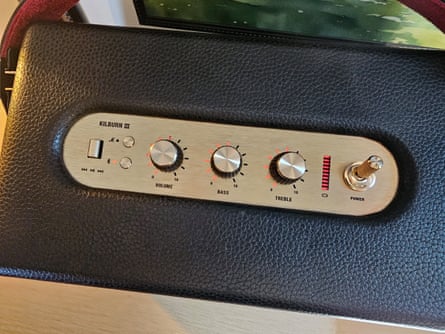
The Kilburn III also plays nicely with other gear, even analog sources like turntables. Of the nearly 40 speakers I tested for this roundup, only eight have auxiliary ports built in. Of those eight, only the Kilburn manages to deliver satisfying, room-filling sound for under $400.
With its IP54 protection from dust and water splashes, I’d avoid poolside use, but a bit of rain won’t be a problem.
It’s a shame that … it can take up to 22 hours to charge the battery with a standard 5-watt phone charger, and Marshall doesn’t include a 30-watt charger, which is what you’ll need to achieve the fastest charging time of 3 hours. You can’t stereo pair it with a second Kilburn, either. Multispeaker audio is possible, but only via Auracast, and Marshall’s implementation isn’t as easy to use as JBL’s.
Key specs:
Weight: 6.17lbs
Battery life: Up to 50 hours
Water/dust resistance: IP54 (splashproof, some dust resistance)
Can charge other devices (powerbank mode): Yes
Best for bass and outdoor parties:
JBL BoomBox 4
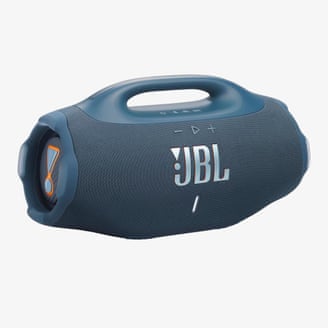
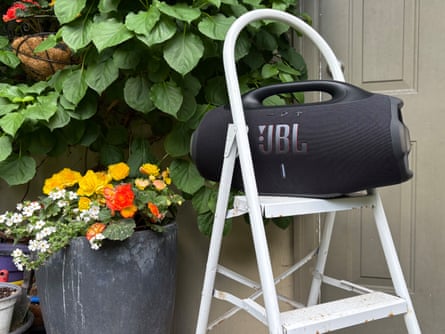
If you want to provide the soundtrack for an outdoor party, complete with thumping bass, you’re going to want the sheer sonic power of JBL’s BoomBox 4.
Why we love it
Even when contained inside a closed garage, I could hear the BoomBox 4 half a block away. Clearly.
At a distance of six feet, the BoomBox 4 can produce dangerously loud levels if pushed to its limit.
I don’t recommend doing that, but if you do (hopefully with some kind of hearing protection) you may be as surprised as I was at the almost total lack of distortion. None of the other speakers I tested can match it.
This kind of power comes with a price both in dollars ($549.95) and portability. At just 13 pounds , it’s a beast, and I had no desire to lug it any further than from our house to our garage. Still, the large and comfortable integrated carrying handle makes the bulk manageable. Astonishingly, this beast is not only fully dust and waterproof, but it also floats – with the front grille facing up.
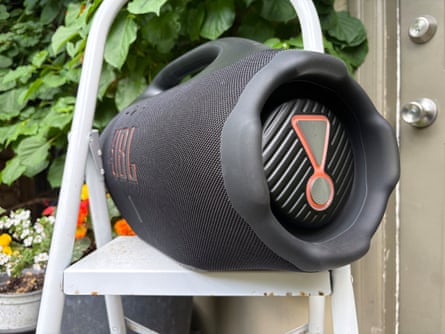
Like many of JBL’s portables, you can stereo pair or group the Boombox 4 via the JBL app. It can charge your phone and connect to your devices via USB-C for lossless audio. I also really dig the way JBL’s exclamation mark logos on the side-mounted passive radiators glow and pulse orange or white when using the two available Bass Boost modes.
Speaking of bass, the runner-up Brane X produces more visceral bass at the same perceived loudness at half the weight of the JBL. If you find the Boombox 4’s bulk too unwieldy, the Brane X might be a great alternative.
It’s a shame that …
The BoomBox 4 is such a fun speaker, you’ll want to use it for regular home listening, too. Unfortunately, its lack of an analog input means it doesn’t connect to gear like turntables or CD players.
Key specs:
Weight: 13 lbs
Battery life: Up to 34 hours
Water/dust resistance: IP68 (completely dust and waterproof)
Can charge other devices (powerbank mode): Yes
Best for travel:
JBL Go 5
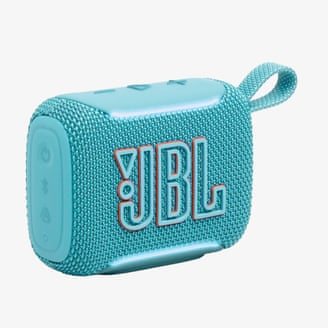
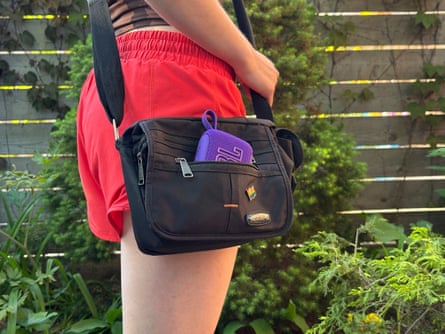
How small can you make a Bluetooth speaker and still get satisfying sound? The JBL Go 5 is the answer.
Why we love it
This tiny, flyweight(.51 lbs) speaker is only a tad thicker than two decks of playing cards, yet it manages to deliver genuinely enjoyable sound, in a nearly bulletproof package (actually dust-, water-, and drop-proof if we’re being honest).
On a recent trip to New York City, I tossed the Go 5 into my backpack and forgot it was there until I unpacked it in my hotel room – the perfect environment for the Go 5’s small-but-complete sound profile.
You don’t get a lot of extras in tiny speakers, yet the Go 5 offers a fun animated LED light show and you can use its USB-C input with your computer or smartphone for lossless audio – a very slight improvement in terms of detail over a Bluetooth connection. You can stereo pair a second Go 5 just by bumping them together, and Auracast lets you connect an unlimited number of other JBL Auracast portables.
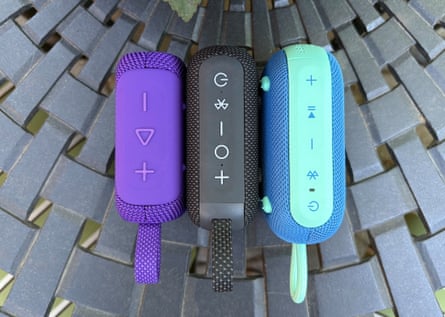
The Go 5 has plenty of competition. Some, like the Soundcore Select 4 Go and Tribit PocketGo are actually less expensive and have better battery life. But balancing sound frequencies and managing distortion at this size is no easy feat, and the Go 5 is simply better at it, plus it’s a tad more compact.
It’s a shame that …
With a maximum lifespan of 10 hours, the Go 5 can only play half as long as the Tribit Pocket Go before needing a charge. It doesn’t float, and there’s no speakerphone function.
Key specs:
Weight: .51 lbs
Battery life: Up to 10 hours
Water/dust resistance: IP68 (dust and waterproof)
Can charge other devices (powerbank mode): No
The best of the rest
Best for musicians:
Fender Audio Elie 6
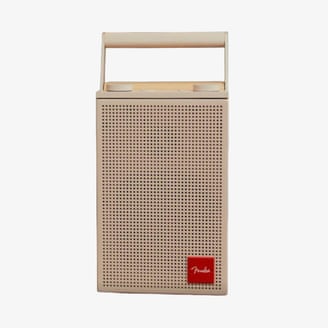
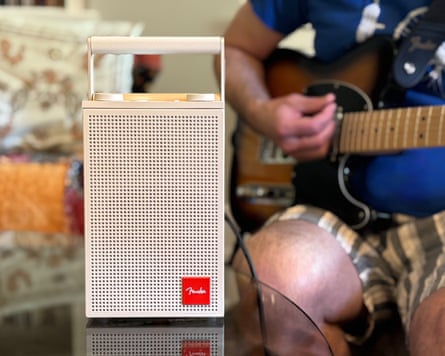
With clean lines and controls that would make Dieter Rams smile, wood trim, and a sleek stowaway handle, Fender Audio’s Elie 6 Bluetooth speaker is built to impress. And it does, with surprisingly authoritative bass, warm tone, and better-than-garden-variety Bluetooth audio via the LHDC and aptX Adaptive codecs. (If those terms mean nothing to you, don’t worry, very few phones are actually compatible).
But what really sets the Elie 6 apart is its array of musician-friendly features, like its multifunction instrument/mic/line-in input, separate mixing level control, and future compatibility with Fender’s upcoming wireless audio accessories.
Its 18-hour battery can charge your phone, and you can choose to stereo-pair it with another Elie 6 or play the same sound on up to 100 of these slick speakers. I wish Fender included an app for tweaking the EQ and a way to skip tracks from the onboard controls, but otherwise, this is an awesome choice for those who want both an amp and a Bluetooth speaker.
Weight: 3.95 lbs; Battery life: Up to 18 hours; Water/dust resistance: IP54
Best for multiroom audio:
Sonos Play
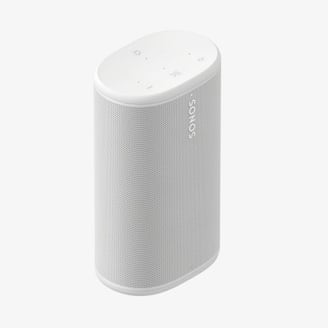
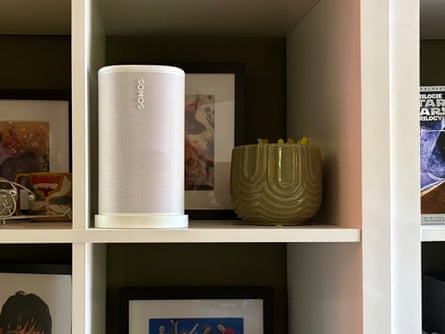
Bluetooth is perfect for when you’re outside, on the road, or anywhere else that isn’t home. But it doesn’t compete with Wi-Fi for audio quality, control of multiple speakers, or instant access from your favorite music apps. That’s why I’m a fan of the Sonos Play: it does both extremely well. It’s a fully dust and waterproof BT speaker when away from home, and a hi-res, multiroom-compatible Amazon Alexa smart speaker when connected to Wi-Fi.
As with all Sonos speakers, the Play delivers excellent audio for its size, and the inclusion of a charging base means its 24-hour battery will always be fully charged when you head out the door.
Weight: 2.87 lbs; Battery life: Up to 24 hours; Water/dust resistance: IP67
Best for pools/lakes/water:
Ultimate Ears Wonderboom 4
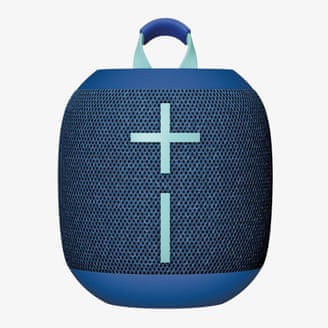
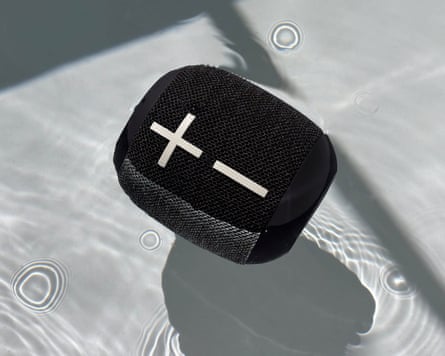
The UE Wonderboom 4 is the most portable, water-friendly speaker I’ve found. Several of the speakers I tested can float, but only a few will happily bob around in a pool or lake with their speakers facing upward, out of the water. Of these, only the Wonderboom 4 delivered such a good combo of great sound, ultra portability, and affordability.
Weight: .93 lbs ; Battery life: Up to 14 hours; Water/dust resistance: IP67
What other products did The Guardian test?
-
Brane Audio Brane X
-
EarFun UBoom L
-
IKEA Kallsup
-
IKEA Vappeby gen 3 + Eneby battery
-
JBL Charge 6
-
JBL Clip 5
-
JBL Grip
-
JBL Xtreme 5
-
KEF MUO (2025)
-
Klipsch Austin
-
Klipsch Detroit
-
Klipsch Nashville
-
Marshall Emberton III
-
Marshall Middleton II
-
Marshall Tufton
-
Sonos Move 2
-
Sonos Roam 2
-
Sony SRS XB100
-
Sony ULT FIELD 1
-
Sony ULT FIELD 3
-
Sony ULT FIELD 5
-
Soundcore Boom 2
-
Soundcore Boom 2 Plus
-
Soundcore Boom Go 3i
-
Tribit StormBox Micro 3
-
Tribit StormBox Mini+
-
UE Boom 4
-
UE Everboom
-
UE Miniroll
What you need to know about Bluetooth speakers
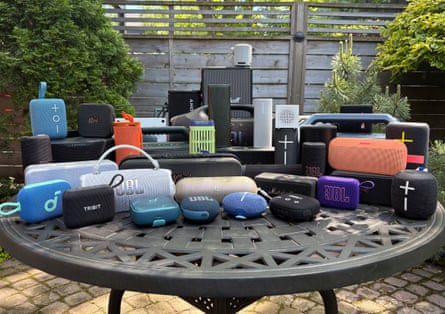
What features should I look for in a Bluetooth speaker?
First, consider how you plan to use it. Some people need a speaker that can go anywhere and survive rocky trails and sandy beaches, while others simply need a speaker that they can move from room to room. Features you don’t need add size, weight, and expense.
Most speakers under 2 pounds will comfortably travel in a backpack. I had no trouble carrying models weighing up to 7 pounds – though I definitely learned to appreciate the ones that included a shoulder strap – while anything over 7 pounds is more luggable than portable.
Durability is usually expressed as a combination of ingress protection (IP) rating, and drop-proofing/shock resistance: You want at least IP57 if there’s a risk of the speaker going kerplunk in a pool or at the beach.
From there, you can start to look at traits like sound quality, battery life, price, ease of use, and extra features such as speakerphone capability or the availability of an analog input for your turntable or other accessories. Personally, I would rank sound quality above other considerations, but there are legit reasons to favor battery life, especially if you know your travels will take you far from power for extended periods, like camping trips.
How much should I spend on a Bluetooth speaker?
No surprise: The more you spend on a Bluetooth speaker, the bigger and more powerful it gets. But it’s not a linear progression. For instance, I found that the Beats Pill ($149) performed just as well as the slightly larger but much more expensive KEF Muo ($249). Guides like this this can help you identify which speakers offer the highest priority features at the lowest price, keeping in mind that the cheapest option in a given category is rarely going to offer top performance on any feature.
What Bluetooth speaker brand has the best sound quality?
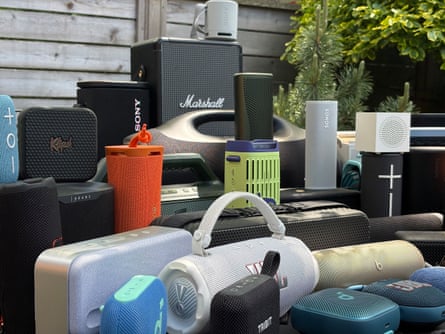
I’ve been delighted by the sound from a variety of brands, including JBL, Klipsch, Sonos, Beats, Marshall, and Sony. But during my testing, one brand did shine a bit brighter than the others when it came time to evaluate just sound quality: Klipsch.
Klipsch currently makes three portable Bluetooth speakers: the Detroit ($324.99), Nashville ($159.99), and Austin ($109.99). In their respective price ranges, they consistently performed better on sound than the competition, with more power, bigger bass response, and often, better clarity for vocals and other upper-midrange sounds. And all three can be stereo-paired or grouped with up to 100 other Klipsch speakers from the same family.
If sound quality is your top priority, over other considerations like price, size, weight, or features like auxiliary inputs, I highly recommend these Klipsch speakers.
How many speakers should I buy?
For a quiet bedroom or a condo balcony, an ultra-compact speaker like the JBL Go 5 is likely just fine. But outdoors, the lack of ceiling means sound (especially bass) can dissipate rapidly. Add wind and a noisy group of party goers, and your tunes could easily get lost.
A single big speaker like the BoomBox 4 can overcome these challenges, but one very loud source of sound isn’t always ideal – particularly if you’re stuck standing beside it. Consider using two smaller speakers, like the JBL Xtreme 5, Sony ULT Field 5, or Soundcore Boom 2 Plus, at opposite ends of your gathering.
Another benefit to twin speakers is the option of stereo pairing (where two identical speakers act as left and right channels) Stereo pairing can be a fantastic way of creating a more immersive sound, especially if you place both speakers at one end of a space, facing your listeners.

Other pieces you might enjoy from the Filter, the Guardian’s guide to buying fewer, better things:
-
Sonos review: Are these the best portable speakers that money can buy? I tested to find out
-
How do Apple’s AirPods Pro 3 compare against hearing aids? I put them to the test
-
Ignore all the smart home gimmicks. These five devices actually make life easier
The Guardian wp:paragraph
هلدینگ کاسپین استانبول | خرید ملک در ترکیه | صرافی معتبر ایرانی در ترکیه | خرید و فروش طلا در ترکیه | مهاجرت به ترکیه | واردات و صادرات در ترکیه | نیازمندیهای ترکیه | اخبار ترکیه | اخبار جهانی | توریست ایران | خدمات توریستی در ایران | تورهای گردشگری ایران | هلدینگ اول | خدمات کاریابی و فریلنسری و شغل | مرجع اطلاعات ایران (همه چیز در ایران) | کیف پول و خدمات مالی و پرداخت یار | اخبار ایران | تابلو زنده قیمت ارز در ترکیه و استانبول | صرافی آنلاین ترکیه | قیمت طلا و نقره در ترکیه | سرمایه گذاری در ترکیه | جواهرات در ترکیه | نرخ لحظه ای ارزها در استانبول | قیمت دلار امروز در ترکیه | قیمت دلار استانبول امروز | قیمت لحظه ای دلار | اخبار روز ترکیه استانبول | اپلیکیشن ISTEX | اپلیکیشن قیمت لحظه ای دلار و یورو و لیر و ارزها در ترکیه
/wp:paragraph wp:paragraph /wp:paragraph
About the Author