The Republican senator Bill Cassidy, who just lost re-election to a primary challenger backed by Donald Trump, told reporter he argued with the president over the war with Iran when he visited the US Capitol today.
Speaking to reporters after the president’s lunch with the Senate GOP, Cassidy, who on Tuesday was one of four Republicans who helped pass a war powers resolution intended to prevent the president from resuming hostilities with Iran, said Trump asked: “Why would anybody vote for the War Powers Act?”
“Is that a rhetorical question, or would you like to really know?” Cassidy said he replied.
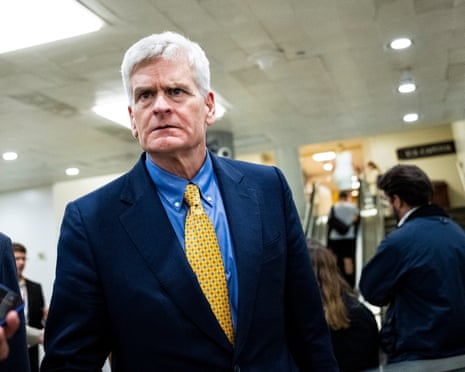
When the president demanded an answer, the Louisiana senator said he stood up and said he wanted answers from the president, noting that a conflict Trump said would last four weeks has instead lasted four months without achieving the US objectives. After Cassidy reiterated that he would vote for war powers resolutions until he received a briefing that answered his questions, the senator said: “He did not particularly care for my comments [and] raised his voice. I lost my temper. That’s not appropriate, it’s the Irish in me. But I again matched his tone and his volume, and it went back and forth. But at some point my gut said, ‘OK, I’ll sit down’, and so I sat down and tried to de-escalate.”
Cassidy, who placed third in Louisiana’s Republican Senate primary after Trump endorsed one of his opponents, said: “I make no apologies for standing up to the president, if you will, trying to demand that more information be shared with the Senate, and more information be shared with the American people. I make no apologies for that, whatever. And if someone tries to bully me into not asking that question, I’m not going to accept that either. I am sticking up for the American people, even if I’m speaking to the president.”
Faced with Donald Trump’s unprecedented effort to decide who can and cannot vote by mail, Senate Democrats have written a strongly worded letter to the postmaster general, David Steiner, demanding that the United States Postal Service not proceed with a proposed rule change, which would allow the USPS to refuse to deliver mail ballots to voters in states that do not allow the Trump administration to vet their lists of eligible voters.
The senators noted that they are writing now because they “received no response” to a previous letter to the Trump-appointed head of the USPS advising him that the executive order directing the postal service to not deliver ballots in states that refused to let the federal government decide who is eligible to vote by mail in their states is unconstitutional.
“We write for a second time regarding the unconstitutional and illegal attempt to transform the United States Postal Service (USPS) into an election administration agency controlled by the White House and President Trump,” the senators wrote.
“Ultimately, the proposed rule seeks to create a centralized national absentee voter database with individualized barcodes connected to the voters’ names under the control of the President that contains the voting information of millions of Americans,” they added. “That information would be ripe for potential abuse or improper disclosure potentially imperiling the integrity of American elections.”
“Accordingly, we insist that the Postal Service abandon this proposed regulation and return to its core mission of providing universal postal services to every American. The Constitution and federal law demand nothing less,” the Democrats concluded.
The most senior Democrat on the House energy and commerce committee, New Jersey congressman Frank Pallone, called on Wednesday for “a national AI datacenter moratorium, until we can find a way to ensure they don’t harm our nation’s air, water and power bills”.
Speaking during a subcommittee meeting, Pallone pointed out that datacenter electricity consumption doubled between 2017 and 2023 and could account for more than 15% of all US electricity demand by 2030.
The growth of AI infrastructure, he said, is driving up utility bills for consumers and straining the nation’s power grid.
“Americans across the county have expressed concern and opposition to the rampant construction of AI datacenters and Congress should take this political groundswell seriously with a datacenter moratorium,” Pallone said. “Democrats have been clear: families around the country should not see their power bills rise by a single cent because of datacenters.”
Pallone noted that residents and local officials in the part of New Jersey he represents have taken the lead in trying block datacenter construction.
“Towns in my district are way ahead of this Congress in seeking a moratorium. Asbury Park, Red Bank, Old Bridge and Sayreville all have taken this bold step. The city of New Brunswick put a stop to a datacenter plan after the community stood together to oppose the project. We need to follow in their footsteps here in Congress,” Pallone said.
As is so often the case, Donald Trump, in his 40 minutes of remarks on Wednesday in the Oval Office, said so very many things that were entirely or partly untrue or just baffling that it can be hard to keep up with the task of debunking or decoding what he said.
To take one example, when the president was asked about the resignation of the UK prime minister, Keir Starmer, and his likely replacement, Andy Burnham, Trump admitted that he knew close to “nothing” about the new man, but quickly turned the question into an opportunity to air one of his most longstanding grievances with the policies of his late mother’s homeland: the UK’s embrace of wind energy and its move away from drilling for North Sea oil.
In a week when much of Europe is struggling with a heatwave, and temperatures reached 29.4C even in the Scottish city of Aberdeen, Trump reminisced fondly about the days of the North Sea oil boom, when, he said “Aberdeen … was the hottest city in the the whole continent. It was the oil city.”
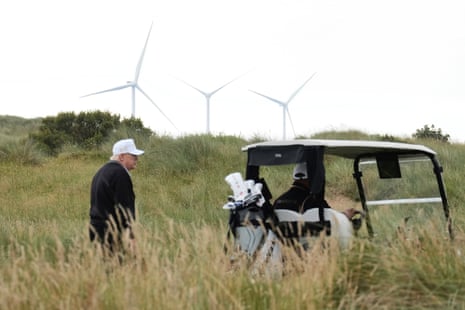
Under Starmer’s leadership, the UK Labour party was elected in 2024 promising to make the UK “a green energy superpower”, moving away from North Sea oil and embracing renewable energy, which Trump has hated for more than a decade, since he lost his quixotic battle to stop the installation of 11 turbines off the coast of an Aberdeenshire golf course he owns.
On Wednesday, Trump told reporters: “I have had every oil company come to see me. ‘Sir, could you give us access to the UK? We would do anything to drill in the North Sea,’” he said, recounting conversations with US oil executives who, for some reason, suggested he could grant them the licenses to drill the UK refuses to issue.
“UK is dying,” Trump added. “So they should open up the North Sea. And it’s an easy one. And a lot of good things are going to happen.”
While Donald Trump has indefinitely suspended signing a bipartisan bill aimed at lowering housing costs for Americans, it’s worth mentioning that the Trump Organization, the conglomerate privately owned by the president, has recently or is currently in the process of developing over a dozen luxury properties, the majority of which are residential, in foreign countries.
At a time when many Americans are struggling to afford housing, the Trump-run real estate group announced the development of a new $2bn project in Tbilisi, Georgia, the centerpiece of which will be a new Trump Tower. This skyscraper will measure approximately 70 stories and hold the record as the “tallest building in Georgia” upon completion, the Trump Organization boasts.
According to data from the watchdog group Citizens for Responsibility and Ethics in Washington, the self-proclaimed “America First” president will have developed around 24 Trump-branded luxury building projects in other countries during his time as president, with most costing between $1bn and 2bn.
Trump has also made no effort to separate these business moves from his political maneuvers; quite the contrary, his luxury resorts are often used to host elected leaders from all over the world. A Guardian analysis of campaign finance records from earlier this year found that US political campaigns and committees spent at least $1.3m at Trump properties since January 2025. But foreign governments and private corporations are not required to disclose their spending, so this figure likely represents a very small slice of the gold-plated pie.
Donald Trump once again devoted a large portion of an Oval Office event to insisting, without evidence, that his troubled renovation of the Lincoln Memorial reflecting pool, plagued by algae blooms and a peeling polyurethane liner, was actually caused by vandals.
Asked by a reporter if the repairs to the pool would be completed by the Fourth of July, Trump said, “It’s in great shape,” before launching into a 1,300-word monologue on how the project was done perfectly, but then sabotaged by “thugs” who “went down with probably a box cutter, or a very sharp razor of some kind, or knife, and they cut and … started ripping it up. You know why? Because they’re sick people.”
Trump then repeated his claim that there is visual evidence, in the form of photographs or video, of at least one vandal engaged in this attack on the polyurethane liner the president had installed, at a cost of over $14m – images, which, for some reason, no one else but him appears to have seen.
“They have pictures”, the president insisted. “They took razor blades and they cut patches like that 350ft long. A lot of them are like a foot, a foot, a foot. They cut the lining and there’s pictures of the guy bending over. I don’t know if anybody saw that, but there are pictures of the guy.” Despite repeated requests from journalists to see these supposed pictures the president continues to say exist, the White House, the parks department and the interior department have so far failed to produce even one such image.
Instead, there are multiple video clips of curious local residents or tourists being arrested by large numbers of federal officers for merely dipping their hands into the pool to retrieve floating bits of debris or just mocking the heavy security presence along the water’s edge.
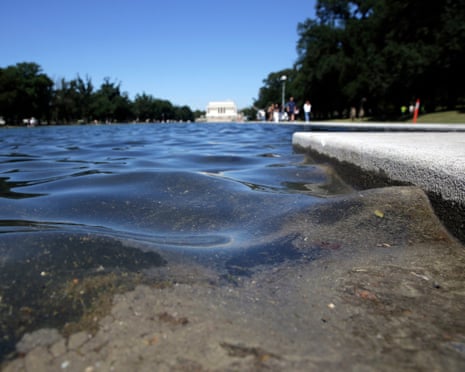
Trump, of course, has form for insisting that there is visual evidence to support his false claims that things that never happened did happen.
As a candidate for the presidency in late 2015, Trump told his supporters that he had “watched” television images on 11 September 2001 that showed “thousands and thousands” of Arabs in New Jersey “cheering” as “the World Trade Center came tumbling down”.
In what was, briefly, a central concern of the Republican primary campaign, Trump refused to retract that false claim, continuing to insist that he had seen such scenes that day even after it became apparent that there was simply no footage, for the good reason that televised mass celebrations had not taken place.
In an early example of his brazen disregard for the truth being impervious to factchecking by journalists, Trump instead continued to insist the spectacle he fabricated “was well covered at the time”, and journalists, and his rivals for the Republican nomination, simply moved on.
Donald Trump claimed on Wednesday that he had not seen the results of the Pentagon investigation into the deadly strike on a girls’ elementary school in the Iranian town of Minab on the first day of US and Israeli strikes that killed at least 175 people, mostly children.
Video evidence acquired by news organizations revealed that a US-made Tomahawk missile was fired into the school, Trump falsely said that Iran also had access to the cruise missiles. It does not.
Pressed as to why he had not seen the report, nearly four months after the strike, Trump said: “I have to wait for it to be complete. I don’t know that they’re ever going to solve that problem … in terms of whose fault was it, because there were missiles flying all over the place.”
“It’s horrible what happened, but there were missiles flying all over the place,” the president added.
“What do you think, Pete?” Trump then asked his defense secretary, Pete Hegseth, seated to his left.
“We’ve taken the investigation very seriously,” Hegseth said, adding that the outcome would be revealed “when the appropriate time is right”.
“I don’t think it was us,” Trump said.
In the Oval Office, after Donald Trump complained to the Nato secretary general, Mark Rutte, about Nato allies Italy, Spain and the UK refusing to let the US use airbases on their territory to launch offensive strikes on Iran, the president opened the floor to questions from reporters, starting by calling on a series of correspondents from partisan, pro-Trump outlets.
After one reporter praised him for being “so transformative vis a vis Nato”, Trump called on a correspondent from GB News, the rightwing British broadcaster, who asked him what he knows about Andy Burnham, the likely next prime minister of the UK.
“I don’t know anything,” Trump answered. “I see that he was, I guess, the mayor of a town,” he added, apparently vaguely aware that Burnham was the mayor of greater Manchester.
“I hear he’s extremely liberal,” Trump continued. “So that means he probably won’t open up the North Sea. You know, I gave, I gave Keir Starmer some pretty good advice. I said, ‘Open up the North Sea,’” the US president said in reference to his horror at the Labour party’s manifesto commitment to not award new licenses to drill for oil in the North Sea.
A few minutes later, Trump returned to the subject, even claiming, incorrectly, that Starmer’s refusal to abandon wind energy and turn to oil exploration had cost him his prime ministership.
Mark Rutte, the Nato secretary general, just started an Oval Office meeting with Donald Trump by praising the US president for confronting Iran as “the leader of the free world”, reinforcing Trump’s claim that the central issue was preventing Iran from obtaining a nuclear weapon. (As recently as last year, before Trump bombed enrichment facilities in Iran, US intelligence agencies assessed that Iran had stopped pursuing nuclear weapons in 2003.)
Rutte, a former center-right prime minister of the Netherlands, then moved on to trying to gently correct Trump’s claims that Nato allies in Europe had not supported the US strikes on Iran, pointing to 5,000 of US air force flights that took off from airports in Romania and elsewhere in Europe.
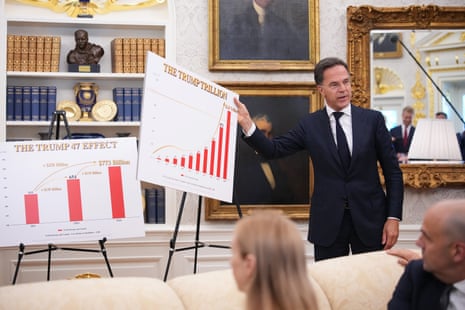
He then moved on to praising Trump for pressing Nato allies in Europe to ramp up defense spending, using a chart headlined “The Trump Trillion” to show what he said was increased spending by the allies since Trump took office in 2017.
Israel’s defence minister, Israel Katz, has said that the IDF would not withdraw from southern Lebanon, further complicating US-Iran peace talks as fighting in Lebanon continues to be an obstacle to permanent peace.
Speaking on stage in an interview in Tel Aviv, Katz said Israeli troops would remain in south Lebanon – echoing sentiments from Israel’s prime minister, Benjamin Netanyahu.
“The IDF is prepared … and we are not retreating. We announced that in any case we are not withdrawing, and as of this moment – and this is a political achievement – there is no American demand for Israel to withdraw from Lebanon,” Katz said.
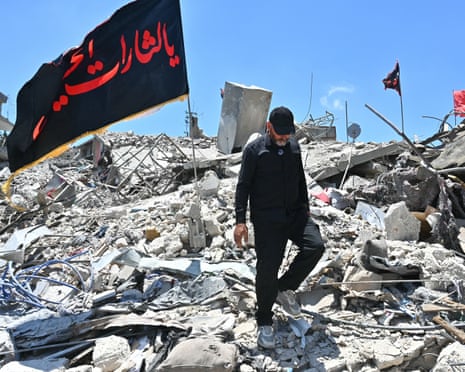
The US and Iran signed an accord last week extending a fragile ceasefire and setting the stage for 60 days of talks meant to lead to a permanent peace. The first hiccups to the memorandum of understanding (MOU) came last week after Israel continued its campaign in south Lebanon, leading Iran to threaten closure of the strait of Hormuz.
The US and Iran’s interpretation of the MOU has significantly differed, particularly over Lebanon. Iran has insisted that Israel needed to stop its war there and withdraw its troops in the south of the country. Israel has occupied large swathes of southern Lebanon in what it calls a “security zone”.
The Israeli and Lebanese governments are engaged in US-mediated talks, which, among other things, seek to arrange an Israeli withdrawal from Lebanese territory.
Israel is seeking a phased approach whereby it will hand off territory to the Lebanese army, tasked with keeping the area free of Hezbollah fighters. These talks do not involve Hezbollah, however, calling into question how effective they can be.
Iran, which is not a part of the Israel-Lebanon talks, has worked hard to link a ceasefire with Iran to an end to fighting in Lebanon.
“For us, a ceasefire in Lebanon is as important as a ceasefire in Iran and, further, an end to the war in Lebanon is as important as an end to the war in Iran,” Iran’s parliamentary speaker, Mohammad Bagher Ghalibaf, said on Wednesday.
Israeli strikes have killed more than 4,200 people and displaced at least 1.3 million in Lebanon since the eruption of renewed hostilities on 2 March.
The US army’s commander of its forces in Europe and Africa – who was memorably the last American soldier to leave Afghanistan in 2021 – is unexpectedly stepping down from his post after just 18 months in the job, the army confirmed late last night.
Gen Christopher Donahue, commanding general of US Army Europe and Africa and commander of Nato’s Allied Land Command, will relinquish his command on 2 July, according to an army statement provided to the Associated Press.
He is the latest in a line of nearly two dozen top military leaders to either retire or depart their jobs early under the leadership of the defense secretary, Pete Hegseth, who has undertaken an effort to thin the ranks of the military’s top brass with the mantra “less generals, more GIs”.
Donahue’s deputy, Maj Gen Christopher Norrie, will perform his duties in the meantime, the statement added.
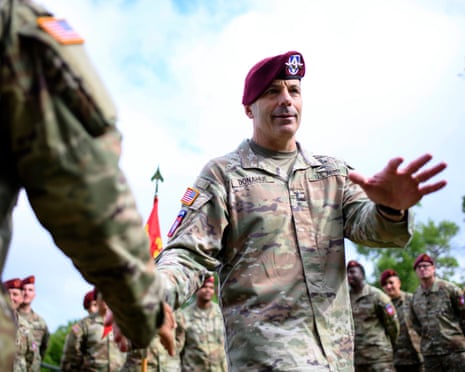
An army official who spoke on condition of anonymity in order to talk about sensitive discussions told the Associated Press that Donahue’s departure comes as the army is discussing downgrading US Army Europe and Africa from a four-star to a three-star command.
This move would come amid ongoing criticism from Hegseth about European allies.
Last week, Hegseth told Nato allies he would be conducting a six-month Pentagon review of American forces in Europe that is “designed to ensure that Nato is moving fast and irreversibly toward Europe leading, stepping up to take primary responsibility for the defense of Europe”.
“It’s a review that some countries will fail and others will pass with flying colors,” he added.
The Pentagon did not immediately comment on the news of Donahue’s departure, which was first reported by the Atlantic.
Earlier, the National Republican Congressional Committee delivered flowers (from Whole Foods!) and a sympathy card to the office of the House minority leader, Hakeem Jeffries, today after the House candidates he endorsed lost to those backed by New York City’s mayor, Zohran Mamdani,in last night’s Democratic primaries.
“Three losses in one night is tough. We wanted so-called ‘Leader’ Jeffries to know our thoughts are with him, his candidates, and whatever remains of his influence in the Democrat Party,” said NRCC spokesperson Mike Marinella.
Donald Trump spoke only briefly to reporters before and after his lunch with Republican senators, but offered no indication he was changing course on a series of policy decisions that have upended Congress.
The president is demanding that the Senate pass the Save America Act, a bill to tighten voting regulations nationwide that has no path to passing the upper chamber. Earlier, he cancelled a signing ceremony for a major housing bill, saying he wanted Save America approved first, and has similarly tied its approval to the renewal of a key foreign surveillance bill.
Addressing the press after the lunch, Trump made a point to note that “we like our leader”. That seemed to be an endorsement of John Thune, the Republican Senate majority leader whose job he has made more difficult by demanding he shepherd through the chamber legislation that does not have the votes to clear the Democrats’ filibuster.
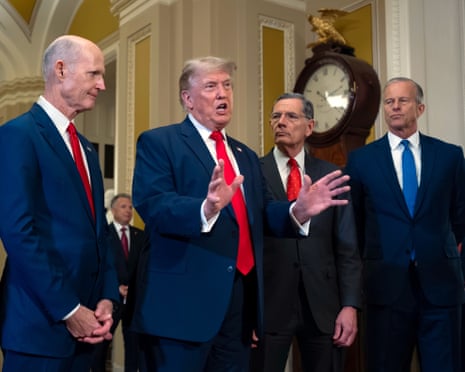
And one GOP senator described the meetingwith Donald Trump as “more of a venting session for the president”.
That and these are from Punchbowl News’s Andrew Desiderio:
Trump and Cassidy just went at each other over Iran during the Senate GOP lunch, per source in room. Trump was interrupting Cassidy as Cassidy was calling the war a ‘blunder.’ Other senators tried to jump in but Cassidy & Trump kept going back & forth, source said.
In addition to the below, another GOP senator (who asked to be referred to as ‘disgruntled’) said Trump was in a sour mood from the start, and that was only exacerbated by his interaction with Cassidy over Iran, which came as Trump was berating R’s who voted for war powers res
Per multiple people in the room: – Cassidy came in guns blazing, at one point stopped calling Trump ‘Mr President’ and referred to him as ‘brother’ —Trump repeated what he’s said on social media about the housing bill, SAVE Act & the filibuster, but nobody pushed back
I’m also told that there were no direct interactions between Trump and Thune during the meeting.
The Guardian wp:paragraph
هلدینگ کاسپین استانبول | خرید ملک در ترکیه | صرافی معتبر ایرانی در ترکیه | خرید و فروش طلا در ترکیه | مهاجرت به ترکیه | واردات و صادرات در ترکیه | نیازمندیهای ترکیه | اخبار ترکیه | اخبار جهانی | توریست ایران | خدمات توریستی در ایران | تورهای گردشگری ایران | هلدینگ اول | خدمات کاریابی و فریلنسری و شغل | مرجع اطلاعات ایران (همه چیز در ایران) | کیف پول و خدمات مالی و پرداخت یار | اخبار ایران | تابلو زنده قیمت ارز در ترکیه و استانبول | صرافی آنلاین ترکیه | قیمت طلا و نقره در ترکیه | سرمایه گذاری در ترکیه | جواهرات در ترکیه | نرخ لحظه ای ارزها در استانبول | قیمت دلار امروز در ترکیه | قیمت دلار استانبول امروز | قیمت لحظه ای دلار | اخبار روز ترکیه استانبول | اپلیکیشن ISTEX | اپلیکیشن قیمت لحظه ای دلار و یورو و لیر و ارزها در ترکیه
/wp:paragraph wp:paragraph /wp:paragraph
About the Author