Home – CBSNews.com
A House Democrat said Friday’s retaliatory strikes by the U.S. against Iran showed that the war isn’t ending anytime soon.
“I don’t think this war is anywhere near over,” Rep. Suhas Subramanyam, a Democrat from Virginia, said on CBS News’ “The Takeout” Friday.
He also doubted the memorandum of understanding between the U.S. and Iran would hold up.
“Iran is difficult to deal with in the first place, and then you have an administration that has showed itself to be incompetent when it comes to foreign affairs and diplomacy, and so that’s why you have the breakdown of all these frameworks,” Subramanyam said.
A U.S. official told CBS News the retaliatory strikes against Iran are ongoing.
The U.S. military says it hit Iranian targets on Friday over Iran’s drone attack on a commercial vessel in the Strait of Hormuz, marking the first American strikes on Iran since the two countries agreed to extend an already rickety ceasefire last week.
The strikes targeted Iranian missile and drone storage facilities and radar sites, U.S. Central Command said in a statement posted to social media, calling it a “powerful response” to Iran’s “dangerous behavior.”
President Trump was asked by a reporter in the Oval Office whether Iran would face any consequences for carrying out a drone strike on a cargo ship in the Strait of Hormuz.
“You’ll find out,” Mr. Trump said.
Asked if the ceasefire between the U.S. and Iran was still in place, the president said, “I don’t like the fact that they took a shot yesterday – actually four, we knocked down three – at a ship, not an allied ship, but a ship, a very expensive ship.”
“They shouldn’t be doing that,” Mr. Trump said.
Describing the U.S. response to a drone strike that President Trump blamed on Iran, the president said one got through unnoticed and struck a ship on Thursday.
“We knocked down three of them. One of them, I guess – we didn’t miss it. Nobody saw it coming,” Mr. Trump said on Friday.
He made the comment while addressing the Faith and Freedom Coalition policy conference in Washington after remarking that Iran still has “some capability, not much.”
“You can’t do that stuff,” he added. Earlier on Friday he called the strike a violation of the ceasefire agreement between Iran and the United States.
CBS/AP
Israel and the government of Lebanon have agreed to the framework of a deal to bring “lasting peace and security” between the neighboring countries, U.S. Secretary of State Marco Rubio announced Friday.
“Today is a good day in that we are happy to announce the framework agreement between the sovereign government of Lebanon and, of course, the government of Israel, with the mediation and support of the United States of America, that begins to put in place a framework for lasting peace and security,” Rubio told reporters at the State Department after several days of negotiations between the two sides.
However, the negotiations did not include Hezbollah, the Iran-backed militia that has been involved in the fighting against Israel in southern Lebanon. A previous deal between Israel and Lebanon was quickly rejected by Hezbollah.
Rubio referred to the deal as “the first step” in the pursuit of a lasting peace.
“The people of Israel deserve to live in peace and security. The people of northern Israel in particular, who have been targeted repeatedly by terrorist attacks launched from the territory of Lebanon, but not by the Lebanese people, not by the Lebanese government, but by an outside actor who has sought to use that territory to target innocent civilians who have been unable to live in these places for a long time,” he said, referring to Hezbollah.
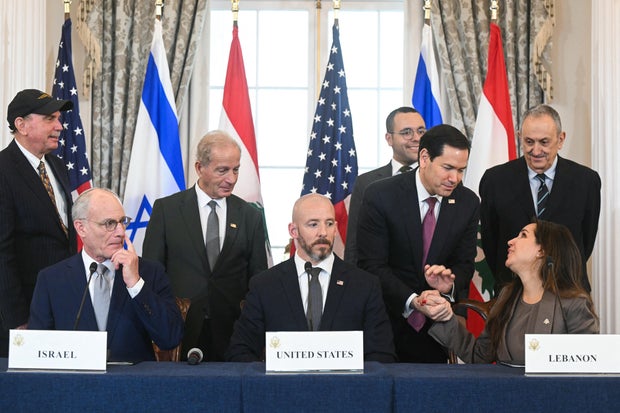
Saul Loeb/AFP via Getty Images
It was not immediately clear how the trilateral framework agreement was any different than the ceasefire agreement already in place between Lebanon and Israel, which has been repeatedly defied by Hezbollah with daily attacks against an Israeli military it says is occupying sovereign territory.
Israel’s prime minister’s office released a statement saying it will “maintain its security zone along the Yellow Line in Lebanon until the day when Hezbollah and other terrorist organizations in Lebanon are disarmed and no longer pose a threat to the territory of the State of Israel from Lebanon.”
That would seem to directly contradict Hezbollah and Iran’s assertion that Israel withdraw from Lebanese territory in order to further negotiate a lasting peace deal with the U.S.
Iran issued a strong condemnation of this week’s Gulf Cooperation Council meeting on Friday, singling out the Gulf countries for agreeing with the U.S. position on the war with Iran.
The meeting, which involves the countries of Bahrain, Kuwait, Oman, Qatar, Saudi Arabia and the United Arab Emirates, was attended this week by Secretary of State Marco Rubio. A lengthy statement issued after the meeting condemned Iran’s attacks on neighboring countries and affirmed the need for free transit of the Strait of Hormuz.
Though the United States wasn’t mentioned by name, the implication was clear.
“There is no doubt that Iran is more committed to the collective security of the region than any other party,” Iranian Foreign Ministry spokesperson Esmaeil Baqaei said on X. “And if the Gulf Cooperation Council believes that resolving this concern lies in seeking protection from the greatest violator of security, then that in itself constitutes a deviation from the intended goal, a bitter paradox, and a disappointing indicator of failing to learn from the recent bitter experiences.”
Iran has regularly fired missiles and drones at several of the members of the GCC during the war.
Like the U.S. and Israel, Iran repeatedly invoked the need for self-defense in its statement.
“Iran’s national security and dignity are matters that brook no compromise or condition; just as the inherent right to legitimate self-defense is not open to discussion, the means of this defense cannot be subject to bargaining or concession with any party,” Baqaei wrote.
About 115 vessels and 2,500 sailors have been evacuated from the Persian Gulf via the Strait of Hormuz since Tuesday, the head of the United Nations’ International Maritime Organization said Friday.
Secretary-General Arsenio Dominguez gave the update after the agency on Thursday suspended its efforts to evacuate some 600 ships and 11,000 sailors, following an attack on a vessel in the Gulf of Oman that U.S. Central Command said was carried out by Iran.
Dominguez said during an online news conference that “115 [vessels] have evacuated in the last three and a half days, representing around 2,500 seafarers that have now safely left the Strait of Hormuz.”
It was unclear whether the operation had resumed.
President Trump has accused Iran of a “foolish violation” of the ceasefire with the U.S.
In a post on Truth Social Friday, the president said Iran has shot “at least four” attack drones at ships traversing the Strait of Hormuz, presumably a reference to Iranian strikes carried out Thursday.
“One of the Drones solidly hit the upper deck of a large and very expensive Cargo Carrying Ship,” Mr. Trump wrote, apparently referring to the strike on the Singapore-flagged Ever Lovely on Thursday. “Damage was done, but the Ship was able to proceed on its way. We knocked down three other Drones.”
“Obviously, this is a foolish violation of our Ceasefire Agreement,” he added.
22 Iranian crew members from an oil tanker that was intercepted by the U.S. have been transferred to Iran’s consulate in Karachi, according to an Iranian state media outlet and Pakistan’s foreign minister.
Pakistan, Iran’s neighbor to the east – and the primary mediator in talks with the U.S. – facilitated the return of “the 22 Iranian seafarers whose oil tanker had been seized by the United States,” Iran’s official state news agency IRNA reported.
The crew were handed over to Iranian diplomats in Karachi and they were expected to return to Iran in the coming days, according to the agency.
Ishaq Dar, Pakistan’s foreign minister, identified the vessel as the Lenore/Davina, which U.S. forces boarded on June 5.
“Arrangements are now being finalized in close collaboration with the Iranian Missions in Pakistan to facilitate their earliest and safe return to their homeland,” Dar wrote on X, adding that Pakistan had “remained in close contact with the U.S. and Iranian authorities throughout this process.”
Dar said Pakistan had helped with “the repatriation of over seventy Iranian brethren” over the course of the conflict.
CBS/AFP
Iran has turned back three foreign tankers after they attempted “unauthorized” passage through Strait of Hormuz, a state media outlet reported Friday.
The three tankers tried to use the “southern corridor,” according to a correspondent for state-affiliated IRIB News.
Oman said Wednesday that – along with the U.N.’s International Maritime Organization – it had established two temporary shipping lanes through the strait, an arrangement rejected by Iran.
CBS News reported Thursday that tracking data from MarineTraffic.com showed three oil tankers heading toward the strait on a southern route near Oman’s coast turning back in the other direction. Three other ships that had also been on the southern route appeared to divert to the north, toward a route designated by Tehran that skirts the Iranian coast.
Maritime intelligence firm Lloyd’s List said Thursday that many ships had started using the Omani route this week.
But quoting a statement from Iran’s Revolutionary Guard Corps, the IRIB correspondent said Friday that the IRGC had “warned all vessels in the Persian Gulf and the Gulf of Oman that the new route announced by some authorities for passage through the Strait of Hormuz — without coordination with Iran — is illegal, unacceptable, and extremely dangerous.”
“The only legal route for crossing the Strait of Hormuz is the route previously designated by Iran,” he said.
Oil prices dropped about 4% on Friday as fears appeared to ease after Iran attacked a vessel in the Strait of Hormuz. The cargo ship, which the U.S. military’s Central Command said was hit by Iran, resumed its transit through the strait with the crew, vessel and cargo “unharmed,” Taiwanese shipping operator Evergreen Marine said Friday.
International benchmark Brent crude oil was trading at about $72 a barrel Friday, not far from the 70$ prices seen before the war began.
“The attack has rattled the fragile confidence of shipowners and crews, though ships continued to transit through the narrow corridor on Friday,” said DNB Carnegie analysts.
Wall Street opened lower, with the tech-heavy Nasdaq Composite index falling more than 1%. European stocks were lower, with Frankfurt shedding 1.5% in afternoon deals, following sharp losses across Asian markets.
South Korea’s Kospi closed down almost 6%, a rout that sparked a 20-minute trading halt, after a volatile week for chip giant and market heavyweight SK hynix, whose share price shed more than eight percent Friday.
Tokyo, also heavy with tech firms, fell more than 4%, with tech investment giant SoftBank plunging over 12% as The New York Times reported that ChatGPT-maker OpenAI is considering holding off on an initial public share offering.
CBS/AFP
Israel’s defense minister said Friday that any new Iranian attack on the country would be Tehran’s “biggest mistake yet.”
“Nothing will stop us,” Defense Minister Israel Katz wrote in a post on X, referring to the retaliation Israel would exact for any new attack. “Our forces are prepared to finish the job.”
Iran and its powerful proxy group Hezbollah have demanded that Israel withdraw its forces from Lebanon under the ongoing ceasefire, which was extended under the memorandum of understanding signed last week by the U.S. and Iran.
“If you do not withdraw voluntarily today,” the commander of Iran’s elite Quds Force, the foreign operations branch of its Revolutionary Guard Corps, said Thursday, “tomorrow you will inevitably be forced to flee in humiliation and defeat.”
Israeli drones have dropped leaflets on the southern Lebanese town of Al-Mansouri ordering residents to evacuate the area.
Al-Mansouri is close to the “security zone” that Israeli forces have occupied across southern Lebanon during their operations against Hezbollah.
The leaflets are the first evacuation orders issued by Israel to Lebanese civilians since a ceasefire was agreed to last week by Israel and Hezbollah. The truce has failed to stop the fighting, though it has been less intense over the last week.
Pictures on social media show a leaflet that reads: “Danger zone! Stay away! Any approach to Israeli army forces puts you at risk. Do not approach!”
Iran and the U.S. have established a communications line to prevent further military incidents in the Strait of Hormuz, Iran’s state-backed Press TV reported Friday.
It comes a day after Iran’s Islamic Revolutionary Guard Corps struck a commercial vessel in the strait, causing the United Nations to halt efforts to evacuate stranded sailors from the Persian Gulf through the strategic waterway.
Article 5 of the memorandum of understanding signed last week by President Trump and his Iranian counterpart states that Iran and Oman, the two nations with coastlines in the Strait of Hormuz, will discuss the “future administration” of the passage.
Oman said Wednesday that it had established two temporary shipping lanes through the strait in conjunction with the U.N.’s International Maritime Organization. Iran rejected the new arrangement, saying it had only authorized one route, passing close to the Iranian coast.
Pakistani and Qatari mediators said Monday that Iran and the U.S. had agreed to establish the line of communication following their first round of direct talks, held Sunday in Switzerland.
In a joint statement, the mediators said the line would be established “to avoid incidents and miscommunication with the aim of safe passage for commercial vessels through the Strait of Hormuz.”
Safe passage through the Strait of Hormuz “cannot be guaranteed,” Iran’s deputy foreign minister said Friday.
In a post on X, Kareem Gharibabadi wrote: “Safe passage through the Strait of Hormuz, with ambiguous arrangements, parallel routes, or decision-making outside of Iran’s considerations as the coastal state, cannot be guaranteed.”
The United Nations’ International Maritime Organization said Tuesday that two routes were available for commercial vessels to transit the waterway, which is the only route in or out of the Persian Gulf: One through Iranian waters in the north of the strait, and another that skirts Oman’s coast to the south.
But disagreements over the strait have persisted. The U.S. has encouraged ships to use the Omani route, while Iran insists that all vessels must seek its permission before transiting the strait, and use the route closer to its coastline.
Lebanese President Joseph Aoun welcomed Friday France and Italy’s efforts to set up a multinational coalition to succeed the United Nations peacekeeping force in his country, whose mandate expires at the end of the year.
The peacekeeping force in southern Lebanon, UNIFIL, is made up of roughly 7,500 personnel from nearly 50 countries. It has been in place since 1978, although its presence has not prevented repeated outbreaks of conflict between Israel and Iranian-backed forces in Lebanon.
Last August, the U.N. Security Council, under U.S. pressure, decided to end UNIFIL’s mandate on December 31, 2026.
In a statement, Aoun called the European initiative “a sincere expression of the international commitment to supporting Lebanon’s sovereignty and stability.”
On Thursday, after meeting with Italian Prime Minister Georgia Meloni, French President Emmanual Macron said the two countries “want to launch a coalition for the post-UNIFIL arrangement, obviously in coordination with the European Union and the United Nations, to strengthen Lebanon’s sovereignty and that of its armed forces” and to prevent Lebanese territory from being used as “a foothold for regional escalation.”
UNIFIL says seven of its soldiers have died in Lebanon since the Hezbollah-Israel war broke out in early March.
Iran’s foreign ministry spokesperson has mocked President Trump’s comment that “food is desperately needed in Iran,” citing statistics on food poverty in the U.S.
“Charity begins at home – and it is desperately needed there,” Esmail Baqaei wrote Friday in a post on X, before listing multiple statistics about rising numbers of Americans facing food insecurity.
“The ‘solution’ from U.S. authorities? In September 2024, the USDA quietly terminated its 30-year-old annual report on household food insecurity — effectively ending the official tracking and acknowledgment of hunger in America. So, after ‘solving’ domestic hunger by simply stopping the reports, Washington now feels qualified to lecture the world about hunger elsewhere,” Baqaei wrote.
President Trump said once again Thursday that Tehran would be compelled to buy U.S. wheat, corn and soy with long-frozen Iranian funds set to be released as part of the peace process – a claim Iranian authorities have denied.
“Food is desperately needed in Iran, and we will be purchasing it for them exclusively from the United States,” the president wrote on Truth Social, framing it as a win for American farmers.
CBS News’ producer in Tehran, Seyed Bathaei, reports that, while soaring inflation has made many staples harder for Iranians to afford, there have been no signs of food shortages in the capital.
The head of Hezbollah has reiterated the Iranian-backed group’s refusal to disarm, calling it “Israel’s agenda.”
In a speech Friday, Naim Qassem, the general secretary of the Iranian-backed group, said the Lebanese government must cooperate with Hezbollah and “reject the pressure exerted by Arab and foreign states to drag Lebanon into internal strife, reconciliation with Israel, or policies that serve Israeli interests.”
Qassem said some countries were telling Lebanon’s government: “Disarm, and then we will help you,” which he dismissed as an Israeli demand, adding “The resistance will continue — with its presence, its organization, its decisions, and its capabilities. It is now the cornerstone of Lebanon’s independence and liberation, and it will remain so.”
The Lebanese government has sought to, and discussed for months with the U.S., disarming Hezbollah.
Israeli leaders have made it clear that until Hezbollah no longer poses a threat, they will not withdraw Israeli forces from southern Lebanon.
The deal struck by the U.S. and Iran shows that “we have defeated the Israeli-American project,” the head of Hezbollah said Friday.
“The United States and Israel also sought to eliminate Iran,” said the group’s general secretary, Naim Qassem, in a speech to mark Ashoura, an important day in Shi’ism.
But with the help of Hezbollah, “Iran stood firm,” he added. “It reached the memorandum of understanding, which amounted to an official acknowledgment of the defeat of the United States and Israel.”
Qassem thanked Iran and added that the next phase of the war would be “defeating the Israeli project and preparing the way for the removal of the Israeli entity from our land.”
Israel must “withdraw completely” and “unconditionally” from Lebanon, the head of Hezbollah said Friday in a televised address to mark the Shiite Muslim commemoration of Ashoura.
“Israel has no option but to withdraw completely from every inch of Lebanese territory and to end all forms of aggression,” said Naim Qassam, the Iranian-backed group’s general secretary.
“U.S. Secretary of State Marco Rubio claims that Israel is in Lebanon because Hezbollah fires rockets at it,” he continued. “No. Israel is in Lebanon because it seeks to swallow Lebanon. Israel is in Lebanon because it wants to occupy it as part of the project of Greater Israel.”
Referring to peace talks between Israel and Lebanon, he added: “No agreement that compromises Lebanon’s sovereignty will be accepted … no normalization, no end to the state of hostility, no gains for Israel, and no continued Israeli presence on Lebanese soil. Israel must leave humiliated and defeated — and that is exactly what will happen.”
Hezbollah and Israel agreed to a new U.S.-brokered truce last week, but both have continued attacks, claiming they are in response to ceasefire violations by the other side.
President Trump said once again that Iran is expected to buy U.S. wheat, corn and soy — a claim a top Iranian negotiator has denied.
“All over the world, we’re opening up markets for the farmers,” the president said Thursday at a White House event with farmers. “And we have another one, a new market coming up, and that’s called the lovely country of Iran.”
The president continued during the Rose Garden event: “We’re going to be taking some of their money and we’ll spend it, and we’re going to be buying wheat, soybeans and corn. A lot of it. And that process is going to be starting pretty soon.”
Mr. Trump made a similar announcement Tuesday, writing on Truth Social that any sanctioned Iranian funds released by the U.S. Treasury will be “used for the purchase of food and medical supplies, exclusively from the United States.” He framed the plan as a win for American farmers.
But Iranian Parliament Speaker Mohammad Bagher Ghalibaf, who has helped lead negotiations with the U.S., called that claim false in a social media post Thursday.
“The only crop we’re harvesting is what you planted: decades of mistrust. It’s organic, abundant, and homegrown,” Ghalibaf wrote.
Iran’s powerful Islamic Revolutionary Guard Corps struck a Singapore-flagged commercial vessel in the Strait of Hormuz, a U.S. official confirmed to CBS News.
The cargo vessel in the Strait of Hormuz was struck by an “unknown projectile” on Thursday evening near the Oman coast, according to the U.K. Maritime Trade Operations. The U.S. official confirmed the vessel was hit by an Iranian drone.
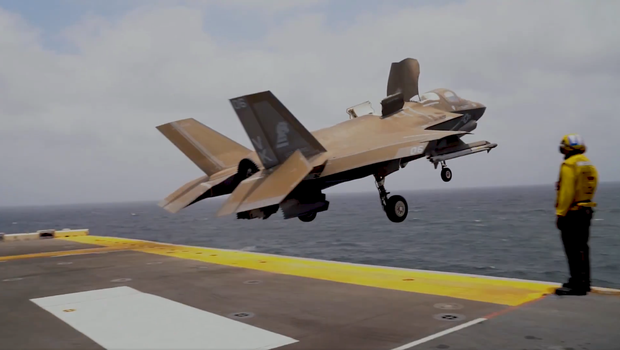
CENTCOM
The U.S.-approved route for ships to travel through the Strait of Hormuz involves hugging the Omani coastline, while Iran has called for ships to travel along a northern route.
The Persian Gulf Strait Authority, the agency set up by Iran to manage transit through the Straight of Hormuz, said in a statement after the attack, “Any passage through routes outside the framework designated by PGSA will not be covered by safe passage guarantees and will not be entitled to insurance coverage or related liabilities.”
It added, “The consequences arising from passage through unauthorized routes shall be the responsibility of the owner, operator, and vessel commander.”
The vessel suffered damage to its bridge, but said no one was injured, according to the UKMTO, which receives reports of suspicious activity from all vessels in the Gulf region.
The ship continued on its way following the strike.
A U.N. maritime agency has paused the evacuation of ships through the Strait of Hormuz after the British military said a vessel was hit Thursday by a projectile off the coast of Oman.
The head of the International Maritime Organization said the plan to move stranded ships through the strait will be on hold until the agency can confirm safety guarantees for the ships on the evacuation list and in the region.
“I have been informed of an attack today in the Gulf of Oman,” IMO Secretary General Arsenio Dominguez said on X. “Seafarer safety remains paramount. To ensure coordinated approach & navigational safety, the IMO evacuation plan will be paused until further clarity.”
The Islamic Revolutionary Guard Corps struck the commercial vessel in the Strait of Hormuz, a U.S. official confirmed to CBS News.
CBS/AFP
wp:paragraph
هلدینگ کاسپین استانبول | خرید ملک در ترکیه | صرافی معتبر ایرانی در ترکیه | خرید و فروش طلا در ترکیه | مهاجرت به ترکیه | واردات و صادرات در ترکیه | نیازمندیهای ترکیه | اخبار ترکیه | اخبار جهانی | توریست ایران | خدمات توریستی در ایران | تورهای گردشگری ایران | هلدینگ اول | خدمات کاریابی و فریلنسری و شغل | مرجع اطلاعات ایران (همه چیز در ایران) | کیف پول و خدمات مالی و پرداخت یار | اخبار ایران | تابلو زنده قیمت ارز در ترکیه و استانبول | صرافی آنلاین ترکیه | قیمت طلا و نقره در ترکیه | سرمایه گذاری در ترکیه | جواهرات در ترکیه | نرخ لحظه ای ارزها در استانبول | قیمت دلار امروز در ترکیه | قیمت دلار استانبول امروز | قیمت لحظه ای دلار | اخبار روز ترکیه استانبول | اپلیکیشن ISTEX | اپلیکیشن قیمت لحظه ای دلار و یورو و لیر و ارزها در ترکیه
/wp:paragraph wp:paragraph /wp:paragraph
About the Author