
Home – CBSNews.com
Add CBS News on Google
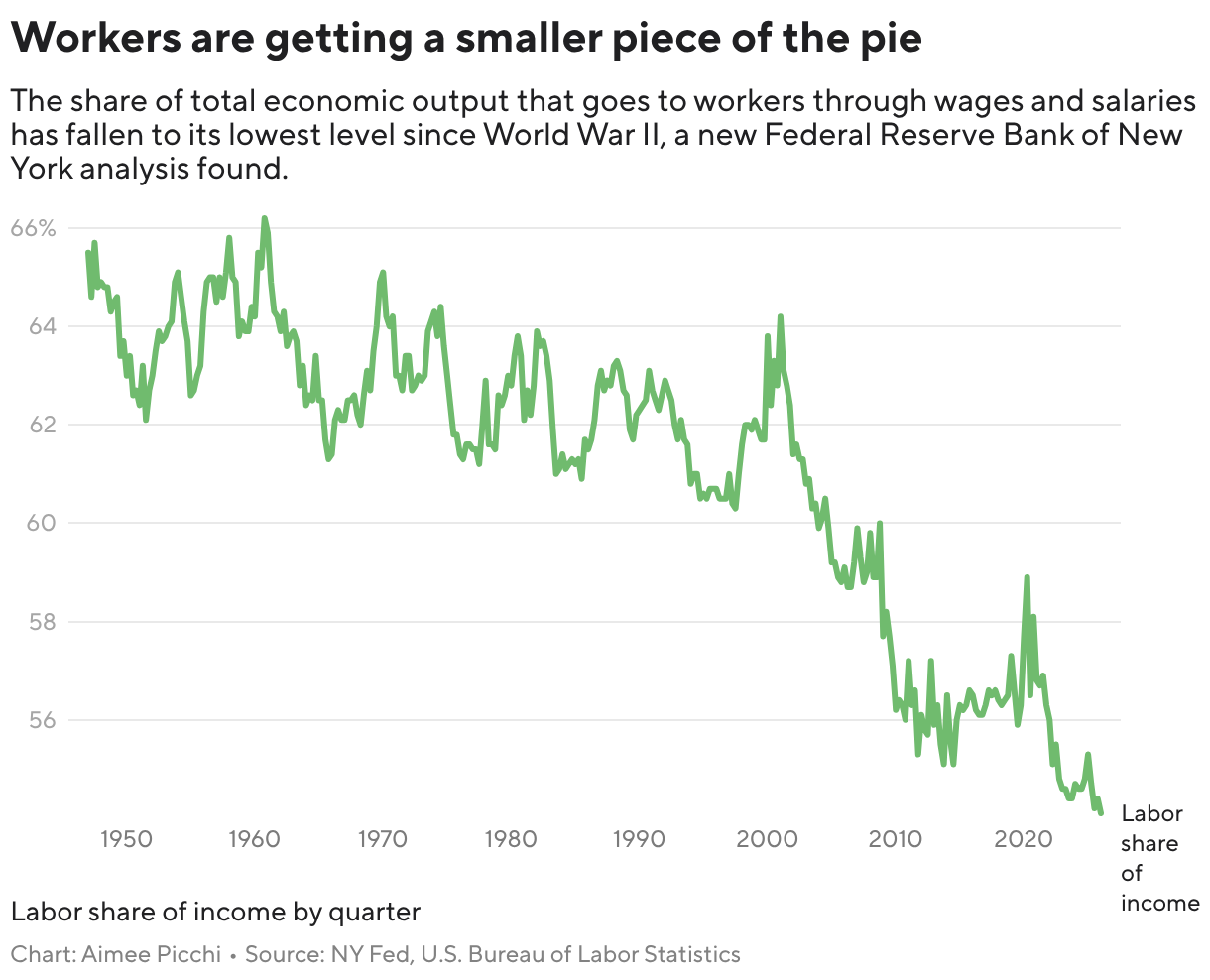
American workers’ share of the economic pie has fallen to its lowest level since at least 1947, when the federal government began tracking the data, according to an analysis by Federal Reserve economists.
The measure, known as “labor share of income,” tracks how much of the nation’s economic output flows to workers in the form of wages and salaries, as opposed to the share that goes to investors and corporations through profits, dividends and other capital income. A shrinking labor share of income indicates that more economic gains are flowing to shareholders and business owners, rather than to workers.
As of early 2026, American workers received 54.1% of national income, according to research from the Federal Reserve Bank of New York. By comparison, that figure topped 65% almost 80 years ago, when the government began tracking the data following World War II. In early 2020, it stood at 57.7%, indicating that workers have continued to lose ground since the pandemic.
Roughly 48% of Americans said their financial situation was worse in May than a year ago, the highest share since January 2023, according to a recent survey by the Federal Reserve Bank of New York.
Three-quarters of Americans said their incomes aren’t keeping up with inflation, according to a May CBS News poll. Roughly 29% of respondents said the economy was in good shape.
American workers are taking home a smaller share of the nation’s income — capturing less of what the economy produces — due to several long-standing issues, ranging from the erosion of union membership to tax law changes that have steered more gains to CEOs, investors and high-income Americans, economists told CBS News.
As those currents played out over decades, many low- and middle-income workers have lost economic ground, making them feel increasingly financially precarious even as the economy as a whole has continued to expand and rebound in the wake of multiple crises.
“You’ve got a lot of people who seem to work for firms that, in the aggregate, seem to be doing really well,” said Josh Bivens, chief economist at the Economic Policy Institute, a nonpartisan think tank. “They’re very profitable, and yet [workers’] wages aren’t growing particularly fast relative to how fast the firms are growing.”
He added, “A lot of people look up after 10 years of working and just feel like they have not gained as much ground as they want to. More and more stuff just seems to be out of their grasp, because their wages have not kept up.”
A related way to measure the shift is to consider the change in U.S. workers’ share of company profits, Bivens said. Workers received 71.3% of corporate income in the first quarter of 2026, down from 77.8% at the start of 2020, according to an EPI analysis of labor data. In 1979, the starting year for the EPI’s analysis, the share stood at 79.1%.
That figure shows that the share of corporate income that goes to people’s paychecks, rather than to business profits, is declining, with more rewards flowing to shareholders and top executives via dividends, stock buybacks and other forms of capital. Capital gains are taxed at a lower rate than ordinary income, benefiting shareholders and other investors.
The change in labor income helps explain the emergence of the so-called K-shaped economy, said Angela Hanks, chief of policy programs at the left-leaning Century Foundation. The term describes the growing fortunes of America’s top earners, while low- and middle-income earners are failing to keep up.
“You see this chart, and you immediately understand why consumer sentiment is so low — you understand why, at 4% unemployment, people are pessimistic about the economy,” she said. “Even if you have a job, even if you feel like your household is relatively stable, you do feel this underlying precarity at all times.”
Why workers are losing ground
The declines in labor’s share of income and corporate income are the cumulative result of policy changes over the past few decades, including the weakening of collective bargaining power, Bivens said. Union membership has steadily eroded, falling to 10% of all U.S. workers last year, from 20% in 1983, according to the Center for Economic and Policy Research.
“A good symbol of this is the value of the federal minimum wage — it’s the lowest today in inflation-adjusted terms than it’s been in about 50 years, and that’s just a clear symbol that boosting wages for typical workers has not been a policy priority,” Bivens said.
The federal minimum wage remains $7.25 an hour, where it was set in 2009.
At the same time, the shift of income away from workers and toward investors and corporations is becoming self-reinforcing, Hanks said.
“As labor’s share declines, it becomes harder for labor to exercise its power to demand higher wages, better working conditions, and easier for capital to suppress that demand,” she added.
In other words, as workers get a smaller piece of the economic pie, they lose power to bargain for better pay and working conditions. By contrast, corporations and shareholders gain leverage in keeping the upper hand, she said.
Reaching a debt end
To be sure, other factors are weighing on Americans’ views of the economy. Resurgent inflation, which in May hit its highest level in more than three years, is pressuring people’s budgets, with Gallup finding in a recent poll that high gasoline prices have caused financial hardship for two-thirds of households.
Inflation has also outpaced worker wages, meaning the typical household is losing purchasing power. More Americans report struggling to pay for healthcare, while credit card delinquencies across the U.S. have reached their highest level in 15 years. And the rise of AI is fueling public concerns about losing jobs to automation.
With many families increasingly financially pinched, some are turning to credit cards and other forms of debt to cover daily expenses, which could also contribute to their pessimism about the economy, Hanks said.
“People are increasingly using debt as a way to make ends meet — we have record-high credit card debt, auto debt,” she said. “People are falling into delinquency and default at concerning rates, and are using these products not for extravagant purchases, but just to get by and make ends meet.”
wp:paragraph
هلدینگ کاسپین استانبول | خرید ملک در ترکیه | صرافی معتبر ایرانی در ترکیه | خرید و فروش طلا در ترکیه | مهاجرت به ترکیه | واردات و صادرات در ترکیه | نیازمندیهای ترکیه | اخبار ترکیه | اخبار جهانی | توریست ایران | خدمات توریستی در ایران | تورهای گردشگری ایران | هلدینگ اول | خدمات کاریابی و فریلنسری و شغل | مرجع اطلاعات ایران (همه چیز در ایران) | کیف پول و خدمات مالی و پرداخت یار | اخبار ایران | تابلو زنده قیمت ارز در ترکیه و استانبول | صرافی آنلاین ترکیه | قیمت طلا و نقره در ترکیه | سرمایه گذاری در ترکیه | جواهرات در ترکیه | نرخ لحظه ای ارزها در استانبول | قیمت دلار امروز در ترکیه | قیمت دلار استانبول امروز | قیمت لحظه ای دلار | اخبار روز ترکیه استانبول | اپلیکیشن ISTEX | اپلیکیشن قیمت لحظه ای دلار و یورو و لیر و ارزها در ترکیه
/wp:paragraph wp:paragraph /wp:paragraph
About the Author