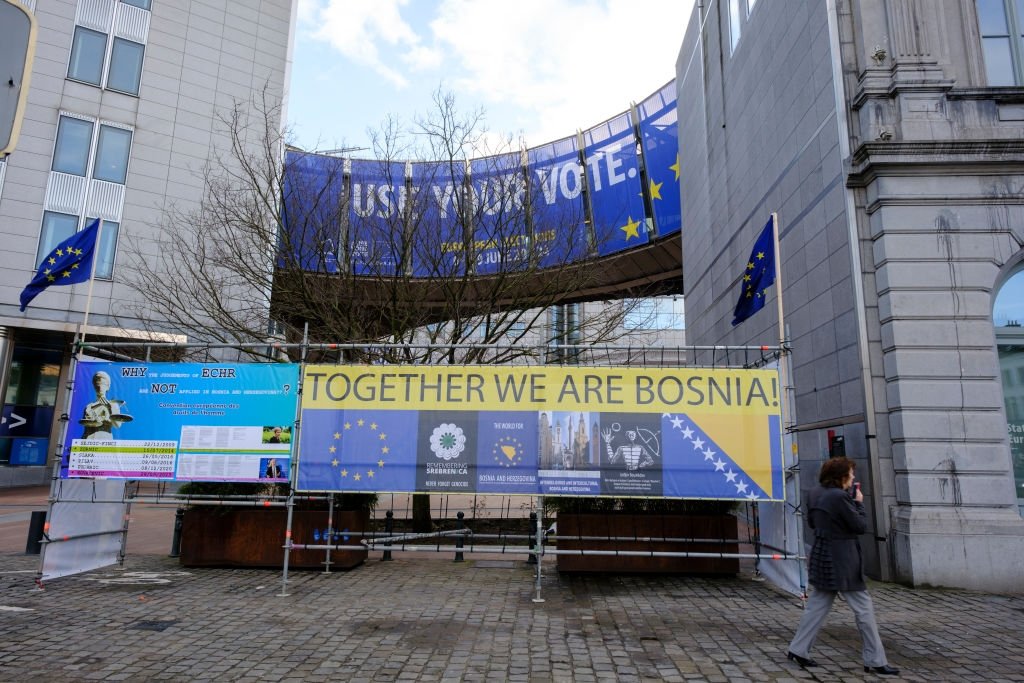
As Bosnia-Herzegovina prepares for its parliamentary and presidential elections on Oct. 4, concern is growing over the surprisingly low number of Bosnians living abroad who have registered to vote.
According to Central Election Commission (CIK) Chairperson Suad Arnautovic, 11,379 citizens living abroad accessed the e-Izbori platform, created user accounts and submitted registration applications between May 8 and early July. Of these, 7,779 fulfilled the requirements to participate in the elections, while another 1,037 applications are still being processed.
Particularly concerning, according to Arnautovic, is the fact that 1,037 applications were rejected, accounting for 9.11% of all submitted requests. The most common reasons were missing documents, invalid identification papers, lack of proof of residence abroad or unsigned forms.
The largest number of registrations came from Germany with 2,300 applications, followed by Croatia with 2,212, Austria with 1,223 and Serbia with 557.
Considering that the Bosnian diaspora is estimated at well over 2 million people, these figures appear disappointing.
Arnautovic has publicly expressed his concern. While the Central Election Commission is responsible for organizing the electoral process and registration procedures, he argues that responsibility for the low participation rate does not rest with the commission alone.
Political parties and state institutions must also ask themselves why so few citizens abroad are being reached. The election commission can explain how to vote, he says, but political parties must explain why citizens should vote.
His criticism raises a fundamental question: Why are so few Bosnians abroad registering for an election that will help determine the political future of their homeland?
Why Bosnia neglects diaspora
One explanation is surprisingly simple. Many people living in Germany, Austria, Switzerland and other countries assume that once they have registered to vote, they remain permanently on the electoral roll. This is how the system functions in many Western democracies. Bosnia-Herzegovina, however, requires overseas voters to register again before every election. This procedure has existed for years. Yet many citizens only learn about the requirement shortly before registration deadlines expire.
One of those overseas voters is 73-year-old Hamid Uzunovic. The former guest worker arrived in Germany in the 1970s and has participated in Bosnian elections for years. Yet every election brings the same frustration.
“Every time it’s the same story,” says Uzunovic. “We have to scan and upload documents. Many older people cannot do that on their own. I simply do not understand why our country cannot create a system where I register once and remain on the electoral roll permanently.”
For people like him, the problem is not a lack of interest in Bosnia-Herzegovina. Quite the opposite. The problem is that participating in elections has been made unnecessarily complicated. While younger people generally navigate digital platforms without difficulty, many older members of the diaspora struggle with procedures that require technical knowledge, scanners, smartphones and digital literacy.
Yet the low registration figures reveal a problem far deeper than bureaucracy alone. For decades, Bosnia-Herzegovina has benefited enormously from its diaspora. Every year, billions of euros flow into the country through remittances, investments and financial support for family members. In many municipalities, money sent from Germany, Austria, Switzerland, Scandinavia or North America is economically more important than government development programs.
Despite this dependence, governments in Sarajevo have failed to develop a serious and coherent policy toward the diaspora. Politicians regularly praise Bosnians abroad as patriots, investors and ambassadors of the country. Ministers travel to diaspora events, representatives of state institutions attend community gatherings and political parties actively seek support before elections. Yet beyond symbolic gestures, little has been done to address the everyday concerns of people living abroad.
The contradiction is obvious. A state that depends heavily on the economic contributions of its citizens abroad still requires them to repeatedly prove their identity, residence and eligibility simply to exercise a fundamental democratic right.
Many members of the diaspora therefore ask a legitimate question: If banks can verify identities digitally, if tax declarations can be filed online and if Estonia allows citizens to cast their ballots electronically, why is Bosnia-Herzegovina unable to create a system in which a single registration is sufficient? The answer is not technological incapacity. The answer is political neglect.
For years, diaspora policy has consisted largely of speeches, patriotic rhetoric and symbolic visits. What is missing are institutional reforms. Consular services remain cumbersome, administrative procedures fragmented and digitalization continues at a painfully slow pace. This neglect has consequences.
Many Bosnians abroad increasingly feel that they are valued primarily for the money they send home. They transfer billions of euros, build houses, support relatives, purchase property and invest in local businesses. At the same time, they often feel that the state has little interest in making their lives easier.
Within diaspora communities, one hears the same phrase time and again: “When they need money, they remember us. When they need votes, they remember us again.”
Whether this perception is entirely fair or not is almost beside the point. What matters is that it is widespread. Adding to this is a deep sense of political disillusionment. Governments, coalitions and political actors have changed repeatedly over the decades. Yet many people continue to see the same structural problems remain in place: corruption, patronage networks, inefficient administration, ethnic deadlock and the continued emigration of young people. As a result, many voters no longer believe elections can bring meaningful change. Politicians change, but the structures remain.
At the same time, today’s diaspora differs significantly from the generation of guest workers. The first generation often thought daily about their hometowns and villages and dreamed of returning one day. The young software engineer in Munich, Amsterdam, Stockholm or Toronto lives in a different reality today. His or her career is abroad. Their apartment is abroad. Their partner is abroad. Their children are growing up abroad. Bosnia remains part of their identity, but it is no longer the center of their daily life.
Political parties have also failed to adapt to this development. Campaigns continue to revolve around defending the nation, protecting the state or saving Bosnia. Yet many people in the diaspora are more interested in practical questions: Can administrative procedures be completed online? How can investments be made without drowning in bureaucracy? Why do simple administrative procedures take months? These are the issues that shape everyday life for many Bosnians abroad. In political debates, however, they often play only a secondary role.
Diaspora votes matter
Yet diaspora votes can be decisive. In many municipalities, a few hundred votes from abroad are enough to influence mandates or shift political majorities. Nevertheless, this reality is rarely communicated.
The solution is neither complicated nor revolutionary. Automatic registration for citizens with a registered foreign residence would remove many obstacles. Simplified digital procedures could significantly increase participation. Campaigns conducted through social media, messaging services and diaspora associations would likely be more effective than bureaucratic announcements. Above all, political decision-makers must begin to see the diaspora as a permanent part of the nation rather than an electoral reserve that is mobilized every four years.
Ultimately, the issue is about trust. Forms can be simplified. Websites can be modernized. Procedures can be digitalized. Yet none of this will make a meaningful difference as long as people continue to feel that the political class neither understands nor takes their concerns seriously.
The diaspora has not abandoned Bosnia-Herzegovina. Millions continue to follow developments in the country, maintain family ties and make significant economic contributions. What has been lost is not the connection to the homeland. What has been lost is the confidence that the state is listening. Until that changes, the low registration numbers will remain merely a symptom of a much larger problem: the growing alienation between Bosnia and one of its most important resources – its diaspora.
The views and opinions expressed in this article are solely those of the author. They do not necessarily reflect the editorial stance, values or position of Daily Sabah. The newspaper provides space for diverse perspectives as part of its commitment to open and informed public discussion.
DAILYSABAH
هلدینگ کاسپین استانبول | خرید ملک در ترکیه | صرافی معتبر ایرانی در ترکیه | خرید و فروش طلا در ترکیه | مهاجرت به ترکیه | واردات و صادرات در ترکیه | نیازمندیهای ترکیه | اخبار ترکیه | اخبار جهانی | توریست ایران | خدمات توریستی در ایران | تورهای گردشگری ایران | هلدینگ اول | خدمات کاریابی و فریلنسری و شغل | مرجع اطلاعات ایران (همه چیز در ایران) | کیف پول و خدمات مالی و پرداخت یار | اخبار ایران | تابلو زنده قیمت ارز در ترکیه و استانبول | صرافی آنلاین ترکیه | قیمت طلا و نقره در ترکیه | سرمایه گذاری در ترکیه | جواهرات در ترکیه | نرخ لحظه ای ارزها در استانبول | قیمت دلار امروز در ترکیه | قیمت دلار استانبول امروز | قیمت لحظه ای دلار | اخبار روز ترکیه استانبول | اپلیکیشن ISTEX | اپلیکیشن قیمت لحظه ای دلار و یورو و لیر و ارزها در ترکیه
About the Author