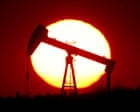
As the world swelters in ever more dangerous heat, why are oil companies being allowed to turn up the gas instead of paying for the consequences of their greed?
That ought to be the question on everyone’s minds amid baking heat domes over much of the northern hemisphere, temperature records being smashed day after day, children dying in locked cars, hospitals filling with heatstroke victims and emergency services tackling wildfires.
There is no doubt that oil, gas and coal companies already bear a disproportionate share of the blame yet have a financial incentive to further disrupt the climate. These perverse incentives will continue unless their generous government subsidies are replaced with windfall taxes.
There is an overwhelming scientific consensus that the more fossil fuels are burned, the hotter the planet will get. The latest attribution study concludes that the “most severe and widespread heatwave to have ever affected this large a region of Europe” could not have happened without human-caused climate change.
Yet Big Oil is planning to make a bad situation worse, because more fuel burning means bigger bucks. A recent surge in profits, thanks to high oil prices driven by wars in the Middle East, including Iran, is going to be followed by a splurge in investment in new wells.
A new analysis shows petroleum companies are racing one another to extract more oil and gas from the ground. Shell, ExxonMobil, Chevron and seven other publicly listed firms aim, on average, to increase production by 14% between 2024 and 2030, according to the Climate Transition Centre at the London School of Economics and Political Science (LSE).
More fuel is the last thing an already overheated world needs. It pushes the planet in the opposite direction from the goals set by the Paris climate agreement, to which many of these companies promised to align themselves. To limit global heating to between 1.5C and 2C by 2100, oil output needs to fall this decade. The current planned expansion is much worse than the International Energy Agency’s gloomy business-as-usual scenario, which envisages a 5.9% increase in oil and gas production this decade, leading to a catastrophic 2.9C global temperature increase by the end of the century.
The IEA could not have put this more clearly: to align with the Paris agreement’s goal of keeping global heating well below 2C, there can be no new long-term oil and gas exploration or development projects.
So why do fossil fuel companies plan to pump more than ever? Because their executives are forced to operate in a different universe, where the ethical compass is set to maximising shareholder value rather than maintaining the habitability of the planet. To maintain this perverse situation, investors and supporters in the media have grabbed power and changed the global climate debate.
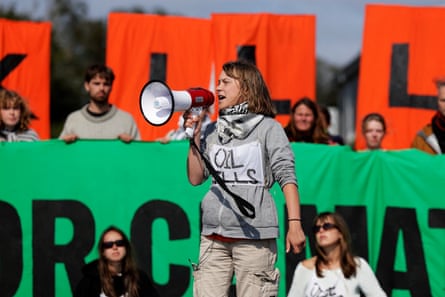
Six years ago, the petroleum business was on the defensive. Greta Thunberg and climate strikers were marching against fossil fuels on streets around the world. Opec bosses warned these protests were the “greatest threat” the industry had ever faced because oil executives were being challenged by their own children in their own homes. Momentum was growing for change. Numerous governments had set net zero decarbonisation targets. Financial institutions committed themselves to more ambitious environmental governance targets.
Some oil companies, mostly in Europe, aligned themselves with the Paris agreement. BP was then among the most ambitious, pledging a 40% cut in oil and gas production, and a tenfold increase in investment in renewables. The CEO at the time, Bernard Looney, promised BP would become “a force for good as well as a provider of competitive returns”.
The fine-sounding, far-off pledges were never sufficient to fully align with the Paris climate goals to keep global heating at 1.5C as they relied on unproven solutions, such as carbon capture and storage, but they helped to placate public opinion until the climate campaigners were off the streets. Later, when concrete actions were needed to make even these vague targets a reality, many petroleum firms started backtracking.
BP is a case in point. Looney was forced out in 2023, the same year as the company watered down its 40% fossil-fuel cut to 25%. Two years later, it announced a strategic reset, slashing renewable energy investments by $3bn and increasing oil and gas spending to $10bn each year. The current CEO, Meg O’Neill, has continued this retreat from low-carbon investments with a strategy of “simpler and stronger” that is in effect a return to petro-business as usual. Shareholder value, rather than social and environmental responsibility, is now the company’s priority. So, while the world burned and conflicts raged, BP’s profits more than doubled in the last quarter.
It is a similar story elsewhere. The six European oil majors increased their combined profits in the same period by 43% to the highest level – $22bn – since 2022. Most have backtracked on green energy commitments in recent years and ramped up production plans. Norway’s state oil company, Equinor, has lifted its oil and gas output target by 6% by 2030. Brazil’s Petrobras is aiming to supply 21% more oil by 2030. Almost every country and company, it seems, is racing to produce the last barrel of oil.
In the US – by far the world’s biggest oil-and-gas-producing nation, pumping more than Saudi Arabia and Russia combined – many petroleum companies did not even bother making low-carbon commitments in the first place. With Donald Trump’s administration working in their interests, they have political cover to increase production (Exxon by a staggering 25% and Chevron by 15% by 2030) and expand markets by whatever means necessary. Meanwhile, their investors and supporters are nudging Europe in the same direction through shareholder activism or by funding for far-right politicians and thinktanks campaigning against net zero policies.
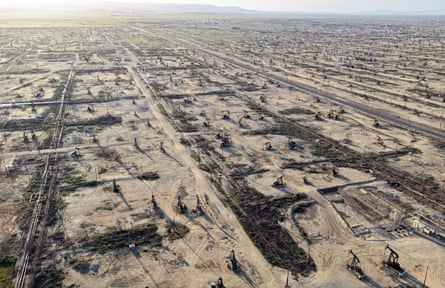
Add all of this up – higher oil prices, shifting boardroom priorities, state capture, political cover and an injection of cash to fill the streets with far-right anti-net zero campaigners rather than youth climate strikers – and you have all the ingredients for the petroleum industry to pump ever more fuel on to the global fire. A perfect storm for ever more extreme storms.
With a new El Niño now confirmed – and forecast to be one of the most severe in decades – this is folly on a globally calamitous scale. The Amazon is bracing for more fire and drought, without having time to recover from the devastation of the last El Niño, which saw usually clear forest skies turn the smoky grey of an industrial town, led to the drying up of some of the world’s biggest rivers, and resulted in the mass deaths of dolphins and other animals.
The polar regions will see more melting of the snow and ice that normally reflects solar heat back into space. And other vital elements of Earth’s life-support system will approach dangerous tipping points. Catastrophic consequences are becoming ever more likely.
It never had to be this way and it does not have to be this way in the future. Values have to change. Incentives need to shift. Fossil fuels, which were for long so beneficial to humanity, have to be recognised as poisons. And petroleum companies must pay for backtracking on their promises and putting shareholder dividends ahead of planetary health and human wellbeing.
The Guardian wp:paragraph
هلدینگ کاسپین استانبول | خرید ملک در ترکیه | صرافی معتبر ایرانی در ترکیه | خرید و فروش طلا در ترکیه | مهاجرت به ترکیه | واردات و صادرات در ترکیه | نیازمندیهای ترکیه | اخبار ترکیه | اخبار جهانی | توریست ایران | خدمات توریستی در ایران | تورهای گردشگری ایران | هلدینگ اول | خدمات کاریابی و فریلنسری و شغل | مرجع اطلاعات ایران (همه چیز در ایران) | کیف پول و خدمات مالی و پرداخت یار | اخبار ایران | تابلو زنده قیمت ارز در ترکیه و استانبول | صرافی آنلاین ترکیه | قیمت طلا و نقره در ترکیه | سرمایه گذاری در ترکیه | جواهرات در ترکیه | نرخ لحظه ای ارزها در استانبول | قیمت دلار امروز در ترکیه | قیمت دلار استانبول امروز | قیمت لحظه ای دلار | اخبار روز ترکیه استانبول | اپلیکیشن ISTEX | اپلیکیشن قیمت لحظه ای دلار و یورو و لیر و ارزها در ترکیه
/wp:paragraph wp:paragraph /wp:paragraph
About the Author

