“I’m in that moment of sheer terror,”says Christopher Nolan, sitting in a suite at the Corinthia hotel in London, in a slightly rumpled suit, next to a pot of tea. Outside, crowds jostle, hoping to catch a glimpse of one of the stars within – Matt Damon, Tom Holland, Lupita Nyong’o. It is the day before the world premiere of Nolan’s latest film, an adaptation of Homer’s epic poem the Odyssey, and the last day of waiting before audiences decide whether the biggest gamble of Nolan’s career has paid off. The film, which reportedly cost $250m (£185m), doesn’t just need an audience to show up. It needs the entire moviegoing world to do so.
“It never gets any easier, becauseI make films for audiences and the audience tells me what it likes,” he says. “They finish the film. I don’t have anything to hide behind. I can’t just be like: ‘Oh, people don’t get it.’ Those aren’t the films I make.What does the audience make of it? Do they turn up? Do they like it if they do turn up?
“By the way, I don’t think I’d be doing my job right if I wasn’t petrified every time I put a film out, because you’re trying to challenge yourself, you’re trying to take risks.”
He doesn’t seem terrified. He seems about as relaxed and happy as I’ve seen him in 20 years. I’ve interviewed Nolan many times, and he is a famously cautious, if unfailingly amiable, interviewee, who has perfected the art of talking about his films while revealing next to nothing about himself – “the most accessible reclusive director in America” is how he once described himself to me. Interviewing him can at times feel like attempting to debrief John le Carré’s master spy George Smiley.
But whatever the reason – the seven Oscars for Oppenheimer, the happy exhaustion of having finally finished The Odyssey, shot over a period of six months in as many countries – something seems to have thawed in Nolan. Maybe it’s the new dog, a chocolate lab named Charlie “who can hear the fridge open from a mile away”, acquired by Nolan and his wife, Emma Thomas, after the last of their four children left home.
“They’re all off in the world,” he says. “We’ve got a dog and then I decided to make The Odyssey because it’s the ultimate dog movie. I never had a dog as a kid, and we never got a dog when the kids were younger because we travelled too much. They’re a bit fed up that we got one as soon as they left, although they love the dog. And then coming to the Odyssey, I’m not being glib, but it really is a very important part of that story.” When Odysseus finally makes it home to Ithaca, after 20 years, he is instantly recognised by his old hunting dog Argos, who is glimpsed in Nolan’s trailer as a puppy. “A little taste of young Argos was a fun thing to have and I was pleased they did that,” he says.
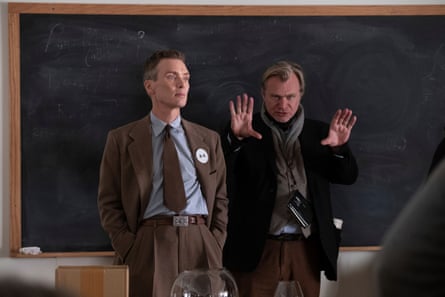
Conceived in the contrails of Oppenheimer’s success, greenlit by Universal’s Donna Langley and set in stone the moment the directing Oscar was handed to Nolan with a hug from Steven Spielberg – “I sort of collapsed in his arms like a runner crossing the finish line,” says Nolan – the film is in every sense the child of Oppenheimer. “I thought: OK, I’ve now got an opportunity to make a film that I wouldn’t be able to make otherwise,” says Nolan.
Thomas, his wife and producing partner, whom I speak with later, puts a finer point on it. “I don’t think there’s any world we could have gone to a studio and said: ‘We want to adapt a 2,700-year-old poem,’ and that be an automatic huge movie,” she says. “We were asking for a big budget to do it. That would not have happened without Oppenheimer.”
Being on the campaign trail for nine months meant Nolan couldn’t start writing until April 2024, but the delay only sharpened the long-distance rumination over structure he started doing the moment he picked a poem he hadn’t read since primary school. “I’ve spent many years in hotel rooms like this talking about the non-linear structures of my film as if it was so radical, and then you go back to the oldest foundational literary text and it’s got an absolutely radical structure. It’s stories within stories, it’s flashbacks within flashbacks. And that immediately was exciting.”
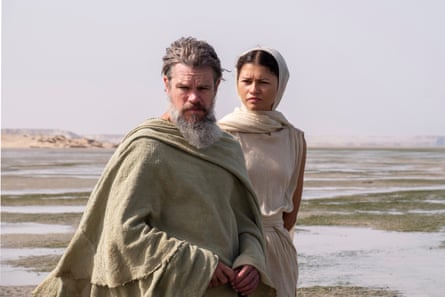
It wasn’t his first pass at Homer. In the early 2000s, in the wake of Memento’s success, Nolan found himself briefly attached to David Benioff’s script for Troy, based on The Illiad, which was eventually directed by Wolfgang Petersen, so “I had spent a lot of time figuring out how do you present that to an audience who all know that the belly of that horse is stuffed with Greeks?” he says. “How do you make that credible?” The image that came to him, the germ of his later screenplay for The Odyssey, was the image of a beached monument, sinking into the sand. “A true Hail Mary, as we say in America, just an act of absolute desperation that shouldn’t work. That was the first image I had. I carried that with me for 20 years. I always wanted to do it.”
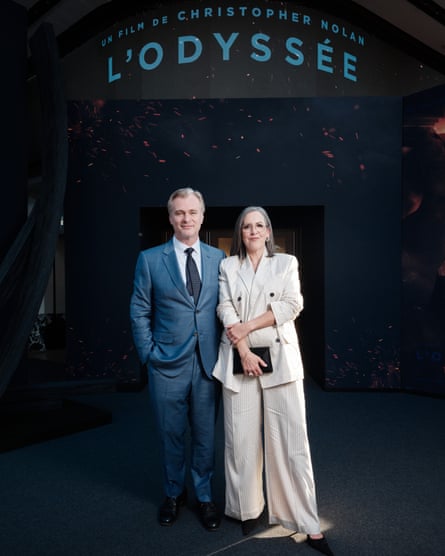
Almost everyone describes it as the hardest shoot of their career – like making seven ambitious movies in one, says Thomas. The cast and crew crossed deserts, mountains, seas and Arctic landscapes, often reaching locations only by helicopter or long hikes. The cinematographer Hoyte Van Hoytema’s team had to lug 300lb (136kg) Imax cameras, the weight of a small refrigerator, across terrain where simply getting people to set was often challenge enough. “At the end of each day the heads of department would have dinner and then we’d collapse into a screening room to watch dailies,” says Thomas. “Every time you would get through one challenge, you’d think: oh my God, we did it. And then you’d think: oh no, next week we’ve got a whole other thing to deal with. It was just the relentlessness of the challenges that were posed.”
Nolan and difficulty are old friends, of course. His preference for real locations over soundstages, for “in camera” effects over computer-generated ones, and for Imax – the immersive format that can only be shot in three-minute bursts and requires a small blimp to silence the camera – have made the roiling seas that lashed Dunkirk’s shoot seem like merely a spot of bad weather.
Is difficulty the point? “It’s really not,” says Nolan. “The more we talk about it, the more it feels like it was a some sort of Herzogian ordeal but that’s really not my bag. In truth, it’s just about The Odyssey. You need things that you haven’t seen before. I get bored on sound stages and sets, not because I wouldn’t want it to be difficult. It’s because nature and the real world gives you a scale and a set of options and serendipity that you can’t achieve in the studio. But yeah, it was daunting physically and there were times where I felt like maybe I’d bitten off more than I could chew.”
If he ever doubted himself, it wasn’t on set. It was the night before. “I sleep well because I get exhausted,” he says, but come Sunday, he’d get a chance to read the script again and look at the schedule for the week ahead. “I’d go: ‘Oh shit, how the hell am I going to do that week?’ and that keeps me up often at times all night, Sunday night, just not able to sleep. So I come to set frazzled, the next day, but I was prepared. I had a way out.”
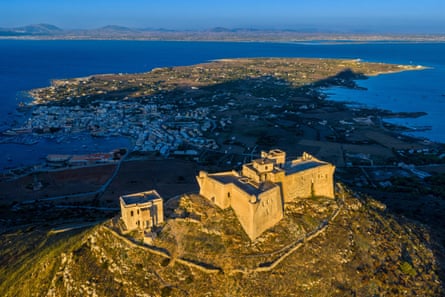
One location in particular preyed on his mind: the ruined clifftop Castello di Santa Caterina on the Sicilian island of Favignana which he and production designer Ruth De Jong had selected for Odysseus’s Ithaca home. Reaching it required a 45-minute hike up a stony, zigzagging path every day. “That loomed very large over me knowing that we were going to be in that situation, but we got such a great spirit from the cast and crew. You’ve got Tom Holland bounding up this path like a gazelle, making me feel very old and tired, but as an example to everybody, he was just in there.”
On the very last day, after filming finished on the lot at Universal in Los Angeles around one o’clock in the morning, Thomas cracked open a few bottles of champagne as she and Nolan usually do. “On this one, I think this was the first time we’d done that and it really felt like nobody wanted to leave,” says Thomas. “It was like we were totally trauma-bonded. You want to carry on, jump out the plane again.”
Ahead of its release, The Odyssey has generated the usual amount of culture-war static, after sections of the manosphere fixated on the casting of Nyong’o as Helen and Elliot Page as Sinon. Homer’s epic poem, thought to be about the valour of men – “Tell me, muse, of a man,” it begins – has recently been taken up as a kind of Alamo for cultural conservatives eager to hold off the “woke” onslaught. “Homer’s Odyssey is in, gender studies is out,” wrote one activist recently. There is a certain irony, then, to the fact that Nolan, to my mind, has written his strongest ensemble of female parts to date. In his film, Helen, Penelope, Circe, Athena and Calypso are not just prizes, temptations or divine interventions, but figures fully realised in performances of great power.

“In the text, they’re icons,” says Nolan. “The problem is that there’s not so much to them beyond these ideals in whatever form they take. What I love about what the women in this movie have done is they give you a sense of the person behind the icon. Watching Lupita as Helen you suddenly have some sense of what it would actually be like to be the catalyst for this huge war and siege – what that would mean, what that would do to a person. And then Anne [Hathaway] as Penelope – very strong, very nuanced.”
That depth, he says, is forged in conversation with the actors rather than imposed by the script. “I’ve been on enough sets to know that horrible moment where, as the writer-director, you’re asked that question you can’t answer. And you have to have an answer. There might be a planned ambiguity – the way Anne’s played Penelope, I almost didn’t want to know what she had in her head – but yeah, you have to be on your toes.”
If history is any guide, right about now is the time when Nolan gets the first tugs towards his next project. “The first signs are probably about a week after he’s had nothing to do he starts to get really antsy,” says Thomas. “That’s when he’ll begin to really home in on: ‘OK, I need to do something.’” Restlessness, after all, is what brought him to Ithaca in the first place. But The Odyssey looks unlikely to release him anytime soon, with rolling premieres across the globe – from Mumbai to London – followed by what is certain to be a non-stop awards campaign for the film, in every category, until next spring.
“I’m so desperate to have a period I have nothing to do,” he says. “It feels so long since I had a time like that. It’s true – I get bored very quickly and that’s one of the reasons I like to go back to work. I get restless.” He pauses. “At the moment, all I can see is just trying to get through this, put the film out and then take a little break.”
The Guardian wp:paragraph
هلدینگ کاسپین استانبول | خرید ملک در ترکیه | صرافی معتبر ایرانی در ترکیه | خرید و فروش طلا در ترکیه | مهاجرت به ترکیه | واردات و صادرات در ترکیه | نیازمندیهای ترکیه | اخبار ترکیه | اخبار جهانی | توریست ایران | خدمات توریستی در ایران | تورهای گردشگری ایران | هلدینگ اول | خدمات کاریابی و فریلنسری و شغل | مرجع اطلاعات ایران (همه چیز در ایران) | کیف پول و خدمات مالی و پرداخت یار | اخبار ایران | تابلو زنده قیمت ارز در ترکیه و استانبول | صرافی آنلاین ترکیه | قیمت طلا و نقره در ترکیه | سرمایه گذاری در ترکیه | جواهرات در ترکیه | نرخ لحظه ای ارزها در استانبول | قیمت دلار امروز در ترکیه | قیمت دلار استانبول امروز | قیمت لحظه ای دلار | اخبار روز ترکیه استانبول | اپلیکیشن ISTEX | اپلیکیشن قیمت لحظه ای دلار و یورو و لیر و ارزها در ترکیه
/wp:paragraph wp:paragraph /wp:paragraph
About the Author