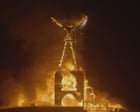
In 1986, a group of starving artists seeking release amid a devastating economic downturn built an oversized wooden stick figure, hauled it on to a San Francisco beach and set it ablaze as police officers and passersby looked on in disbelief. Forty years later, Burning Man is the festival to end all festivals – a sprawling spectacle of music, art and self-expression that draws tens of thousands to the Nevada desert every summer for community, catharsis and spiritual connection. It is a pilgrimage for Bohemians and billionaires, a byword for a particular strain of woo-woo hipsterism, a countercultural institution wrestling with the contradictions between its libertine ideals, corporate reality and the regular presence of lightning-rod figures such as Grover Norquist, the conservative strategist, and Elon Musk’s brother.
The only way to truly grasp the meaning of the place, it seems, is to take the trip –figuratively at first, then literally once fully immersed in Black Rock City’s psychedelic, anything-goes culture. “It’s such an immersive experience that it seems that it would be impossible to capture on film or convey what it feels like to be inside a city that exists for a week, that’s imagined, built and sustained entirely by the people inside,” says Jehane Noujaim, co-director of The Man Will Burn, a new docuseries that premiered on HBO this month on the festival.
Noujaim, who earned widespread acclaim for her documentaries on Al Jazeera’s coverage of the 2003 Iraq invasion and the NXIVM sex cult, did not set out to chronicle Burning Man’s steampunk world. Her curiosity was piqued while trying to clear footage she had shot at the festival for The Great Hack, her documentary on the Cambridge Analytica data scandal, which used a curtain-raising scene featuring one of the whistleblowers at a makeshift temple on site. “I spent about eight months trying to get permission to use that shot – the longest time ever for a shot, which is crazy,” she says. “I didn’t know Burning Man had a CEO or a board.”
Once properly introduced and trusted, Noujaim learned of a vast film archive that the festival had been privately compiling since its earliest days in hopes that an independent film-maker might turn it into something someday. That was enough of a carrot to hook her and bring Vikram Gandhi, the film-maker behind Barry and Kumaré, aboard as co-director. Their collaboration resulted in a deep dive told in four parts, tracing the full arc of Burning Man’s peculiar social experiment as the festival confronts Covid, a board revolt and the effects of global warming.
Noujaim and Gandhi frame Burning Man as a love story between Larry Harvey, a protest artist who saw the festival’s future when it was still a modest gathering for Bay Area eccentrics, and Marian Goodell, his longtime partner and right hand who has carried that vision forward as festival CEO since Harvey died at age 70 from complications of a stroke in 2018.
Viewers meet Goodell as she’s grappling with the decision to cancel the festival for the second straight year because of the pandemic. Kimbal Musk, an outsized presence on the Burning Man board, sees her caution not as prudence but as an opening for a leadership change, rallying a faction of disgruntled board members to his cause. Individual festivalgoers, meanwhile, weigh the risks of joining a renegade gathering determined to return to the desert regardless of the consequences, or staying home as Burning Man adapts to the virtual age.
To Burning Man organizers, it seemed like the worst possible time to have cameras around – and on more than a few occasions they told the film-makers there wouldn’t be much to shoot because the festival wasn’t going to happen. But Noujaim and Gandhi pushed for access anyway. “It was a really important time to go deep and try to understand what the place was about and why so many people around the world care about it so much that they would push through a pandemic and still go even when it was canceled,” Gandhi says. “When we were starting our shoot at the renegade burn, we didn’t know if it was going to be a triumph or another Fyre Festival.”
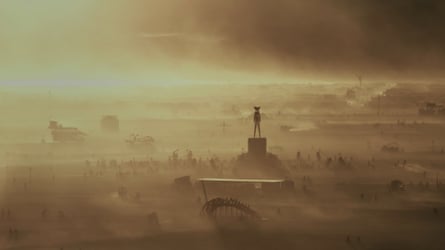
Decommodification, radical inclusion and civic responsibility are among the guiding principles of Burning Man. Since the turn of the century, the festival has been held at Black Rock City, a semicircular community 100 miles from Reno that is built up and torn down without a trace each year – “swept away in the first big wind”, as revered co-founder Harvey puts it in the doc. But it’s the spiritual hold that the festival seems to have on longtime pilgrims that can make devotion look like delusion to outsiders – to the point where a Burning Man reference on a dating profile is taken as an immediate red flag.
“My first film was about me impersonating a religious leader and starting a fictional religion,” Gandhi says, referring to Kumaré. “All the thought process I had when making the film was about creating a story, a creation myth, some kind of sacred space, not necessarily commandments but teachings – it’s all very similar to what Harvey designed for Burning Man. But the main difference is people come up with their own faith system. It has all the things in our religions – place, self-references, rituals – but really no dogma.”
There’s much to admire about Burning Man’s big tent: peaceniks in communion with gun nuts. Google co-founder Sergey Brin grabbing a chow hall shift at rush hour. Norquist, one of the architects of trickle-down economics, extolling the virtues of Black Rock City’s cashless barter system. “The first day that I was there filming, I was sitting around a fire next to a platoon leader I interviewed for my film Control Room about Al Jazeera,” Noujaim says. Yet a community built around letting everyone find their own truth inevitably leaves room for blind spots.
For all of Burning Man’s humanistic virtues, it has long struggled to escape the perception – and reality – that it caters primarily to white people with the time and means to take a week off around Labor Day to reconnect with their inner child on the playa. The film does make a point of pushing against that perception, following a Black ex-paratrooper on a Burning Man pilgrimage to address his battlefield PTSD. Still, all the talk of community, gifting and radical inclusion scarcely survives the trip home, washing off in the first hot shower. The experience on the playa has become more stratified – backpackers bearing the elements in pole tents while A-listers and influencers drop tens of thousands on air-conditioned RVs with all the trappings of a luxury spa experience.
Even the non-profit behind Burning Man has begun to look like a cash grab to festivalgoers who see its $60m operating budget and sprawling real estate portfolio and wonder how much higher ticket prices can climb in this economy. In the end, Black Rock City seems like just another gentrification casualty, a magic sandbox for cosplayers to act out socialist fantasies that would never fly in their own neighborhoods. “It’s almost like Burning Man has become expensive because the world is expensive,” Gandhi says. “But actually the ticket is probably cheaper than Coachella – which is, what, like $600 now? But I agree that it’s changed and money has become a much bigger part of it.”
The Man Will Burn could have played up the festival’s more scandalous aspects to appeal to viewers who now expect documentaries to only entertain: the power struggles, the gratuitous nudity and psychedelic use, the pilgrims who died out in the desert; the torrential rains that turned the playa into a muddy quagmire and had cable news viewers calling for a national guard rescue. Instead, Noujaim and Gandhi deliver a thorough and balanced view of festival life and times – one that will inspire Fomo in some and leave others feeling like they’ve experienced enough of Burning Man without ever having to go.
The long, strange trip may be worth taking either way. “One of the things that’s so awe-inspiring is that you’ve never actually seen so many resources going into something that only exists for a week and is burnt later,” Gandhi says. “It’s a spiritual experience you could look at two ways: you could see it as rich people burning money. Or you could see it as a rare ritual that exists in the world that maybe you’re not part of. But we don’t really have things like that. This is just an event for the event, for the feeling.”
-
The Man Will Burn is available on HBO Max
The Guardian wp:paragraph
هلدینگ کاسپین استانبول | خرید ملک در ترکیه | صرافی معتبر ایرانی در ترکیه | خرید و فروش طلا در ترکیه | مهاجرت به ترکیه | واردات و صادرات در ترکیه | نیازمندیهای ترکیه | اخبار ترکیه | اخبار جهانی | توریست ایران | خدمات توریستی در ایران | تورهای گردشگری ایران | هلدینگ اول | خدمات کاریابی و فریلنسری و شغل | مرجع اطلاعات ایران (همه چیز در ایران) | کیف پول و خدمات مالی و پرداخت یار | اخبار ایران | تابلو زنده قیمت ارز در ترکیه و استانبول | صرافی آنلاین ترکیه | قیمت طلا و نقره در ترکیه | سرمایه گذاری در ترکیه | جواهرات در ترکیه | نرخ لحظه ای ارزها در استانبول | قیمت دلار امروز در ترکیه | قیمت دلار استانبول امروز | قیمت لحظه ای دلار | اخبار روز ترکیه استانبول | اپلیکیشن ISTEX | اپلیکیشن قیمت لحظه ای دلار و یورو و لیر و ارزها در ترکیه
/wp:paragraph wp:paragraph /wp:paragraph
About the Author