Although Türkiye’s transformation over the past two decades has often been explained primarily through economic indicators, foreign policy initiatives or infrastructure investments, it in fact represents a far deeper paradigm shift. At the heart of this transformation lies the construction of a new language, a new mode of thinking, and a new form of institutional organization. Having long been shaped by the center-periphery divide that persisted for nearly two centuries, by one-directional Western-centered modernization projects, and by top-down efforts to reshape society, Türkiye has, for the first time in the 21st century, begun to move forward with a renewed sense of social dynamism grounded in the rediscovery of its own capabilities, aspirations and self-confidence. This new language is not merely a political preference; it is the defining feature of a foundational transformation that has enabled the restructuring of state-society relations, the expansion of economic capacity, and the emergence of Türkiye as an autonomous actor in international affairs.
For many decades, Türkiye’s modernization was shaped by a narrow bureaucratic and intellectual elite positioned at the center. The periphery, in contrast, represented a broad segment of society assigned the role of adapting to this center while frequently remaining excluded from decision-making processes and unable to integrate into the cultural framework defined by the center. Conducted within Western-centered epistemic frameworks, this process sought to transform both society and state institutions through a one-way project of indoctrination, grounding the legitimacy of the state less in the will of society than in external systems of reference. As a result, Türkiye was compelled to regard its own historical legacy, cultural continuity and social dynamism not as sources of strength but as obstacles to modernization.
The construction of this new language marked a decisive break with that longstanding framework. It brought the state closer to the will of the people, transformed the relationship between the center and the broad segments of society that had long been relegated to the periphery in political, economic, and cultural life, and enabled opportunities to spread more widely across society rather than remaining concentrated in the hands of a single elite. The impact of this new language was most evident in three principal areas. The first was the democratization of the state and the rollback of military-bureaucratic tutelage. For decades, the tutelary system had functioned as a supra-political mechanism that both constrained decision-making processes and limited political competition. As this structure gradually dissolved, politics, for the first time, gained the opportunity to institutionalize itself through the broad participation of society and according to its own natural dynamics. This transformation reopened political legitimacy to society and significantly enhanced society’s capacity to move toward the center of political life.
The second was the transformation of Türkiye’s structural position in international relations from one defined by dependency to one based on reciprocity. Across a wide range of domains – including the defense industry, regional diplomacy, humanitarian assistance and energy policy – Türkiye gradually evolved from a passive participant in the international system into an actor capable of formulating and pursuing its own strategic interests. This transformation reshaped not only the country’s foreign policy orientation but also redefined the state’s strategic capacity and its ability to exercise agency in international affairs.
The third was the structural transformation of the economy. Through high levels of investment, the expansion of domestic production capacity, large-scale infrastructure projects and regional development initiatives, Türkiye developed a more dynamic economic model capable of competing in the global marketplace. This model broke with the traditional system in which a centralized elite largely determined the allocation of resources, opening new avenues for production and entrepreneurship to much broader segments of society. As a result, the economy became not only an engine of growth but also a transformative force that strengthened social cohesion.
It was precisely during this period that the Gülenist Terror Group (FETÖ) emerged as the most organized and systemic threat to Türkiye’s state capacity, institutional continuity and political agency. FETÖ was not merely an organization that had infiltrated state institutions; it was a parallel structure seeking to establish an alternative center of decision-making by transforming and ultimately capturing the institutional order from within. The Dec. 17-25 judicial interventions targeted the fault lines of this new paradigm, aiming to reverse Türkiye’s political trajectory and restore a tutelary order. They constituted an operation designed to paralyze the country’s political-economic decision-making mechanisms, re-entrench dependency in its international relations and undermine public self-confidence. The attempted coup of July 15 represented the most radical phase of this process. The effort to seize control of the state in its entirety was an assault on Türkiye’s democratic order, the collective will of its people and its historical continuity.
FETÖ’s infiltration of state institutions and the attempted coup of July 15 constituted not only a profound political rupture in Türkiye but also a deep societal trauma. This trauma produced multidimensional consequences, including the erosion of collective trust, the weakening of the perceived legitimacy of public institutions, and the disruption of the networks of confidence that underpin social relations. Broad segments of society witnessed how an organization that had operated for years through concealed networks was able to manipulate the public sphere and establish a parallel order across virtually every domain of public life, from the judiciary and education to law enforcement and the business community.
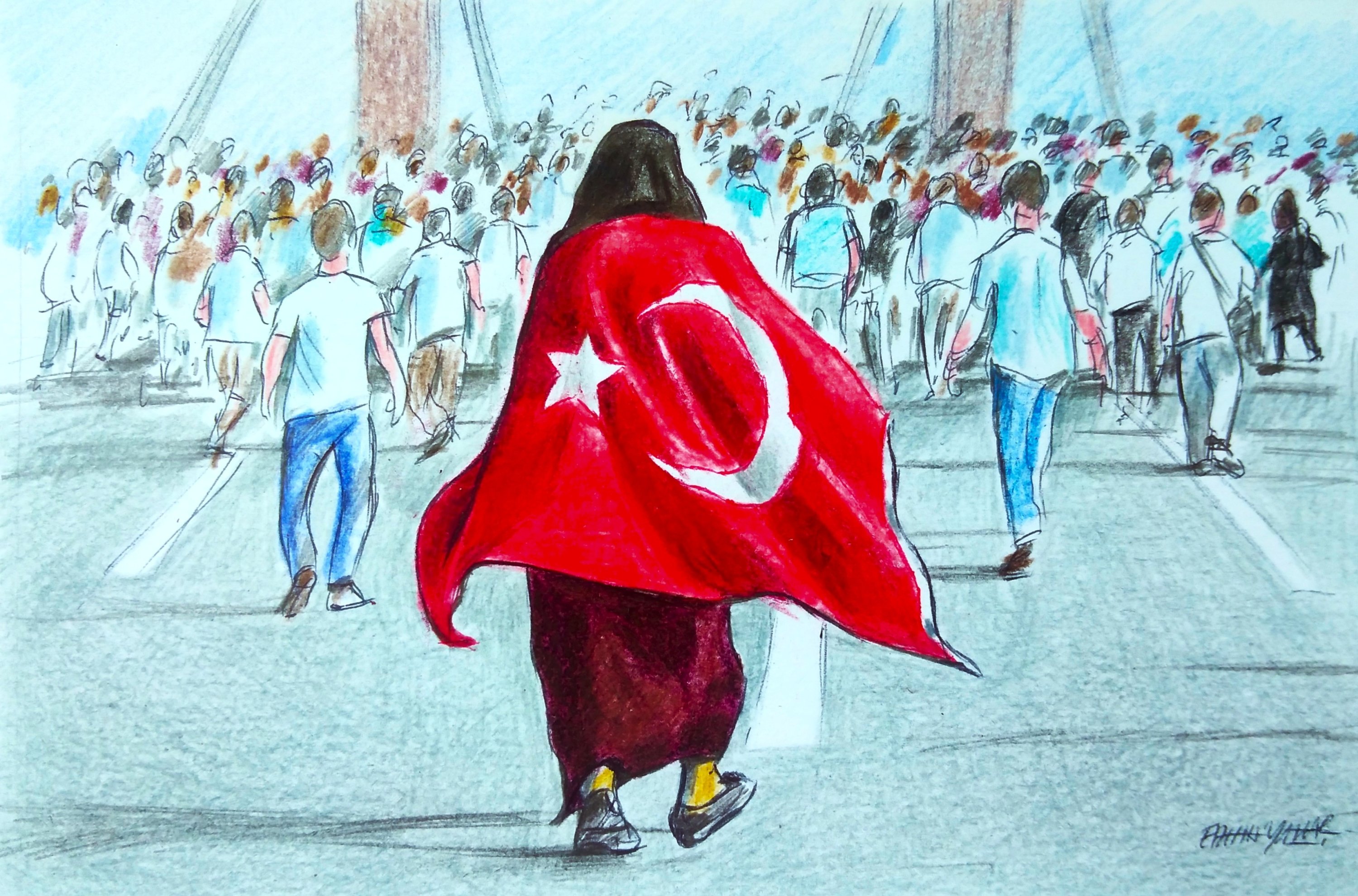
This experience left a lasting fracture in the country’s social fabric. The events of the coup night became etched into the national memory as an assault on the very foundations of the social contract between the state and society. Transcending political differences, this attack generated a shared perception of existential threat that simultaneously reinforced both social solidarity and a heightened sense of vigilance. In this respect, the trauma associated with FETÖ represents not only the experience of confronting a major security threat but also one of the defining moments in the rearticulation of the relationship between the state and society through a renewed collective consciousness.
For this reason, Türkiye’s struggle against FETÖ has been far more than a matter of security or counterterrorism; it has also been a critical effort to safeguard the new political language and the institutional order built upon it. The dismantling of FETÖ enabled Türkiye, after many years, to continue a process of transformation centered on its own trajectory, conceptual framework and social dynamics. From this perspective, the neutralization of FETÖ represented not merely the elimination of a major threat but also a strategic threshold for the sustainability of this new political paradigm. Through this process, the state’s decision-making mechanisms were reconstituted within a unified framework of legitimate authority, parallel hierarchies within public institutions were dismantled, the foundations of the relationship between the state and society were reinforced, and Türkiye’s capacity to exercise agency in foreign policy was further strengthened. Collectively, these developments enhanced the country’s ability to determine its own strategic direction across a wide range of domains, including national security, economic development, foreign policy and social mobility.
In this context, the experience with FETÖ has made it clear which principles should underpin a healthy relationship between civil society, the state, and politics. Above all, it demonstrated that organizing public offices and appointments on the basis of merit is not merely an administrative technique for enhancing efficiency but also a fundamental prerequisite for national security. Wherever meritocracy is weakened, bureaucratic positions can be rapidly occupied by closed and hierarchical networks resembling FETÖ, allowing the acquisition of one position to facilitate access to others and thereby creating a self-reinforcing cycle of institutional capture.
At the same time, the FETÖ experience underscored that while the pluralistic character of civil society should be encouraged, it must also be subject to appropriate public oversight. Closed organizations can imitate the appearance of civil society in order to gain influence, making transparency, institutional autonomy, and public accountability indispensable safeguards. Ultimately, the experience with FETÖ has powerfully demonstrated that whenever the principles of meritocracy, checks and balances, institutional autonomy, and democratic legitimacy are weakened, spaces may emerge in which undemocratic organizations can take root, thereby posing a serious threat to the state’s capacity for sustainable and autonomous governance.
Today, following the neutralization of the FETÖ threat, Türkiye possesses greater scope to pursue its institutional restructuring within a more rational and comprehensive framework. This opportunity is significant for deepening the country’s democratization process, broadening the social foundations of its economic transformation, and consolidating the agency it has achieved in foreign policy through durable institutional arrangements. The new political language that Türkiye has developed over the past two decades has, in the aftermath of the struggle against FETÖ, acquired a stronger institutional memory and broader societal support. Accordingly, Türkiye’s confrontation with FETÖ should be understood not merely as a security issue but as a strategic turning point with far-reaching implications for political agency, institutional capacity, social mobilization, and the country’s position in the international system. That threshold has now been crossed. The challenge ahead is to achieve the institutional deepening necessary to secure the long-term sustainability of the new paradigm that has been established.
DAILYSABAH
هلدینگ کاسپین استانبول | خرید ملک در ترکیه | صرافی معتبر ایرانی در ترکیه | خرید و فروش طلا در ترکیه | مهاجرت به ترکیه | واردات و صادرات در ترکیه | نیازمندیهای ترکیه | اخبار ترکیه | اخبار جهانی | توریست ایران | خدمات توریستی در ایران | تورهای گردشگری ایران | هلدینگ اول | خدمات کاریابی و فریلنسری و شغل | مرجع اطلاعات ایران (همه چیز در ایران) | کیف پول و خدمات مالی و پرداخت یار | اخبار ایران | تابلو زنده قیمت ارز در ترکیه و استانبول | صرافی آنلاین ترکیه | قیمت طلا و نقره در ترکیه | سرمایه گذاری در ترکیه | جواهرات در ترکیه | نرخ لحظه ای ارزها در استانبول | قیمت دلار امروز در ترکیه | قیمت دلار استانبول امروز | قیمت لحظه ای دلار | اخبار روز ترکیه استانبول | اپلیکیشن ISTEX | اپلیکیشن قیمت لحظه ای دلار و یورو و لیر و ارزها در ترکیه
About the Author